Foundations - Exam 3
 Call Kai
 Learn
Learn Practice Test
 Spaced Repetition
 Match
Match Flashcards
 Knowt Play
1/352

There's no tags or description
Looks like no tags are added yet.
Name | Mastery | Learn | Test | Matching | Spaced | Call with Kai | Chat |
|---|
No analytics yet
Send a link to your students to track their progress
353 Terms
Intervertebral spaces on the periphery of the x-ray will show up
as narrow so if you want to see a certain point of the spine have it in the center on the shot

What is this called
Block vertebra

What is this called?
dorsal hemivertebra

What is this called?
Ventral wedge shape

What is this called?
Lateral hemivertebra

What is this called?
Lateral wedge shape

What is this called?
Dorsolateral hemivertebra

What is this called
Butterfly vertebra

What is this called
Hemivertebra

What is this called?
Butterfly vertebra

What is this called?
Spina Bifida

What is this called
block vertebra

What is this called
Transitional vertebra
Spondylosis deformans - definiton
bone proliferation associated with vertebral endplates on ventral and lateral contours (osteophytes of vertebra)
Also a degenerative process
Spondylosis deformans - signalment
almost all older dogs and some cats
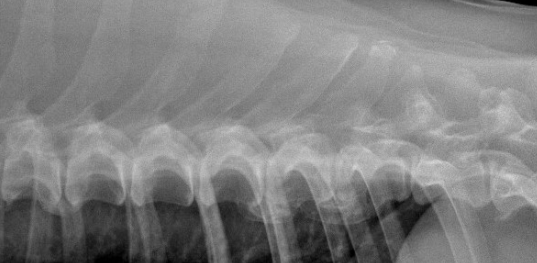
What is this
Spondylosis deformans
Atlantoaxial Instability - definition and signlament
Increased movement between C2 and C1
can be due to c2 agenesis, hypoplasia, fragmentation, malangulation, or absence of ligament support or truama that causes fx of the dens
mini/toy breeds but also in larger dogs

What is this?
Atlantoaxial instability
Changes in morphology and biomechanics of the intervertebral disc may result in
Portusion of the nucleus pulposus into the annulus fibrosus, but without annular rupture
extrusion of the nucleus through a ruptured annulus, into the spinal canal
Intervertebral disc extrusion
Acute extrusion of the nucleus pulposus through the ruptured annulus fibrosus, more common in chondrodystrophic breeds
AKA hansen type I
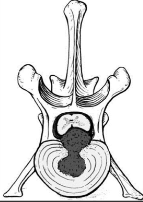
What is this
Intervertebral disc extrusion
Intervertebral disc protrusion
Dorsal buldge or protrusion of the nucleus that gradually passes through into the annulus fibrosus without annular rupture
usually more chornic
aka hansen type II
hypertrophy
Cells are gigger
Atrophy
Cells are smaller than normal
Hyperplasia
Too maby cells
Metaplasia
orderly replacement of one mature epithelial type by another
Acquired dysregulated growth
Atrophy, hyperplasia, hypertrophy, metaplasia, dysplasia
Developmental distrubances of growth
Hypoplasia, aplasia, agenesis
Begnin neoplasia
Locallized and non invasive (basmement membrane intact)
Control, organized, and reversible nonneoplastic disturbances of growht
protooncogenes
hypertrophy, hyperplasia, metaplasia
dysplasia
abnormal changes to the cells that may regress but after additional mutations and clonal selection can become neoplasia
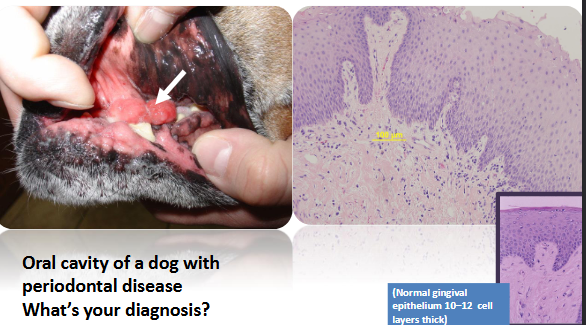
What non-neoplastic disturbances?
Hyperplasia
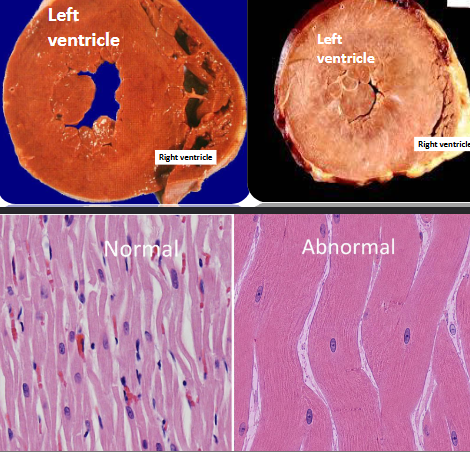
What non-neoplastic distrubance of growth
hypertrophy
Labile cells and what non-neoplastic distrubance of growth will they undergo
retain the ability to divide throughout their life spans and are epithelial origin
these will undergo hyperplasia
Stable (quiescent) cells and what non-neoplastic distrubance do they undergo
Lose the ability for significant cell division (muscle, chondrocytes, osteocytes)
hypertrophy
Permanent cells
lose the ability for cell diiison, when damaged they die and don’t come back
CNS
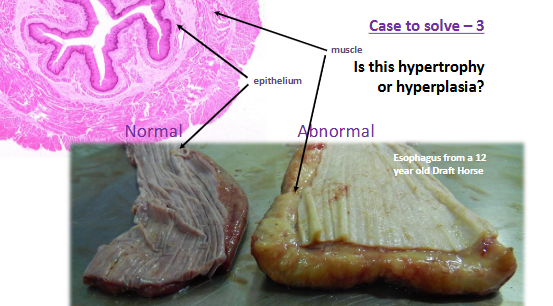
is it hypertrophy or hyperplasia
hypertrophy becuase the muscle is sticking out and that undergoes hypertrophy

What is your diagnosis
hyperplasia
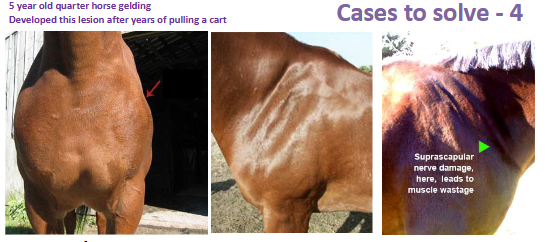
Diagnosis, etiology, pathogeneis, reversible or irreversible
swiney shoulder
damage to the suprscapular never that leads to decrease muscle stimulaiton and leads to muscle atrophy
reversible except if it is denervation
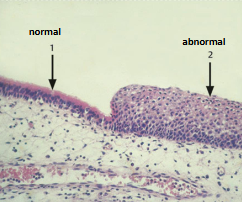
What distrubance of growth and is it reversible or not?
metaplasia and it is reversibleq
Agenesis
no formaiton at all
Aplasia
formation of something unrecognizable
Hypoplasia
formation of orgna or structure jsut small (never reached full size)

what’s your diagnosis
Renal agenesis
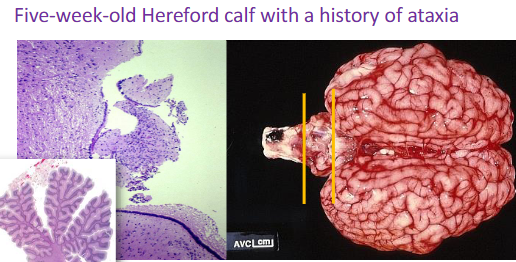
What is your diagnosis
Cerebellar aplasia
Ectopic tissue
normal tissue or organ in abnormal place
Hamartoma
too much of a tissue in a normal place
Choristoma
Normal tissue in abnormal place
Supernumerary
More than the correct number
Coloboma
defect in ocular tissue
Neoplasia
an abnormal tissue mass whose growth exceeds and is uncoordinated with that o adjacent normal tissue and persists after cessation of the stimuli that provoked it
cancer refers to only
malignant neoplasma
is the same thing as malignant tumor
Bening neoplasm
a neoplasm that grows without invading adjacent tissue of spread to distnat sites
usually well-circumscribed due to the lack of invasion of surrounding tissues
Malignant neoplasm
a neoplasm that invades the surrounding normal tissue
usually spreads to distant sites given sufficiet time
usually is not well circumscribed
Benign tumor - cell ize, nucleoli, mitose, N:C ratio, effect on host
cell size - uniform
nucleoli - normal
mitoses - few
N:C ratio - low
effect on host - does not metastasize
Malignant tumor - cell size, nucleoli, mitoses, N:C ratio, effect on host
pleomorphic large/multiple, numerous, high, may metastasize
Anaplastic cells
have lost many of the cellular characterisitcs of normal, differentiated cells
no longer resemble normal cells
irreversible cellular changes
malignant cells often exhibit varying deggres of anaplasia
papiloma
bening epithelial tumor with differnt types of epithelia
Adenoma
bening epithelial tumor
can be solid or cystic (serous/mucous)
Carcinoma
malignant epithelial tumor
Squamous cell carcinoma or adenocarcinoma (glandular epithelium or solid organ)
Mesenchyla bening tumors
lipoma, leiomyoma, hemangioma
Sarcoma
malignant mesenchymal tumor
Matrix (fibrosarcoma, chondrosarcoma, osteoscaroma)
no matrix (spindle cell sarcoma, round cell sarcoma, giant cell sarcoma)
Round cell neoplasia
neoplasia of inflammatory cells
lymphocytes, plasma cells, marcophages (hstiocytes)
Are benign and maligant tumors reversible or irreversible
irreversible
teratoma
neoplasm of germ cells
seminoma
neoplasm of seminiferous epithelium
melanoma/melanocytoma
neoplasm of melanocytes
Leukemia
neoplasm of blood cells
lymphoma
malignant neoplasm of lymphocytes in tissue
neoplasm of squamous epithelium - benign and malignant
Bening - squamous papiloma
sqauous cell arcinoma
Neoplasm of endothelial cells bening and malignant
Hemangioma
hemangiosarcoma
Neoplasm of mammary glands bening and malignat
mammary adeoma
mamary adenocarciinoma
Neoplams of bone - bening and malignant
Osteoma
osteosarcoma
Neoplasm of hepatocytes - beining and malignant
heptaoma, hepatic ademoma
Hepatic carcinoma, adenocarcinoma
Neoplasm of thyroid gland - being
thyroid gland adenoma
Neoplasm of neutrophils only in blood vascular systems
myeloid leukemia - any wbc
nuetrophilic leukemia
Rhabdomyoma - on test
a bening neoplasm of striated both cardiac and skeletal muscle
hemangiosarcoma
a maligant neoplasm of endothelial cells lining blood vessels
Non-natrually produced toxicants (5)
pesticides, pharmaceuticals, food aditives, solvenet, enrvironmental contaminats
Biotxisn (4)
plants - phytotoxins
fungal - myotoxins
bacterial - exotoxins
animals/insects - venoms
Top 10 veterinay posions
1) human over the counter meds
2) Human food/drinks
3) Human presecreption meds
4) chocolate
5) vet products nad medications
6) plants and fungi
7) Rodenticides
8) hosehold products
9) insecticides
10) recreational durgs (thc decreasing, hallucinogneics/psychedelics increasing)
Most common species for posion control calls
dogs 86% cats 11%
more common in dogs under 4 years
Toxicants exposures are most common during what months
may-august with a spike in december
top 3 toxicants causing death
organophsphate insecticide, ethylene lgycol, rodenticides
Toxicology - target (site)
where a toxicant produces its effect, locatoin
target site - molecular or subcellular organelle
Toxicosis
illness or disease state
toxicity
the amount that produces the advere effect
Toxic
how bad is iti
Toxicosis (charaterisitics)
immediate vs delayed
reversible vs irreversible
local vs multisystemic
relay toxicosis
animal to animal
individyal dose response relation ship characterisitics
graded - spectrum of responses over a range of doses, severity increases with increasing dose
How to determine the population’s dose response
single dose - give dose to a wide range of P and see effets, spectrum of responses, normal distributiona cross population, median response, outliers
single -endpoint - it does the one thing we are looking for or it doesnt (letahlity, min/max dose, 50% response dose, therapeutic indeix, margin of safety)
Threshold
point at which the detoxifcation pathways/ the repair mechanism become saturated/overhwlemed
once corssed adverse response is observed
Threshold dose
therortical dose where the d-r curve approaches the x-axis
no response to the drug
What determine toxicitt
chemical factors (toxicant factors - physical/chem properties or presence of other chemicals/potential interaction), biological factors (host and environmental), exposure factors (route and duration)
antagonism - toxicity chemical factors
exposure to one chemical results in a recution in the effect of the other chemical
Potentiation
exposure to one inactivate chemcial reuslts in the other chemical producing an effect greater than if given alone
Synergism
exposure to one chemical cuases a dramatic increase in the effect of another chemical
Species related factors in toxicology
biotransformaiton (metabolic) pathways, excretion pathways, antatomy/physiology of gi tract/repsiratory tract, target recepotr density/subtypes
Host factors toxicocology related to age
Enzyme expression - developmental differences in detoxification and bioactivation pathways
organ function (ex decreased renal clearance)
presence of protective barriers