PHYSL 212 Lecture 2 - Membrane Transport (Terms)
 Call Kai
 Learn
Learn Practice Test
 Spaced Repetition
 Match
Match Flashcards
 Knowt Play
1/26

There's no tags or description
Looks like no tags are added yet.
Name | Mastery | Learn | Test | Matching | Spaced | Call with Kai | Chat |
|---|
No analytics yet
Send a link to your students to track their progress
27 Terms
Simple Membrane Diffusion
A passive mechanism for molecule movement across membranes favoured by small nonpolar molecules in which they move naturally with their concentration gradient
Diffusion Equilibrium
The state of volume distribution of a molecule in which there is an equalized number of particles in all areas

Net Flux
The direction of diffusion, which is a product of the directional one-way fluxes between compartments
Facilitated Diffusion
A passive mechanism for molecule movement across membranes favoured by small polar molecules (ions, amino acids) in which they are facilitated by a membrane protein to travel down their concentration gradient
Ion Channels
A type of transmembrane protein used in facilitated diffusion that forms a pore to allow ions to diffuse across cell membranes via the electrochemical gradient across the membrane
Electrochemical Gradient
The net ionic flux across a membrane, comprised of both the chemical ion concentration as well as the electrical membrane potential
Ligand-Gated Channel
An ion channel that is regulated via the binding of a specific molecule to the channel, causing a conformational change that will open or close the channel
Voltage-Gated Channel
An ion channel that is regulated via changes in membrane potential, causing a conformational change that will open or close the channel
Mechanically-Gated Ion Channel
An ion channel that is regulated via a physical change in the membrane, where movement such as stretching will open or close the channel
Membrane Transporters
A type of transmembrane protein used in facilitated diffusion that uses conformational changes to transport molecules and solutes across the membrane
Primary Active Transport
An active mechanism for molecule movement across membranes in which a transport protein directly hydrolyzes ATP to move molecules against their concentration gradient
Sodium Potassium Pump
Primary active transport protein found in all animal cells that maintains high levels of intracellular K+ and low levels of intracellular Na+
Secondary Active Transport
An active mechanism for molecule movement across membranes in which a transport protein harnesses the energy released from movement of ions down an electrochemical gradient and couples it to the transport of other molecules, moving molecules against their concentration gradient
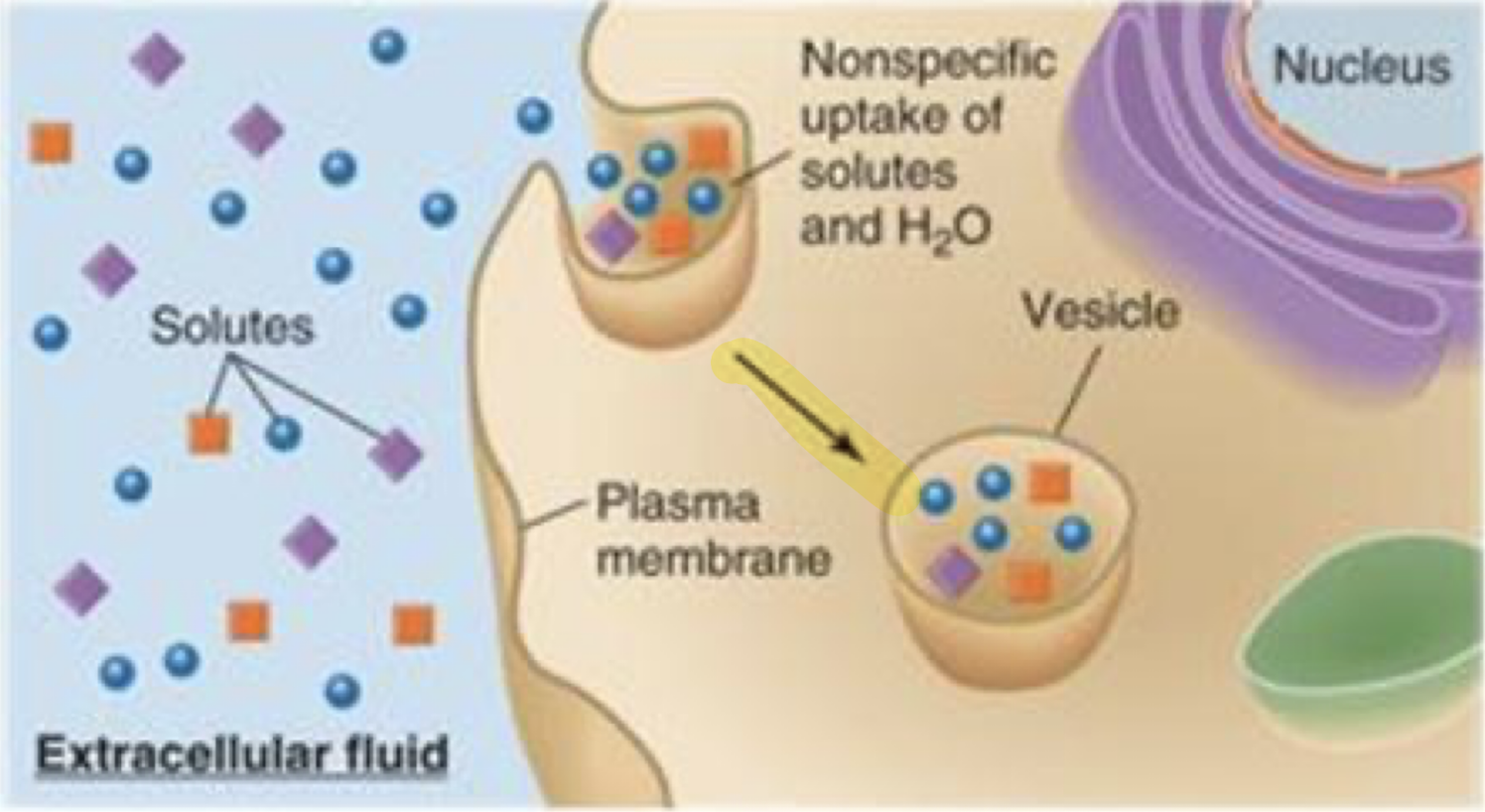
Vesicular Transport
An active mechanism for molecule movement across membranes in which molecules are enclosed into vesicles that pinch off of the membrane instead of moved across
Endocytosis
A form of vesicular transport in which membrane envaginations enclose a small volume of extracellular fluid, which is taken into the cell
Exocytosis
A form of vesicular transport in which intracellular membrane-bound vesicles fuse with the plasma membrane, releasing its contents into extracellular fluid
Pinocytosis
A form of endocytosis in which a nonspecific volume of extracellular fluid and its solutes is taken into the cell via a vesicle
Phagocytosis
A form of endocytosis in which a specific solute (bacteria, cell debris) is uptaken into the cell via extension of the membrane to enclose it into the cell

Phagocytes
Specialized cells of the immune system that uptake damaged tissues and bacteria via phagocytosis
Phagosome
Internalized vesicle formed around a solute endocytosed via phagocytosis
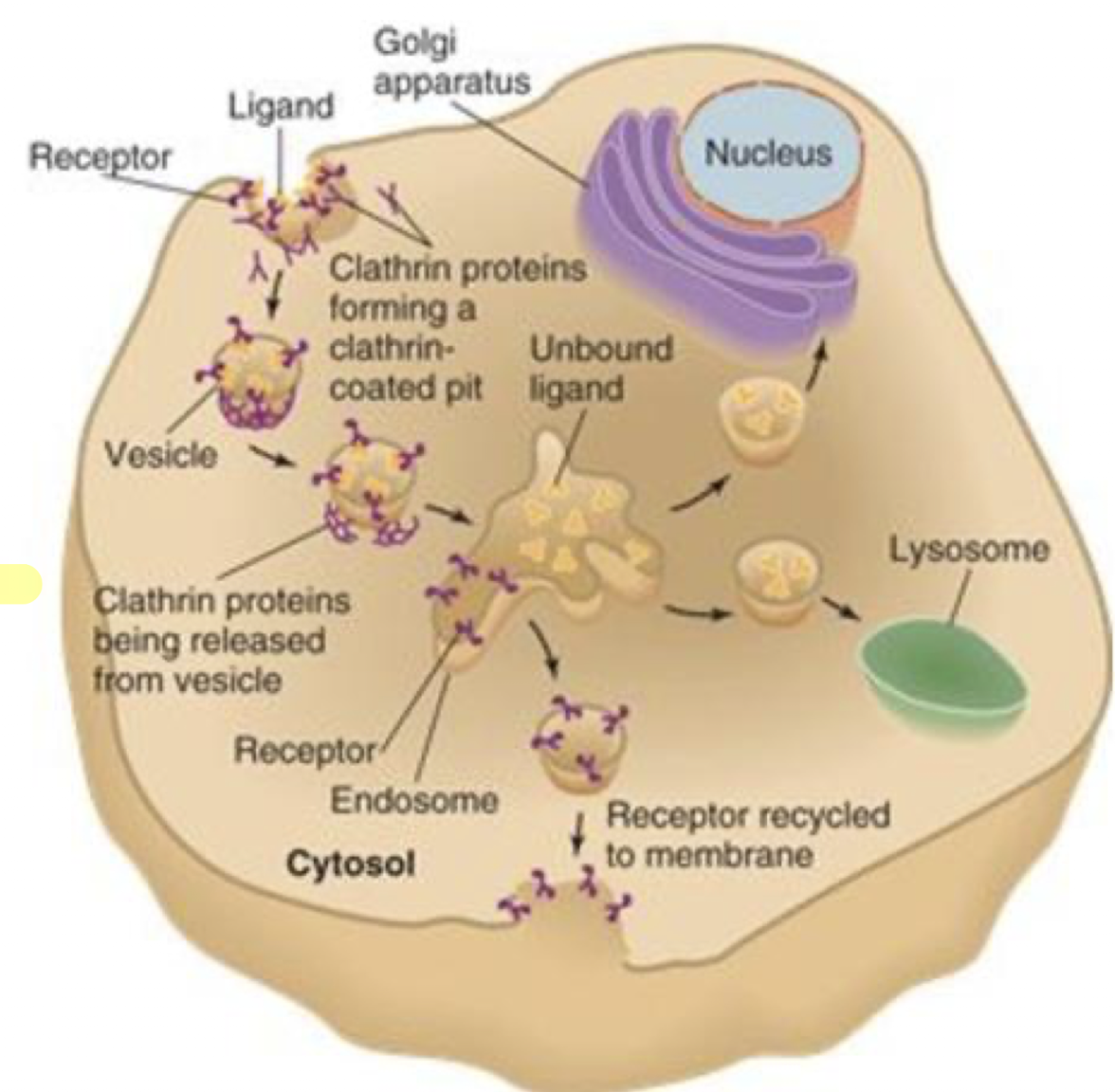
Receptor-Mediated Endocytosis
A form of endocytosis in which cell surface receptors bind to clusters of specific high-affinity ligands on the membrane, forming a clathrin-coated pit that is then internalized
Potocytosis
A specific type of receptor-mediated endocytosis restricted to small molecules (vitamins) that generates small caveolae vesicles to deliver to the cytosol
Epithelial Cells
Cells that line the cavities and surfaces of vessels and organs
Apical Membrane
The inner membrane of an organ or vessel made of epithelial cells that faces the inside of the organ
Basolateral Membrane
The outer membrane of an organ or vessel made of epithelial cells that faces outside the organ, adjacent to blood vessels
Paracellular Pathway
A mechanism of movement across epithelial membranes favoured by water and small ions in which molecules diffuse across the tight junctions in between epithelial cells

Transcellular Pathway
A mechanism of movement across epithelial membranes favoured by larger molecules in which molecules move through the epithelial cell via a combination of diffusion and protein-mediated processes
