Bacterial Cell Structure
 Call Kai
 Learn
Learn Practice Test
 Spaced Repetition
 Match
Match Flashcards
 Knowt Play
1/19

There's no tags or description
Looks like no tags are added yet.
Name | Mastery | Learn | Test | Matching | Spaced | Call with Kai | Chat |
|---|
No analytics yet
Send a link to your students to track their progress
20 Terms
A thin sheet of lipid and protein that surrounds the cytoplasm and controls the flow of materials into and out of the cell pool.
Cytoplasmic (Cell) Membrane
(#1)

composed of condensed DNA molecules. DNA directs all genetics and heredity of the cell and codes for all proteins
Bacterial Chromosome or Nucleold
(#2)

Tiny particles composed of protein and RNA that are the sites of protein synthesis.
Ribosomes
(#3)
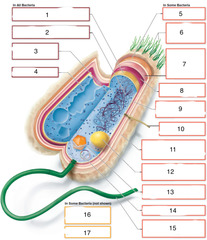
water-based solution filling the entire cell
Cytoplasm
(#4)
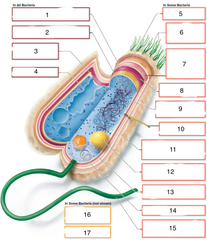
Monolayer of protein used for protection and/or attachment.
S Layer
(#5)
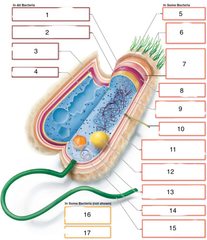
fine, hairlike bristles extending from the cell surface that help in adhesion to other cells and surfaces
Fimbriae
(#6)
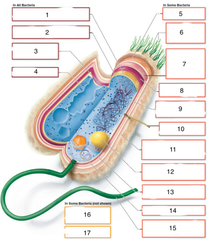
extra membrane similar to cell membrane but also containing lipopolysaccharide. Controls flow of materials, and portions of it are toxic to mammals when released
Outer Membrane
(#7)
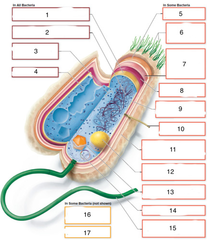
a semirigid casing that provides structural support and shape for the cell
Cell Wall
(#8)
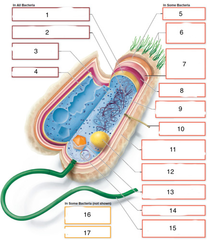
long fibers of proteins that encircle the cell just inside the cell membrane and contribute to the shape of the cell
Actin Cytoskeleton
(#9)
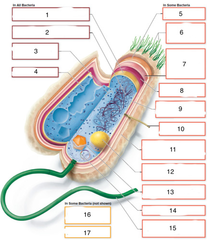
an appendage used for drawing another bacterium close in order to transfer DNA to it
Pilus
(#10)
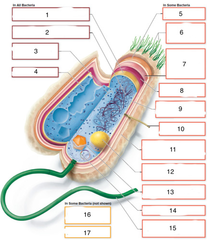
A coating or layer of molecules external to the cell wall. It serves protective, adhesive and receptor functions. It may fit tightly or be very loose and diffuse. Also called Slime Layer or Glycocalyx.
Capsule (Tan Coating)
(#11)
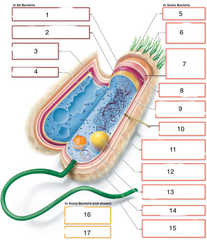
Stored nutrients such as fat, phosphate, or glycogen deposited in dense crystals or particles that can be tapped into when needed.
Inclusion/ Granule
(#12)
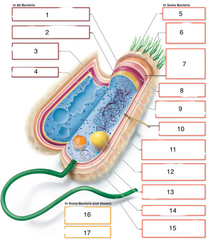
protein-coated packets used to localize enzymes and other proteins in the cytoplasm
Bacterial Micro-compartments
(#13)
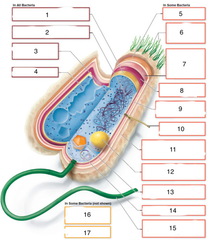
Double-stranded DNA circle containing extra genes.
Plasmid
(#14)
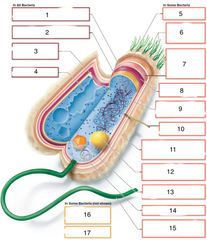
Specialized appendage attached to the cell by a basal body that holds a long rotating filament. The movement pushes the cell forward and provides motility.
Flagellum
(#15)

Dormant body formed within some bacteria that allows for their survival in adverse conditions.
Endospore
(#16)
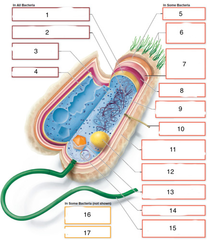
Membranes inside the cell
Intracellular membranes
(#17)
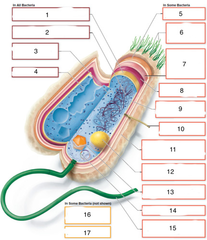
What are the structures that are commonly found in all bacteria?
-Cytoplasmic (Cell) Membrane
-Bacterial Chromosome or Nucleoid
-Ribosomes
-Cytoplasm
What are the structures only found in some bacteria?
-S layer
-Fimbriae
-Outer Membrane
-Cell Wall
-Actin Cytoskeleton
-Pilus
-Capsule
-Inclusion/Granule
-Bacterial Microcompartments
-Plasmid
-Flagellum
What are in some bacteria (#16 and #17) that are not shown on this picture?
-Endospore
-Intracellular Membranes
