aphg ch6
 Call Kai
 Learn
Learn Practice Test
 Spaced Repetition
 Match
Match Flashcards
 Knowt Play
1/40

There's no tags or description
Looks like no tags are added yet.
Name | Mastery | Learn | Test | Matching | Spaced | Call with Kai | Chat |
|---|
No analytics yet
Send a link to your students to track their progress
41 Terms
action space
geographical area containing space an individual interacts w/ on a daily basis
beaux arts
movement within city planning & urban design combining older, classical forms w/ newer, industrial ones. (wide thoroughfares, spacious parks, civic monuments stressing progress, freedom, & national unity)
blockbusting
real estate agents & developers encouraging affluent white property owners to sell homes & businesses at loss by stoking fears that neighbourhoods were being overtaken by racial or ethnic minorities. early as 1900
boomburb
large, rapidly growing city suburban in character but resembles population of larger urban cores
borchert’s epochs
john r. borchert. american cities undergone 5 major epochs/periods of development shaped by dominant forms of transportation/communication at time
sail wagon (1790-1830)
iron horse (1830-1870)
steel rail (1870-1920)
auto-air-amenity (1920-1970)
high-technology (1970-present)
central business district
downtown/nucleus of city where retail stores, offices, & cultural activities are concentrated, high building density & transportation systems converge
central-place theory
walter christaller, early 1900s. explains size & distribution of cities in terms of competitive supply of goods & services to dispersed populations
city beautiful movement
environmental design, drawing directly from beaux arts school. put order on industrial centers by creating urban spaces w/ sense of morality & civic pride
colonial cities
cities established by colonizing empires as administrative centers. often established on existing native cities, overtaking infrastructure
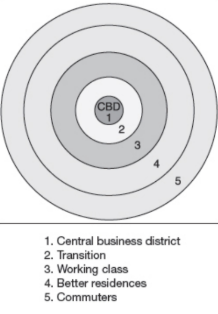
concentric-zone model
describes urban environments as series of rings of distinct land uses radiating out from central core, or central business district (chicago)
edge cities
cities located on outskirts of larger cities, serve same functions of urban areas but in sprawling, decentralized suburban environment
european cities
extreme density, narrow buildings, winding streets, ornate church as city center, high walls surrounding city center
exurbanite
person who left inner city & moved to outlying suburbs or rural areas
feudal cities
cities that arose during middle ages & represent time of stagnation in urban growth. fostered dependent relationship between wealthy landowners & peasants who worked land, very little alternative economic opportunities.
forward capital
capital city placed in remote/peripheral area for economic, strategic, or symbolic reasons (brasilia, brazil; Islamabad, pakistan)
galactic city model (multiple nuclei model)
circular-city model characterizing role of automobile in postindustrial era (la, houston)
gateway cities
cities that become ports of entry & distribution centers for large geographic areas bc of their geographic location
gentrification
trend of middle & upper-income americans moving into city centers & rehabilitating architecture & replacing low-income populations, changing social character of neighbourhoods
ghettoization
process in inner cities where they become dilapidated centers of poverty when affluent whites move out to suburbs & immigrants & poc vie for scarce jobs & resources
great mgiration
early 1900s mass movement of african americans from deep south to industrial north (esp chicago)
hinterland
market area surrounding urban center than urban center serves
inner-city decay
parts of large urban areas that lose significant portions of populations as result of change in industry or migration to suburbs. inner city loses tax base, becomes center of poverty
islamic cities
cities in muslim countries owing structure to religious beliefs. mosques at center, walls guarding perimeter. open-air markets, courtyards w/ high walls, dead-end streets limiting foot traffic in residential neighbourhoods
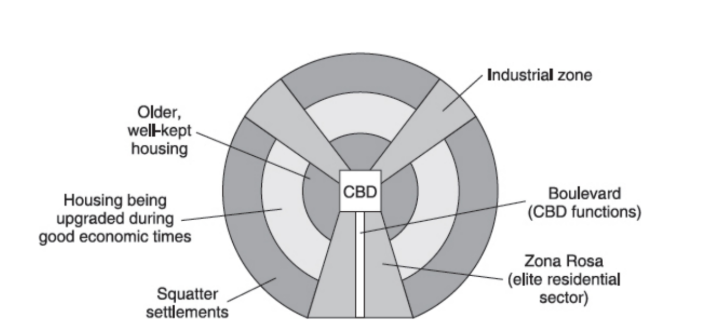
latin american cities
colonialism, rapid rise of industrialization, rapid increases in population. distinctive sectors of industrial/residential development radiating out from cbd
megacities
cities where high population growth & migration caused them to explode in population since wwii. chaotic & unplanned growth, terrible pollution & widespread poverty [paris, london]
megalopolis
several metropolitan areas originally separate but joined tgther to form large, sprawling, urban complex
metacities
larger than megacities, urban region where multiple dense areas/cores are interspersed w/ suburbs & green spaces (& squatter settlements in case of developing countries) [tokyo, nyc, mumbai]
metropolitan area
urban area consisting of 1 or more whole county units, usually containing several urbanized areas/suburbs all acting together as coherent economic whole
modern architecture
efficient geometrical structures made of concrete & glass
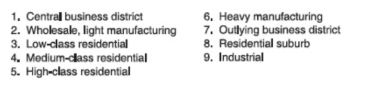
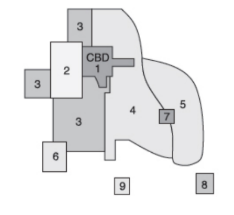
multiple-nuclei model
cities having numerous centers of business & cultural activity > 1 central place
new urbanism
promoting mixed-used commercial & residential development & pedestrian-friendly, community-oriented cities. reaction to sprawling, automobile-centered cities.
node
geographical center of activity. large cities have multiple
postmodern architecture
reaction to sterile alienation from modern architecture. uses, older, historical styles & sense of lightheartedness & eclecticism. combine pleasant-looking forms & playful colours, more people-friendly.
primate city
country’s leading city w/ population disproportionately greater than other urban areas. over 2x
rank-size rule
population of any given town inversely proportional to rank in country’s hierarchy when distribution of cities according to sizes follows pattern
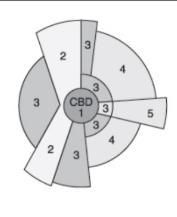
sector model
model of urban land use placing cbd in middle w/ wedge-shaped sectors radiating outward along transportation corridors
segregation
resulting from suburbanization when affluent individuals leave city center for homogenous suburban neighbourhoods. isolates individuals who can’t afford relocation, must remain in certain pockets of central city.
squatter settlements
residential developments characterized by extreme poverty usually existing on land just outside of cities neither owned or rented by occupents
suburbs
residential communities outside city centers, relatively homogenous populations
urban morphology
physical form of city/urban region
urban revitalization
process occurring in some urban areas experience inner-city decay. usually involves construction of new shopping districts, entertainment venues, & cultural attractions to entice young urban professionals into cities for more accessible nightlife/culture.