ceutics 8 drug release and dissolution
 Call Kai
 Learn
Learn Practice Test
 Spaced Repetition
 Match
Match Flashcards
 Knowt Play
1/70

There's no tags or description
Looks like no tags are added yet.
Name | Mastery | Learn | Test | Matching | Spaced | Call with Kai | Chat |
|---|
No analytics yet
Send a link to your students to track their progress
71 Terms
_______________ is the process by which drug solutes leave a finished dosage form into the medium
drug release
what 4 factors affect drug release
Order of Release (zero vs first)
Physicochemical parameters
Physiological factors
Formulation Factors
(OPPF)
which drugs are typically zero-order release?
non-disintegrating tablets (topical, transdermal)
oral controlled (osmotic, low solubility matrix)
zero order processes take place at a ________ rate
constant
do zero order processes depend on concentration
no
If a patient was given 100mg of drug A, which absorbs at a rate of 10mg/min at ZERO ORDER kinetics, how much will be absorbed after 5 minutes?
5*10mg= 50mg
equation for zero order release
Qt=Q0 +Kt
Qt= cumulative amount of drug released at time t
Q0= initial amount of drug
K= constant
t= time
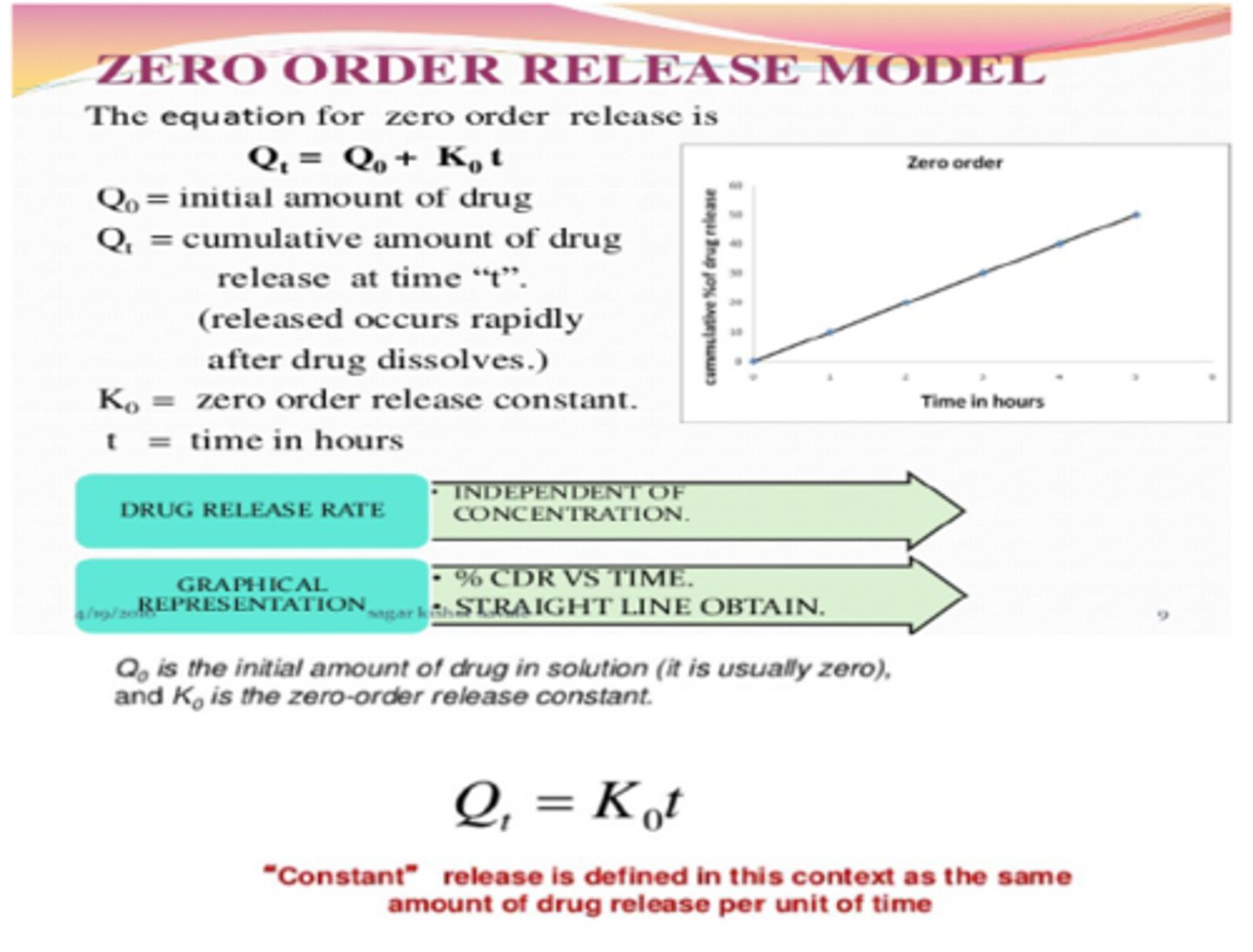
in a drug release vs time graph, what slope does a zero order process follow?
linear slope
first order processes takes place at a constant ______________ of the drug concentration
proportion
(not a constant rate!)
which drug release kinetics is dependant on concentration
first order
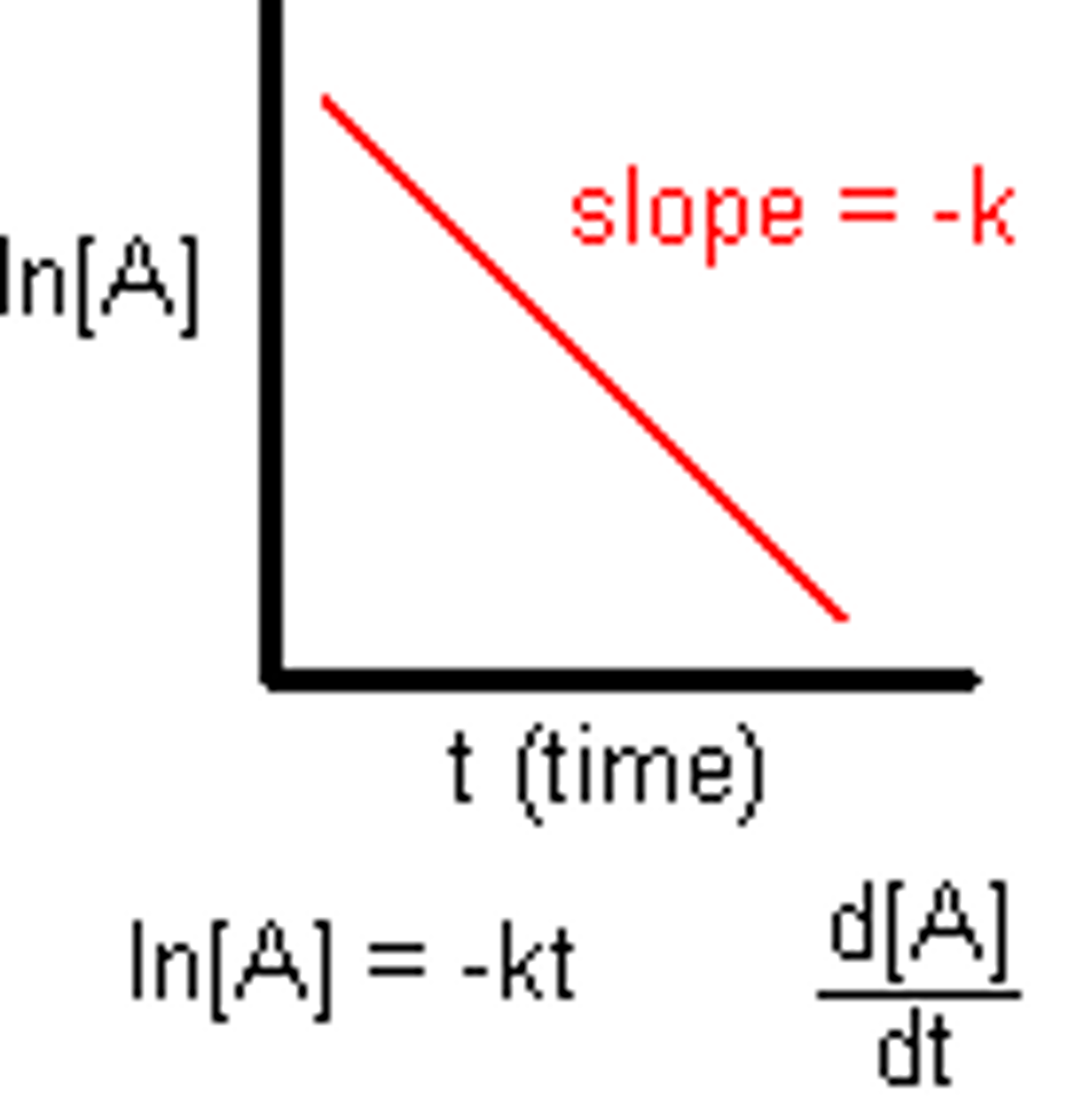
If a patient was given 100mg of a drug that follows first order kinetics and absorbs 10%/min, how much is absorbed after 2 minutes?
minute 1= 100(.1)= 10mg absorbed
minute 2= 90(.1)= 9mg absorbed
which kinetics absorption process theoretically never comes to an end
first order
first order release equation
Log Qt= LogQ0 +Kt/2.303
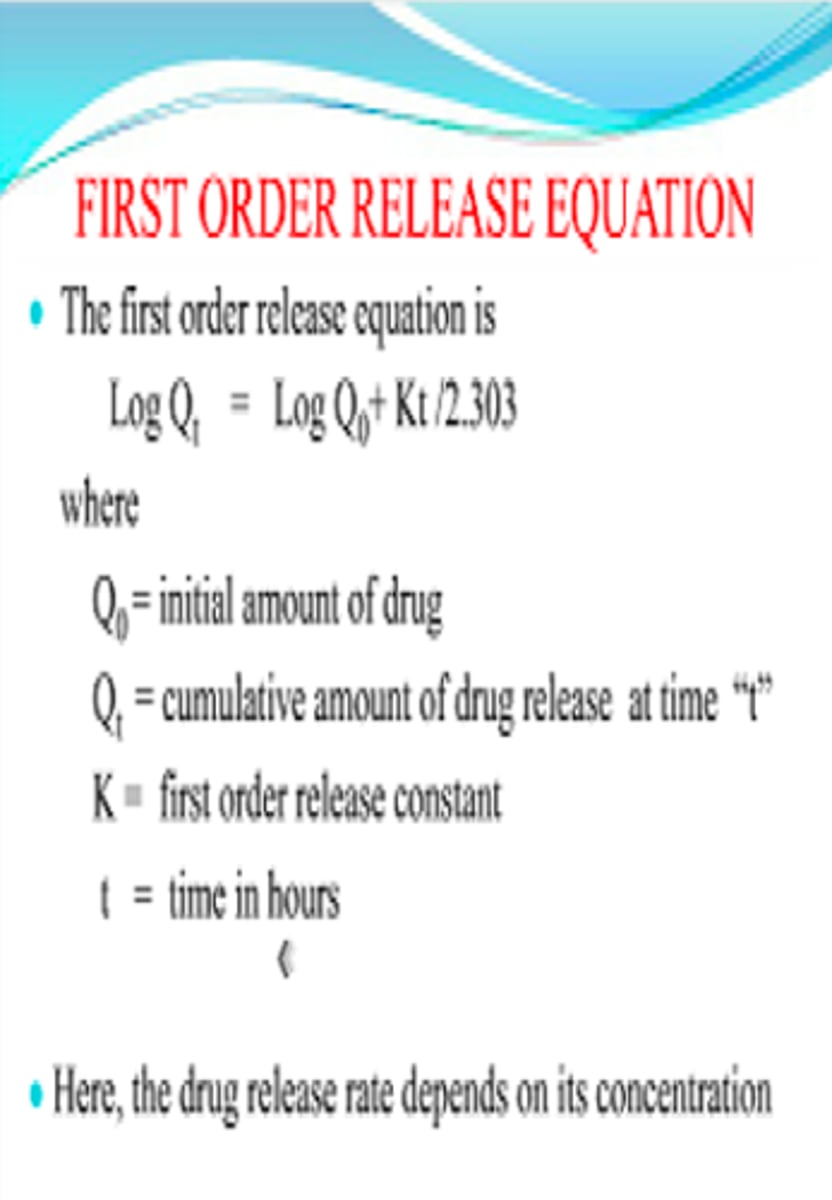
to get a straight line of a first order kinetics process, what is put on the x and y axis?
x= time
y= LOG % of drug release
[note in zero order, its time vs % of drug release]
![<p>x= time</p><p>y= LOG % of drug release</p><p>[note in zero order, its time vs % of drug release]</p>](https://knowt-user-attachments.s3.amazonaws.com/e1ac8c92-2254-4a58-b9ed-cfb95e708a5d.jpg)
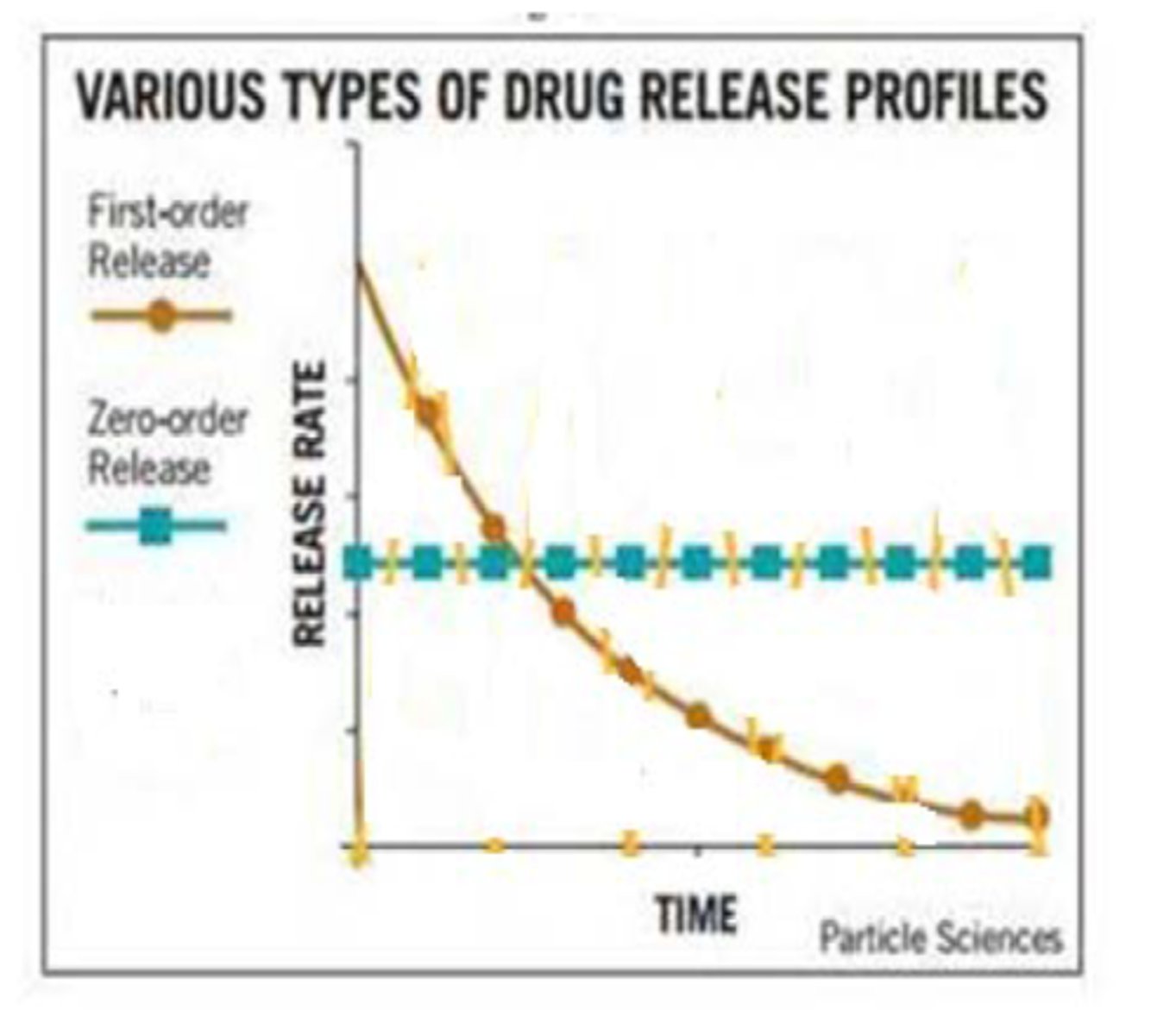
describe how a zero order vs a first order release line would look on a graph of time vs release rate
zero order: horizontal line (constant)
first order: non-linear decrease (depends on concentration)
what are the formulation factors and physicochemical properties that can affect drug release
pH
temp
Ionic strength
Enzymes
dissolution rate is defined as the amount of solute dissolved in a given solvent under standard conditions of ________(4 things)____
Temp
constant solid surface Area
pH
solvent composition
TAPS
what is the difference between solubility and dissolution
dissolution: kinetic; process of solute dissolving to form solution
solubility: thermodynamic; outcome of dissolution
what is the rate determining step of a drug with low solubility? Which BCS class is this?
RDS= dissolution
-this step is often the slowest
BCS class 2 and 4
for soluble drugs, what is the rate determining step? what BCS class is this?
RDS= absorption
BCS class 1 and 3
prerequisites for drug absorption
release, dissolution, and permeation
what can affect the rate of dissolution
-particle size
-solubility
-salts
-crystalline state
- drug formulation
-manufacturing methods
-environmental factors
-physiological factors
what can be added to prevent clumping of very small particles during dissolution to increase absorption
a wetting agent (ex: Tween 80)
explain the particle size and solubility equation
log (s/s0)= [2yV]/[2.303RTr]
s= solubility of fine particles
s0= solubility of large particles
y= surface tension
V= molar volume
r= final radius (cm)
R= gas constant= 8.314*10^7
T= temp in KELVIN (C+273.15)
*remember to convert Celsius to kelvin and micro to cm
what is pHp
-below which an acid will precipitate
-above which a base will precipitate
[not on exam]
pHp equations for base and acid
base: pHp= pKw-pKb + log [s0/(s-s0)]
acid: pHp= pKa + log [s0/(s-s0)]
s0= molar solubility of acid/base
s= molar concentration of Salt initially added
**both are M or mol/L
[not on exam]
explain what salts you would use for an IM injection vs an oral drug
oral: whichever has highest concentration (for better absorption) [fast release]
IM: whichever absorption is more constant (not necessarily highest absorption) [slow release]
![<p>oral: whichever has highest concentration (for better absorption) [fast release]</p><p>IM: whichever absorption is more constant (not necessarily highest absorption) [slow release]</p>](https://knowt-user-attachments.s3.amazonaws.com/d865b309-1ca1-4968-8c6d-34eb250ab3c8.jpg)
what are polymorphs
drugs with various crystal forms
= different solubility and dissolution properties
as solubility increases, stability ___________
decreases
if drug A has 3 polymorphs with
A= stable
B= metastable
C= unstable
which polymorph has the lowest solubility?
A because it is more stable, longer shelf life, less likely to dissolve
what does amorphous mean
any non-crystalline drug
does an amorphous or crystalline drug dissolve more rapidly
amorphous (bc less stable)
what would happen if an amorphous drug began to convert to a crystalline form
crystalline forms are more stable and therefore slower to dissolve= less effective
explain what happened when the diluent for sodium phenytoin capsules changed from calcium sulfate dehydrate to lactose
when lactose was used as a diluent, drug absorption increased
= dose lowering was necessary
T/F: excipients do not have an effect on drug dissolution
false
which lubricants and glidants were shown to reduce absorption and for which drugs?
cyanocobalamin: talc and magnesium stearate (slows dissolution)
if magnesium stearate slows drug dissolution, why might it still be used as an excipient
you may want to slow absorption if you are giving a drug via IM
how do viscous solutions affect drug dissolution rate
= increase amount of time spent in stomach
= decrease in rate of movement of drug to SI for absorption
*this LOWERS dissolution rate
what is the order of dosage forms going from most to least bioavailable
aqueous solution (most)
aqueous suspension
SGC
HGC
uncoated tablets
coated tablets (least)
what are the factors affecting the rate of dissolution of tablets related to composition/manufacturing
1-3. diluent, disintegrant*, surfactant amount/type
4. granule size
5. tablet machine type
6. compression force/speed
7. wet or dry method
what are the factors affecting the rate of dissolution of capsules related to composition/manufacturing
1. diluent, lubricant*, surfactant amount/type
2. granulation vs slugging
3. granule/powder size
4. compression force
5. capsule shell composition/properties
what environmental factors can affect drug dissolution
1. humidity
2. storage conditions
3. shelf-life/aging (ex: SGC swelling=crosslinking= hard to open)
how do you know which kinetics model to use for a drug?
based on correlation coefficient (r)
=model with highest r value is used
which 5 math models did we learn about for drug release
1. zero order (constant)
2. first order (depends on initial concentration)
3. Noyes-Whitney (constant SA; depends on solubility)
4. Hixson-Crowell
5. Higuchi
In the noyes-whitney equation, what is assumed to be constant
surface area of particle (S) and static diffusion layer (h)
In the noyes-whitney equation, what determines the dissolution of a drug?
aqueous solubility
Noyes-Whitney equation
dissolution (mass/time)= (DS/Vh)(Cs-C)
D= diffusion coefficient (cm2/sec)
S= SA (cm2)
V= solvent volume
h= thickness of stagnant layer (cm)
*remember thickness is in cm
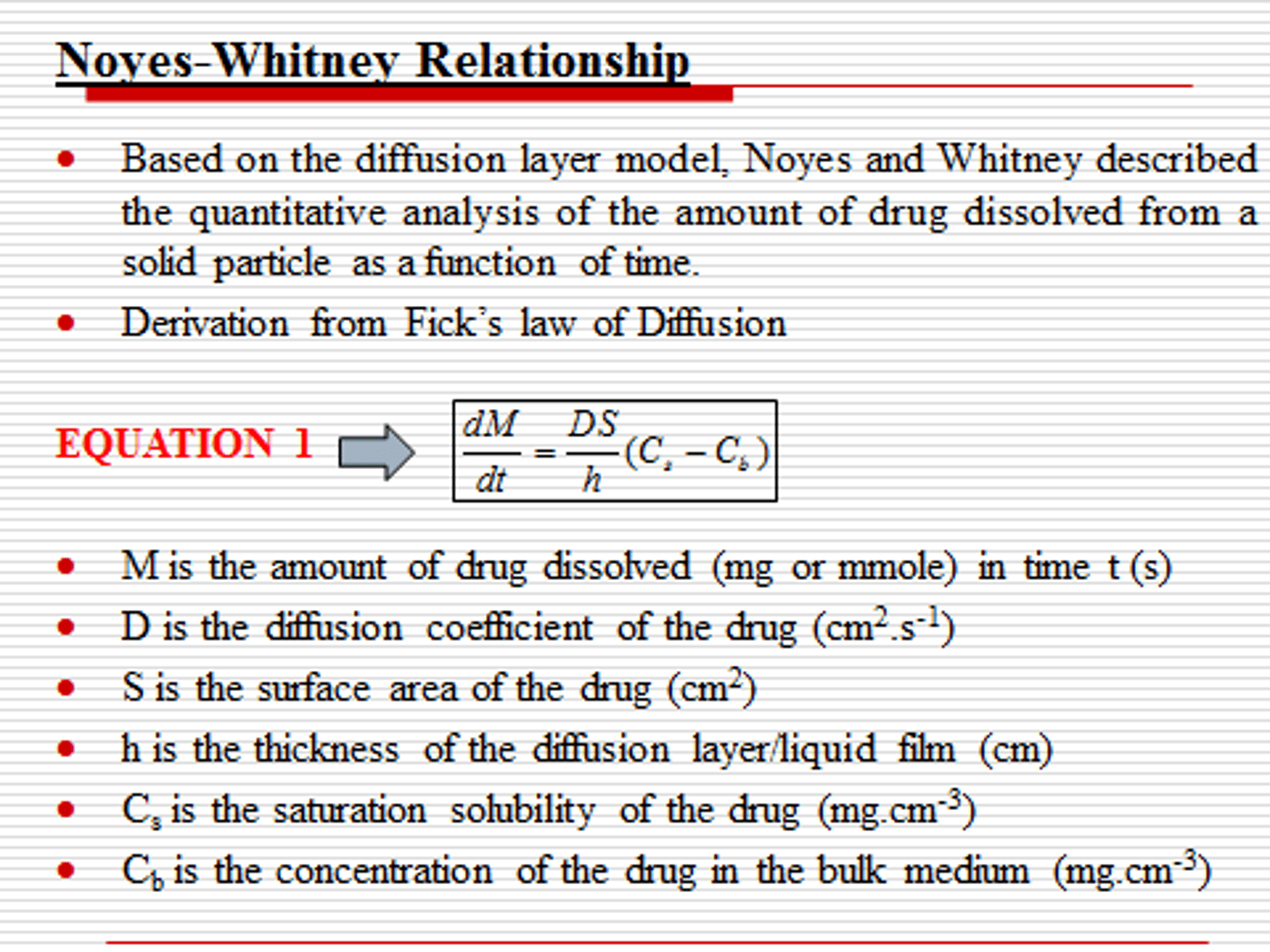
in the Noyes whitney model, what is Cs vs C
Cs= concentration of drug in stagnant layer
C= concentration of solute in bulk solvent (lower)
**C is not present under sink conditions!!
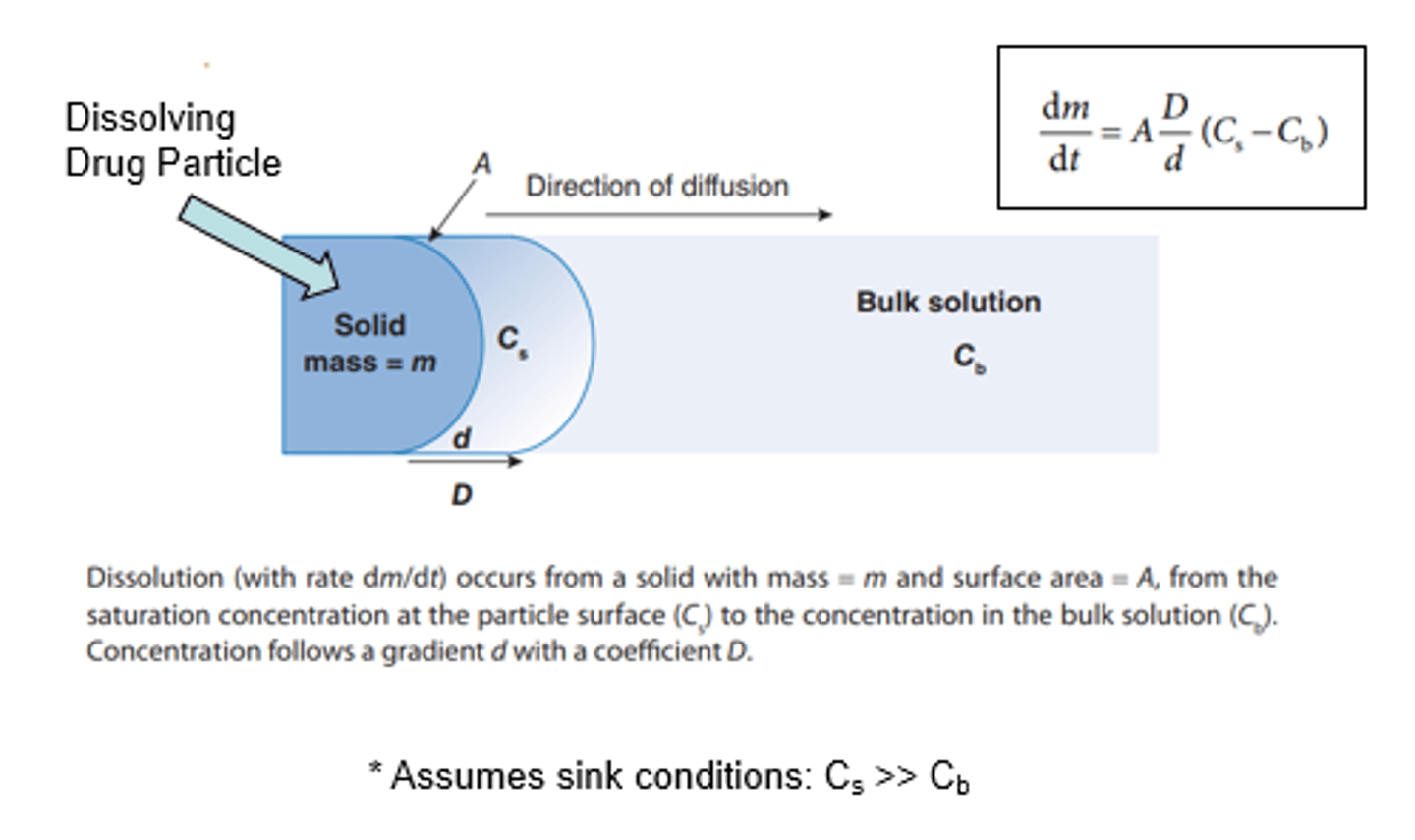
what are sink conditions
solvent in which drug is dissolved in is constantly replenished to mimic GI conditions
**no influence of concentration gradient
using the Noyes Whitney equation, how can you enhance solubility?
1. increase SA by decreasing particle size
2. reduce diffusion layer thickness (h) by mechanically stirring
for Noyes Whitney equation, how can you decrease "h" (static layer thickness)
mechanical stirring
what dosage form could the Noyes Whitney model work for
medication with constant SA
ex: transdermal patches
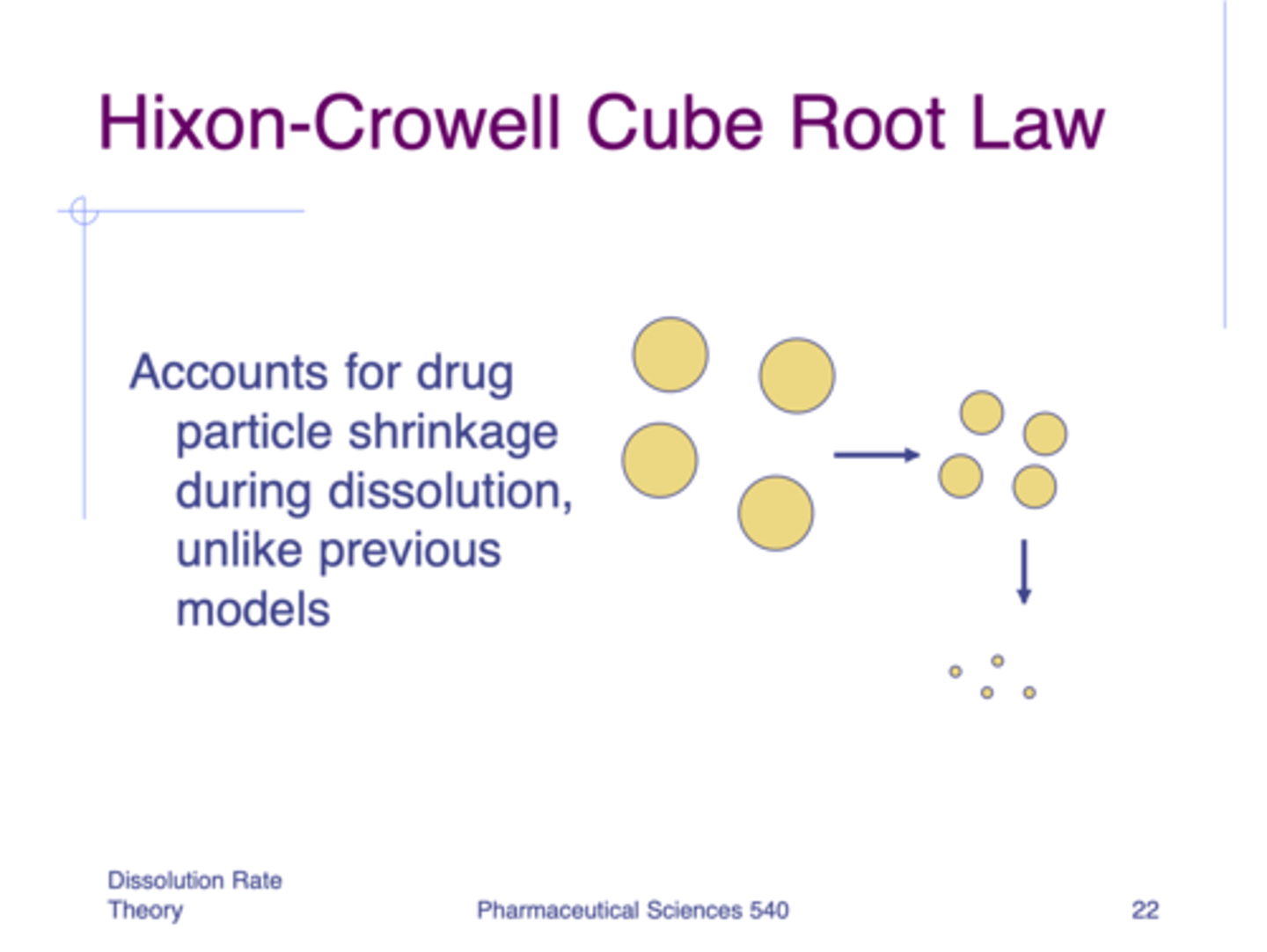
Hixon-Crowell model applies for what drugs and assumes what?
- applies for powder drugs (tablets, capsules, suspensions)
assumes
1. spherical particles
2. shape remains spherical
3. all particles have same size (uniform)
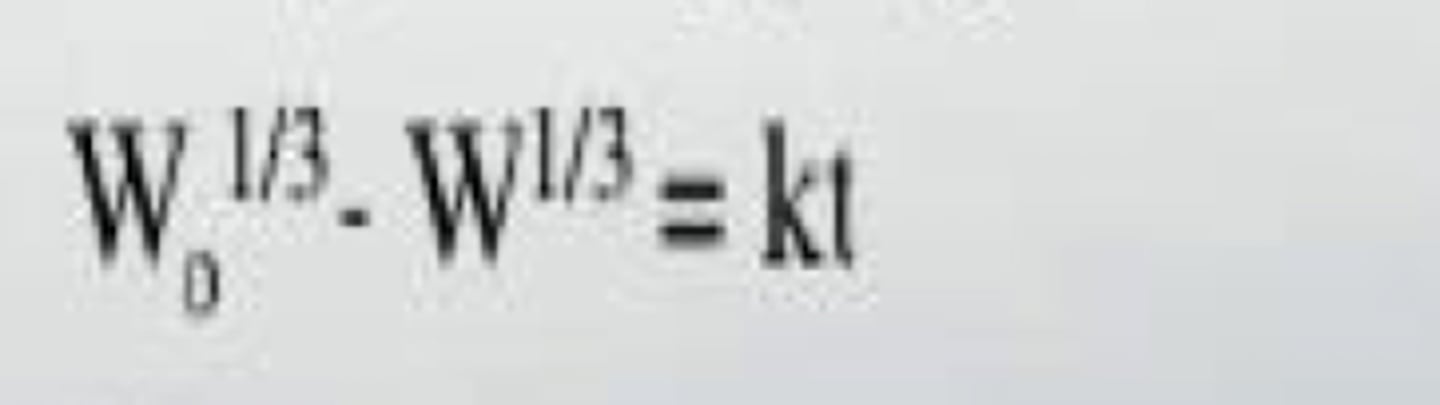
Hixon Crowell equation
W0^(1/3) - W^(1/3)= kt
w0= original mass
w= mass of drug remaining
k= dissolution rate constant
**uses cube roots
Higuchi equation
Q= Kh t^(1/2)
Q= cumulative amount of drug released at time t
Kh= higuchi constant
t= time in HOURS!
x and y axis for linear higuchi model
x= square root of time in HOURS
y= cumulative amount of drug released
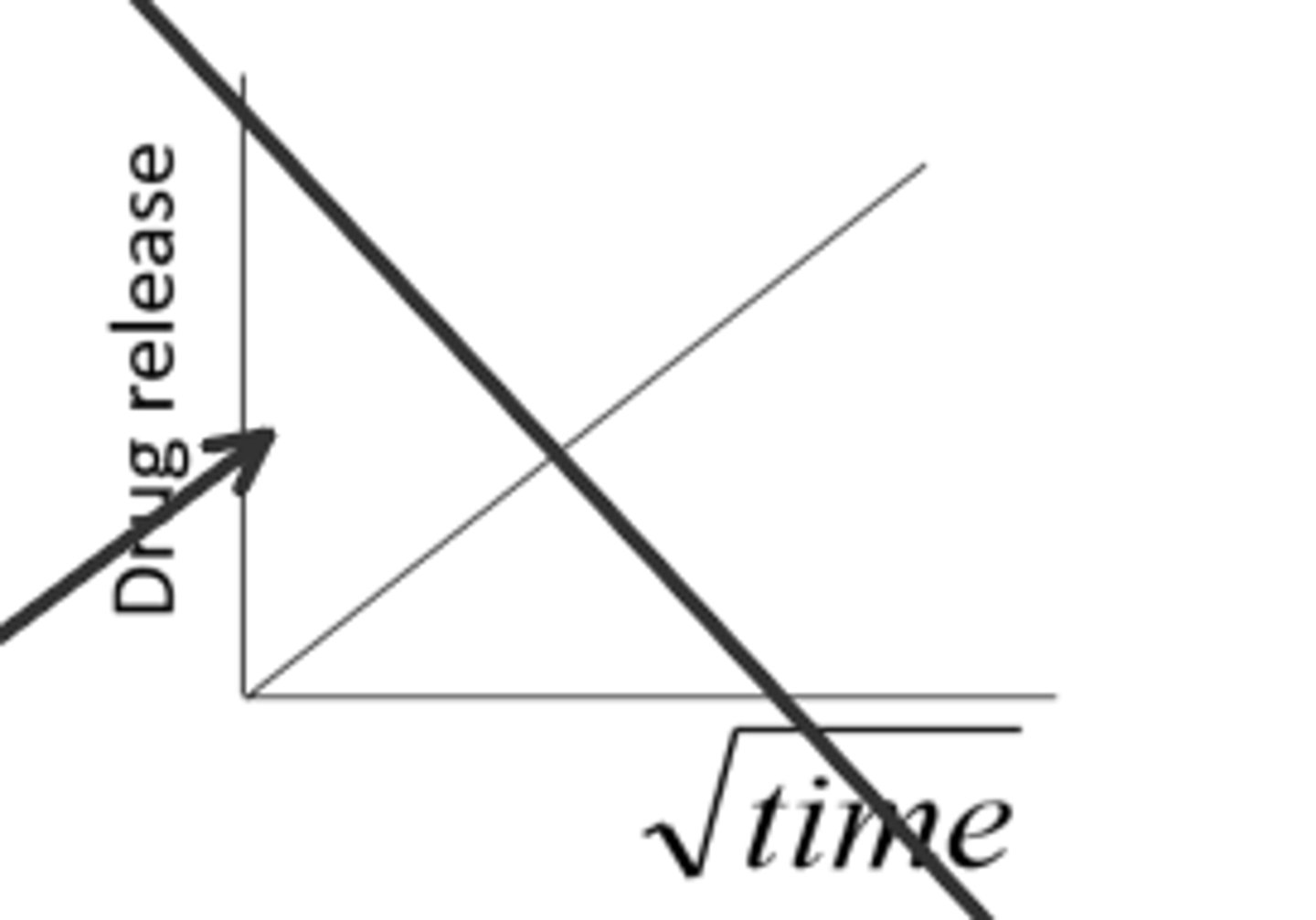
which drugs is a higuchi model used for
drugs released from a matrix
T/F: dissolution is a good predictor of therapeutic efficiency
false! its a qualitative tool for bioavailability and batch-to-batch consistency
*good quality control tool
rotating basket method vs paddle method
basket: USP 1
-capsules, suppositories with LOW DENSITY and tend to FLOAT
paddle: USP 2
- tablets and capsules that SINK
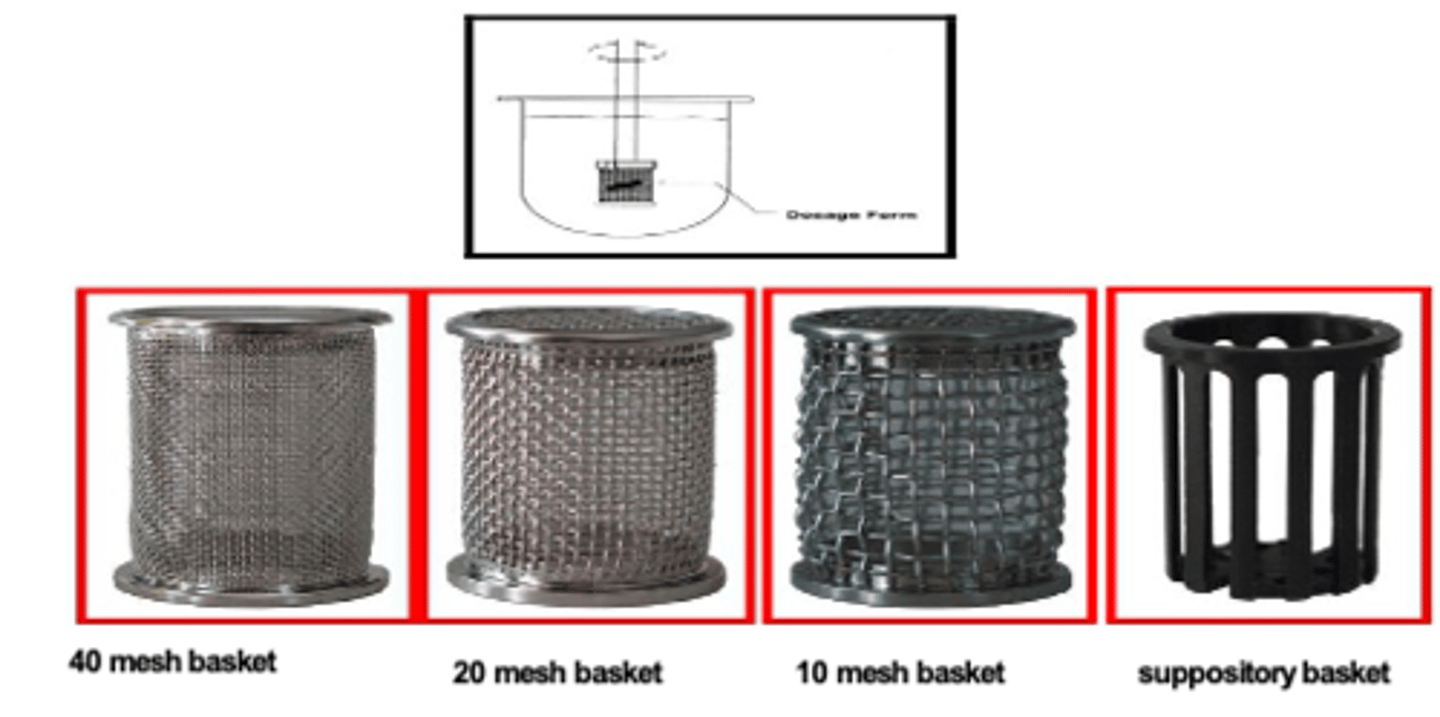
disadvantages of rotating basket method
1. gummy substance can clog basket screen
2. inadequate flow rates when particles leave basket and float up
which mesh size is USUALLY used for the rotating basket method?
40-mesh
in which dissolution method is degassing important
rotating basket method
standard volume for rotating basket method and paddle method
900/1000ml
advantages of the rotating basket method
1. more than 200 monographs
2. full pH change during test!
3. easily automated
advantages of paddle method
1. easy and robust
2. easily adapted to apparatus 5
3. long experience
4. pH change possible
(**full pH change in basket method)
5. easily automated
what is the method of first choice to assess dissolution
paddle method (USP 2)
most distinct disadvantage of paddle method (USP 2)
coning problem (clumping of drug under paddle)
what is the basket/paddle method aimed to replicate?
process of the GI tract
*NOT anatomy/ physiology
paddle and rotating basket methods have a pH ranging from _____
1.1-7.5
what are some composition differences btwn simulated gastric vs intestinal fluid
gastric: NaCl, HCl, deionized water
intestines: KH2PO4
NaOH
deionized water
for delayed release tablets:
paddle and rotating basket methods have pHs of
2 medias:
pH= 1.1
pH= 6.8-7.5