Nucleotide Metabolism and DNA Replication - Biology Study Materials
 Studied by 0 people
 Call Kai
 Learn
Learn Practice Test
 Spaced Repetition
 Match
Match Flashcards
 Knowt Play
1/87

There's no tags or description
Looks like no tags are added yet.
Name | Mastery | Learn | Test | Matching | Spaced |
|---|
No study sessions yet.
88 Terms
Nucleotides are synthesized through two main pathways
De novo pathways
Salvage pathways
In De novo pathways, the nucleotide bases are assembled from __________________ The framework for a pyrimidine base is assembled first and then attached to ribose. The framework for a purine base is synthesized ______________ directly onto a ribose-based structure.
simpler compounds (CO2, Amino acids, Activated ribose, ATP)
piece by piece
In Salvage pathways, ___________________ are recovered and reconnected to a ribose unit.
Preformed bases
De novo synthesis and most salvage pathways lead to the synthesis of __________________
ribonucleotides
All _______________ are synthesized from the corresponding ribonucleotides
deoxyribonucleotides
In both pathways, _______________ plays a crucial role in converting ribonucleotides to deoxyribonucleotides, with the electrons for reduction ultimately coming from NADPH
ribonucleotide reductase
The _________________ is generated by the reduction of ribose within a fully formed nucleotide.
deoxyribose sugar
The _________________ group that distinguishes the thymine of DNA from the uracil of RNA is added at the last step in the pathway.
methyl
Nucleotide biosynthesis is regulated by feedback inhibition. Pyrimidine Biosynthesis Is Regulated by __________________
Aspartate transcarbamoylase (ATCase)
Aspartate transcarbamoylase (ATCase) is a key enzyme for the regulation of _______________ in bacteria.
pyrimidine biosynthesis
ATCase is inhibited by CTP, the final product of pyrimidine biosynthesis, and stimulated by ______________
ATP.
The Synthesis of Purine Nucleotides Is Controlled by _______________ at Several Sites. That said, the regulatory scheme for purine nucleotides is more complex than that for pyrimidine nucleotides
Feedback Inhibition
Salvage Pathways Recycle _______________ Bases
Pyrimidine
Pyrimidine bases can be recovered from the breakdown products of DNA and RNA by the use of __________________ and is reincorporated into a nucleotide.
salvage pathways
Pyrimidine bases like thymine released from degraded DNA is salvaged in two steps: First, thymine is converted into _________________ Thymidine is then converted into a nucleotide by thymidine kinase.
the nucleoside thymidine by thymidine phosphorylase.
Pyrimidine bases like thymine released from degraded DNA is salvaged in two steps: First, thymine is converted into the nucleoside thymidine by thymidine phosphorylase. Thymidine is then converted into _________________
a nucleotide by thymidine kinase.
The _________________ Is Assembled on Ribose Phosphate. The initial committed step is the displacement of the _______________, to produce 5-phosphoribosyl-1-amine. Nine additional steps are required to assemble the purine ring. The final product is the nucleotide inosine monophosphate (IMP, or inosinate).
Purine Ring, pyrophosphate by ammonia
AMP and GMP Are Formed from ____________________
inosine monophosphate (IMP, or inosinate).
____________ nucleotides can also be synthesized by salvaging and recycling intact purines released by the hydrolytic degradation of nucleic acids and nucleotides.
Purine
The pathway for the degradation of AMP includes adenosine deamination. The Loss of Adenosine Deaminase Activity Results in _________________ an immunological disorder (a loss of T cells)
Severe Combined Immunodeficiency (SCID)
a lack of __________________ results in an increase of 50 to 100 times the normal level of dATP, which inhibits ribonucleotide reductase and, consequently, ____________________
adenosine deaminase, DNA synthesis.
In the regulation of ribonucleotide reductase, each subunit in the reductase dimer contains two allosteric sites in addition to the active site. One of the allosteric sites regulates _______________, and the other regulates ________________
the overall activity, substrate specificity.
Functions of Nucleotides Other Than DNA and RNA Building Units: Nucleotides Carry ________________ in Cells
Chemical Energy
The phosphate group covalently linked at the 5' hydroxyl of a ribonucleotide may have one or two additional phosphates attached. _______________ of nucleoside triphosphates provides the _________________ to drive many cellular reactions.
Hydrolysis, chemical energy
Functions of Nucleotides Other Than DNA and RNA Building Units: Adenine Nucleotides Are Components of Many __________________
Enzyme Cofactors
A variety of enzyme cofactors serving a wide range of chemical functions include _____________ as part of their structure
adenosine
Many enzyme cofactors, such as _______________, include nucleotides as part of their structure. These cofactors are essential for processes such as acyl group transfers, hydride transfers, and electron transfers.
Coenzyme A (CoA), NAD+, and FAD
Functions of Nucleotides Other Than DNA and RNA Building Units: Some Nucleotides Are _________________. The interaction of these extracellular chemical signals (“first messengers”) with receptors on the cell surface often leads to the production of __________________ inside the cell, which in turn leads to adaptive changes in the cell interior.
Regulatory Molecules, second messengers
Regulatory Molecules: Nucleotides also serve as _____________ in cellular signaling. For instance, ____________ is produced from ATP and regulates numerous cell processes by acting as a second messenger in signal transduction pathways. cAMP serves regulatory functions in virtually every cell outside the plant kingdom.
second messengers, cyclic AMP (cAMP)
Guanosine 3',5'-cyclic monophosphate (cGMP) occurs in many cells and also has ______________ functions.
regulatory
In some organisms, nucleotides such as _____________ serve as effective scavengers of reactive oxygen species, acting as _________________
urate, antioxidants
_____ enables DNA replication
base pairing
DNA double helix contains a sequence of nucleotides that is exactly complementary to the nucleotide sequence of its partner strand. Each strand can therefore serve as a template, or mold, for the synthesis of a new ______________
complementary strand.
In each round of DNA replication, each of the two strands of DNA is used as a template for the formation of a new, complementary strand. DNA replication is __________________ because each daughter DNA double helix is composed of one conserved strand and one ______________________
"semiconservative", newly synthesized strand.
Watson and Crick proposed the hypothesis of semiconservative replication. The hypothesis was proved. Three models for DNA replication make different predictions:
- semiconservative model
- dispersive model
- conservative model
In the ___________________, each parent strand serves as a template for the synthesis of a new _________________
semiconservative model, daughter strand.
In the _________________, each generation of daughter DNA will contain a mixture of DNA from __________________ and the newly synthesized DNA.
dispersive model, the parent strands
In the _________________, the parent molecule remains intact after being copied. In this case, the first round of replication would yield the __________________ and an entirely new double helix.
conservative model, original parent double helix
The first part of the Meselson-Stahl experiment ruled out _______________ of DNA replication, but does not distinguish between the semiconservative and dispersive models
the conservative model
To distinguish between the semiconservative and dispersive models, Meselson and Stahl ______________ DNA to high temperatures. The hydrogen bonds holding the two strands together break and the helix comes apart, leaving a collection of single-stranded DNAs. One strand of the DNA was heavy, whereas the other was light. This observation supported only the ______________
heated, semiconservative model
DNA Synthesis Begins at Replication Origins. The double helix must first be _____________ and the two strands separated to expose _____________.
opened up, unpaired bases
The process of DNA synthesis is begun by ________________ that binds to specific DNA sequences called _________________ to pry the two DNA strands apart, breaking the hydrogen bonds between the bases.
initiator proteins, replication origins
A bacterial genome, a circular DNA molecule of several million nucleotide pairs, has a single ________________.
replication origin
DNA Replication in E. coli Begins at a Unique Site. This origin of replication, called the _________________, contains five copies of a sequence that are preferred binding sites for the origin-recognition protein DnaA. The _______________ begins the building of the replication complex
oriC locus, binding of DnaA molecules
Once an initiator protein binds to DNA at a replication origin and locally opens up the double helix, it attracts a group of proteins that carry out DNA replication. These proteins form a replication machine. DNA molecules in the process of being replicated contain Y-shaped junctions called ______________
replication forks.
In DNA, __________________ are formed at each replication origin
two replication forks
In DNA, at each fork, a replication machine moves along the DNA, opening up the two strands of the double helix and using each strand as a template to make a new daughter strand. The two forks move away from the origin in opposite directions, unzipping the DNA double helix and replicating the DNA as they go
The slower rate of fork movement in humans (indeed, in all eukaryotes) may be due to the difficulties in replicating DNA through the more_________________ of eukaryotic chromosomes
complex chromatin structure
___________________ Synthesizes DNA Using a Parental Strand as Template
DNA Polymerase
The movement of a replication fork is driven by the action of the replication machine, at the heart of which is an enzyme called DNA polymerase. DNA polymerases require __________________
a primer to begin synthesis.
A primer strand having a free 3’-OH group must be already bound to the template strand. ________________ catalyzes the addition of nucleotides to the ____________ of a growing DNA strand, using one of the original, parental DNA strands as a template.
DNA Polymerase, 3ʹ end

A new DNA strand is synthesized in the _________________
5ʹ-to-3ʹ direction.
DNA polymerase adds a deoxyribonucleotide to the _______________ of a growing DNA chain
3ʹ end
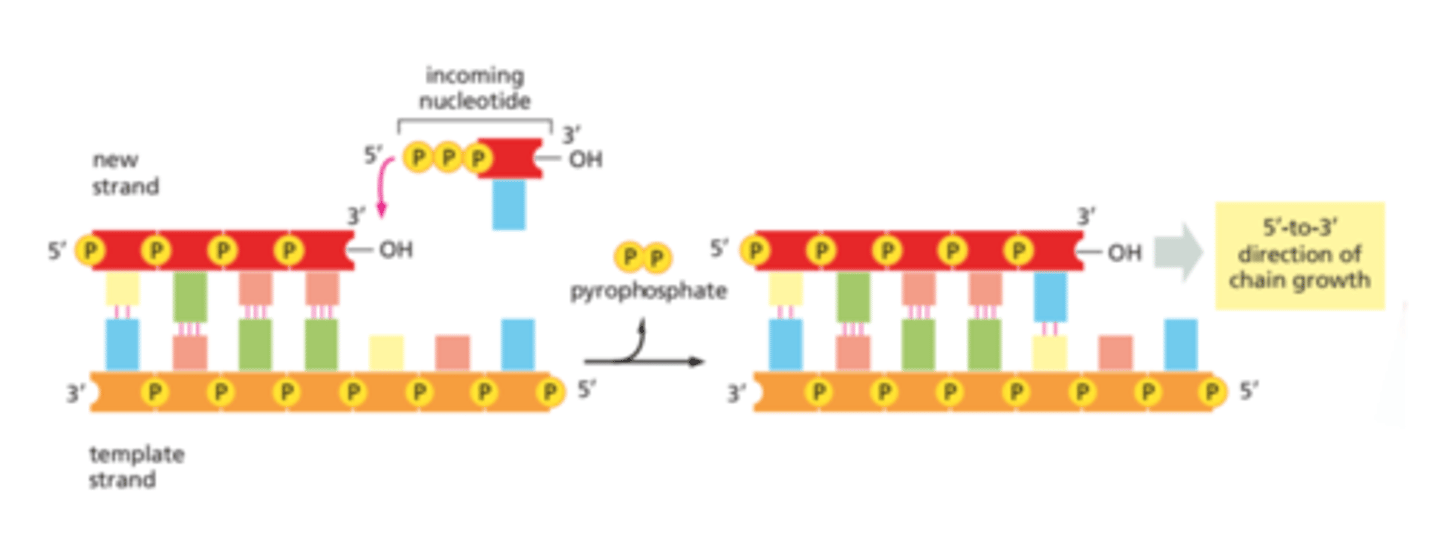
The DNA polymerization reaction involves the formation of __________________ between the 3ʹ end of the growing DNA chain and the _______________ of the incoming nucleotide, which enters the reaction as a deoxyribonucleoside triphosphate.
a phosphodiester bond, 5ʹ-phosphate group
DNA polymerase does NOT ______________ from the DNA each time it adds a new nucleotide to the growing strand; rather, it stays associated with the DNA and moves along the template strand stepwise for many cycles of the polymerization reaction
dissociate
All DNA polymerases have structural features in common. the Klenow fragment of DNA polymerase I includes a domain with 3' to 5' exonuclease activity that participates in _______________ and correcting the polynucleotide product
proofreading
The Specificity of Replication Is Dictated by the Complementarity of Bases. The binding of the dNTP containing the proper base is favored by the formation of a base pair, which is stabilized by specific ___________________
hydrogen bonds
____________________—the change in the structure of the enzyme when it binds the correct nucleotide.
Induced fit
______________ is Self-correcting since it carefully monitors the base-pairing between each incoming nucleotide and the template strand. Only when the match is ______________ does DNA polymerase catalyze the nucleotide-addition reaction.
DNA Polymerase, correct
Many DNA polymerases are able to correct mistakes in DNA by removing mismatched nucleotides. This is termed ________________
Proofreading
DNA polymerase I has three distinct active sites:
- the polymerase site
- a 3' to 5' exonuclease site
- a 5' to 3' exonuclease site.
Proofreading of DNA takes place at the same time as _____________________
DNA synthesis.
DNA polymerase contains separate sites for _________________
DNA synthesis and proofreading
When the DNA polymerase adds an incorrect nucleotide, the newly synthesized DNA strand transiently _____________ from the template strand, and its growing 3ʹ end moves into the error correcting catalytic site to be removed.
unpairs
The Separation of DNA Strands Requires Specific ________________ and _____________
Helicases, ATP Hydrolysis
The two strands of the double helix must be separated from each other, at least at the site of replication. Specific enzymes, termed _______________, utilize the energy of ______________ to power strand separation.
helicases, ATP hydrolysis
_________________ Prepare the Double Helix for Unwinding
Topoisomerases
This excess twisting in front of the replication fork creates tension in the DNA that—if allowed to build—makes unwinding the double helix increasingly difficult and impedes the forward movement of the replication machinery. Cells use proteins called __________________ to relieve this tension.
topoisomerases
Topoisomerases produce _______________, which temporarily release the tension.
transient nicks in the DNA backbone
Topoisomerases produce transient nicks in the DNA backbone, which temporarily release the tension. They then _________________ before falling off the DNA
reseal the nick
An ______________ Synthesized by ______________ Enables DNA Synthesis to Begin
RNA Primer, Primase
DNA polymerases can add nucleotides only to ______________; they cannot start a strand de novo.
a free hydroxyl group
RNA primers are synthesized by an RNA polymerase called ________________, which uses a DNA strand as a template.
primase
Like DNA polymerase, primase works in the __________________
5ʹ-to-3ʹ direction.
Unlike DNA polymerase, primase can start a new polynucleotide chain by joining together two nucleoside triphosphates without the need for a base-paired ______________________
3ʹ end as a starting point.
The RNA primer is removed at a later stage of replication by _________________
5' to 3' exonuclease
One Strand of DNA Is Made Continuously and the Other Strand Is Synthesized in ____________________
Fragments
DNA polymerases synthesize DNA in the _________________ but NOT in the 3' to 5' direction.
5' to 3' direction
A significant proportion of newly synthesized DNA exists as small fragments called __________________. As replication proceeds, these fragments become covalently joined through the action of _______________,
Okazaki fragments, DNA ligase
________________ is an enzyme that uses _________________ to power the joining of DNA fragments (Okazaki fragments) to form one of the daughter strands
DNA ligase, ATP hydrolysis
The other new strand is synthesized continuously (leading strand). The strand formed from Okazaki fragments is termed the ___________________
lagging strand
_________________. has a high catalytic processivity due to its β2 subunit, which refers to the ability of an enzyme to catalyze many consecutive reactions without releasing its substrate.
DNA polymerase III holoenzyme
______________ This enzyme catalyzes the addition of nucleotides to the 3ʹ end of a growing DNA strand using a parental strand as a template. It requires a primer with a free 3ʹ-OH group to begin synthesis. DNA polymerases also have proofreading capabilities via 3ʹ-to-5ʹ exonuclease activity to correct errors during replication.
DNA Polymerase:
_____________ This enzyme is responsible for unwinding the DNA double helix, separating the two strands by using the energy from ATP hydrolysis.
Helicase:
______________: These enzymes relieve the tension that builds up ahead of the replication fork due to the unwinding of DNA, by creating temporary nicks in the DNA backbone.
Topoisomerase
______________ This enzyme synthesizes an RNA primer to provide a starting point for DNA polymerase. This is an RNA polymerase that joins nucleotides without needing a 3ʹ-OH group.
Primase:
_______________ This joins Okazaki fragments on the lagging strand by catalyzing the formation of phosphodiester bonds using ATP hydrolysis.
Ligase:
_________________ These proteins stabilize single-stranded DNA and prevent it from reannealing before replication is complete
Single-Strand Binding Proteins (SSBs):