Biology Unit 3 Topic 2
 Call Kai
 Learn
Learn Practice Test
 Spaced Repetition
 Match
Match Flashcards
 Knowt Play
1/37

Earn XP
Description and Tags
Functioning ecosystems and succession
Name | Mastery | Learn | Test | Matching | Spaced | Call with Kai | Chat |
|---|
No analytics yet
Send a link to your students to track their progress
38 Terms
Explain the conversion of light into chemical energy
Sun provides most of Earth’s energy in the form of heat and light energy
70% of solar energy is absorbed by the atmosphere and Earth’s surface during the day and radiated as heat energy at night
30% of the incoming solar energy is reflected back into space
A small proportion of solar (light) energy is absorbed and captured by plants and algae.
This light energy is transformed via photosynthesis into chemical energy i.e. energy stored in the bonds of glucose molecules.
Explain the production of biomass
Chemical energy is used by organisms to move, grow and reproduce.
Growth and reproduction contribute to increasing biomass.
Biomass = total mass of living matter (organic matter) in an ecosystem
Some of the chemical energy produced via photosynthesis is used by autotrophs for metabolic processes, while the rest is stored as biomass in the form of starch or plant structures (leaves, stems, roots and fruit).
Describe a heterotroph
Heterotrophs (consumers) are organisms that cannot photosynthesise.
They must consume other organisms to transfer their chemical energy into their own body systems.
Describe an autotroph
an organism that can produce its own organic compounds (glucose) from sunlight, water and carbon dioxide
List the ways biomass interacts with components of the carbon cycle
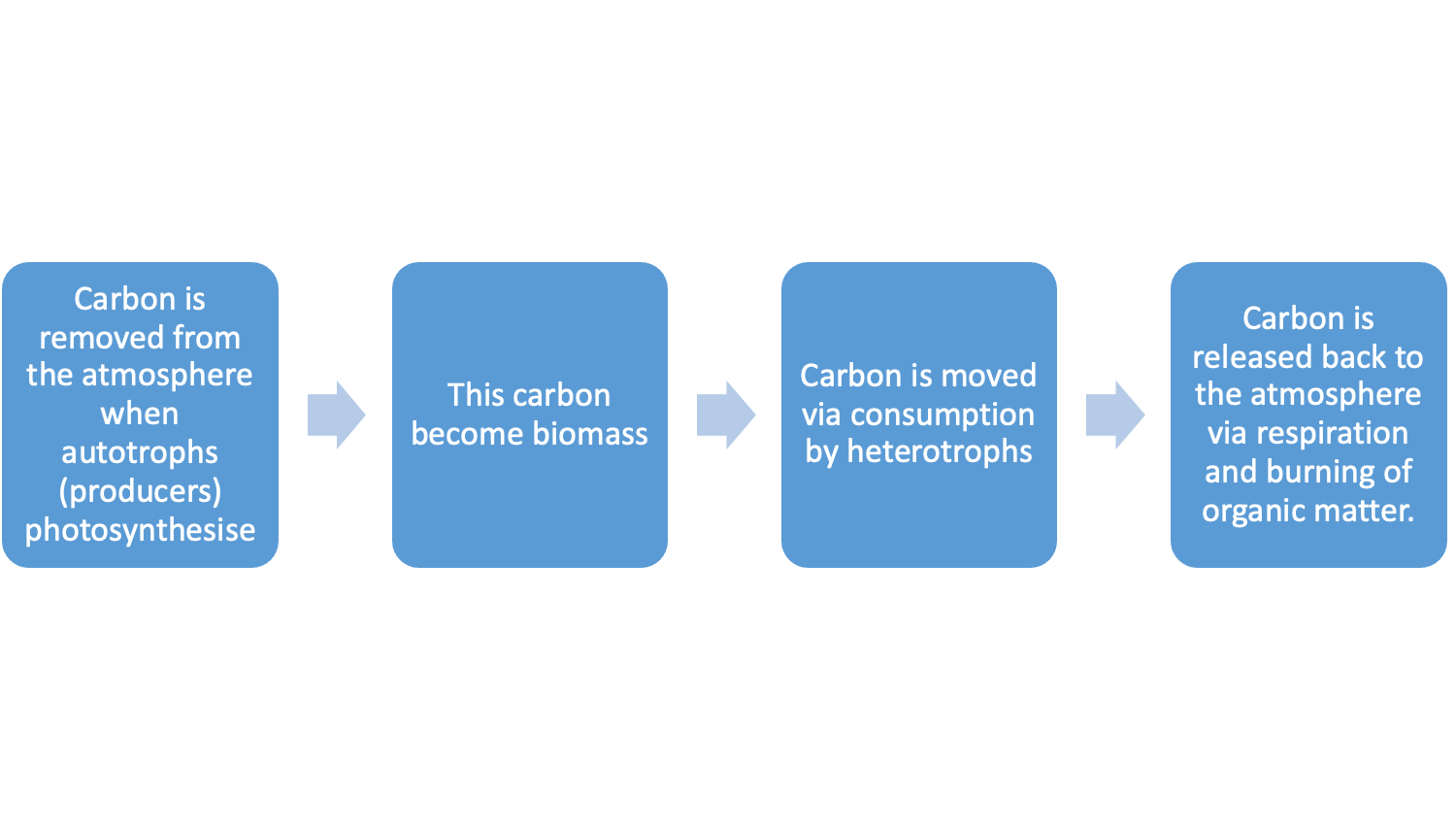
Chemical energy produced by photosynthesis
Heterotrophs
Cellular respiration
Decay
Burning organic matter
What is cellular respiration?
Cellular respiration breaks down glucose molecules, releasing chemical energy from their bonds.
This energy is used for metabolism.
Respiration also transforms some of the chemical energy into heat energy.
Carbon dioxide is released to the atmosphere during respiration.
Explain how decay transfers chemical energy
Decay of wastes and dead organisms transfers chemical energy from the wastes to nutrients in the soil.
Carbon dioxide is released to the atmosphere by decay processes and some chemical energy is transformed to heat energy
Explain how burning organic matter transforms chemical energy
Burning organic matter transforms chemical energy to heat and light energy.
Carbon dioxide is released during burning.
Summarise the interactions with components of the carbon cycle
What is an Endotherm?
an organism that regulates and maintains internal body temperature higher than the temperature of the surroundings
In endotherms (mammals and birds), while some heat energy is lost to the surroundings, they also use some of the heat energy to maintain a constant internal body temperature
To balance heat loss and still maintain a constant body temperature, endotherms need to consume greater amounts of food than equivalently sized ectotherms.
What is an Ecotherm?
an organism whose internal body temperature fluctuates with the surroundings
rely on external sources of heat to regulate their body temperature.
Define food chain
simple linear arrangement of organisms showing the flow of matter and energy from one organism to another through feeding relationships
Define food web
A diagram that show the flow of matter and energy through an ecosystem, specifically showing the interconnecting food chains in an ecosystem.hatw
What do the arrows in food chains and webs represent?
Arrows represent the transfer of energy and matter (biomass) as one organism is eaten by another (arrows point in direction of energy flow).
What is a trophic level?
It is a level in the food chain of an ecosystem based on feeding relationships e.g. producer, herbivore.
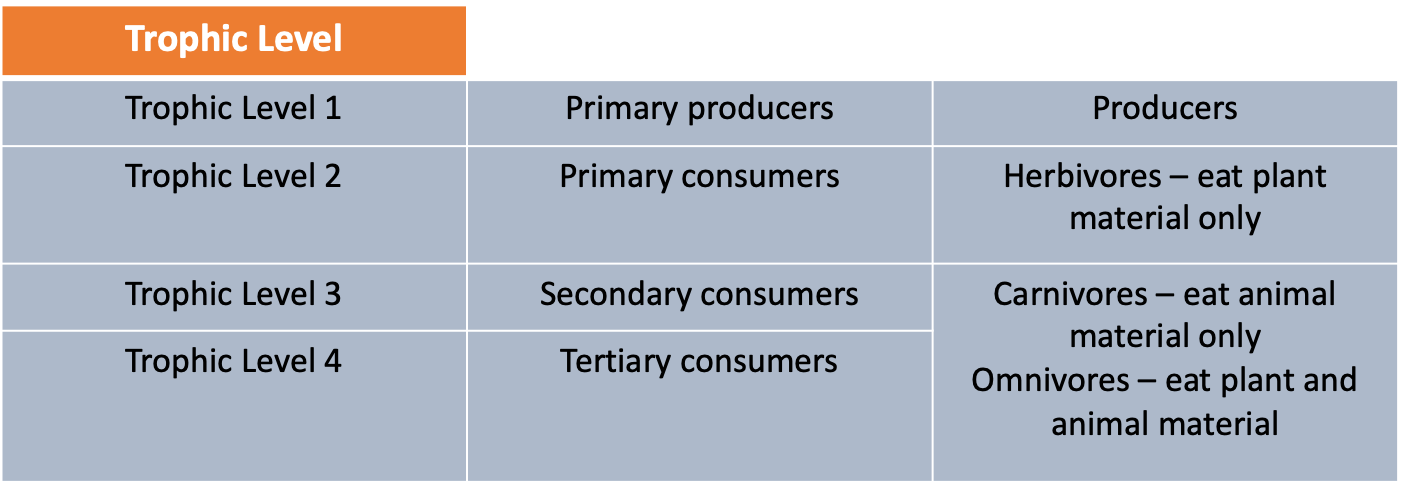
Identify and describe what consumers be classified as?
First-order (primary) consumers = herbivores that eat plant material.
Second-order (secondary) consumers =carnivores that eat herbivores.
Third (tertiary)and higher-order consumers =carnivores that eat other carnivores.
What is an omnivore?
Omnivores =organisms that eat both producers and consumers. May be both a 1stand higher order consumer simultaneously
What is a specialist?
Specialists = a heterotroph that can thrive only on a limited diet. e.g. koalas only eat the young leaves of specific eucalypts
What is a generalist?
Generalists = a heterotroph with a varied diet. e.g. bandicoots eat insects, spiders, earthworms, berries, grass seeds, and young stems and roots.
Identify and describe the classifications of carnivores
Predators = hunt and kill other animals for food.
Parasites = feed on living organisms.
Scavengers = feed on animals they have not themselves killed.
What is detritus?
Detritus is the organic debris from decomposing plants and animals
What are detritivores?
organisms that ingest and digest the nutrients in detritus internally e.g. worms
What is a decomposer?
organisms that break down (externally digest) dead organisms or waste matter and then absorb the resulting nutrients e.g. bacteria, fungi and some protozoans
What is the initial source of biomass and energy in ecosystems?
Producers
What is photosynthetic efficiency?
how well a producer converts light energy into chemical energy (glucose) during photosynthesis
What is photosynthetic efficiency reliant on?
sunlight, water and CO2 availability; nutrient availability; temperature; light intensity and the nature of the organism
Identify and define GPP
Gross Primary Productivity (GPP)= the total amount of organic matter produced annually in an ecosystem by producers through photosynthesis
Identify and define NPP
Net Primary Productivity (NPP) = the amount of organic matter (glucose) made available to herbivores annually in an ecosystem. NPP= GPP minus the energy required by the producers
How much energy is transferred between trophic levels?
10% of energy at one trophic level is transferred to the next level. (i.e. 10% transfer efficiency)
What limits the number of trophic levels?
Energy loss limits the number of trophic levels in a food chain, usually to 4 or 5 (very rarely more than six links).
The closer a consumer’s tropic level is to a producer, the more energy is available to be transferred
Why is the number of trophic levels limited?
At higher trophic levels there is not enough energy to support organisms.
This is why higher trophic levels contain fewer organisms and less biomass
What type of animals lose the most energy through heat radiation?
Endothermic animals
What is the formula to calculate percentage (transfer/energy) efficiency?
Percentage efficiency = net productivity of the organism x 100
net productivity of the previous trophic level
What is the formula to calculate total energy lost?
Total energy lost=Initial energy−Final energy
How is solar energy lost (3 ways)
Absorption: 70% absorbed by atmosphere and earths surface
Reflection: 30% is reflected back into space
Radiation: 30% radiated back into space
What is an ecological pyramid?
A pyramid diagram representing the amount of energy, biomass or number of individuals at each trophic level.
The width of each level in a pyramid indicates the relative biomass, number of individuals or amount of energy available in each trophic level.
What are the three types of ecological pyramids?
1. Pyramid of numbers: shows the number of individual organisms at each trophic level in a food chain
2. Pyramid of biomass: shows the amount of living matter (i.e. mass of the organisms) at each level in a food chain
3. Pyramid of energy: shows the amount of energy transferred through a food chain