M.O of special importance
 Call Kai
 Learn
Learn Practice Test
 Spaced Repetition
 Match
Match Flashcards
 Knowt Play
1/47

There's no tags or description
Looks like no tags are added yet.
Name | Mastery | Learn | Test | Matching | Spaced | Call with Kai | Chat |
|---|
No analytics yet
Send a link to your students to track their progress
48 Terms
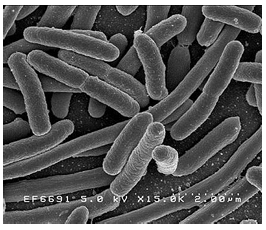
What type of bacterium is Escherichia coli in terms of Gram stain, shape, and oxygen requirement?
Gram-negative
Rod-shaped (bacillus)
Facultative anaerobe
Non-sporulating
Member of enteric bacteria (order Enterobacteriales)
Which metabolic features characterize enteric bacteria like E. coli?
Gram-negative rods
Facultative anaerobes
Catalase positive
Ferment glucose → produce acids
Reduce nitrate → nitrite
Why is Escherichia coli commonly called the “poop bacterium”?
It is a normal inhabitant of the lower gastrointestinal tract of humans and animals and is commonly found in feces.
What beneficial roles does E. coli perform in the human gut?
Helps digest food
-Catalase positive: converts toxic hydrogen peroxide to water and oxygen
-Ferment glucose → produce acids
-Reduce nitrate → nitrite
Produces vitamin K2 (menaquinone)
Part of normal intestinal microbiota
Why is E. coli used as an indicator organism in environmental microbiology?
Presence of E. coli in surface water indicates fecal contamination, because it originates from intestinal microbiota.
Why can identification of enteric bacteria be difficult? and how is it done?
As they are genetically closely related, they require many biochemical diagnostic tests for differentiation.
An API biochemical test panel which tests multiple metabolic capabilities are done for identification.
Why is E. coli one of the most studied organisms in biology?
grows quickly (20 mins- generation time under optimal conditions)
is easy and cheap to culture
has well-understood genetics
is easily genetically engineered
What metabolic classification describes E. coli?
Chemoheterotroph
Meaning it obtains:
energy from chemical compounds
carbon from organic molecules
What must be present in a chemically defined medium for E. coli?
A source of carbon and energy such as glucose
Which fermentation pathway does E. coli use under anaerobic conditions and what are the resultant products of it?
Mixed-acid fermentation
Produces:
lactate
succinate
ethanol
acetate
CO₂
What respiration strategy allows E. coli to grow in both oxygen-rich and oxygen-poor environments?
It is a facultative anaerobe.
It can:
use aerobic respiration when oxygen is available
switch to fermentation or nitrate reduction when oxygen is absent
Nitrate (NO₃⁻) is reduced to nitrite (NO₂⁻).
Which two E. coli strains are commonly used in molecular biology?
K-12 strain
B strain
Why are some E. coli strains dangerous while others are harmless?
Different serotypes possess virulence genes such as:
toxins
adhesion proteins
invasion mechanisms
Why can E. coli thrive on many substrates?
It has metabolic versatility, allowing utilization of a wide variety of organic molecules.
What is the typical size of Thiomargarita namibiensis cells?
Diameter:
100–300 µm
occasionally up to 750 µm
visible to the naked eye.
Why can Thiomargarita namibiensis become so large?
Because it has a large central vacuole, leaving only a thin cytoplasmic layer.
This reduces diffusion distance.
What does the large vacuole in Thiomargarita namibiensis store?
Large amounts of nitrate (up to 0.8 M).
What do the smaller inclusions in Thiomargarita namibiensis store?
Elemental sulfur (S⁰).
What metabolic type is Thiomargarita namibiensis?
Chemolithotroph
Uses inorganic compounds for energy.
What electron donor does Thiomargarita namibiensis use?
Hydrogen sulfide (H₂S).
What electron acceptor does Thiomargarita namibiensis use?
Oxygen when aerobic respiration takes place.
nitrate when anaerobic respiration takes place.
What oxygen conditions does Thiomargarita namibiensis prefer?
Microaerophilic conditions (low oxygen).
Why does Thiomargarita namibiensis store nitrate and sulfur inside the cell?
To bridge environmental fluctuations when:
nitrate
sulfur
oxygen
are temporarily unavailable.
What disease is caused by Borrelia burgdorferi?
Lyme disease (borreliosis).
What type of bacterium is Borrelia burgdorferi morphologically?
A spirochete (spiral-shaped bacterium).
How do spirochetes move?
Using axial filaments (endoflagella) located in the periplasm.
What movement pattern do axial filaments produce? and why is it beneficial?
Corkscrew motion, allowing movement through viscous environments.
It allows movement through:
host tissues
mucus
connective tissue
What is the generation time of Borrelia burgdorferi?
12-24 hours
What oxygen requirement does Borrelia burgdorferi have?
Microaerophilic (low oxygen).
What is the optimal growth temperature for Borrelia burgdorferi?
32°C
What unusual genomic feature does Borrelia burgdorferi possess?
One linear chromosome
Multiple plasmids
Why are plasmids important in Borrelia burgdorferi?
They encode virulence factors, including outer surface proteins (Osp).
How do humans become infected with Borrelia burgdorferi?
Through the bite of an infected tick.
What animals serve as reservoirs for Borrelia burgdorferi?
Rodents, especially mice.
What alternative forms can Borrelia burgdorferi adopt?
Spirochete form usual
Cyst form and L-form (cell wall deficient) are alternate forms which are chemically significant as they increase resistance to antibiotics.
What are Osp proteins in Borrelia burgdorferi?
Outer surface proteins; probably plays an important role in virulance
What domain of life does Haloquadra walsbyi belong to?
Archaea
What environment does Haloquadra walsbyi inhabit?
Extremely hypersaline environments (salt lakes).
What salt concentration does Haloquadra walsbyi prefer?
Above 3 M NaCl.
What unusual cell shape does Haloquadra walsbyi have?
Square cells with right angles.
What is the thickness and aprroximate cell surface of Haloquadra walsbyi cells?
About 0.5 µm (extremely thin); up to 1600micrometer square; increasing surface area to volume ratio
Why does Haloquadra walsbyi stay near the water surface? and which structures allow them to float near the water surface?
to access light for photosynthetic energy capture through gas vacules/vesicles
Why is water availability limited in hypersaline environments?
their approximate Aw is 0.6-0.7 because high salt concentration surroundings reduce water activity (Aw).
Why do spirochetes often infect tissues effectively?
Their corkscrew motility allows penetration of viscous host tissues.
What protein was discovered in Haloquadra walsbyi that resembles human mucin? and what is itsfunction
halomucine
Forms a mucus-like layer around the cell that:
binds free water
helps survival in extremely salty environments.
Why is MgCl₂ important for Haloquadra walsbyi?
They stay in high mgcl2 conditions because they help stabilize DNA in extreme conditions.
Why are gas vesicles beneficial for phototrophic microorganisms?
They allow cells to control buoyancy and remain in the photic zone.
How can Haloquadra walsbyi move?
Using flagella.