Anatomy: Cleft lip / palate
 Call Kai
 Learn
Learn Practice Test
 Spaced Repetition
 Match
Match Flashcards
 Knowt Play
1/48

There's no tags or description
Looks like no tags are added yet.
Name | Mastery | Learn | Test | Matching | Spaced | Call with Kai | Chat |
|---|
No analytics yet
Send a link to your students to track their progress
49 Terms

External ear, Middle Ear, Inner ear
Pinna & External auditory canal
Tympanic membrane & ET
Cochlea, Organ of corti & semicircular canals


Nose & nasal cavity
*lip closed by 3 months (feeding)
*palate closed by 10 months b/c of growth
Naris = nostril
upper lip
philtrum
philtral ridges/columns
cupid’s bow
white roll
vermilion
tubercle


Nose & nasal cavity


Nasal septum
quadrangle septal cartilage
vomer: fits in median palatine suture groove
perpendicular plate of the ethmoid
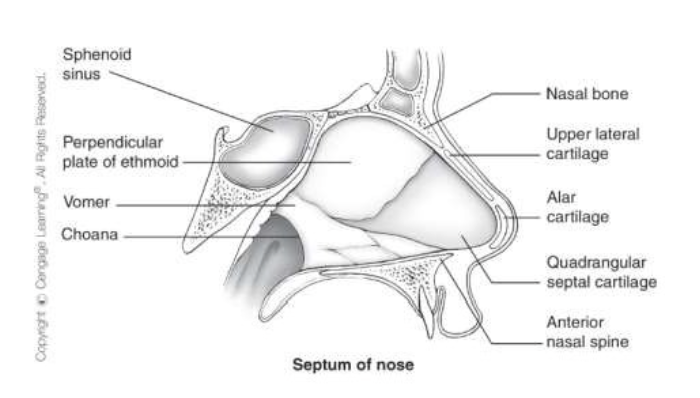
Turbinates (choane/bone) & meatuses (hallway)
superior , middle, inferior turbinates (Choane)
superior, middle, inferior nasal meatuses
paranasal sinuses
*MIDDLE TURB BEST FOR ENT TO SEE, informs surgical processes (VP closure)

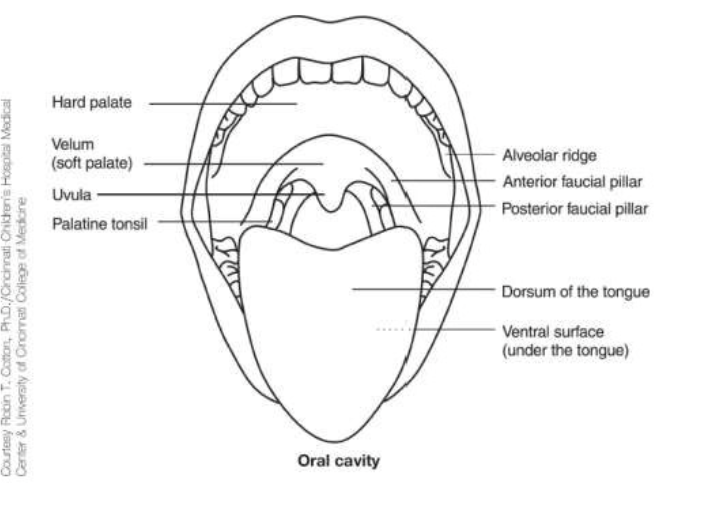
oral cavity
hard palate
alveolar ridge
velum (soft palate)
uvula
tongue (dorsal & ventral surface)
faucial pillars (ant & post)
tonsils (palatine tonsils)
PPW
Palate & pharynx
hard palate (maxilla)
velum (soft palate)
ET
tonsils
adenoid (pharyngeal tonsil)
tonsils (palatine tonsils)
lingual tonsil (base of tongue)
epiglottis
*sleep apnea, HYPO nasality, ET dysfunction w/ enlarged tonsils

Hard palate
separates nasal cavity & oral cavity
serves as roof of mouth and floor of nasal cavity
palatal vault: dome on upper part of oral cavity
alveolar ridge (alveolus): provides bony support for teeth
*APERTS = high narrow arch
Hard palate: mucoperiosteum
tissue that covers the hard palate
mucous membrane: lining of stratified squamous epithelium & lamina propria
periosteum: thick, fibrous tissue that covers bone
*right side is hard palate

hard palate: rugae
ridges that run horizontally
incisive papilla: projection of mucosa at area of incisive foramen (just behind central incisors)
palatine (median) raphe: line from incisive foramen to uvula

hard palate: foramen
hole or opening in a bony structure to allow blood vessels and nerves to pass through to the mucosa
incisive foramen: in the area of alveolar ridge behind the central incisor, starting point of embryological development

hard palate: premaxilla
triangular-shaped bone
bordered by incisive foramen and incisive sutures
4 maxillary incisors
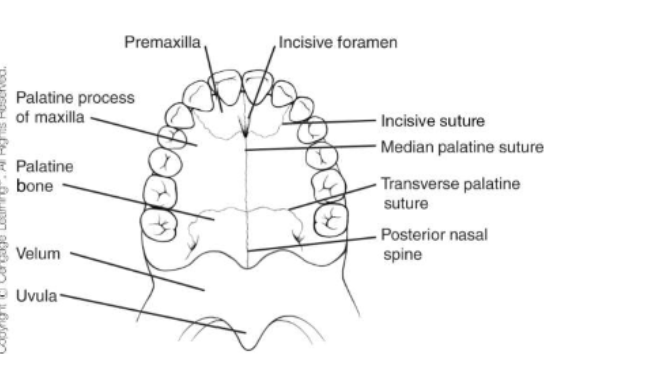
Hard palate: palatine processes of maxilla
forms anterior 3/4th of maxilla
two plates separated by median (intermaxillary) palatine suture
nasal aspect of palatine suture forms groove for lower portion of vomer (nasal septum)

Hard palate: suture lines
incisive suture lines
median intermaxillary palatine suture
transverse palatine palatomaxillary suture lines
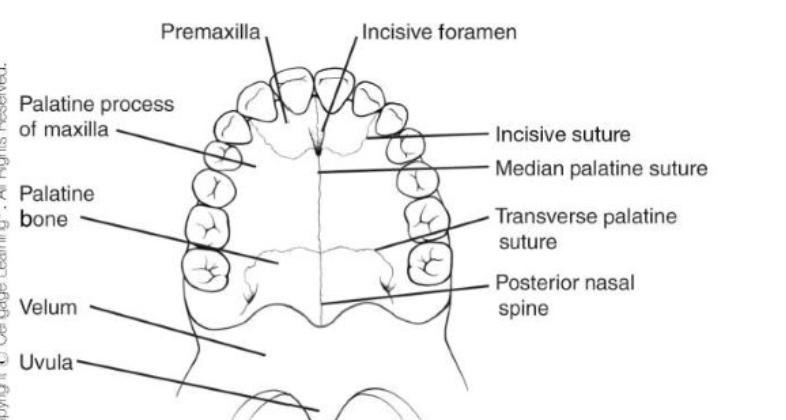
hard palate: horizontal plates of the palatine bones
posterior portion of the hard palate
bordered by the transverse palatine suture lines
meet in midline at the median palatine suture
ends with the posterior nasal spine

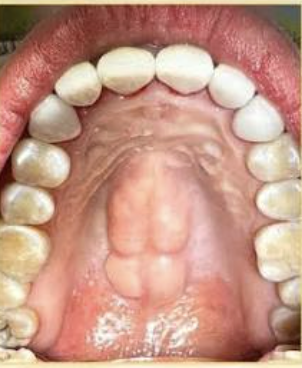
Hard palate: torus palatinus (palatine torus)
seen in some caucasians of northern european descent
prominent longitudinal ridge on oral surface along intermaxillary suture line
normal variation and usulaly not cause of the problem
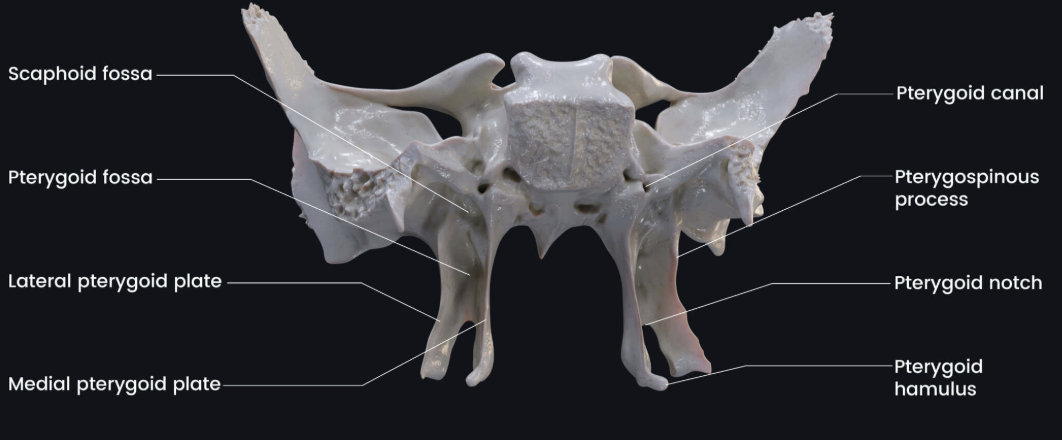
Sphenoid & temporal bones
medial & lateral pterygoid plates: part of pterygoid process of spehnoid bone
pterygoid hamulus: inferior end of pterygoid plate
both provide bony attachment for VP musculature

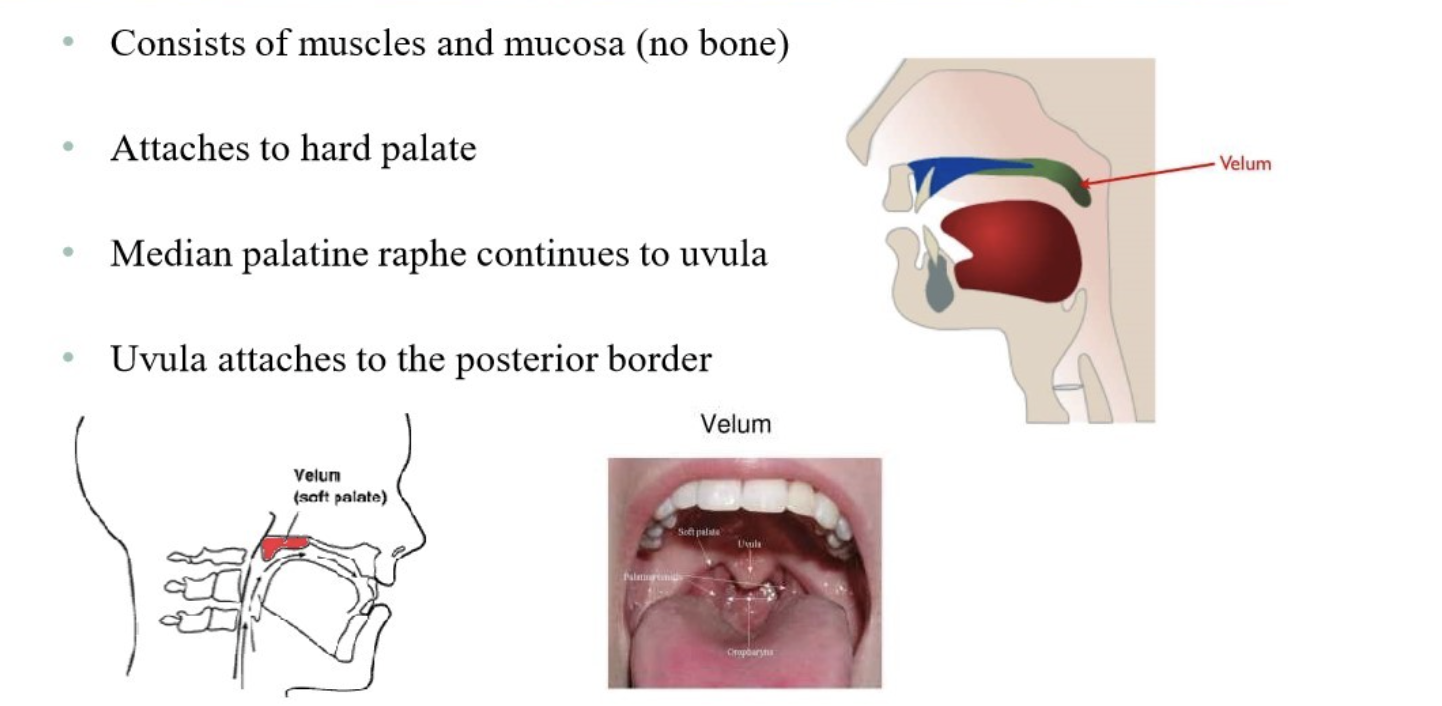
Velum (soft palate)
consists of muscles & mucosa (no bone)
attaches to hard palate
median palatine raphe continues to uvula
uvula attaches to posterior border
Velum: palatine velar aponeurosis
consists of fibrous, connective tissue
anchoring point for velar muscles
provides stiffness

Uvula
teardrop-shaped pendulum
consists of mucosa, glandular, and adipose tissue
very vascular
no known function

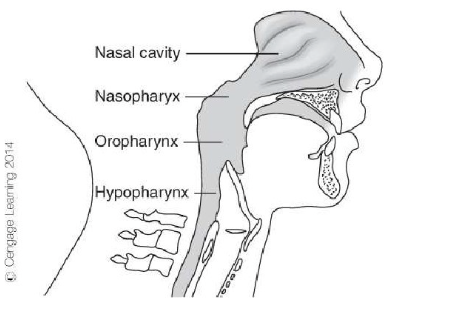
Pharynx (throat)
nasopharynx: above velum
oropharynx: below velum
hypopharynx
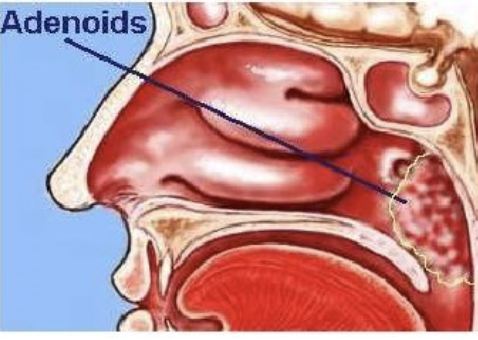
posterior pharyngeal wall (adenoid tissue located behind velum)

Adenoid pad
mass of lymphoid tissue
located on PPW behind velum
more prominent in children than adults
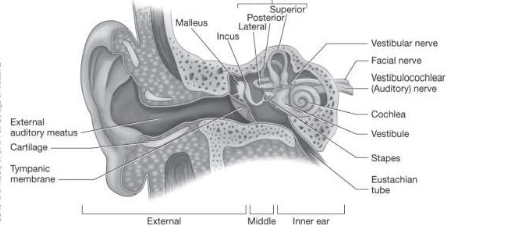
Eustachian tube
connects middle ear with pharynx
at horizontal angle in children under age 6
at 45 degree angle in adults

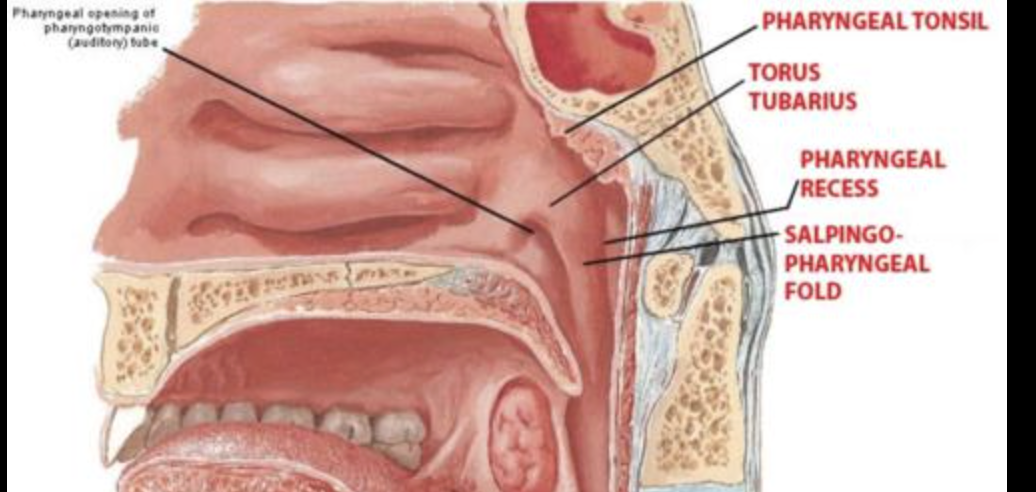
ET
pharyngeal tube opening is lateral & slightly above velum
torus tubarius - ridge located posteriorly to ET
Salpingopharyngeal folds - originate from torus tubarius and course down to lateral pharyngeal wall
*empties into pharynx

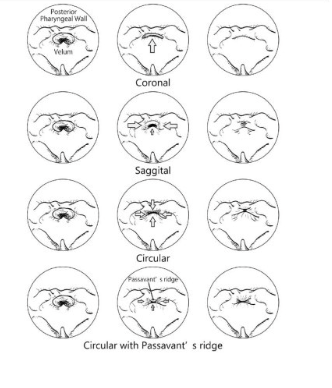
VP closure
coordinated 3 dimensional closure of structures
valve like a sphincter
close off nasal from oral
* coronal most common

VP function
regulates and directs transmission of sound energy and airflow in the oral and nasal cavities
important for production of “pressure sensitive consonant sounds & all vowels”
MOST Difficult = fricatives
VP function requires
coordinated movement of the following structures
velum (soft palate)
lateral pharyngeal walls
posterior pharyngeal wall
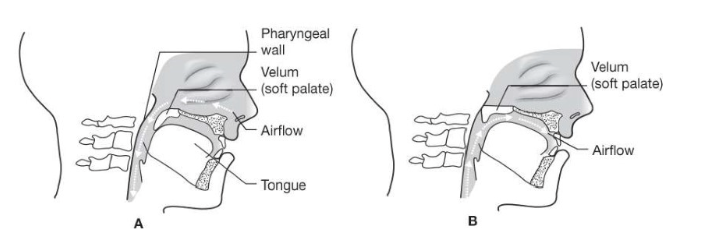
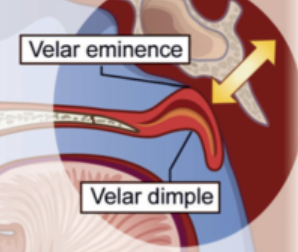
velar movement
moves in a superior & posterior direction
kneeing action
moves toward the PPW
velar dimple - point of bend in the velum during contraction
*incompetence: neurological
*insufficiency: structural
LPW movement
moves medially
usually close against the velum
sometimes close in midline behind the velum

PPW movement
moves anteriorly toward velum
has very little role
passavant’s ridge - bulge of muscle on the PPW; occurs in some normal/abnormal speakers

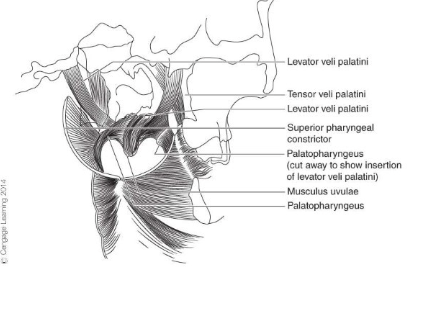
muscles of VP closure
levator veli palatini (velar sling)
superior constrictor (pharyngeal ring)
palatopharyngeus (posterior faucial pillar)
palatoglossus (anterior faucial pillar)
musculus uvulae (bulge on nasal surface)
tensor veli palatini
Motor & sensory innervation
pharyngeal plexus: network of nerves that lies along posterior wall of the pharynx and consists of the pharyngeal branches of the glossopharyngeal nerve CN IX and the vagus nerve CN X

Cranial nerves
trigeminal V
facial VII
Glossopharyngeal IX
Vagus X
Accessory XI
Hypoglossal XIII
Patterns of VP closure
coronal: velum & PPW
Sagittal pattern: LPW’s least common
Circular pattern: all structures, passavant’s ridge

Pneumatic vs. Nonpneumatic activities
nonpneumatic
swallowing, gagging, vomiting
velum is raised high in pharynx
LPW close
want to prevent nasal regurgitation
Pneumatic (using air pressure)
positive pressure (whistling, blowing, speech)
negative pressure (sucking, kissing)
During NONpneumatic
entire length of LPWs move together with exaggerated movement
closure is higher than with speech
SPEECH: greatest movement with high-pressure consonants
closure for speech are different DONT work on blowing/sucking to improve speech
Timing & height of closure
timing: valve closes before phonation begins typically, otherwise it will sound hypernasal
closure is maintained until a nasal consonant or the utterance is ended
HEIGHT: closure contact may vary with different sounds
higher and tighter with high vowels, and high pressure consonants, voiceless!
closure affected by rate / fatigue
firmness / rate / fatigue
FIRMNESS: varies with consonant, gap of 5mm (20mm2) is the threshold for hypernasality, even small gaps cause nasal emission
RATE/FATGUE: velar movement / closure decrease with rapid rate and fatigue, affects height and firmness of closure
changes w/ growth & age
velum increases in thickness / length (velar stretch)
maturation results in increased oral-motor coordination
facial skeleton (hard & soft palate too) moves down and forward
PPW bends forward
Adenoid tissue decreases around puberty
age 8-12 VPI
Subsystems for speech
respiration
phonation
prosody (stress, rhythm, intonation)
resonance & velopharyngeal function
articulation
Respiration
air pressure is required to initiate and sustain phonation
vocal folds close
psub builds
vfs break open & vibrate
pressure is released
soft voice syndrome (less hypernasal perception)
breathing for vegetative purposes is different than breathing for speech, control breathing for phrasing
Speech breathing
quiet breathing in 40 out 60
speech breathing in 10 out 90

respiration provides
airflow, converts to intraoral air pressure for articulation
important for pressure sensitive (plosives, fricatives, affricates)
Phonation
must be able to start and stop phonation quickly throughout an utterance
e.g., a cup
prosody
stress & intonation
VP function
oral: velopharyngeal valve is closed
acoustic energy to enter oral cavity
important for the production of most consonant sounds (plosives, fricatives, affricates, vowels)
NASAL: velopharyngeal valve is open
allows most energy to enter nasal cavity (m, n, ng)
VP function: must open and close quickly and efficiently
articulation
vowels: produced by altering oral resonance
formant frequencies affected by: position of tongue/jaw/lips, size and shape of oral cavity
acoustics and vowel perception affected by formant frequencies
consonants
produced with partial or complete obstruction of oral cavity then release
usually produced with air pressure
manner of production
plosives: close oral cavity, build up air pressure, release suddenly (p,b,t,d,k,g)
fricatives: partially close oral cavity, build up air pressure, release gradually (f, v, s, z, sh, th, th)
affricates (ch, j)
subsystems
all subsystems need to be good team players
if one is not working, affects other players