UNIT 3/4 P.E EXAM (merged sets)
 Call Kai
 Learn
Learn Practice Test
 Spaced Repetition
 Match
Match Flashcards
 Knowt Play
1/702

There's no tags or description
Looks like no tags are added yet.
Name | Mastery | Learn | Test | Matching | Spaced | Call with Kai | Chat |
|---|
No analytics yet
Send a link to your students to track their progress
703 Terms
define what a skill is and an example
involves a sequence of movements (subroutines) that are learned over time, in order to achieve a specific objective.
example = tennis serve
define fundamental movement skills and 4 types
are foundational skills that are the basis for successful participation in a range of physical activity.
includes object control, body control, locomotive skills and aquatic skills
define sport specific skills and give an example
are advanced fundamental movement skills that are developed to achieve sport specific objectives
example = a high mark in AFL
motor skill development on participation (5 steps / impacts)
motor skill development =
better performance in physical activity
more positive experience
have more belief they can succeed and perform at higher level
more motivation and confidence to participate
participate in greater levels of physical activity
3 different classifications or sub-categories for movement / motor skills (3)
movement precision
type of movement
predictability of the environment
categories in precision of movement
fine skills and gross skills
define fine skills and given an example
involve small muscles or muscle groups where accuracy and precision are required
example = darts
define gross skills and example
involve large muscle groups or whole body movements where less precision is required
example = kicking a football
subcategories in movement type (3)
discrete skills
serial skills
continuous skills
define discrete skills and example
have distinct beginning and end points
example = netball pass
define serial skills and example
is a combination of discrete skills in succession
examples = gymnastics routine or triple jump
define continuous skills and example
have no distinct beginning or end point
examples = running, swimming or cycling
subcategories in predictability to environment (3)
stability of environment
timing of skill
inter-trial variability
stability of environment consists of
stable or unstable
timing of skill consists of
internally timed or externally timed
define inter-trial variability
weather the skill is performed differently each time
what does an open skill consist of
occurs in an unstable environment
externally timed
high inter-trial variability
what does a closed skill consist of
stable environment
internally timed
limited inter-trial variability
define learning
occurs over time as a result of practice and the use of feedback to recognise errors and modify performance
3 stages of learning
cognitive (beginning stage)
associative (practice stage)
autonomous (automatic or advanced)
characteristics of the cognitive stage of learning (6)
the beginner is trying to understand the requirements of the task
frequent and large errors
can’t detect their own errors (needs coach)
lots of cognitive thought needed to complete skill
uncoordinated movement - not fluid
easily distracted
how to help people in cognitive learning stage improve (6)
only a few simple instructions at a time
demonstrating is best
break more complex skills into small parts
focusing on mastering fundamental movements
provide positive and constructive feedback
lots of practice / closed skill
characteristics in associative stage of learning (6)
this is the practise stage
the learner becomes familiar with the order of sub-routines and timing
techniques are refined / makes smaller and less frequent errors
can’t detect some of their own errors
more gradual improvements (some people may be stuck in this stage forever)
can start focusing on some tactics
ways to help people in the associative stage of learning improve (2)
regular feedback to refine skills and reduce chance of poor habits developing
opportunities to practice with increased variability (more random / more open)
characteristics of the autonomous stage of learning (5)
the skill is automatic, requiring little conscious thought
attention given to tactics and opportunities
can cause anticipation
performance is coordinated, accurate and consistent
makes few errors, small errors and can self-detect and correct
how to help people in the autonomous stage improve (3)
practice under game like conditions to focus on tactics / shit selection
practice opportunities with high levels of variability / open environment
practice that challenges each athlete to use higher order thinking via a range of problem-based learning scenarios
list the socio-cultural influences on skill development (4)
the 4 P’s
peers
parents
positive role models
price point / socio-economic status
what is practice required for
to learn and master skills
4 considerations of practice
amount of practice
types of practice
distribution of practice
variability of practice
what’s amount of practice
diminishing returns - the rate of fitness improvement
explain diminishing returns
amount of practice
the rate of fitness improvement eventually reduces and tapers off. We cannot continue to improve at the same rate
types of practice (2)
part practice
whole practice
distribution of practice (2)
mass practice
distributed practice
variability of practice
blocked practice
random practice
explain part practice and example
breaking a skill down into it’s sub-routines and practicing one or more parts
example = ball toss in a tennis serve
when does part practice work well
for beginners
for complex tasks
for elite athletes wanting to fine tune techniques
what is whole practice and an example
involves practicing a skill in its entirety
example = gymnastics somersault
when does whole practice work well
it’s not complex
cannot be broken down into parts / continuous
would lose it’s flow & rhythm if broken down into parts
what’s massed practice
training sessions that are longer in duration but less frequent
example = local team training 2 x a week for 3 hours
when does massed practice work well
non-professional or social athletes/teams
athletes with work/school commitments
athletes with family commitments
what’s distributed practice and example
more frequent but shorter training sessions
example = AFL training 5 x a week for 75 minutes
when does distributed practice work well
professional or full time athletes
highly motivated
participating in physically demining sports
compare massed and distributed practice
distributed practice has more frequent breaks with opportunities for a coach and teammate, suiting cognitive learners attempting to grasp a new skill.
Whereas
massed practice is more continuous practice with little or no rest breaks in between. There is repeated rehearsal of skill in the training session.
pros and cons of massed practice
pros
useful when there is limited time
good for learners who are motivated and willing to work hard for long time periods
helps build physical and mental stamina due to longer duration
cons
physically and mentally fatiguing as less breaks and longer sessions
can get boring, repetitious and monotonous
pros and cons of distributed practice
pros
more chance for rest due to shorter sessions and breaks between trainings
prevents fatigue / boredom due to shorter session
recovery allows memory consolidation
cons
more time consuming and frequent during week
if breaks in between training are too long learners may lose rhythm
what’s blocked practice and an example
practicing the same skill repeatedly without variation
example = 50 chest passes
when does blocked practice work well
suits beginners trying to master a new skill
if the task is relatively simple
if the physical demands of the tasks are low
what’s random practice and an example
practicing a variety of skills in the same drill or session
example = rallying in tennis with a range of shots
when does random practice work well
suits athletes in the associative or autonomous stages of learning
promotes decision making
develops game sense
what is feedback
is information the athlete receives about their performance.
without feedback…
there can be no learning
feedback allows for…
identifying errors
allows modification
reinforces learning
provides information
6 types of feedback
intrinsic feedback
augmented feedback
knowledge of results
knowledge of performance
terminal feedback
concurrent feedback
define intrinsic feedback
information about the performance which comes from our senses
4 types of intrinsic feedback
visual - sight
auditory - sound
proprioceptive - position in the air and body
touch - feel
define augmented feedback
information about the performance which comes from external sources
examples of augmented feedback
coach
crowd
parents
define knowledge of results feedback and example
information about the outcome of the skill performance
example = ball goes in the hoop; i scored a goal
define knowledge of performance feedback and example
information about the outcome of the skill performance
example = I didn’t bend my knees enough & flick my wrists
define terminal feedback
occurs at the end of the event
define concurrent feedback
occurs during the event
define qualitative movement analysis
the systematic observation and judgement of the quality of human movement for the purpose of providing appropriate intervention to improve performance
steps of qualitative movement analysis
preparation
observation
evaluation
error correction
planes, over, eastern, europe
whats in preparation of qualitative movement analysis
research sport, decide movement being analyzed, how will you analyze it
whats in observation of qualitative movement analysis
gather information about the performance using live or recorded footage (always mention recording)
whats in evaluation of qualitative movement analysis
judging the quality of performance (always mention strengths and weaknesses)
whats in error correction of qualitative movement analysis
implementing practice to change technique and provide feedback (types of practice)
examples of object control
kicking, throwing, catching, hitting
examples of body control
balancing, tumbling, climing
examples of locomotive skills
running, hoping, jumping, skipping, using a wheelchair, using a prosthetic
examples of aquatic skills
floating, early swim strokes, paddling, standing on a surf board
psychological skills training is based around (9)
Arousal management
Mental imagery and preparation
Adequate Sleep
Increasing motivation
Goal setting
Confidence
Attention and concentration
Self-talk
Mental plans
4 types of motivation
intrinsic motivation
extrinsic motivation
positive reinforcement
negative reinforcement
define motivation
an internal state and reason that activates, directs and sustains behavior towards achieving a set goal or acting a certain way.
define intrinsic motivation and examples
TYPE OF MOTIVATION
motivation to succeed comes from internal sources
Examples = personal satisfaction, sense of achievement, enjoyment, improving performance (BP)
define extrinsic motivation and examples
TYPE OF MOTIVATION
motivation to succeed comes from external sources
Examples = trophies, prize money, awards, acceptance from others
define positive reinforcement
TYPE OF MOTIVATION
is when positive motivation occurs after an athlete receives a reward for their performance
define negative reinforcement
TYPE OF MOTIVATION
an improvement in performance occurs out of fear of consequences of not reaching (external) expectations
Examples = a coach spray, punishments, running extra laps, pushups
is negative reinforcement effective
can be effective at times but constant use may damage an athlete’s self-esteem/self-confidence
what can goal setting allow for (4)
Direction and focus
Increasing motivation
Encourages resilience
Build self-esteem
goal setting considerations and what they are (7)
S – Specific (specific goal and outlined actions)
M – Measurable (can be measured and evaluated)
A – Accepted (agreed upon by all involved – coach)
R – Realistic (challenging yet achievable)
T – Time-oriented (achieved by a certain date)
E – Exciting (is it enjoyable, motivating and challenging)
R – Recorded (written down “I WILL”)
3 types of goals
outcome goals
performance goals
process goals
define outcome goals and examples
depended on factors out of the athlete’s control such as placing or end results
Examples = winning 200 m free, winning AFL grand final
define performance goals and examples
involve comparisons from past performances
Examples = improving 200 m time, kicking 2 more goals than last game
define process goals
focus on actions that need to be performed in order to be at best
Examples = focus on quick strokes and tumble turn in 200, practice set shot kicking and technique
why are outcome goals a poor motivator
acheivement is depended others
why are are performance goals good
focuses on controllable factors & not the concept of winning = can lead to less anxiety
why are progress goals effective
focuses on controllable factors & not the concept of winning = can lead to less anxiety
what does the idea confidence consist of
self-confidence and self-efficacy
define self-confidence
the athlete must be confident and have high self-efficacy that they can perform well in the competitive environment
define self-efficacy
belief that one can perform successfully, as it increases, improvements in performance can be seen
(self-confidence leads to self-efficacy)
consequences of a lack of confidence (6)
Performance anxiety
Stress
Over arousal
Negative thoughts
Focus and blame of external influences
Lack of effort
consequences of over confidence (6)
Low level of arousal
Bored
Easily distracted
Arrogance
Likely to ignore advice or help
Lack of attention to skill execution and strategies
improving confidence strategies (8)
Prepare properly (physically and mentally)
Positive self-talk
Positive mental imagery
Stay process focused
Build resilience
Develop and stick to routines
Adequate sleep
Follow game plans
sleep and it’s impact on performance
The AMOUNT and QUALIITY of sleep will impact athletic performance
what does not enough sleep cause (9)
impeded brain function, decision making and focus
Longer reaction time
Increased tiredness
Increased stress
Decreased tissue repair
Decreased production of glycogen stores (ability to store glycogen)
Decreases glycose metabolizing ability (ability to utilize and create glycogen at a fast rate)
Decreased aerobic performance
Increased risk of injury
what’s arousal management, why it’s good and what it’s influenced by
the readiness to perform well
A certain level of mental & physical arousal is helpful and prepares us for competition
Arousal is influenced by experience, confidence and nature of competition
explain / define inverted U theory
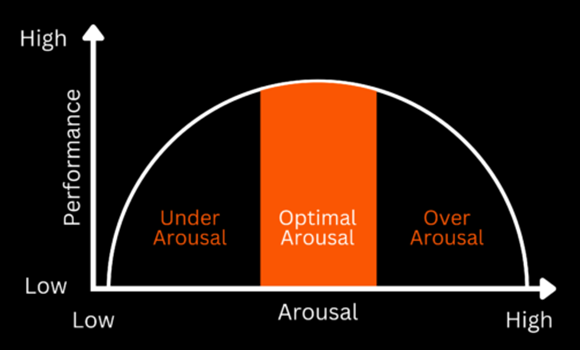
There is an optimal level of arousal for optimal performance (optimal performance zone).
If the arousal is too high or low, then
athletes’ performance is negatively affected.
The middle of the arch in the orange box indicates the optimal arousal level.
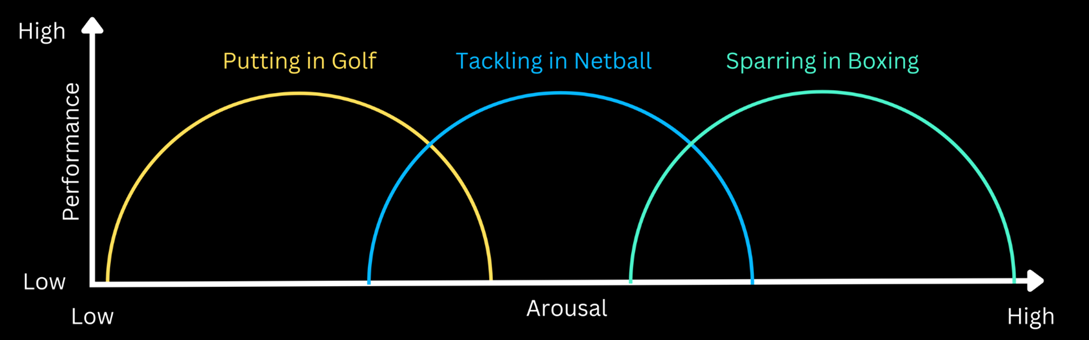
explain the graph
some sports require higher levels of arousal based off their intensity and requirements.
the yellow will have a lower optimal arousal level which is why it is only used for sports such as putting in golf, darts, chess, archery.
As we move higher up the scale to the blue arch, it has a higher optimal arousal level which is why It is used for things such as kicking in footy, tackling footy.
As we move even higher up the scale optimal arousal level also increases better suiting sports such as sparring in boxing, weightlifting or rugby.
under arousal characteristics (7)
Lack of motivation
Lack of energy
Lack of enthusiasm
Lack of effort
Boredom
Lack of focus / attention on irrelevant cues
Slow thinking, decision making & reactions