bio 112 lecture 20: the nervous system
 Call Kai
 Learn
Learn Practice Test
 Spaced Repetition
 Match
Match Flashcards
 Knowt Play
1/33

There's no tags or description
Looks like no tags are added yet.
Name | Mastery | Learn | Test | Matching | Spaced | Call with Kai | Chat |
|---|
No analytics yet
Send a link to your students to track their progress
34 Terms
what is a nervous system?
network of interconnected nerve cells; they allow an animal to sense the environment around it
nervous system evolution
sponges have no nervous system
cnidarians have a simple nervous system
bilaterians have complex nervous systems
neurons
nerve cells; share certain features regardless of function
neuron anatomy
dendrites
axon
axon hillock
axon terminals
myelin sheath
nodes of Ranvier
synaptic cleft
dendrites
tree-like structures that extend away from the cell body to receive messages from other neurons
axon
extends as a narror conduit from the soma to a branching terminal
axon hillock
located at the transition point from the cell body to the axon; where signals multiple dendrites are compiled
axon terminals
produce neurotransmitters to signal the dendrites of the adjacent cells to which they connect
myelin sheath
lipid rich layers that wrap around the neuron axon; provide insulation for the electrically conducted signal
nodes of Ranvier
regular gaps in the myelin sheath where the axon is exposed; allows for the exchange of ions, namely Na+ and K+ to actively be exchanged when signals fire
*Na+ and K+ voltage-gated ions channels are concentrated here
synaptic cleft
gap between connected neurons
glial cells
support neurons by providing a variety of functions including nutrition and support (*more glial cells in the NS than neurons)
types of neurons
sensory
interneurons
motor
sensory neurons
activated by sensory input from the environment
interneurons
short; convey signals between neurons or process information from sensory neurons
motor neurons
long; originate in the brain or spinal cord that may trigger muscle movement or effect change in internal body systems
nerve signal transmission
nerve cell membrane segregates ions by charge:
negative charge inside
positive charge outside
neuron membrane states
polarized
membrane potential
resting membrane potential
polarized
difference in relative charge across the membrane
membrane potential
due to difference in number of charged ions across the membrane (more Na+ outside the cell, more K+ inside the cell)
resting membrane potential
negative at rest (voltage depends on nerve cell type)
action potential
electrical nerve impulse that travels down the axon (axon all-or-nothing firing response)
threshold potential
minimal stimulation needed to trigger the firing of an action potential above the resting
depolarization
once a threshold potential is achieved, the axon depolarizes; begins at the end of the axon closest to the dendrites, and then continues towards the axon terminal
*the voltage across the membrane rapidly changes; Na+ rushes into the cell and K+ rushes out
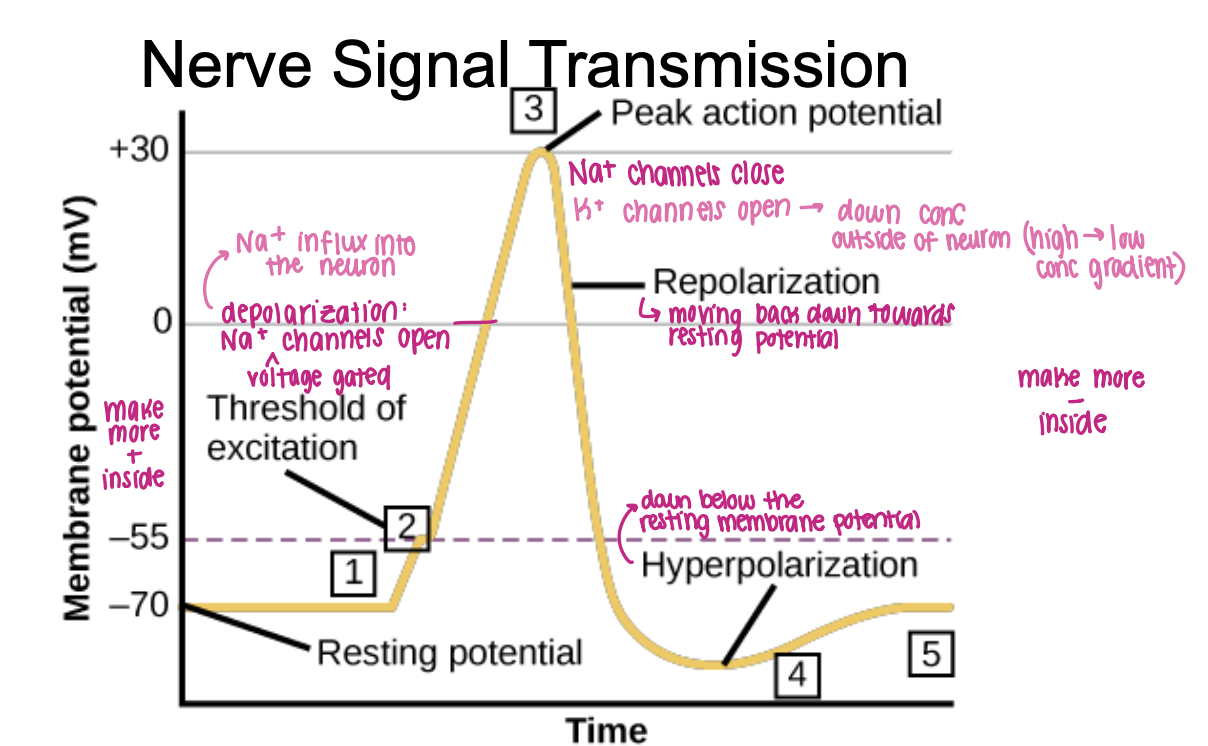
voltage-gated channels
will only open when right amount of voltage is reached
the Na+ and K+ channels are voltage-gated, the action potential travels down the length of the axon
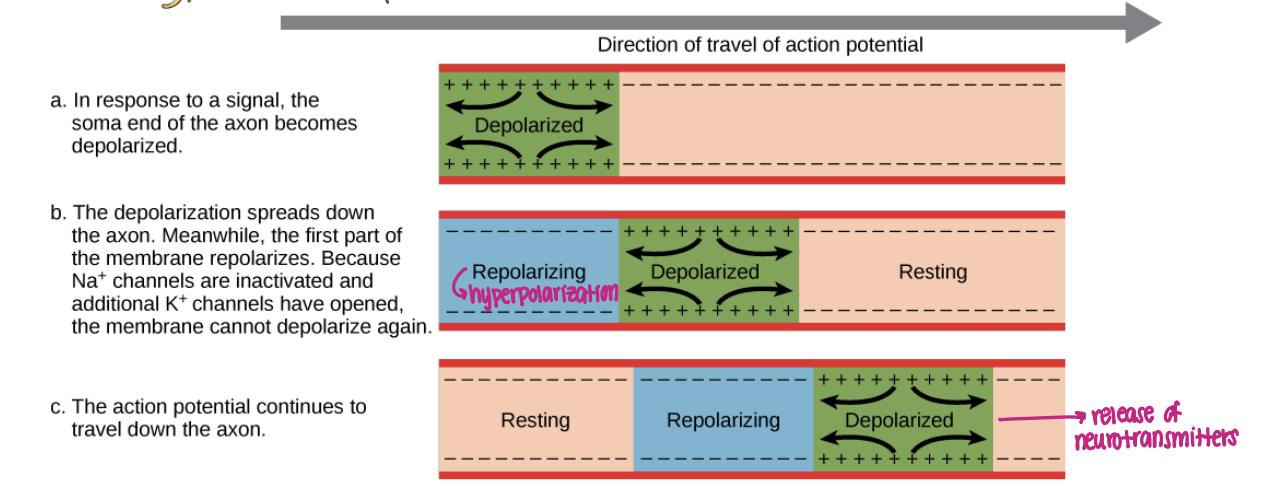
positive-feedback loop
created by voltage-gated channels; depolarization at one point in the plasma membrane ultimately causes depolarization across the whole of the membrane of the axon
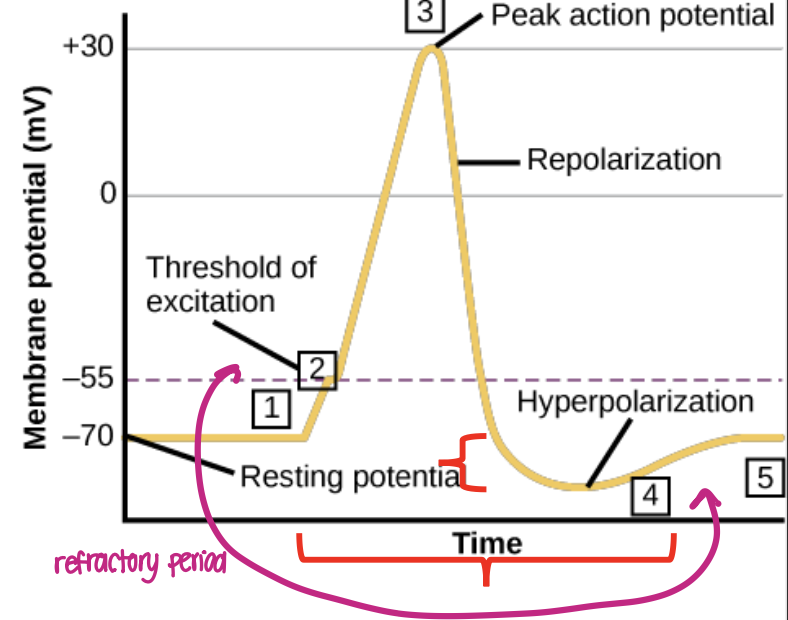
refractory period
slowly closing potassium channels result in hyperpolarization; until the membrane returns to its resting potential, the neuron cannot fire again
saltatory propagation
myelin sheaths and the nodes of Ranvier cause nerve impulses (action potential) to jump from node to node
synaptic signal transmission
voltage-gated Ca2+ channels at the axon terminals are triggered by the action potential; Ca2+ flooding into the axon terminal triggers release of neurotransmitters
*these neurotransmitters connect to ligand-gated ion channels in the receptor cell
**these are excitatory postsynaptic potentials (EPSP)
inhibitory postsynaptic potentials (IPSP)
cause Cl- ions to enter a neuron or by causing K+ ions to exit it; this makes the voltage more negative and therefore harder to fire (neuron membrane becomes hyperpolarized)
nervous system organization
central nervous system
brain, spinal cord
peripheral nervous system
nerves connecting to sensory organs and muscles
peripheral nervous system
somatic (voluntary): under conscious control, sensing and responding to external stimuli
autonomic (involuntary): NOT under conscious control, regulate internal bodily functions
autonomic nervous system
sympathetic: decreases response time and increase action; flight, flight or freeze response
parasympathetic: tends to decrease activity and stimulates digestion; triggers rest and digest behaviors (calms body after stimuli)
reflex responses
coded for in our spines; signals don’t have enough time to go to brain to respond to stimuli