L14 - Cells Junctions & Cytoskeleton
 Call Kai
 Learn
Learn Practice Test
 Spaced Repetition
 Match
Match Flashcards
 Knowt Play
1/43

There's no tags or description
Looks like no tags are added yet.
Name | Mastery | Learn | Test | Matching | Spaced | Call with Kai | Chat |
|---|
No analytics yet
Send a link to your students to track their progress
44 Terms
What is the Cytoskeleton?
A 3-dimensional network of protein filaments throughout the cell that provides structure and supports movement, intracellular transport, changes in cell shape, adhesion, and epithelial organization
What are Major Functions of the Cytoskeleton?
Cell movement
Changes in cell shape
Intracellular transport
Cell division/cytokinesis
Phagocytosis
Cellular support and strength
Cell-cell and cell-ECM adhesion
Maintenance of specialized epithelial structures
What are the 3 Major Families of Cytoskeletal Filaments?
Actin filaments (microfilaments) → dynamic
Intermediate filaments → stable/non-dynamic
Microtubules → dynamic

What are the Major Characteristics of Actin Filaments?
Smallest cytoskeletal filaments: ~5–9 nm
Made of actin monomers
Dynamic + flexible
Form bundles or networks
Concentrated near the cell periphery/apical surface

What is the major relationship between actin and cellular movement/contractility?
Actin forms an extensive network in contractile cells and is a key component of all types of muscle
How does actin contribute to epithelial structure?
Actin forms the structural basis of microvilli, which make up the brush border on the apical surface of certain epithelial cells

Where are brush borders idenitfy?
Apical surface of:
Intestinal columnar epithelium
Proximal convoluted tubule cuboidal epithelial cells
What are the Major Characteristics of Microtubules?
Largest cytoskeletal filaments: ~25 nm
Long, hollow cylinders
Made of α- and β-tubulin heterodimers
Dynamic
More rigid than actin
One end is associated with the centrosome
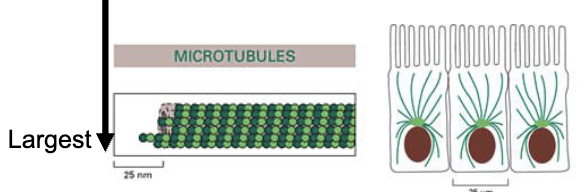
What are the Major Functions of Microtubules?
Maintain cell structure/shape
Necessary for cell division
Provide tracks for intracellular cargo/vesicle transport
Form the structural basis of cilia
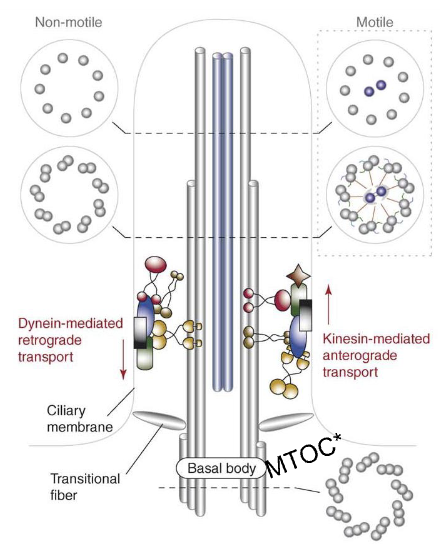
What motor proteins transport cargo along microtubules?
Kinesin + dynein
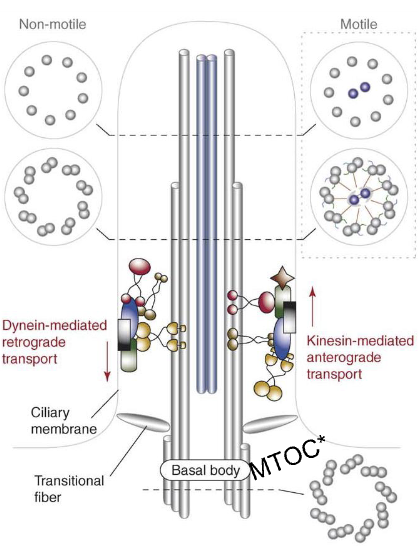
Where do Microtubules Originate?
From a microtubule-organizing center (MTOC), the centrosome
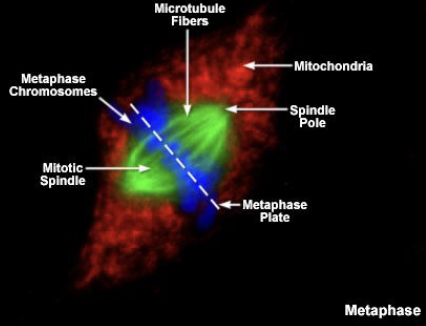
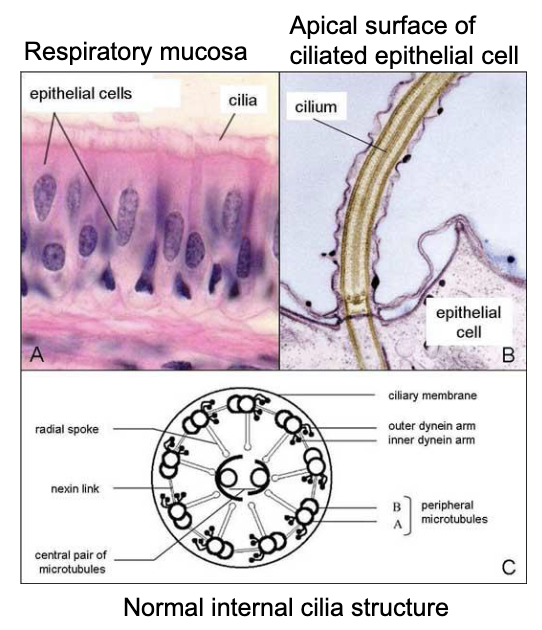
What is the Microtubule arrangement of motile cilia?
9 + 2 arrangement
Dynein arms allow movement
Dynein functions as an ATPase molecular motor
Cilia are attached to a basal body
How do Primary/Non-motile Cilia differ from Motile Cilia?
Primary cilia lack the central microtubules
Dynein arms found in motile cilia
How can abnormal microtubules affect health?
Defects can interfere with structures/functions that depend on microtubules, including cilia and neurons
EX: ciliary dyskinesia and neurological/developmental disorders
What happens in congenital ciliary dyskinesia?
Abnormal microtubules and/or loss of dynein arms cause defective motile cilia
Can lead to abnormal respiratory mucosa, recurrent respiratory infections, digestive issues, and infertility
What are the Major Characteristics of Intermediate Filaments?
~10 nm diameter
Rope-like fibers
Very stable/non-dynamic
Provide mechanical strength
Can span the cytoplasm from one junction to another, transmitting mechanical stresses through tissue layers

What is the Major Function of Intermediate Filaments in epithelial tissues?
Provide mechanical strength and help tissues withstand and distribute mechanical stress.

What are Examples of Intermediate Filaments?
Neurofilaments → neurons
Vimentin → mesenchymal cells
Keratin → nails, hooves
What are the 5 Major Cell Junctions to know?
Tight junctions
Adherens junctions
Desmosomes
Gap junctions
Hemidesmosomes
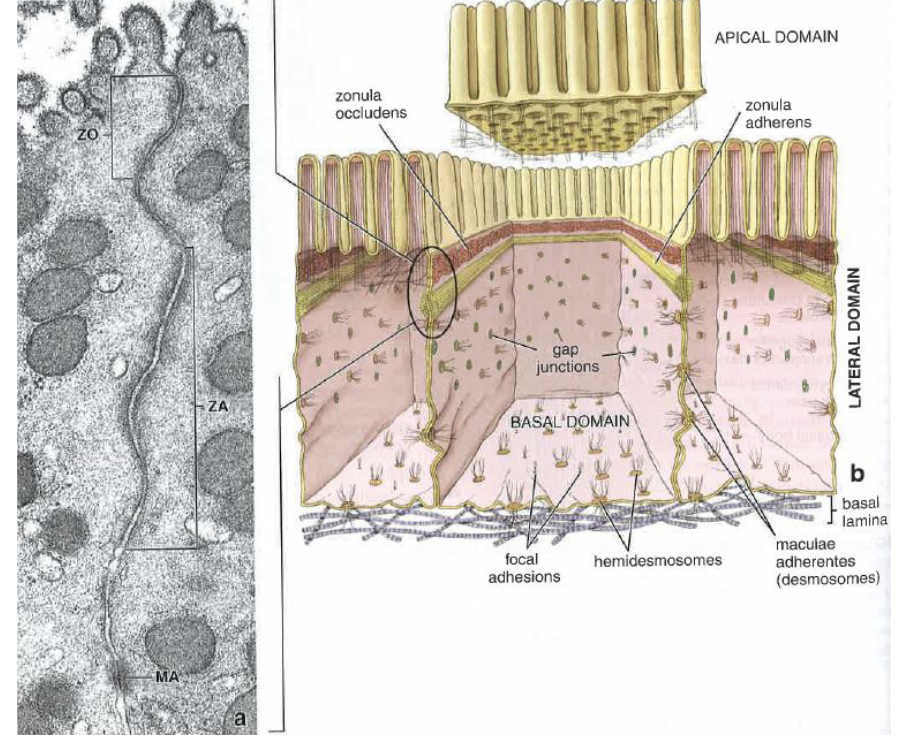
Where are the Major Junctions located on a polarized epithelial cell?
Apical: Tight junction
Lateral: Adherens junctions, desmosomes, gap junctions
Basal: Hemidesmosomes
Which cell junctions connect to which cytoskeletal components?
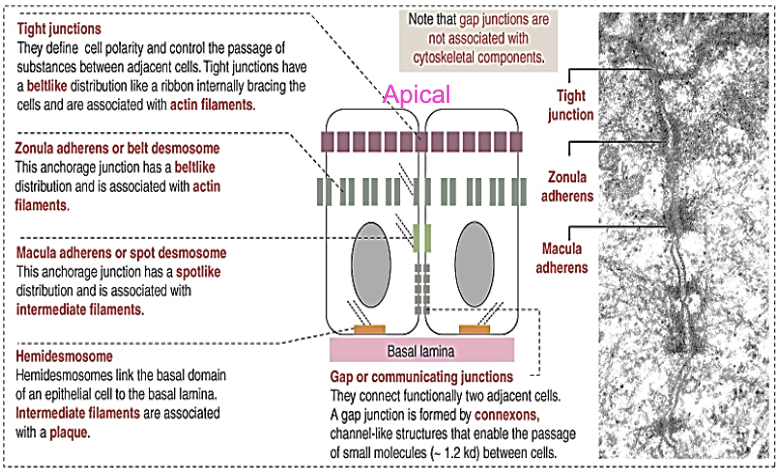
Tight junction → Actin
Adherens junction → Actin
Desmosome → Intermediate filaments
Hemidesmosome → Intermediate filaments
Gap junction → NONE
What is the Major Function of Tight Junctions?
Seal the space between epithelial cells and regulate the movement of water, ions, and solutes through the paracellular pathway

Where are Tight Junctions located?
At the apical/luminal end of the lateral cell membrane, forming circumferential belts around epithelial cells
What are the Major Protein components of Tight Junctions?
Claudins
Occludins
Tricellulin
Which cytoskeletal filament is associated with tight junctions?
Actin microfilaments
What is the Major Function of Adherens Junctions?
Provide cell-cell adhesion and help maintain the sheet-like organization of epithelial cells through the actin cytoskeleton

How are adherens junctions connected to the cytoskeleton?
→ Cadherins → catenins → actin
What analogy does the lecture use for adherens junctions?
Think “zipper/Velcro”
Adjacent cells expressing the same type of transmembrane cadherin adhere to one another
What is the Major Function of Desmosomes?
Form very strong cell-cell adhesions that are crucial for the structural integrity of tissues

Which cytoskeletal component attaches to desmosomes?
Intermediate filaments, especially keratin filaments
What Proteins are important in Desmosomes?
Desmogleins (cadherins) interact with plakoglobin to control cell-cell adhesion and connect adjacent cells to intermediate filaments
What is the Major Function of Gap Junctions?
Cell-cell communication by allowing ions and small molecules to pass between cell

What Proteins form Gap Junction channels?
Connexins
Are gap junctions connected to the cytoskeleton?
No → This makes them the major exception among the junctions
How can connexin abnormalities affect health?
Connexin deficits can cause progressive peripheral neuropathy and/or deafness
Where are Hemidesmosomes located?
At the basal surface of epithelial cells
What is the Major Function of Hemidesmosomes?
Attach epithelial cells to the basal lamina/ECM, helping anchor the epithelial sheet to the underlying matrix

How do hemidesmosomes connect the ECM to the cytoskeleton?
Specialized integrins bind ECM proteins of the basal lamina extracellularly and connect to intermediate filaments intracellularly
Why can defects in cell junctions cause disease?
Junctions connect cells to each other, their cytoskeleton, or the ECM
If junction proteins are abnormal, epithelial sheets may lose their normal adhesion, organization, or structural integrity
How does pemphigus foliaceus demonstrate the importance of desmosomes?
Animals produce antibodies against desmoglein 1, a desmosomal protein
Desmosomal adhesion is disrupted
Epithelial tissues fail to maintain normal structure

What is the overall lesson from diseases involving cytoskeletal/junction proteins?
Structure determines tissue integrity. Altering a cytoskeletal protein or its connection to a junction can disrupt cell adhesion, movement, communication, mechanical strength, or epithelial maintenance
Cytoskeleton Comparison SUMMARY
Feature | Actin Filaments | Intermediate Filaments | Microtubules |
Size | Smallest: 5–9 nm | 10 nm | Largest: 25 nm |
Made of | Actin monomers | Various IF proteins | α + β tubulin |
Dynamic | Yes | No — very stable | Yes |
Structure | Thin, flexible | Rope-like | Long, hollow cylinders |
Location/orientation | Cell periphery + apical side | Span cytoplasm/junctions | Extend from centrosome/MTOC |
Main function | Movement, contraction, cell shape | Mechanical strength | Structure + intracellular transport |
Special structure | Microvilli/brush border | Structural backbone | Cilia |
Junction association | Tight + adherens | Desmosomes + hemidesmosomes |
Cell Junctions SUMMARY
Junction | Location | Main Protein(s) | Cytoskeleton | Main Function |
Tight (zonula occludens) | Apical | Claudins, occludins, tricellulin | Actin | Controls paracellular diffusion |
Adherens (zonula adherens) | Lateral | Cadherins + catenins | Actin | Strong cell-cell adhesion |
Desmosome (macula adherens) | Lateral | Cadherins | Intermediate filaments | Strong cell-cell adhesion |
Gap | Lateral | Connexins | None | Ions/small molecules → communication |
Hemidesmosome | Basal | Integrins + laminins | Intermediate filaments | Anchors cell to basement membrane |
Cytoskeleton → Structure → Function SUMMARY. Contractility/movement and maintenance of epitheliu.
Cytoskeleton | Important Structure/Process | Why It Matters |
Actin | Muscle | ⭐ Contractility |
Actin | Microvilli/brush border | Maintains specialized apical structure |
Actin | Tight + adherens junctions | Maintains epithelial organization |
Microtubules | Intracellular tracks | Vesicle/cargo transport |
Microtubules | Cilia | ⭐ Ciliary movement |
Microtubules | Cell division | Mitotic function |
Intermediate filaments | Desmosomes | ⭐ Mechanical strength between cells |
Intermediate filaments | Hemidesmosomes | ⭐ Anchors epithelium to basal lamina |