Bone Marrow and Leukemia
 Call Kai
 Learn
Learn Practice Test
 Spaced Repetition
 Match
Match Flashcards
 Knowt Play
1/87

There's no tags or description
Looks like no tags are added yet.
Name | Mastery | Learn | Test | Matching | Spaced | Call with Kai | Chat |
|---|
No analytics yet
Send a link to your students to track their progress
88 Terms
What does "myel-" or "myelo-" refer to?
Marrow, spinal cord, or non-lymphoid hemic cells
What does "myeloid" refer to?
Myeloid leukemia --> non-lymphoid leukemia
Myeloid:Erythroid ratio --> non-lymphoid precursors to lymphoid precursors
What is a "myelocyte"?
Neutrophilic myelocyte, eosinophilic myelocyte, etc.
What is myelitis?
Inflammation of the marrow or spinal cord
What does myelogenous refer to?
Marrow or non-lymphoid
Why is proper collection and sample handling of marrow so important?
Marrow degrades rapidly post mortem or after collection
When should marrow samples be collected and analyzed?
It should be collected within 30 minutes following a patient's death, and smears should be made immediately after collection whether for a live or dead patient
When would you want to perform a bone marrow examination in the presence of decreased cells?
To pursue the possible causes of unexplained non-regenerative anemia (persistent), neutropenia, thrombocytopenia, or pancytopenia
When would you want to perform a bone marrow examination in the presence of increased cells?
To pursue the possible causes of unexplained lymphocytosis, thrombocytosis (extreme), erythrocytosis, or mastocytemia
When would you want to perform a bone marrow examination to look for neoplastic cells?
To pursue the possible causes of unexplained atypical or immature cells in blood films, hyperproteinemia, or hypercalcemia
What can you use bone marrow examinations to search for?
Metastatic neoplasia (lymphocytes, mast cells), iron storage (especially when considering iron deficiency), and specific diseases such as Histoplasma or Leishmania
What are the 2 ways a bone marrow sample can be obtained?
Core biopsy or aspirate
What does a core biopsy yield?
A narrow, cylindrically shaped solid piece of bone marrow which maintains its structural integrity
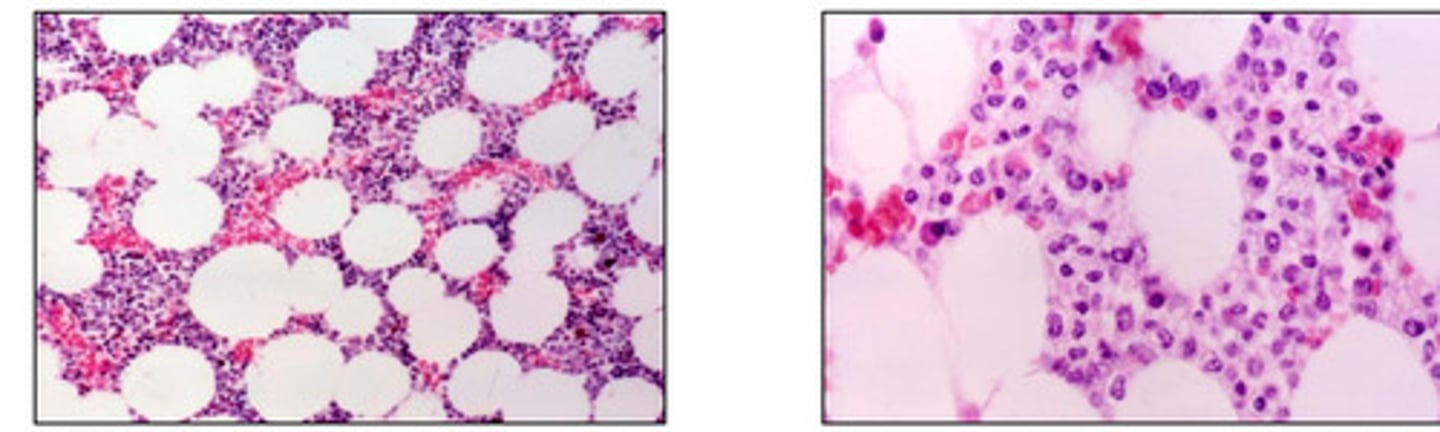
What does a marrow aspirate yield?
Semi-liquid bone marrow
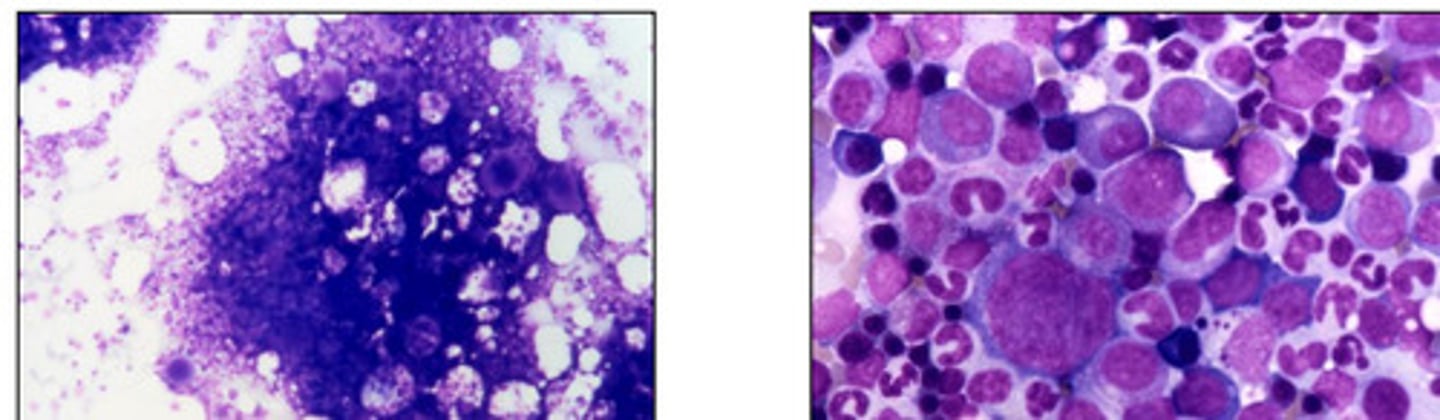
What is the turn around time for a core biopsy?
Minimum of 2 days, but usually 3 or 4 days
What is the turn around time for a marrow aspirate?
As little as 1 hour
What are the advantages of core biopsy samples?
Evaluation of marrow architecture and explains the reason for "dry tap" when no cells are obtained on aspiration
What are the drawbacks of core biopsy samples?
Slow processing and more difficult to assess cell morphology
What are the advantages of marrow aspirate samples?
Rapid turnover time, better assessment of cell morphology, provides material for other tests, and provides relevant quantity of cell types present
What are the drawbacks of marrow aspirates?
May not represent all cells
Where in the bone do you want to collect a marrow sample?
Just below the cortical bone, because if you go too far into the cavity you'll get a lot of blood
What needle do you use for bone marrow aspirates?
Illinois sternal needle
What needle is used for bone marrow cores?
Jamshidi marrow needle
What are the primary sites of aspiration?
Wing of the ilium, proximal humerus, and proximal femur for dogs and cats, sternebrae for large animals, and proximal ribs for cattle
How can you remove blood from your sample on a slide prior to making a squash preparation?
Tilting the slide and sucking it up
How can you remove blood from your sample on a petri dish prior to making a squash preparation?
Tilt the Petri dish and use a glass pipette to transfer the marrow tissue to a slide
What are the smears stained with for routine evaluation?
A Romanowsky-tryp stain
What are the major steps of a bone marrow examination?
1. Know the question that is being asked
2. Know the current CBC data
3. Cellularity of marrow sample
4. Cellularity of marrow fragments (spicules, particles)
5. Assess number of megakaryocytes
6. Identify iron pigment
7. Determine granulocyte to erythroid ratio
8. Assess maturation of cell lines
9. Determine lymphocyte percentage
10. Other findings
Why do you want to collect a blood sample for a CBC the same day as you collect the marrow aspirate?
The bone marrow is interpreted in conjunction with the CBC findings; we need to know what's going on NOW
Why are low cellularity marrow samples considered poor quality?
It is very difficult to form defensible conclusions from
hypocellular samples
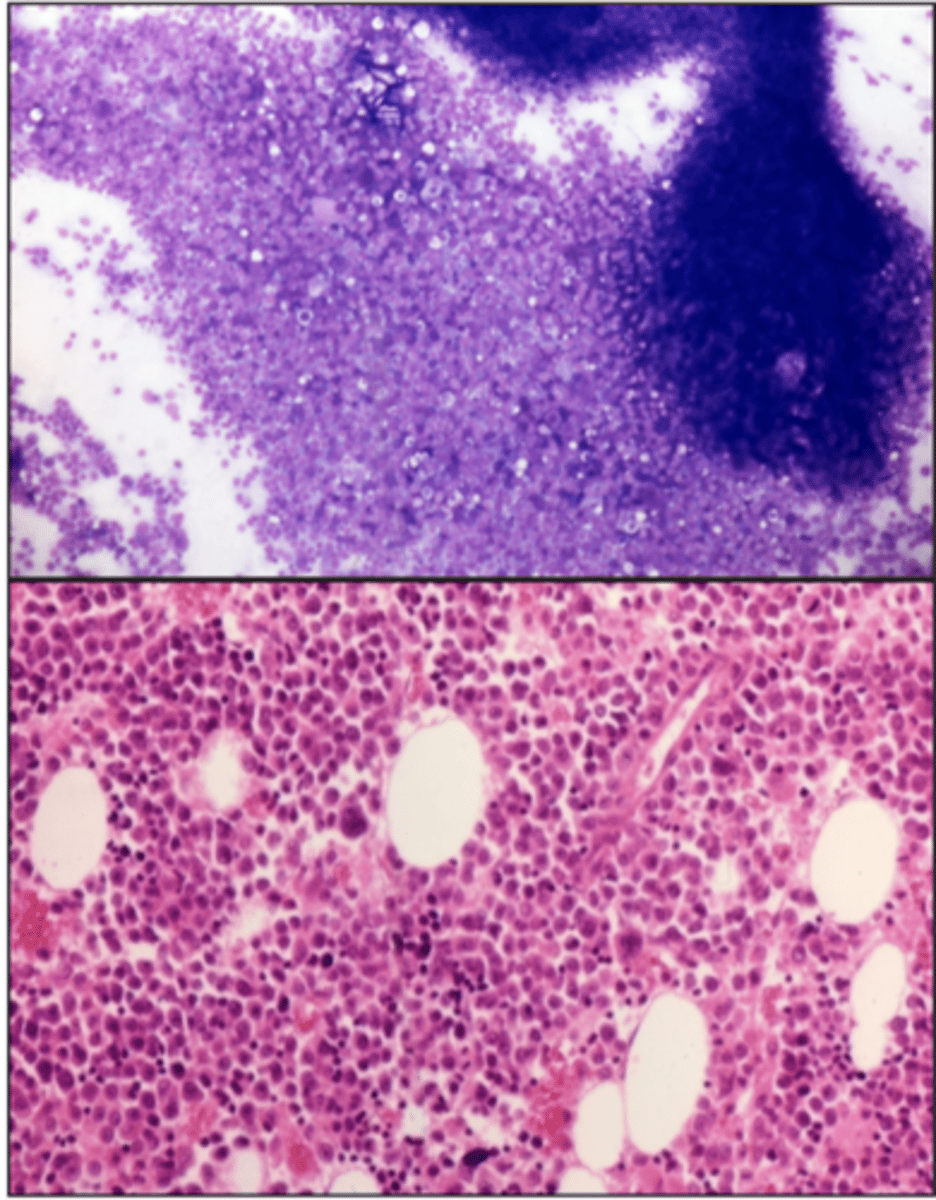
What classifies the bone marrow as hypercellular?
If bone marrow particles, on average, are < 25 % adipose tissue
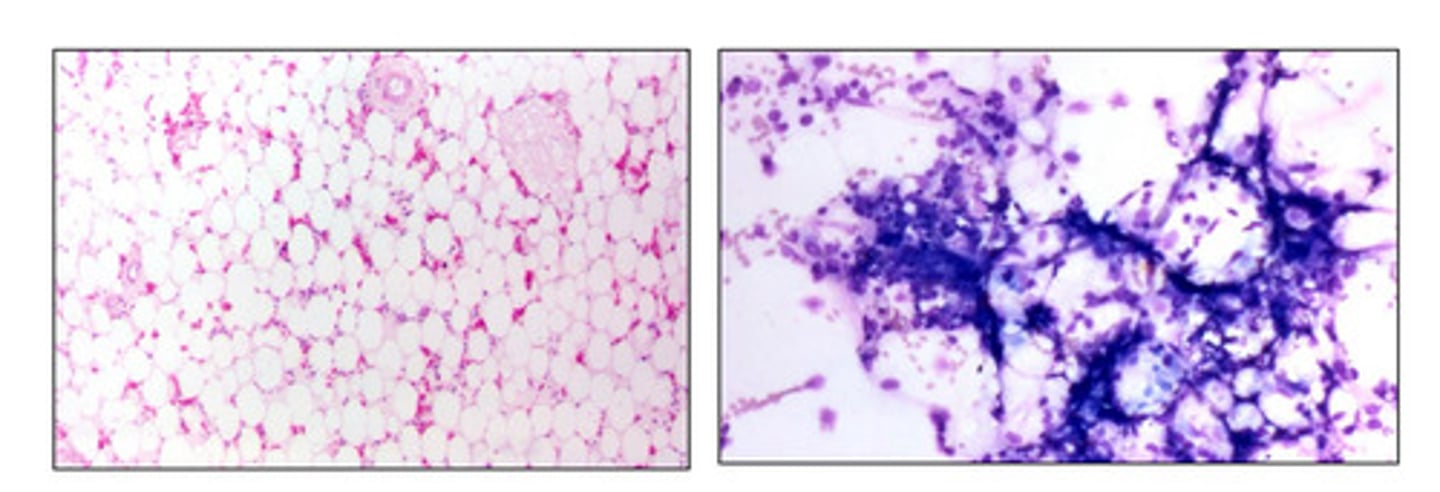
What classifies the bone marrow as hypocellular?
If bone marrow particles, on average, are > 75 % adipose tissue
What does bone marrow particles not being present present and
the preparation is not very cellular indicate about the sample?
The bone marrow may be hypocellular or the sample may
be poorly representative of bone marrow tissue
Which kind of sample is more representative of the hematopoietic tissue of your patient and gives you the most confidence?
Hypercellular samples
What classifies a normocellular sample?
Close to a 1:1 ratio of hemic to fat cells
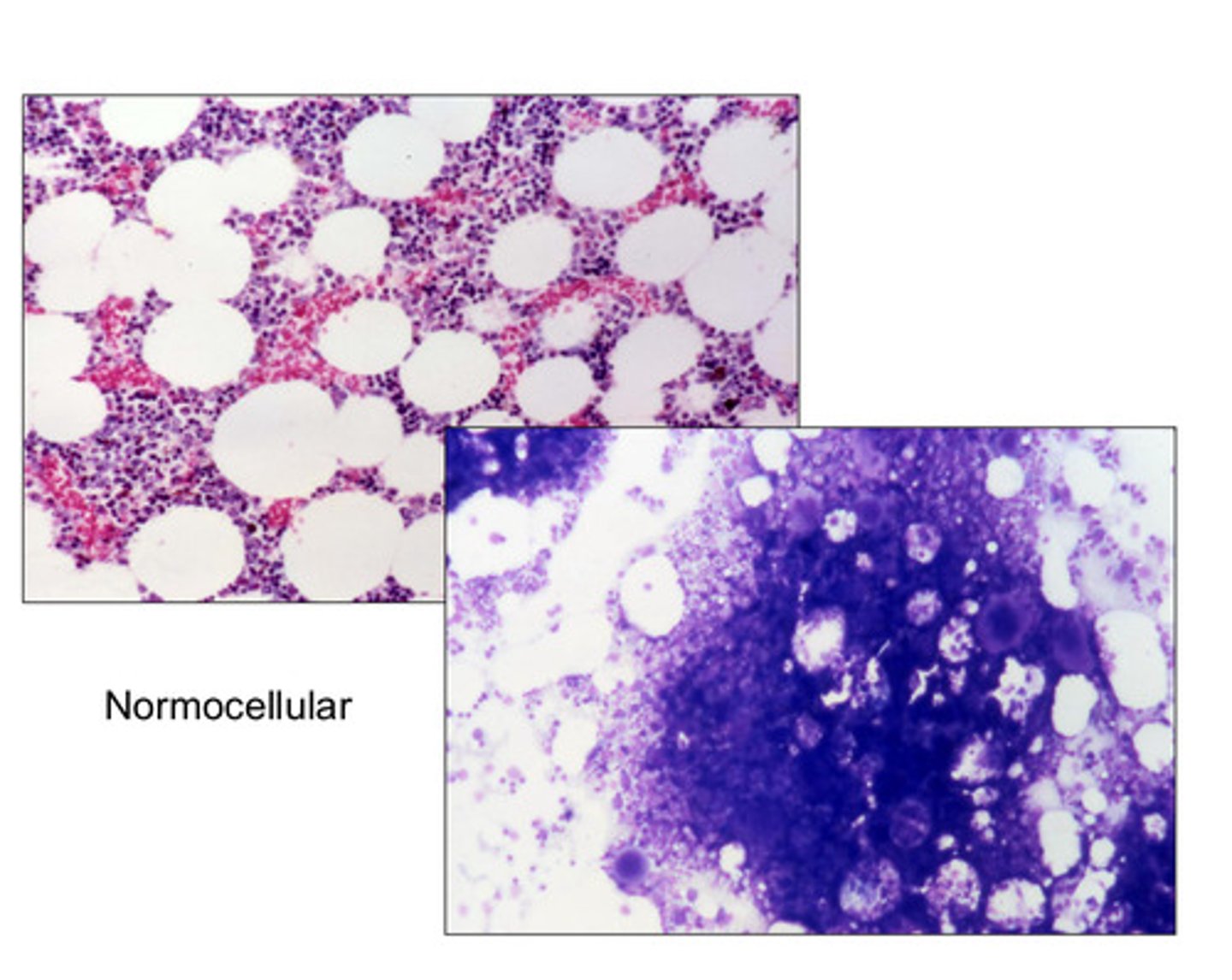
What % of hemic cells should you expect in a sample compared to fat cells?
25% to 75% (1:3 or 3:1 ratio)
What does a low % of hemic cells indicate?
A hypocellular marrow fragment, and a higher % of fat
What does a high % of hemic cells indicate?
A hypercellular marrow fragment, and a lower % of fat
What would you see in peripheral blood if a patient was rebuilding and repopulating its cells following a depletion?
Immature cells
What would a hypocellular sample look like if there was a rapid depletion of hematopoietic cells?
There would be a lack of stroma (structure)
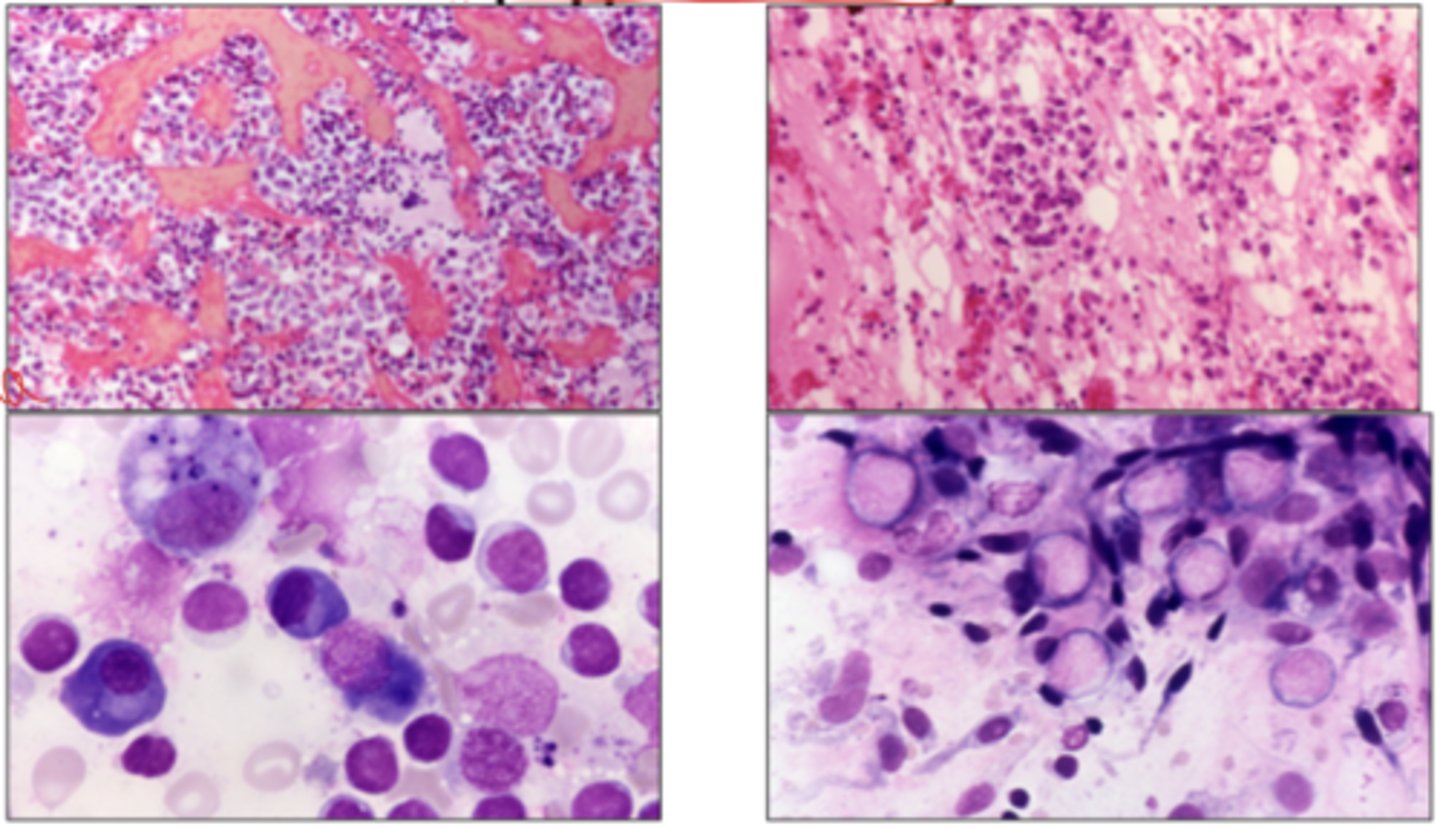
How many megakaryocytes do you expect in a normal animal with platelets WRI?
~4-5 per particle
How many megakaryocytes would you expect to find if the patient has decreased platelets (thrombocytopenia)?
You would expect to see an increase in megakaryocytes --> megakaryocytic hyperplasia
In which species would you expect to find no iron pigment?
Cats
When you're assessing the amount of iron pigment, where is the iron being stored?
Inside macrophages
When is assessing iron storage helpful?
If you're looking for iron deficiency or in disease processes like anemia of inflammation or chronic disease
What should iron stores look like during iron deficiency or disease processes?
There should be an increase in iron stores in the marrow because of the inability to access the iron
What is the minimum cell count for the M:E ratio, and what cells are included in the count?
500 minimum cell count, including myeloid, erythroid, and lymphoid cells
What is an example of when you would see an increase in the M:E ratio?
If there is a granulocytic hyperplasia present
Which granulocytic cells are included in the proliferation pool?
Myeloblast, promyelocyte, myelocyte
Which granulocytic cells are included in the maturation pool?
Metamyelocytes, bands, and segmented cells
What % of cells should the myeloid proliferation pool be in health?
~ 20% of cells
What % of cells should the myeloid maturation pool be in health?
~ 80% of cells
When should the myeloid proliferation pool increase?
If the marrow is properly responding
Which erythroid cells are included in the early erythroid pool?
Rubriblast, prorubricyte, basophilic rubricyte
Which erythroid cells are included in the late erythroid pool?
Polychromatophilic rubricytes and metarubricyte
What % of cells should the erythroid early pool be in health?
~ 10-15%
What % of cells should the erythroid late pool be in health?
~ 85-90%
As an erythroid cell matures, how does it change?
The nuclei becomes smaller and chromatin denser, the size of the cell decreases, the cytoplasmic basophilia decreases, and the eosinophilic staining of hemoglobin increases
When would you see an increase in the early erythroid pool?
If the animal is anemic or slow to respond
What is synchronicity in terms of the erythroid maturation sequence?
1. Progressive decrease in cell and nuclear size
2. Nucleus becomes pyknotic and is extruded
3. Cytoplasm changes color from blue to gray to orange
What causes maturation arrests of the red cell line?
Immune-mediated attack of a specific stage of the red cell precursor
What is caused by an attack on the bone marrow stem cells?
Aplastic anemia
What is the result of an attack on any of the later red cell precursors (rubriblast to reticulocyte)?
Immune-mediated ineffective erythropoiesis
What is the result of the mature red cell being targeted?
Immune-mediated hemolytic anemia
What is the typical % of lymphocytes and plasma cells in the bone marrow in health?
<5% small mature lymphocytes and <2% plasma cells
What is the result of an attack on the blast or colony forming units of the erythroid cell line?
Pure red cell aplasia
What is the result of neoplastic hemic cells?
Leukemia
What is the result of neoplastic non-hemic cells?
Metastatic cells
What are proplastic cells? What is seen with them?
Stimulated cells with increased activity. Usually seen with reactive lymphocytes, shift toward immaturity in neutrophils or a toxic change, and regenerative response in the erythroid line
What is leukemia?
The presence of neoplastic hemic cells in either blood or bone marrow due to a neoplastic proliferation originating in the bone marrow or, sometimes, the red pulp of the spleen
What is acute leukemia?
A relatively more rapid proliferation of less differentiated
hemic cells; it typically consists of many large immature cells or sometimes blast cells, and the duration of the illness is short
What is a blast cell?
An immature cell with replicative potential; they typically have smooth or finely stippled chromatin and lack features of well-differentiated cells
What cells can be described as blast cells?
myeloblasts, monoblasts, rubriblasts, megakaryoblasts, some lymphoblasts
What is chronic leukemia?
a slower proliferation or accumulation (decreased
apoptosis) of relatively well-differentiated hemic cells that are similar in appearance to the mature cell (e.g., neutrophils or lymphocytes); an animal may live for months after diagnosis,
even without treatment
What is a myeloproliferative disease?
Any proliferative neoplastic disorder of non-lymphoid hemic cells, including neutrophils, eosinophils, basophils, monocytes, erythrocytes, megakaryocytes, and perhaps mast cells
What is a lymphoproliferative disease?
A proliferation of lymphocytes, usually implying a neoplastic proliferation
What is lymphoid neoplasia?
Neoplasia of undifferentiated or differentiated lymphoid cells including plasma cells
What is the difference between lymphoma and leukemia?
Lymphoma is of solid tissue origin and leukemia is of bone marrow or splenic origin
What would an aplastic anemia look like?
It would look acellular
What would a pure red cell aplasia look like?
It would have normal granulocytic cells and megakaryocytes, but would lack RBCs in the marrow
What does Precursor-targeted immune mediated anemia (PIMA) look like?
Highly cellular, "maturation arrest"
What is a defining characteristic you should see with immune-mediated hemolytic anemia?
You should see regeneration
What will you see if a metarubricyte is attacked in Precursor-Targeted Immune-Mediated?
We will see a lot of cells in the marrow because it's trying to make RBCs in the presence of anemia
What form of anemia results from an earlier cell within the erythroid line that is being attacked?
Non-regenerative form of anemia
What is the primary value of microscopic evaluation of Wright-stained blood films or bone marrow preparation?
To detect the presence of neoplastic hemic cells
What are cytochemical stained blood films or bone marrow preparations helpful for?
Differentiating the lineage(s) of leukemic cells
What is immunophenotyping and what is it used for?
It involves the use of antibodies to detect cellular epitopes that help to classify cell types; it is typically used to characterize neoplasia, not to confirm it
What methods are used for immunophenotyping?
Flow cytometry, cytochemistry, or histochemistry