Ecology Unit 1
 Call Kai
 Learn
Learn Practice Test
 Spaced Repetition
 Match
Match Flashcards
 Knowt Play
1/17

There's no tags or description
Looks like no tags are added yet.
Name | Mastery | Learn | Test | Matching | Spaced | Call with Kai | Chat |
|---|
No analytics yet
Send a link to your students to track their progress
18 Terms
energy budget
earth’s ratio of incoming to outgoing energy
greenhouse gases
chemicals that absorb and re-emit infared radiation
latitude
distance from the equator (north or south)
intertropical convergence zone (ITCZ)
region that gets high amounts of sunlight and rain, varies depending on time of year
rain shadow
effect created when a mountain range causes one side to receive more rain than another, leading to completely contrasting ecosystems
equinox
happens in march and september, when the equator gets the most direct sunlight
june solstice
northern hemisphere gets the most direct sunlight, marks the start of summer
southern hemisphere gets the least sunlight, marks the start of winter
december solstice
southern hemisphere gets the most sunlight, marks the start of summer
northern hemisphere gets the least sunlight, marks the start of winter
precipitation
This occurs when warm air cools, releasing water
warm, moist air rises at ITCZ
1st step of hadley cells
rising air cools, causing rain
2nd step of hadley cells
cool, dry air falls back down to earth
3rd step of hadley cells
falling air warms and flows back to the equator
4th step of hadley cells
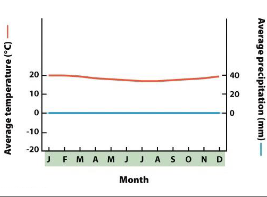
biome
a community defined by climate and a set of plants and animals
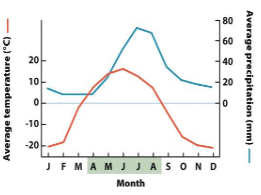
tundra
limited rain and sun, permafrost leads to nutrient-poor soil
rainforest
gets plenty of rain with a consistent warm temperature, nutrient-rich soil leads to high species diversity

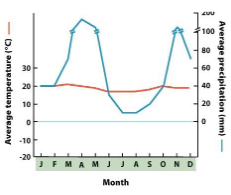
savanna
grassy, sparse trees with many wet/dry seasons
desert
very dry and consistent temperature, plants adapted to harsh environment