BioChem Lecture 4
 Call Kai
 Learn
Learn Practice Test
 Spaced Repetition
 Match
Match Flashcards
 Knowt Play
1/67

There's no tags or description
Looks like no tags are added yet.
Name | Mastery | Learn | Test | Matching | Spaced | Call with Kai | Chat |
|---|
No analytics yet
Send a link to your students to track their progress
68 Terms
Cholesterol
27 Carbon lipid; HYDROPHOBIC
T/F can cholesterol diffuse into cell membrane
T
T/F Cholesterol is not required for animal life
F
Cholesterol can be synthesized by
all nucleated cells (primarily hepatocytes) and obtained through dietary intake
Cholesterol functions
include maintaining membrane fluidity and serving as a precursor for steroid hormones.
Cholesterol Structure
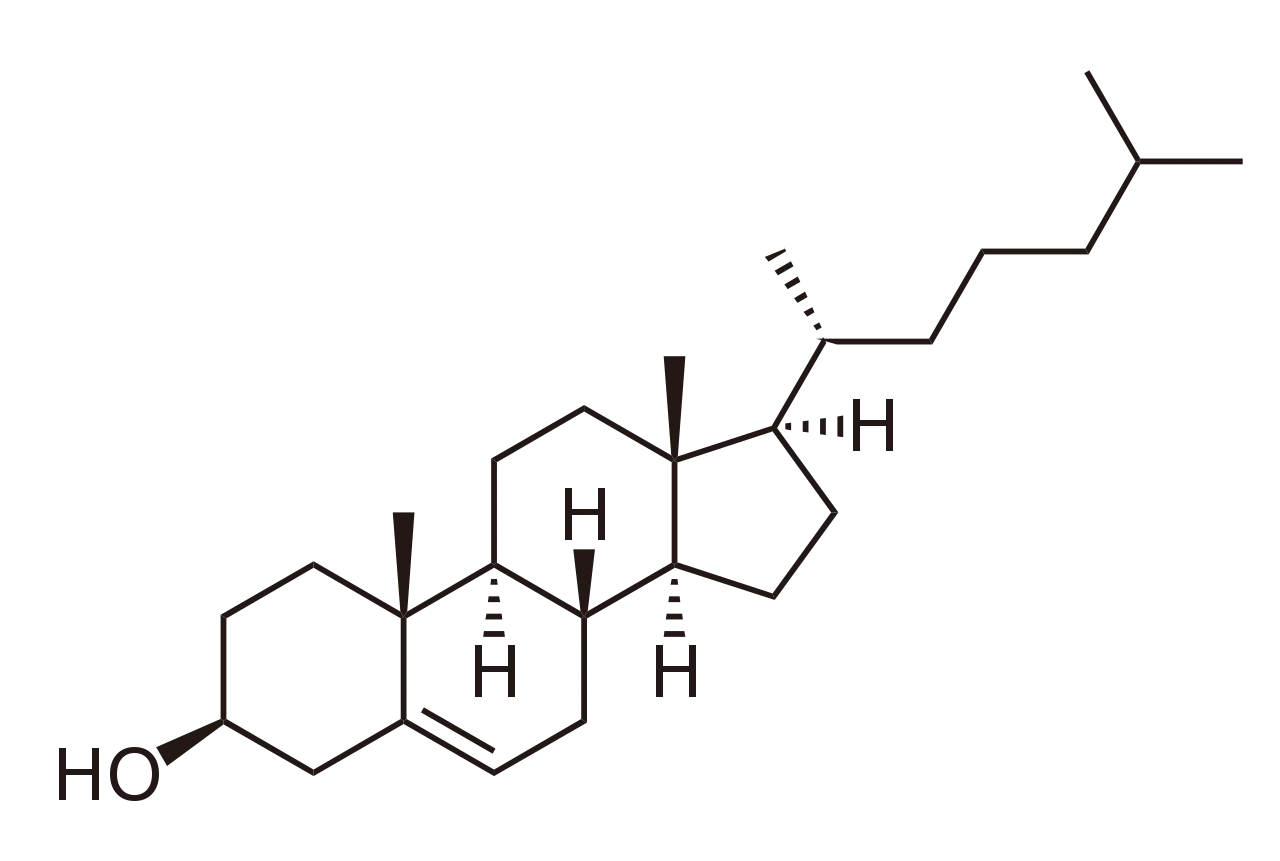
Where are all 27 carbons of cholesterol derived from?
Aceytal Co-A; many enzymes and precursors are necessary
The cholesterol synthesis requires energy from
ATP and reducing power from NADPH during cellular metabolism.
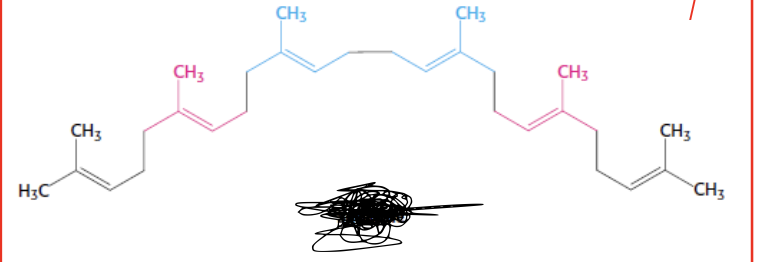
Squalene
serves as an intermediate in the biosynthesis of cholesterol
Squalene Structure
Aceytal-CoA structure

What is the mechanism of action of statins?
They competitively inhibit HMG-CoA reductase, reducing mevalonate formation and cholesterol synthesis.
Lovastatin
A naturally occurring statin used to lower cholesterol by inhibiting HMG-CoA reductase, therefore reducing cholesterol synthesis.
Chylomicron
A lipoprotein particle that transports dietary lipids from the intestines to other locations in the body, primarily delivering triglycerides to tissues.
break down triglyceride into free fatty acids which are absorbed by intestinal cells, and repackaged as triglycerides and sent out ‘in bulk’ in the chylomicrons.
Lipases
Very low density lipoprotein (VLDL)
Endogenous fat transport
Low-density lipoprotein (BAD)
Lipoprotein that carries cholesterol from the liver to cells, often associated with cardiovascular disease.
Cholesterol is Transported in the Bloodstream by
lipoproteins such as VLDL, LDL, and HDL
High-density lipoprotein (GOOD)
Lipoprotein that helps transport cholesterol from the cells back to the liver (REVERSE), reducing the risk of cardiovascular disease.
Bile Acids:
Break down large macroscopic fat droplets into small triglyceride vesicles.
Initial Fat Delivery After a Meal
1. Chylomicrons deliver FFAs to adipocytes and peripheral tissues.
2. Chylomicron remnants cleaned up by liver.
What happens to excess free fatty acids (FFAs) during fasting?
The liver takes up excess FFAs released by adipocytes, preventing their accumulation in the blood, which can become toxic and cause lipotoxicity.
Liver Functions with fats
1) Rebalance Cholesterol
2) control the membrane fluidity of all cells
Cholesterol and FAs storage passage
initially sent out as VLDL, pass through a short-lived IDL form and deliver cholesterol to various tissues as LDL.
LDL/IDL receptor on the liver:
removes the LDL/IDL particle itself from circulation
HDL receptor:
receives cholesterol that HDL collected from tissues.
VLDL synthesized?
Liver
IDL & LDL synthesized?
formed in bloodstream from VLDL which was from the liver
HDL synthesized?
initially by both the liver and intestine, then matures in circulation
Lipoprotein Transport Disruption:
Familial Hypercholesterolemia
Cholesterol-Derived Important Biomolecules:
Bile Salts
Bile salts are in nature
amphipathic: hydrophobic on one side, hydrophilic on the other, like phospholipids
Bile Salts main functions
are to emulsify fats (a.k.a surfactants) and aid in the absorption of fat-soluble vitamins.
Bile Salts are turned into back into bile acids
by gut bacteria recirculated and passively reabsorbed by liver
(enterohepatic recirculation).
All about bile salts
Synthesized as “bile acids” from cholesterol in liver.
Conjugated with glycine or taurine to form a salt.
Stored in gallbladder until needed for digestion.
Released into intestine via bile duct.
VLDL pathway main driver
Excess liver fuel/fat (high carbs, insulin resistance)
HDL pathway main driver
Lipid sensors & gene regulators (PPAR-α/ω, LXR)
VLDL pathway purpose
Ship fuel and cholesterol out to tissues
HDL pathway purpose
Retrieve excess cholesterol
VLDL pathway atherogenic effect
Pro-atherogenic
HDL pathway atherogenic effect
Anti-atherogenic
VLDL pathway medical intervention
Statins, diet, weight loss
HDL pathway medical intervention
Fibrates, exercise, smoking cessation
gallstones
Cholesterol accumulation from impaired bile salt synthesis
or excess fat in diet
Cortisol
Promotes glucose and glycogen synthesis, enhances fat/protein degradation, inhibit inflammatory response.
Aldosterone
Increases Na+ reabsorption
in kidneys and
excretion of K+ and H+.
Progesterone
Establishment
and maintenance
of pregnancy
Testosterone
Male traits and
secondary sexual characteristics
Estradiol
Female traits and
secondary sexual characteristics
Steroid hormone receptors can act as
Transcription Factors
How can estrogen (a steroid hormone) regulate gene transcription?
Estrogen diffuses into the cell → binds its intracellular receptor → causes conformational change and receptor dimerization → receptor dimer binds an estrogen response element (ERE) on DNA → regulates transcription.
what is is Overexpressed in Breast cancer?
Estrogen receptor alpha (ERα)
How can estrogen signaling be therapeutically inhibited?
Aromatase inhibitors such as exemestane reduce estrogen synthesis, while SERMs such as tamoxifen bind estrogen receptors and inhibit estrogen signaling in breast tissue.
Aromatase inhibitors
such as exemestane reduce estrogen synthesis
SERMs
SERMs such as tamoxifen bind estrogen receptors and inhibit estrogen signaling in breast tissue.
Vitamin D is Synthesized
from Cholesterol and Requires Light (λ)—> Photolysis
Photolysis
is the decomposition or change of a chemical substance by light, often involving the breaking of chemical bonds.
True/False Vitamin D is a steroid
False; it acts similarly: through a receptor that acts as a transcription factor.
Vit D Deficiency
Rickets- bone and cartilage weakness
Warfarin
a strong anticoagulant,
has a structure similar to vitamin K.
Vitamin C function
Antioxidant
Vitamin C deficiency
Scurvy (swollen/bleeding gums and subdermal hemorrhaging)
Vitamin D function
Regulation of calcium and phosphate metabolism
Vitamin D deficiency in children
Rickets (skeletal deformities and impaired growth)
Vitamin D deficiency in adults
Osteomalacia (soft, bending bones)
Vitamin E function
Antioxidant; deficiency can cause muscle and nerve lesions (rare)
Vitamin K function
Blood coagulation
Vitamin K deficiency
Subdermal hemorrhaging