Back, Thorax and Abdomen
 Call Kai
 Learn
Learn Practice Test
 Spaced Repetition
 Match
Match Flashcards
 Knowt Play
1/243

There's no tags or description
Looks like no tags are added yet.
Name | Mastery | Learn | Test | Matching | Spaced | Call with Kai | Chat |
|---|
No analytics yet
Send a link to your students to track their progress
244 Terms
axial skeleton
cranium
vertebral column
ribs
sternum
how many total vertebrae
33
how many cervical vertebrae
7
how many thoracic vertebrae
12
how many lumbar vertebrae
5
how many sacral vertebrae
5
how many coccygeal vertebrae
4
lordosis
convex anteriorly
kyphosis
concave anteriorly
what vertebrae are lordosis
cervical and lumbar
what vertebrae are kyphosis
thoracic and sacral
movement of the vertebral column
extension/flexion
lateral flexion
rotation
vertebral arch
consists of two pedicles and laminae
pedicles
short processes that project from the vertebral body
laminae
short, broad, flat plates
vertebral foramen
vertebral arch and posterior portion of vertebral body
vertebral notches
superior and inferior to the pedicle
function of spinous and transverse processes
provide attachment for deep back muscles
serve as levers, facilitating muscles that fix or change the position of vertebrae
atlanto-occipital joint
C1 and base of occiput
motion of atlanto-occipital joint (sagittal)
flexion and extension
atlantoaxial joint
C1 on C2
atlantoaxial joint motion (transverse)
rotation
alar ligament
attach cranium to C2
prevents excessive rotation
ligaments of the atlantoaxial joint
transverse ligament
cruciate ligament
transverse ligament
pocket for DENS
cruciate ligament
longitudinal bands
tectorial membrane of the atlantoaxial joint
continuation of posterior longitudinal ligament
lumbar vertebrae spinous processes extend _______
vertically
lumbar facets extend ______ and move more _______ moving inferiorly.
sagittally, frontally
thoracic vertebrae look like what animal?
giraffe
sacrum
composed of 5 fused vertebrae
joints of the vertebral column
zygapophysial joints (facet)
plane synovial joints (facet)
Joints of the vertebral column are supplied by _____ branches of the _____ rami of spinal nerves.
medial, posterior
intervertebral discs
crisscross pattern of the different layers of the annular wall provides the additional strength required to house the nucleus pulps under weight bearing stresses
anterior longitudinal ligament
strong fibrous band that covers the anterior aspects of the vertebral bodies
extends from pelvic surface of sacrum to anterior tubercle of C1
posterior longitudinal ligament
thin and weaker ligament
runs along the posterior aspect of the vertebral bodies
inter transverse ligament
connecting adjacent transverse processes
supraspinous ligament
strong fibrous band
connecting the tips of the spinous process
extends from C7 to sacrum
interspinous ligament
attach from the root to the apex of each spinous process
ligamenta flava
extend vertically from the laminate above to laminate below
form a posterior wall to the vertebral column
help maintain the vertebral curve
nuchal ligament
external occipital protuberance to C7
provides attachment for muscles that attach to spinous processes of other levels
arteries of the spine
anterior spinal artery
poster spinal artery
deep spinal artery
arteries of the spinal cord
anterior and posterior spinal arteries
What branch of the major cervical supply the vertebrae?
periosteal and equatorial
the spine has both _____ and _____ vertebral venous plexuses.
internal and external
The spine has both _____ and _____ spinal veins.
anterior and posterior
____ branches of the _____ rami innervate the facet joints
medial, posterior
the vertebral column is innervated by the _________ ________ branches of spinal nerves
recurrent meningeal
_____ supply the periosteum, annuli fibrosis and ligaments
nociceptors
_______ fibers are found in the annuli fibrosis and ligaments
proprioceptive
Meningeal branches supply:
periosteum
ligamenta flava
annuli fibrosis, IV discs
posterior longitudinal ligament
spinal dura mater
dura mater
outermost covering of the spinal cord
dura mater is innervated by the
recurrent meningeal nerves
dura mater is separated by the
periosteum-covered bone by the epidural space
arachnoid mater
avascular membrane that lines the dural sac and dural root sheaths
arachnoid mater is separated from the Pia mater via the
subarachnoid space and CSF
pia mater
innermost covering membrane of the spinal cord
splenius capitis origin
nuchal ligament and spinous processes of C7-3 or 4
splenius capitis insertion
fibers run super-laterally to mastoid process of temporal bone and lateral 1/3 of the superior nuchal line of occipital bone
splenius capitis innervation
posterior rami of spinal nerves
splenius capitis function
unilaterally: ipsilateral side bend and head rotation
bilaterally: head and neck extension
splenius cervicis origin
nuchal ligament and spinous process of C7-T3 or 4
splenius cervicis insertion
tubercles of transverse processes of C1-3 or 4
splenius cervicis innervation
posterior rami of spinal nerves
splenius cervicis function
unilaterally: ipsilateral side bend and head rotation
bilateral: head and neck extension
erector spinae group
iliocostalis
longissimus
spinalis
iliocostalis origin
arise by a broad tendon from posterior part of iliac crest, posterior surface of sacrum, sacroiliac ligaments, sacral and inferior lumbar spinous processes and supraspinous ligament
longissimus origin
arise by a broad tendon from posterior part of iliac crest, posterior surface of sacrum, sacroiliac ligaments, sacral and inferior lumbar spinous processes and supraspinous ligament
spinalis origin
arise by a broad tendon from posterior part of iliac crest, posterior surface of sacrum, sacroiliac ligaments, sacral and inferior lumbar spinous processes and supraspinous ligament
iliocostalis insertion
fibers run superiorly to angles of lower ribs and cervical transverse processes
iliocostalis innervation
posterior rami of spinal nerves
longissimus innervation
posterior rami of spinal nerves
spinalis innervation
posterior rami of spinal nerves
iliocostalis function
unilaterally: laterally flex vertebral column and ipsilateral rotation of the spine
bilaterally: extend vertebral column and head, as back is flexed, control movement via eccentric contraction
longissimus insertion
thoracis, cervicis, capitis; fibers run superiorly to ribs between tubercles and angles to transverse processes in thoracic and cervical regions, and to mastoid process of temporal bone
longissimus function
unilaterally: laterally flex vertebral column and ipsilateral rotation of the spine
bilaterally: extend vertebral column and head as back is flexed, control movement via eccentric contractions
spinalis insertion
fibers run superiorly to spinous process in the upper thoracic region and to cranium; spinals: thoracic, cervicis, capitis; fibers run superiorly to spinous processes in the upper thoracic region and to cranium
spinalis function
unilaterally: laterally flex vertebral column and ipsilateral rotation of spine
bilaterally: extend vertebral column and head as back is flexed, control movement via eccentric contraction
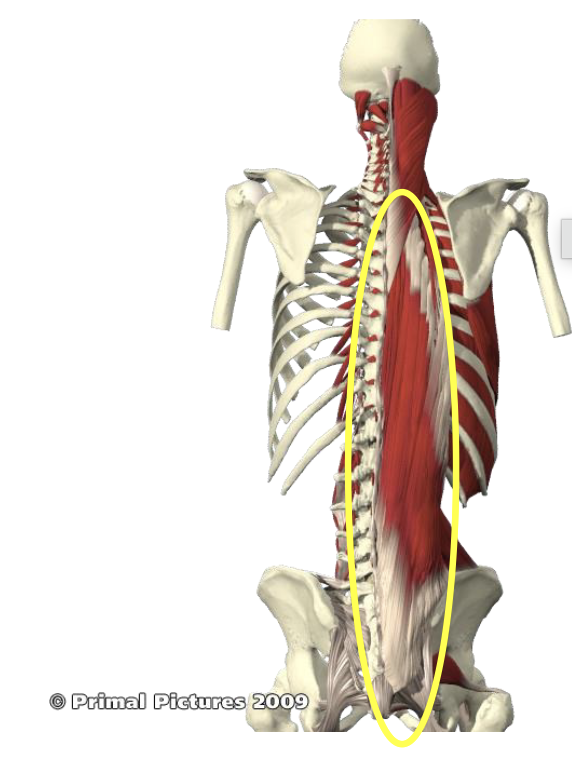
What muscle structure is this?
erector spinae group
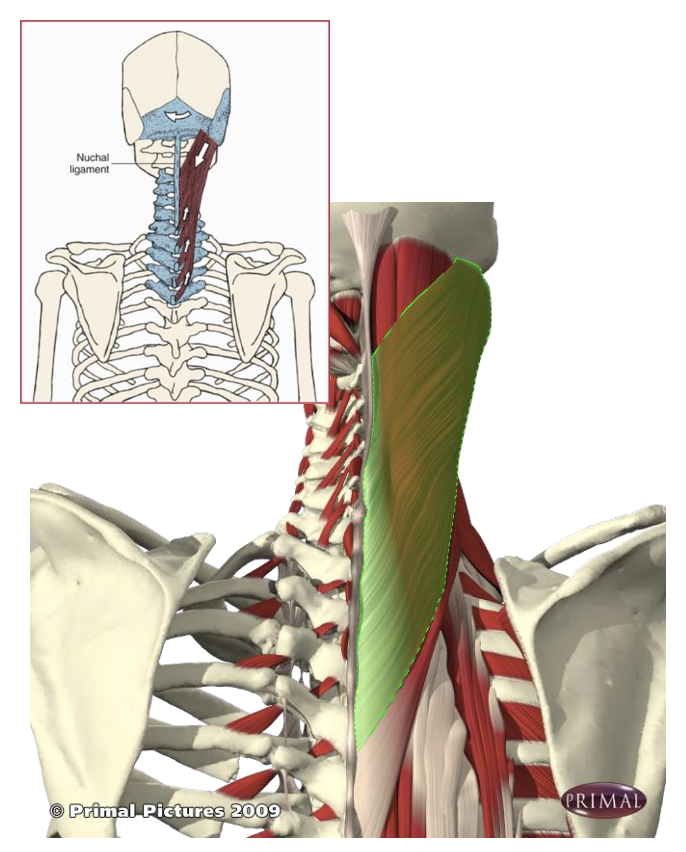
What muscle is this?
splenius capitis
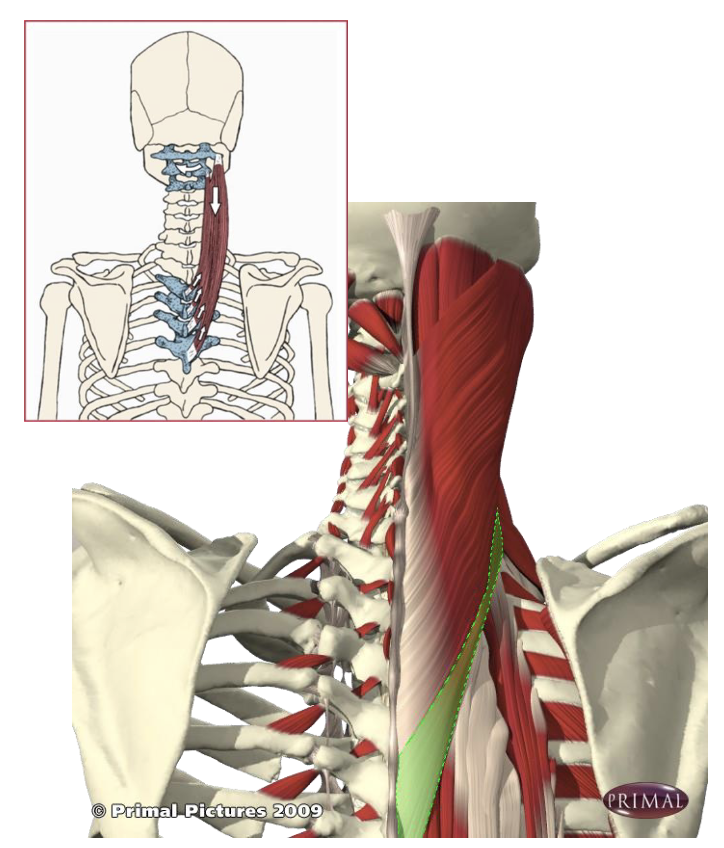
What muscle is this?
splenius cervicis
semispinalis origin
transverse processes of T12-C4
semispinalis insertion
fibers run superomedially to the occipital bone and spinous processes int he thoracic and cervical spine spanning 4-6 segments
semispinalis innervation
posterior rami of spinal nerves
semispinalis function
extends the head, thoracic and cervical regions of the vertebral column, contralateral rotation of the spine
multifidis origin
arises from posterior sacrum, posterior superior iliac spine of ilium, aponeurosis of erector spinae, sacroiliac ligaments, mammillary processes of lumbar processes of T1-3 and articular processes of C4-7
multifidis insertion
thickest in the lumbar region, fibers pass obliquely superomedially to entire length of the spinous processes, located 2-4 segments superior to proximal attachment
multifidis innervation
posterior rami of spinal nerves
multifis function
stabilizes vertebrae during local movements of vertebral column, also aides in contralateral rotation of the spine
rotatores origin
transverse processes of vertebrae, best developed in the thoracic region
rotatores insertion
fibers pass superomedially to attach to junction of lamina and transverse process or spinous of vertebrae immediately or 2 segments superior to vertebra of attachment
rotatores innervation
posterior rami of spinal nerves
rotatores function
stabilize vertebrae and assist with local extension and rotatory movements of the vertebral column (contralateral rotation)
iinterspinales origin
superior surfaces of spinous process of cervical and lumbar vertebrae
interspinales insertion
inferior surface of spinous processes of vertebra superior to vertebra of origin
interspinales innervation
posterior rami of spinal nerves
interspinales function
aid in extension and rotation of vertebral column
intertransversari origin
transverse process of cervical and lumbar vertebrae
intertransversari insertion
transverse process of adjacent vertebrae
intertransversari innervation
posterior and anterior rami of spinal nerves