Isomers or whatever
 Call Kai
 Learn
Learn Practice Test
 Spaced Repetition
 Match
Match Flashcards
 Knowt Play
1/20

There's no tags or description
Looks like no tags are added yet.
Name | Mastery | Learn | Test | Matching | Spaced | Call with Kai | Chat |
|---|
No analytics yet
Send a link to your students to track their progress
21 Terms
Isomerism
Same molecular formula, but different
Constitutional Isomers
Same formula, different connectivity
Stereoisomers
Same formula, same connectivity. Two different types
Configurational Isomers
Type of stereoisomer (same formula, same connectivity). Does not differ by rotation around a single bond only. Two types.
Conformers
Type of stereoisomer (same formula, same connectivity), Only different by rotation around a single bond.
Diastereomers
Type of Conformer (type of stereoisomer, same formula, same connectivity, and only different by rotation around a single bond)
Not mirror image
Example: cis- and trans- isomers
Enantiomer
Type of Conformer, (type of stereoisomer, same formula, same connectivity, and only different by rotation around a single bond)
Is a mirror image
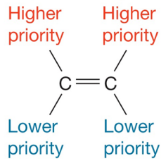
Z configuration
In a double c=c bond, the higher priority groups are on the same side
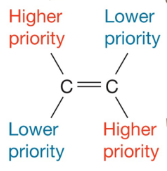
E configuration
In a double c=c bond, the higher priority groups are on the opposite side
If a molecule and its mirror image rapidly interconvert
Effectively achiral
Interconversion by Chair Flip
A chair is flipped so that the most outward bottom carbon is converted to the topmost outer carbon and the chair is mirrored.
Axial and equitorial bonds convert into the other.
Only need rotation to become superimposable
Staggered Conformation
Type of conformer. When the back carbon is bisected by the front carbon

Gauche Conformation
Type of staggered conformation where the bulky groups are 60° apart rotationally (left or right)

Eclipsed Conformation
Type of conformer. When the back carbon is covered by the front carbon

Anti conformation
Type of staggered conformation where the bulky groups are 180° apart rotationally

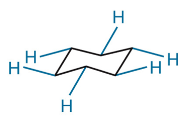
Equatorial bonds
On the plane
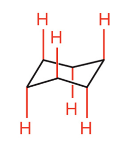
Axial bonds
Perpendicular to the plane
(IHD) Index of Hydrogen Deficiency
half the number of H atoms missing from the molecular formula of an analogous (same number and type of each non-hydrogen atom) saturated molecule.
IHD Formula
(2(# of C atoms) + 2 + (# of N atoms) − (# of halogen atoms))/2
Counting IHD
Each double bond contributes 1 to a molecule’s IHD.
Each triple bond contributes 2 to a molecule’s IHD.
Each ring contributes 1 to a molecule’s IHD