Lecture 21: Embryology of the Femal Reproductive System
 Call Kai
 Learn
Learn Practice Test
 Spaced Repetition
 Match
Match Flashcards
 Knowt Play
1/67

There's no tags or description
Looks like no tags are added yet.
Name | Mastery | Learn | Test | Matching | Spaced | Call with Kai | Chat |
|---|
No analytics yet
Send a link to your students to track their progress
68 Terms
7 weeks
in the first ________________, the embryo is sexually indifferent
Week 5
When:
-genital ridge differentiates and begins to form indifferent gonad
-paramesonephric ducts form
-primordial germ cells are incorporated into the indifferent gonad
Week 6
When:
-primordial germ cells are incorporated into the indifferent gonad
Week 7
When:
-Urorectal septum fuses with and divides the cloacal membrane
-Medula and gonadal cords of the indifferent gonad regress
-Cortex and cortical cords of the indifferent gonad develop
Week 8
When:
-Urogenital membrane partially disintegrates
-Distal paramesonephric ducts fuse
4th - 5th Month
When:
Meiosis begins in primary oocytes
5th - 6th Month
When:
Vaginal plate opens
Early Week 4
When:
-Lateral folding translocates Intermediate mesoderm to the dorsal body wall
-Nephrogenic cord differentiates; Pronephros and pronephric duct forms
Mid Week 4
When:
Folding of the caudal embryo creates the cloaca; Genital tubercle forms
Late Wek 4
When:
Mesonephros forms; Pronephric duct becomes the mesonephric duct
Intermediate Mesoderm
the urogenital system develops from the ________________________ of the posterior abdominal wall
Urogenital Ridge
the urogenital system forms a longitudinal elevation along the dorsal body wall called the _____________________
Week 4
When:
gonads are part of the urogenital ridge
Week 5
When:
• Epithelium of the ridge proliferates
• Forms gonadal ridge
Primordial Germ Cells
• Originate in the epiblast and migrate through the primitive streak to reside among endoderm cells in the wall of the yolk sac
• Recognizable 24 days after fertilization
Gonadal Ridges
During folding, the umbilical vesicle is incorporated into the embryo which moves the germ cells along the dorsal mesentery to the __________________________
Week 6
When:
• Primordial germ cells invade gonadal ridge
• Form gonadal cords (or sex cords)
• Indifferent gonad
The gonads do not develop
What happens if the primordial germ cells do NOT reach the gonadal ridges?
SRY gene
-sex-determining region on the Y chromosome
• Produces a protein [testes determining factor (TDF)] that determines testicular differentiation
TDF
protein that determines testicular differentiation
Genital Ridge
What is the indifferent structure:
Male derivative: Testes
Female derivative: ovary
Primordial Germ Cells
What is the indifferent structure:
Male derivative: Spermatozoa
Female derivative: Ova
Sex Cords
What is the indifferent structure:
Male derivative: Seminiferous tubules
Female derivative: Follicular cells
Mesonephric Tubules
What is the indifferent structure:
Male derivative: Efferent ductules and paradidymis
Female derivative: Oophoron and Paroophoron
Mesonephric Ducts
What is the indifferent structure:
Male derivative: appendix of epididymis, epididymal duct, ductus deferens, ejaculatory duct, seminal vesicles
Female derivative: appendix of ovary, gartner's duct
Mesonephric Ligaments
What is the indifferent structure:
Male derivative: gubernaculum testis
Female derivative: round ligaments
Paranmesonephric Ducts
What is the indifferent structure:
Male derivative: appendix of testis, prostate utricle
Female derivative: uterine tubes, uterus, upper vagina
Definitive Urogenital Sinus
What is the indifferent structure:
Male derivative: penile urethra, bulbourethral glands
Female derivative: lower vagina, vaginal vestibule
Early Urogenital Sinus
What is the indifferent structure:
Male derivative: urinary bladder, prostatic urethra, prostate gland
Female derivative: urinary bladder, urethra, glands of skene
Genital Tubercle
What is the indifferent structure:
Male derivative: penis
Female derivative: clitoris
Genital Folds
What is the indifferent structure:
Male derivative: floor of penile urethra
Female derivative: labira minora
Genital Swellings
What is the indifferent structure:
Male derivative: scrotum
Female derivative: labia majora
TDF
In the absence of ________________ the primitive gonadal cords disassociate into irregularly organized cell clusters
Week 7
When do gonads begin to develop?
Oogonia
femal germ cell
1. Gonadal cords form and degenerate
2. Secondary (cortical) cords develop
3. Secondary cords scatter into isolated cell clusters which will form primordial follicles
three steps of ovary development
Primary oocytes
the the 4th month, oogonias turn into ________________________
5th month
when does production of oocytes stop?
Lower segment of the Gubernaculum
embryologic origin of the round ligament of the uterus
Upper segment of the Gubernaculum
embryologic origin of the Ovarian Ligament
Gubernaculum
• Fibrous structure
• Attaches indifferent gonad to internal surface of labioscrotal swellings
-relatively inelastic
Week 6
when do both genital ducts present?
Urinary Tract
the mesonephric duct becomes the __________________
Reproductive tract
the paramesonephric duct becomes the ______________________
Cranial Region of Paramesonephric Ducts
embryologic origin of fallopian tubes
Uterovaginal Primodium
embryologic origin of:
• Uterus and cervix
• Superior 1/3 of vagina
Uterovaginal Primordium
the caudal region of the paramesonephric ducts becomes the __________________
Paramesonephric Ducts
ducts that project into the dorsal wall of the cloaca
Mesonephric Ducts
• Regresses in females but remnants persist that may be clinically significant after puberty
Epoophoron
-homolog to epididymis in males
-lateral part of mesosalpinx and mesovarium
Gartner's Ducts
-The remnants of the mesonephric ducts that can be found in the vagina as blind cysts or ducts
-typically no clinical significance
Broad Ligament of the Uterus
the urogenital ridges moves MEDIAL to form the ________________________
Uterus and Cervic
the Paramesonephric ducts fuse to form the _____________ and ________________
Week 8
When:
• Fusion of mesonephric ducts
• Regression of mesonephric ducts (absence of testosterone)
• Regression of uterine septum at midline to form uterine cavity
• Caudal mesonephric ducts joins to uterovaginal plate
Testosterone
there is regression of mesonephric ducts in the absence of _____________________
Urogenital Sinus
embryologic origin of the lower vagina
Hymen
separates lumen of vagina from the urogenital sinus
3rd Month
When:
-Urogenital sinus form sinovaginal bulbs and vaginal plate.
• Canalization of vaginal
plate
Cloacal Folds
Mesenchyme from primitive streak migrate to form _________________________
Clitoris
Cranially, the folds unite to form genital tubercle and later will form the _______________________
Labia Minora
the urethral folds anteriorly become the _______________________
Labia Majora
On either side of the urethral folds are the genital swellings that will form ________________
Hypoplasia/agenesis/atresia
no development of the uterus
Unicornuate
only one uterine horn

Didelphys
two separate uterine bodies
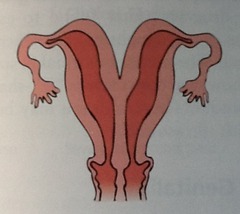
Bicornuate
small common body, two uterine horns
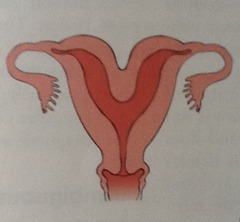
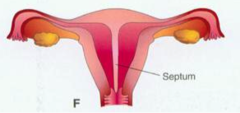
Septate
one body but internal septum
Imperforate Hymen
• Persistent membrane at vaginal opening
• Remnant of urogentital sinus formation
• Presentation- primary amenorrhea, cyclic pain without bleeding, tender mass, dyspareunia