Health Promotion Advocacy
 Call Kai
 Learn
Learn Practice Test
 Spaced Repetition
 Match
Match Flashcards
 Knowt Play
1/15

There's no tags or description
Looks like no tags are added yet.
Name | Mastery | Learn | Test | Matching | Spaced | Call with Kai | Chat |
|---|
No analytics yet
Send a link to your students to track their progress
16 Terms
What is health promotion advocacy
Combination of individual and social actions designed to gain political commitment, policy support, social acceptance and systems support for a particular health goal or programme
Taken on by individuals and groups to create living conditions conducive to health and theachievement of health lifestlyes
Advocacy definition in relation to health issues and or behaviour?
Active support of an idea or cause, in particular the act of pleading for or arguing for something
The act of arguing in favour of or the pratcie of supproting someone to make their voice heard
Examples of advocacy?
Promote public health objectives
overcome barriers that restrict public health opportunities
protect human rights
provide innovative proactive strategies
challenge streotypes and stigma
What are the main goals for health promotion advocacy?
That of protecting people who are vulnerable or discriminated against
And that of empowering people who need a stronger voice by enabling them to express their needs and make their own decisions
What strategies for health promotion advocacy
Lobbying
Raising awareness
Creating debate
Developing partnerships
Building capacity
Mobilising groups
Framing issues
Using champions
Influencing policy
What is the purpose of advocacy?
Aims to raise publci awareness and acceptance as well as influence public policy and resource allocation decisions (in relation to health issues and/or behaviour)
effective in economic and social systems and institutions and it is often motivated from health moral, ethical or value principles
What is lobbying?
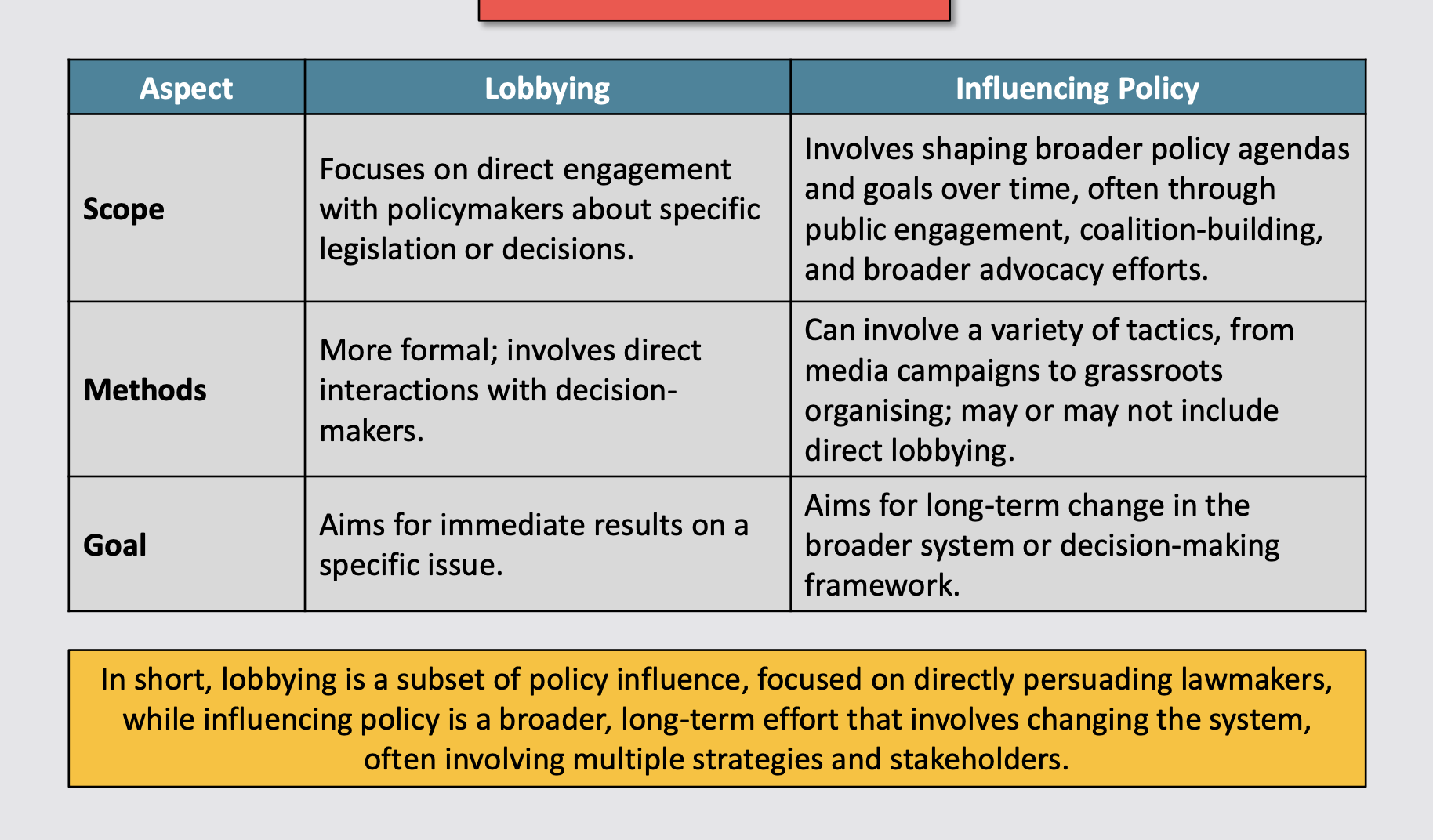
Involves directly influencing law makers or government officials toenact or change policies, legislation or funcding decisions related ot public health
involves one on one meetings, formal petitions, open forums, testifying at hearings
objective is to influence specific legislation or actions related to particular isue by directly engage with decision makers and providing them with the necessary information or arguments oto support a desired outcome
EXAMPLE: a health organisation lobbying for a tobacco tax increase by meeting with legislators and presenting evidence on its potential health benefits
What is influencing policy?
Acting to generate policy change. This includes advocating to policy makers for the adoption of psychic laws, regulations or actions that address public health concerns at the local, national or International level
goal: effect long term change in how policies are formed and implemented, often targeting sociatal systems or government policies rather than a specific piece of legislation
strat is employed when policy or legislative change is necessary to improve public health outcomes
e.g. join student comittee and board to create strategies for incluencing polciy change for food availaable at the canteen and phsyical activity guidelines, oresenting school decision makers with valid research to argue for relevant change to policy and legislation
Difference between lobbying and influencing policy?
What is raising awareness
Involves increasing public knowledge about a health issue or topic to drive understanding engagement and action
most effective when the issue is under recognised or misunderstood or when people need more information to make informed decisions
aimed at raising awareness of mental health challenges can hep reduce stigma and encourage individuals to seek support
What is creating debate?
Involves encourageing discussions around controversoal or important health topics to icnrease public engagemnt and policy focus
particularly useful when complex issue need briad public discourse to drive progress
dont necessarily lead to resolution but aim to raise awareness, educate, allow the adueinece to form their own opinions
publciu debates on vaaccination mandates or sugar taxes can help promtoe healthier lifestyle. most obvious exampels in the two eyars - covid vaccine debate
Whatt t is developing partnerships?
Developing partnerships involves building relationships among health organisations, community groups, government agencies, and other stakeholders to work toward shared health goals.
• This approach is efficient when addressing complex health issues that require the cooperation of multiple sectors.
• Collaborating with health organisations, community groups, government agencies, and other stakeholders ensures a more unified and comprehensive effort to achieve shared health goals.
Developing partnerships Example: efforts to reduce obesity rates can be enhanced through partnerships between schools, healthcare providers, and local governments, all working together to promote healthy lifestyles and provide community support.
What is building capacity
Building capacity involves developing the skills, resources, and knowledge within individuals, organisations, or communities to empower them to take effective action on health issues.
• It focuses on strengthening the ability of communities or organisations to make meaningful changes, adapt, and sustain health improvements over time.
• This approach is particularly important for disadvantaged populations, enabling them to develop the necessary skills and knowledge to advocate for improved health outcomes effectively.
• This strategy is essential when local communities or organisations lack the tools, resources, or expertise to tackle health challenges effectively.
Example: A practical application of capacity building is training community health workers to deliver vaccination services in rural areas, enabling them to address healthcare needs locally and sustainably.
What is mobilising groups
Mobilising groups involves organising and engaging communities or interest groups to take collective action in support of a health initiative.
• It involves encouraging individuals to participate in efforts to influence change, whether actively, such as shifting attitudes, advocating for policy changes, pushing for new legislation, or even influencing votes.
• Community leaders play a key role in mobilising their communities to rally around a cause, empowering them to take collective action.
• The power of numbers cannot be underestimated. By uniting people and inspiring them to act, significant change can be achieved.
• Mobilising groups can be done in a variety of ways, such as;
• A protest (going against an issue, i.e. stop gas mining in the oceans)
• A rally (in support of an issue, i.e. increase funding for schools)
• A petition (can be either for or against an issue, i.e. local community members signing a petition to add a pedestrian crossing on a busy road that school children must cross)
What is framing issues?
Framing issues means presenting a health issue in a way that shapes how it is understood by the public and decision-makers, ultimately gaining traction both politically and with the media.
• It’s about using specific techniques to craft an idea or message in a way that elicits a positive emotional response and encourages people to act.
• How information is worded can significantly influence how it is received, as people react differently depending on the framing.
• This strategy is particularly effective when trying to highlight the importance of a health issue or shift public perception.
What is using champions?
Using champions aims to raise awareness and increase knowledge about health conditions or public health issues by leveraging the influence of well-known figures or respected leaders to advocate for positive change and encourage action within communities.
• Champions refer to influential figures or leaders who can rally support and sway opinions due to their credibility and public influence. These individuals are typically unafraid to speak out on important issues.
• After clearly defining the health issue and gaining support, selecting a champion can be a strategic move.
• The chosen champion should possess the necessary influence, credibility, and commitment, as well as a strong understanding of the issue at hand.
• Advocacy groups can either create a champion (such as Constable Care or Sid the Seagull) or enlist a well-known figure to amplify awareness and drive attention to the cause, i.e. celebrities/athletes/influencers.