Animal Genetics Exam 1
 Call Kai
 Learn
Learn Practice Test
 Spaced Repetition
 Match
Match Flashcards
 Knowt Play
1/103

There's no tags or description
Looks like no tags are added yet.
Name | Mastery | Learn | Test | Matching | Spaced | Call with Kai | Chat |
|---|
No analytics yet
Send a link to your students to track their progress
104 Terms
Genetics
Statistics
Animal Breeding
Discipline in animal science that utiizes the principles of _____ and _____ with the goal of improvement of animals.
Science that helps in the quest to breed better animals
Started with domestication → successful to change animals in . desired ways.
Art
Robert Bakewell
1700s
Father of the ____ of Animal Breeding (at the time it wasn’t a “science)
Had definite ideas about breeding livestock
Responsible for BREEDS → developed grouping animals based on characteristics and desired traits
Shire horses, Leicester sheep, Longhorn cattle
Progeny Testing
Robert Bakewell
Never sold males, he leased them → beginning of _______
inbreeding
Robert Bakewell
Mated the best with the best, regardless of their relationship
Used _______ for increased homozygosity
Genetics
Gregor Mendel
1860s
Father of ______
established the basic genetic principles
used PEA PLANTS
not well understood during his life
Population Genetics
Sewell Wright & Ronald Fischer
1920s
Pioneers of _____
Genetic Drift
Sewell Wright & Ronald Fischer
researched the effects of inbreeding and crossbreeding
known for the concept of ______
statistical
Sewell Wright & Ronald Fischer
provided _____ basis of inheritance
Science
Jay Lush
1930s
Founder of the ____ of Animal Breeding
Separated sperm into X and Y sperm → allows for gendered semen
Dairy cattle breeder
Breeding Values
Jay Lush
Created _____- to refect the genetic make-up of an animal
Predict
We want to understand the genetic principles of inheriticane to _____ potential outcomes
progeny phenotyoic distribution
changes in a population
next record, genetic merit, response to selection
Start of Lecture 2
Start of Lecture 2
Blending
_____ Theory
Theory of inheritance prevailing at the time of Mendel’s work
Hereditary material consisted of fluids that became permanetly mized when combined.
This theory was directly contradicted by Mendel and other’s work
Pure Breeding Strain
_______: A strain in which animals of like phenotypes perpetuate those phenotypes in their progeny
Ex: dalmation: same phenotype displayed in each generation
F1
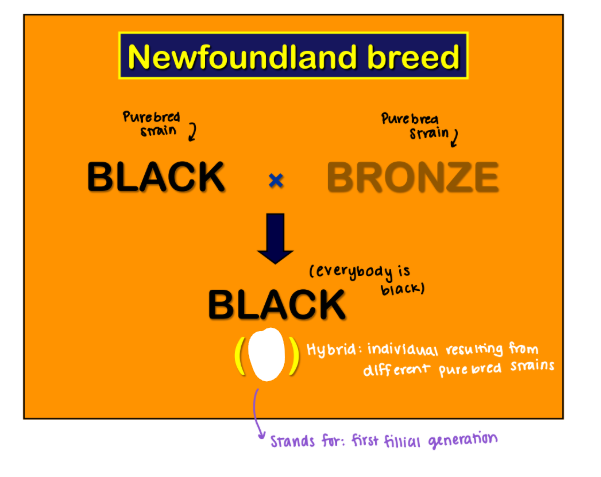
EX: Newfoundland Breed
Black (Purebred) x Bronze (Purebred) → Black (everbody)
The resulting progeny is known as ____ (first fillial generation)/hybrid
Hybrid
_______: a progeny resulting from the mating of different pure breeding strains
usually referred to as F1 animals
Backcross
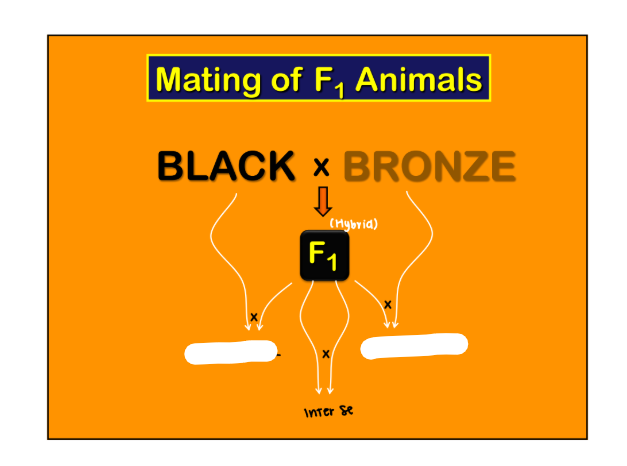
Mating of F1 Animals
____: mating of F1 animals back to an animal of one or the other of the pure breeding strains used to create the F1 animals
F1 x Black/Bronze (Purebred)
Interse
Mating of F1 Animals
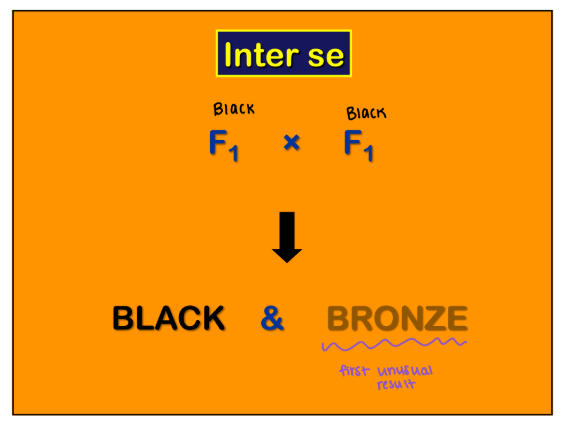
______: mating among themselves
F1 x F1
results in first unusual result
Bronze
Inter Se
When mating F1 x F1, the parents both have black phenotypes, however there is a reappearance of ____ progeny in backcross an interse mating of F1 animals
Mendel created a hypothesis to explain these results
Particulate Theory
What was the name of the hypothesis Mendel created to explain the reamergence of Bronze phenotype?
Factors
Particulate Theory: genetic material consists of distinct _____ that maintain their intergrity over generations
He didn’t know what the factors were, now we know that they are genes
pairs
Law of Segregation: Factors appear in ____ and a random member of the pair is passed from parent to progeny
Pairs
Segregation
Random
2
Law of Segregation
Pairs: factors/gene come in pairs of ___.
Parent
Law of Segregation
Segregation: each memeber of pair in offspring comes from each ____.
Random
Law of Segregation
____: copy we recieve from each parent is random
Dominant
One factor is capable of masking the presence of the second factor in the expression of a phenotype. This factor is said to be ____
This is only observed when the two alleles are together
Recessive
The factor being masked is said to be ______
Chromosomes
________- long strands of DNA in the nucleus of cells
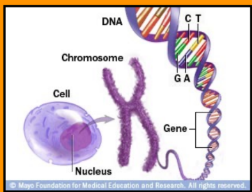
Locus
_________- specific place on a chromosome occupied by a gene
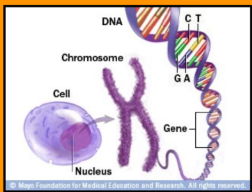
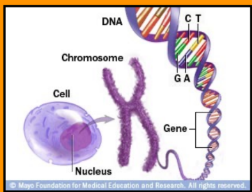
Gene
______- the basic unit of inheritance. A sequence of DNA that codes for proteins

Allele
_____- an alternative form of a gene
Genotype
_______- Genetic composition of an individual → depends of alleles
Aa, AA, aa
Phenotype
_____ or trait - Physical expression of a genotype (what we see)
Alleles
Example: Coat Color → Trait
2 ______: B = Black; b = bronze
Possible Genotypes: BB, Bb, bb
Possible Phenotypes; Black or Bronze
>
Matings
B & b
B = allele for black
b = allele for bronze
Practice Question Format
B = Black
b = bronze
B __ b → shows which allele is dominant.
Underscore
Matings
Practice Question Format
BB = Bb = B_ = BLACK (the ______- shows that it doesn’t matter which allele an individual gets it will always be black)
bb = BRONZE

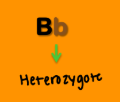
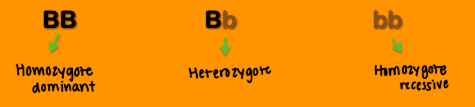
Hetereozygote
Genotypes (__ __ (pair of alleles))
_________: an individual prossessing two different alleles at a locus
Homozygote
Genotypes (__ __ (pair of alleles))
_________: an indivudal possessing two of the same alleles at a locus
**Must specifiy whether it is recessive or dominant
hybrid
Crossing Pure Breeding Strains
BB x bb → Bb (this is F1 or ___)
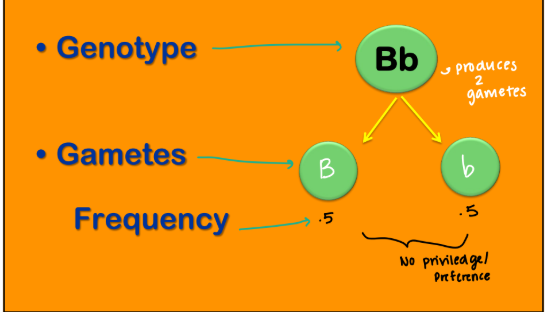
Gametes
Segregation - Single Locus
A parent has Bb genotype, the possible ____ are B or b, the frequency of each of those being passed onto progeny is .5 and .5 → no priviledge/preference
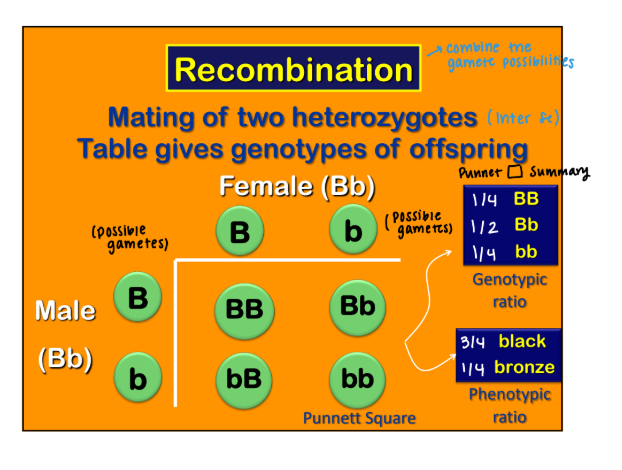
Recombination
______: combining possible gametes to give a new set of alleles
**Review Punnet Square, Genotypic Ratio and Phenotypic Ratio
Test Cross
______: A cross involving one parent showing the dominant phenotype and one parent completely recessive
dominant phenotype x recessive phenotype
Test to determine the second allele in an individual showing the dominant phenotype (carrying one dominant allele) → determines dominant phenotype
Bb
Test Cross
If dominant parent is BB = all progeny will be ___ (black) → no bronze
Bb
Test Cross
If dominant parent is ____ = progeny wil be ½ Bb + ½ bb (1/2 black and ½ bronze)
Independent
Law of _____ Assortment
Describes inheritance of multiple traits
Loci influencing different characteristics segregate at random with respect to each other
Each pair of factors separates independently
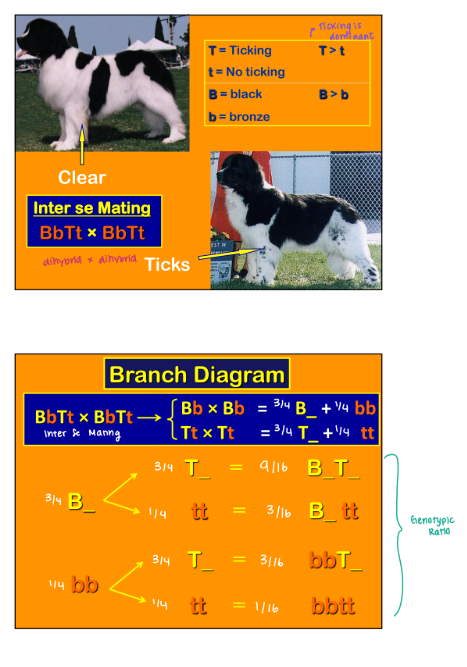
dihybrid
Combination of Traits
Following the inheritance of more than on trait at a time
For two loci the F1 is referred to as a _____ (heterozygous at two loci)
BbAa
Independently
Ex: Landseer Breed
Coat Color: black/bronze
Ticking - the presence of flecks of color in the white area
Segregate _____
Start of Lecture 3
Start of Lecture 3
Pairs
Chromosomes appear in _____
Full complement of chromosomes = 2n, where n is the number of chromosomes in a set
diploid
Organisms having 2n chromosomes are referred to as _____
haploid
Organisms having n chromosomes are referred to as _______
Gametes
____ are the reproductive cells often called sex cells
Sperm
The male gamete is ____
Haploid

Egg
The female gamete is an ____
Haploid

Haploid
Gametes (sperm/egg) have 1 set of chromosomes (n), referred to as _____.
Only cell in body that has just one copy of chromosomes
zygotes
The fusion of male and female gametes form ____ - which are again diploid (2n)
Meiosis
Reproductive cycle
____ is the process that produces gametes (n)
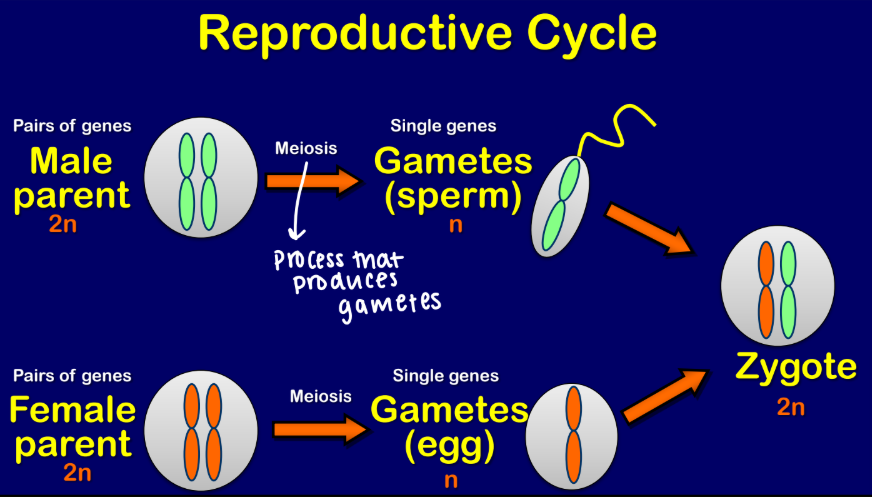
random
Genetic Inheritance is composed of two ____ processes
Formation of Gametes
Formation of Zygote
Random
Genetic Inheritance
Formation of gametes - ____ reduction from dipolid to haploid
Union
Genetic Inheritance
Formation of zygote - random ___ of gametes (restoration of diploid cell)
Probabilistic
The two random processes that make up genetic inheritance results in matings that are ____ (can predict)
likelihood
Probability - Mathematical _____ (chance) that a particular event will occur.
Denoted as: P(event)
EX: P(blue eyes)
NEVER
ALWAYS
Properties of Probability
Probability of an event is a number between 0 and 1 (0 < P < 1) → don’t use percentages
P=0 means event ___ happens
P=1 means it ____ happens
1
Properties of Probability
The total probability of all possible events always sum to ___

Number of total observations
Calculating Probabilties
P(event) = # of observations of the event / _________
Ex: tobiano spotting → spotted horse where typically white appears across the black and all four legs

Review
Calculating Probabilities Example
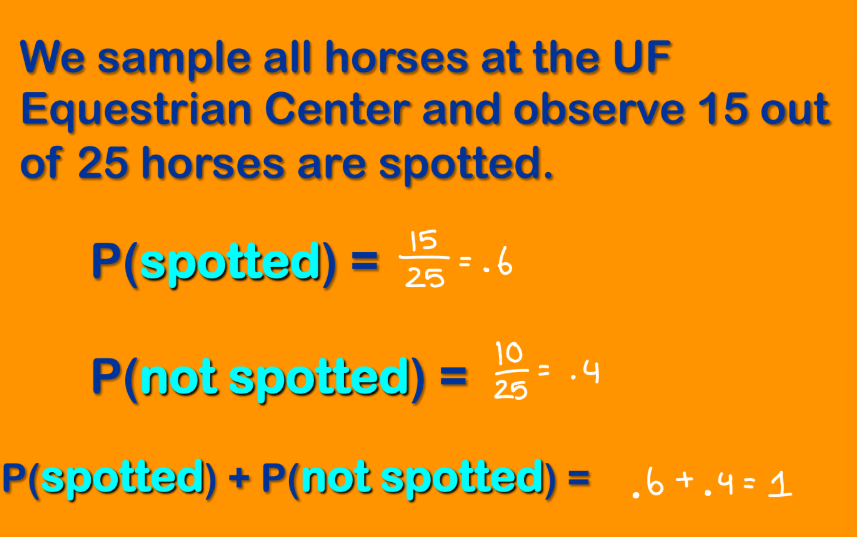
NOT
Independent Events - probability that one event occurs is _____ influenced by the occurence of a second event
AND
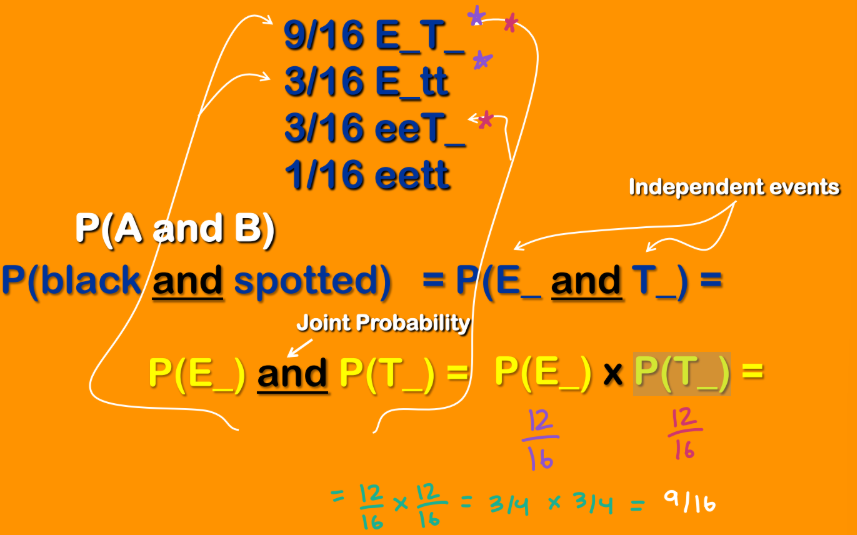
Joint Probability - probability of two or more events occuring together
Can be recognized by the word “____” (multiplication of probabilities)
and that the traits can occur in any combination
In punnet square separate all of the traits and find their probabilities seprarately
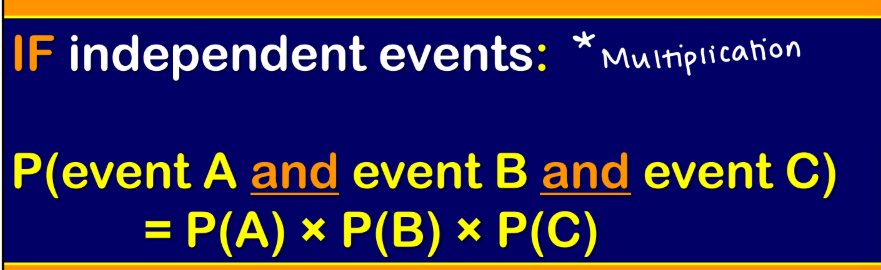
Extension
Joint Probability Example (1)
The basic components of color in horses are black and chesnut
E = Black, e = chesnut | E>e
E is the color used to designate the ____ locus
T = spotting, t = solid | T>t
dihybrids
Joint Probability Example (2)
From mating ____ (both traits are heterozygous), what is the probability of a progeny with black coat color AND spotting?
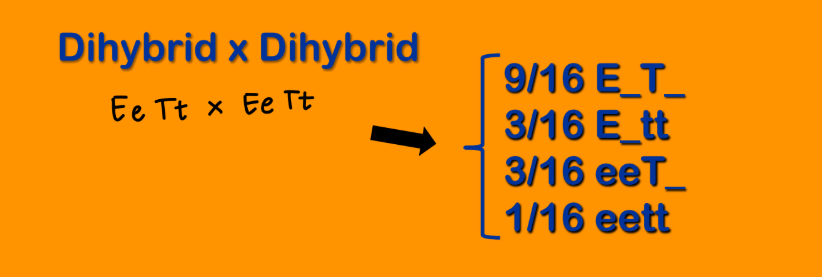
Review
Joint Probability Example (3)
Focus on each separate set of alleles! not the particular event where they both happen to occur!
Dogs
Inheritance of Spotting in Cats
S = spotted, s = solid | S>s (Reverse in ____ (Solid is dominant))
precludes
Mutually Exclusive Events - The occurence of one event _____ the occurence of a second event
Example: spots - if spotted can’t be sloid
One event occurs and prevents the other event from happening → events cannot occur together
OR
Mutually Exclusive Events
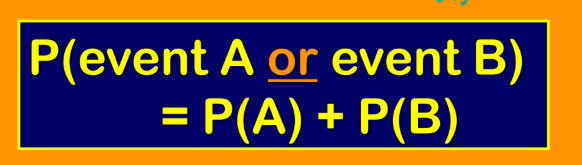
The probability of mutually exclusive events is represnted by the word “____” (addition +)
Sum
P(A or B)
Rule: The probability of two or more mutually exclusive events is the ___ of the probability of each event

GIVEN
Conditional Probabilities
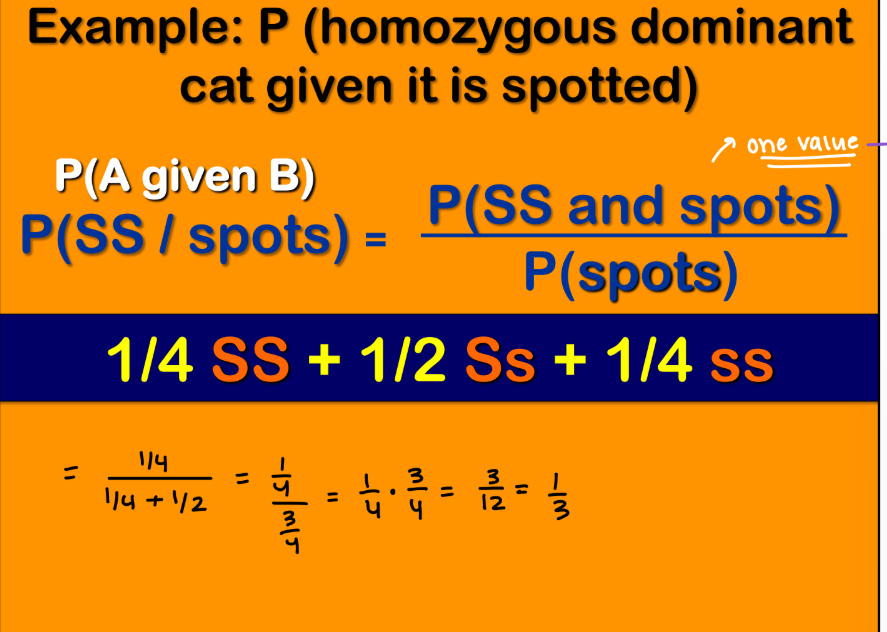
Probability of an event A _____ a second event has occured
Event happened, whats the probability that another event occurs
The P(A and B) is a singular probability (one where both occured → not the same as joint probability)

Review
Conditonal Probabilities Example
The P(SS and spots) is the probability of one indiviudal in the punnet square
OUT OF
Probabilities of Distributions of Events
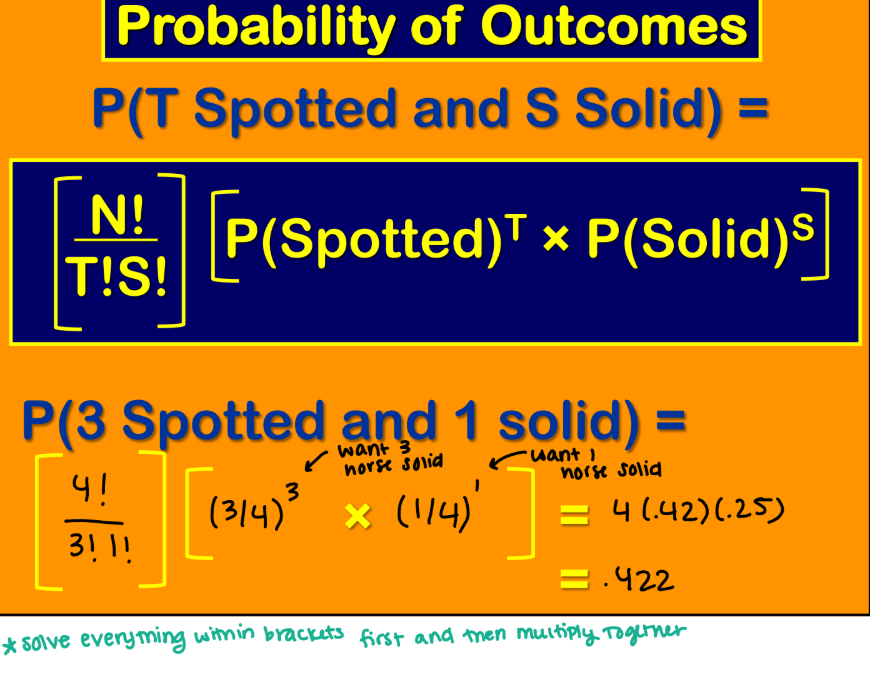
Example: What is the probability that in 4 progeny observed from mating heterozygous Tobiano spotted horses we observe 3 being spotted and one being solid?
"_______”
4
Probability of Outcomes
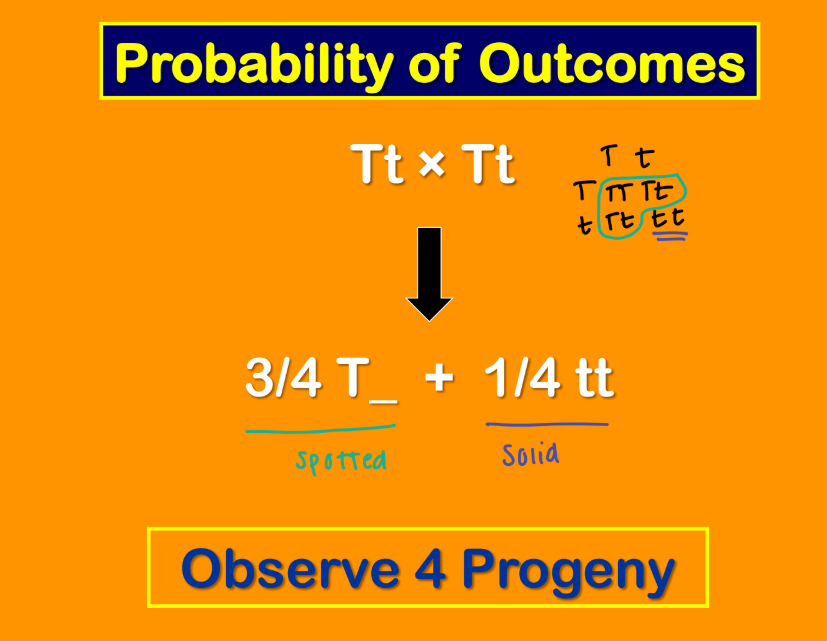
Determine the probabilities of events occuring in a punnet square
Observe ___ Progeny
Total
Probability of Outcomes
T = # of horses with spotting (that we are looking for)
S = # of horses that are solid color (that we are looking for)
T + S = N = ___ # of horses
Solve everything in the brackets first then multiply together
1
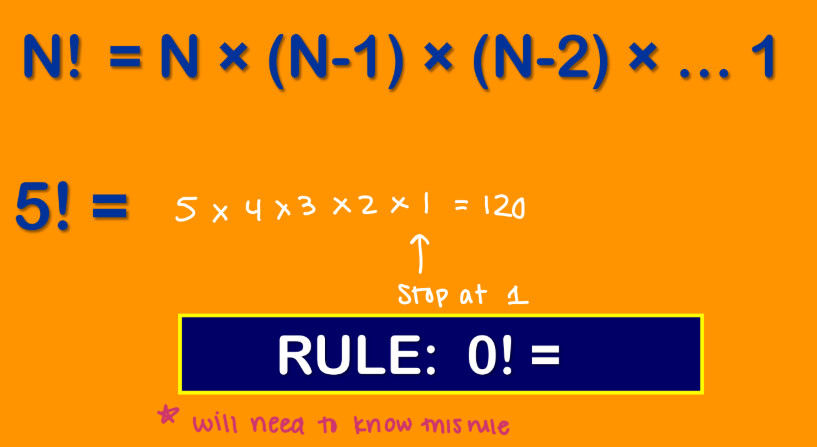
Factorials - Denoted by !
Multiply by N-1 stopping at 1
Rule: 0! = ___ (will need to know this rule)