Athletic Training and Sports Medicine Review Flashcards
 Call Kai
 Learn
Learn Practice Test
 Spaced Repetition
 Match
Match Flashcards
 Knowt Play
1/53

Earn XP
Description and Tags
Vocabulary-style flashcards based on lecture notes covering sports medicine PPE, injury prevention, gait cycles, nutrition, and environmental safety.
Name | Mastery | Learn | Test | Matching | Spaced | Call with Kai | Chat |
|---|
No analytics yet
Send a link to your students to track their progress
54 Terms
Hinge words
Words like likely, may, can, sometimes, often, almost, mostly, usually, generally, and rarely, which are included in answer choices to cover every possibility.
Switchback words
Direction-changing words such as but, although, however, despite, and regardless that alter the flow of a question or answer choice.
PPE Comprehensive Exams are repeated
Physical examinations that must be repeated every 2−3yrs for middle school, high school, and when transferring schools.
Collegiate pre-participation examinations must be completed no more than 1mo before participating in a sports program.
Cardiac Assessment in PPE are specifically to determine what abnormalities
A thorough assessment to determine abnormalities such as hypertrophic cardiomyopathy or coronary artery abnormalities.
Exclusions from sports can be based on
Injuries
Latent conditions (cardiac abnormalities)
Physical disabilities that poses danger
Renal disease
Uncontrolled hypertension
Health condition that poses danger (Staph/MRSA, HIV, hepatitis infections)
Disagreement among physicians
Failure of reasonable accommodations to eliminate risk
Contagious diseases that poses risk
Marfan Syndrome Evaluation are required for
Required for males over 6′ and females over 5′10" who present with two or more signs of the condition.
Q angle
Measured from the ASIS through the centerpoint of the patella to the tibial tubercle; normal for males is 13∘ and females is 15∘.
BMI Formula
BMI=(height in inches)2weight in lbs×703
BMI Weight Categories (Adult)
Underweight is <18.5,
Normal is 18.5−24.9,
Overweight is 25.0−29.9,
Obese is 30.0+.
BMI Categories (Under 20y/o)
Based on CDC charts: <5^{th}\% is underweight,
85<95^{th}\% risk for overweight,
95th%+ is overweight.
Prevention of injury in overweight athletes
Avoid performance enhancing supplies (steroid, stimulants) they result in hypertension, cardiac abnormalities, etc.
Avoid high volume, high intensity plyometric exercise which can result in joint damage
Acclimatize
Maintain a nutritious diet
Skinfold measurement areas
Standard areas include the triceps, biceps, suprailiac, and subscapular areas.
PPE Components
Consists of six parts: medical history, physical examination, cardiovascular screening, orthopedic screening, general medical screening, and wellness screening.
Monocular Athlete Exclusions in the sports of
Athletes with only one eye are excluded from boxing, wrestling, and full contact martial arts due to inadequate protection gear.
When developing a risk management plan, include (5)
security issues, fire safety, electrical equipment safety, emergency action plan (EAP), and crisis management plan.
A good pair of running shoe has lifespan of…. and should be
350−550miles of running.
Breathable, soft+sturdy midsole, good forefoot flexibility, strong heel
A pair of shoes with good ankle support should
Use 1.5-2in porous athletic tape or moleskin
High top shoes with inflatable support to support the ankle
Semi-rigid orthotic stabilizers that fit around the ankle
Shoes with adjustable straps that provide semi ridings support to ankle
ASTM
American Society of Testing Materials; the organization responsible for setting standards for eye protection in sports.
American Society of Testing Materials (ASTM) sets the standards for eye protection in racquet spots, what non-racquet sports? What material is the eye wear?
baseball, basketball, field hockey, skiing
polycarbonate plastic, very resistant to force. 2mm for low risk, and 3mm for high risk activities to dissipate force of impact to prevent intracranial injury
List each sports and what protective equipments involved are
Baseball: helmet+mouth guard. Catchers must wear: mouth guard+shin guards+chest protectors+protective mitts
Football: helmet+mouth guard+shoulder pads+hip pads+tailbone pads+thigh guards
Basketball: midtop shoes+mouth guards
Gymastics: wrist guards+hand grips+soft gymnastic footwear
Skateboard: helmet+kneepads+elbowpads+slip resistant, closed toe shoes
Soccer: shin guards+molded or ribbed sole shoes. Goal posts are padded
Volleyball: knee pads+protective pants, shoes supporting ankles+arch
Keratoderma
Callus formation on the feet; prevented by soaking, using files, wearing double socks, properly fitting shoes, wear protections to prevent friction and applying emollients.
The turf field increases…. prevention tips are
increasers dorsiflexion and hyperextension of toe.
Wear stiff forefoot shoes
Add insoles
Thermo-moldable plastic can be made to limit excessive dorsiflexion
Define the gait cycle
begins when foot contacts ground and completes when same foot contacts ground again
Stance/contact (3)
Contact - heel connected with ground, cushions impact, with foot pronating until it flatten
Mid stance - still pronating while supporting WB, with max pressure on arch. Other foot is in the swing phase
Take off/propulsion - great toe dorsiflexes, plantar fascia tightens, heel rises from ground, foot supinating and provides lever for propulsion
Swing (3)
Follow through - toe lifts from ground
Forward swing - foot swings forward
Descent - heel descends. This phase ends just before contact
Cardiorespiratory endurance tests
Harvard step test, Rockport Fitness Walking Test, and sprint tests.
To improve cardiorespiratory endurance: do 20-60min aerobic activity 3-6x/week
For competitive athletes: perform atleast 45min aerobic activity at least 4x/week
PNF Stretching
Flexibility technique involving an active contraction phase (partner-resisted) and a passive relaxation phase (partner-assisted stretch).
During active contraction: partner provides resistance while muscle is contracted.
During passive relaxation phase: brought into stretched position while athletes relaxes the muscle being stretched
A spotter is needed when.. Your job as the spotter is..
One or more spotters must assist with free-weight exercise where bar passes over face, head, if athlete on their back, or bar in front of shoulders
protect from injury, provide guidance on proper lifting, offer encouragement.
Lifter know how to get out the way of a fail lift attempt
Ensure lifter stabilzed before lift
Stand behind lifter
Monitor lift speed, ROM, lifter’s breath, number of reps
ATR Daily Cleanliness
Includes sweeping floors, disinfecting sinks, emptying trash, and disinfecting tables, hydrotherapy modalities, and equipment.
Principles of adult learning
Practical and goal oriented - provide overviews and examples, collaborative
Self directed - active involvement gives students responsibility
Knowledgeable - show respect for student’s life/experience, validate, relate the new material
Relevancy oriented - explain the applicability, identify objectives
Motivated - CEU and provide certificates when possible
Fartlek training
A form of strength and endurance training that involves running at varying speeds and intensities.
Macronutrient Energy Values
Fat provides 9kcal/g, Carbohydrates provide 4kcal/g, and Protein provides 4kcal/g.
Endurance Protein Requirements
Athletes in endurance activities require 1.2−1.4g of protein per kg of body weight.
Resistance Protein Requirements
Athletes in resistance and strength activities require 1.6−1.7g of protein per kg of body weight.
Psychrometer
An instrument used to monitor environmental conditions by accounting for heat, humidity, and the sun's radiation.
Flash to bang method
Divide the seconds between a lightning flash and thunder by 5 to determine distance in miles.
Define the 3 high
High-altitude pulmonary edema (HAPE)
A condition resulting from high altitude that can lead to acute respiratory distress and death.
Those who collect injury surveillance data:
National Safety Council
NCAA Injury Sureillance System
National High School Sport-Related Injury Surveillance Study
Annual Survey of Football Injury Research
National Center for Catastrophic Sports Injury Research
National Electronic Injury Surveillance System
High-altitude cerebral edema (HACE)
can lead to neurological damage, causing seizures, coma, death
Typical changes during acclimatization are
hyperventilation to increase oxygen uptake (hypoxic ventilatory response)
increased urination and dehydration
increased HR
frequent awakening at night & Cheyne-Stokes respirations
increased BP
High altitude sickness guidelines of immediate treatment
stop ascent in response to signs of AMS until symptoms subside
descend immediately for emergency treatment with signs of HACE or HAPE
if arriving to an area with high elevation, avoid exertion of more ascents for 24hrs
Drink lots of water (4-6L) and keep urine clear or pale
avoid exercise until acclimatized
sleep only at night
eat 70% carbohydrate diet
avoid alcohol, tobacco, depressant drugs
Increase elevation above 10k feet at rate of 1k feet daily, with one rest day for each 1k feet
Endurance training, discuess aerobic and anaerobic endurance training
Aerobic endurance training - to increase production of energy to met demands of athletic activities. Increase VO2 max, and lactate threshold.
Waste products are carbon dioxide (expelled through expiration) and water (expelled through sweating).
Endurance activities may be short (2-8min), medium (8-30min), or long (20-30min)
Anaerobic endurance training - demands for oxygen and energy exceed that which is available. As result, body burns stored energy, lactic acid begins to accumulate.
Endurance activities are classified as short (<25s), medium (25-60s), or long (1-2min)
Goal is to increase anaerobic endurance through high-intensity, repetitive exercise with short recovery periods
What is the purpose of speed training? What is the purpose of strength training?
Speed - goal is to increase ability to repeatedly run high speed sprints over short distance and improve coordination of muscle contractions
Strength - goals is to improve and maintain muscle contractions and force. Ex) weight training, hill and harness running, Fartlek training (run at varying speed and intensity)
Importance of diet
Fat - 9kal/g. Most efficient form of energy, 5hrs to metabolize, should be 30% of the diet
Carbohydrated - 4kal/g. Simple carbs (sugars, fruits, dairy) are fastest source of energy, 30min to metabolize. Complex carbs (whole grains, veggies ) convert to energy more slowly (2hrs). 55-60% of diet
Protein - 4kal/g. Metabolized more slowly (3hrs) but provide longer lasting source of energy. 10-15% of diet.
Athletes expend 2200-4400kal daily. Ensure to consume 2.5L of water per 2400kal burned
Pre-event meals should be 500-1000 calories, consumed 3-4hrs before event
Endurance activities require:
1.2-1.4grams of protein/kg of BW
Resistance and strength activities 1.6-1.7grams of protein/kg of BW
Females need at least 1200-1500kal/day, athletes require more.
Can calcium supplement of 1500mg/day
Vit C will help with abortions of iron also if necessary
Training with Pollution guidelines
practices/games should be held after rush hour (late afternoon)
Check pollen counts and ozone levels daily. Cancel outdoor activities when appropriate
Exercise in the early morning
Jetlag and how to minimize negative effects of travel
Jet Lag aka Circadian rhythm may result in:
Lethargy, dizziness, insomnia, dehydration, drowsiness, impaired athletic performance
Traveling west to east = more problems
Steps to minimize negative effects of travel:
Sleep well the night before
Hydrate, avoid alcohol
Avoid juice, sodas, caffeine, alcohol
Try being on a schedule that coincides
Remove shoes, stretch, walk periodica
Define the 3 high altitude sicknesses, explain their decreased oxygen at what levels
High altitude sickness
17% decrease in oxygen at 5k feet
31% decrease at 10k feet
20-30% decrease (HAS develops) at 8k feet
75% decrease at 14k feet
Three types of high-altitude sickness
Acute mountain sickness (AMS) - failure to acclimatize. May be mild to severe. Presents with headache, lethargy, nausea, confusion, unsteady gait, dyspnea. Occurs 6024hrs after ascent
High-altitude cerebral edema (HACE) - can lead to neurological damage, causing seizures, coma, death
High-altitude pulmonary edema (HAPE) - can lead to acute respiratory distress and death
Medical documentation abbreviations:
B, C/O, D/C, PRE. R/O
B - bilateral
C/O - complained of, under care of
D/C - discharge
PRE - progressive resistance exercise
R/O - rule out
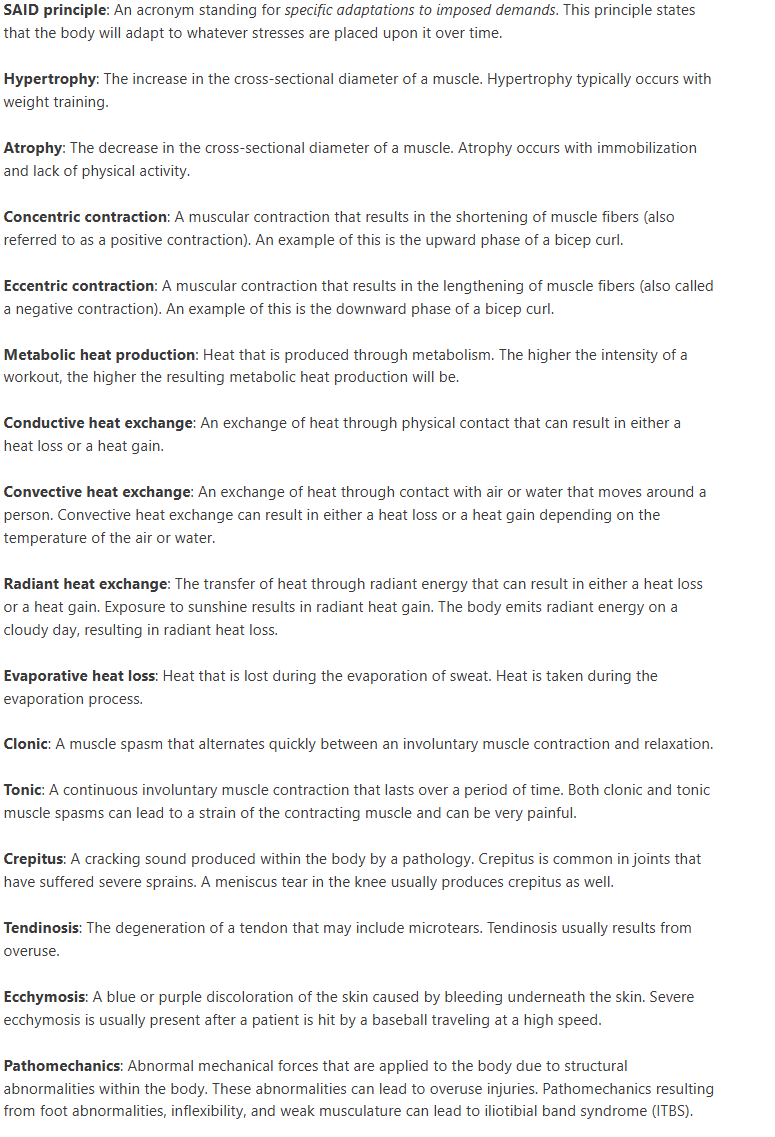
Medical terminology, define: SAID principle, hypertrophy, atrophy, concentric contraction, eccentric contraction, metabolic heat production, conductive heat exchange, convective heat exchange, radiant heat exchange, evaporative heat loss, clonic, tonic, crepitus, tendinosis, ecchymosis, pathomechanic,
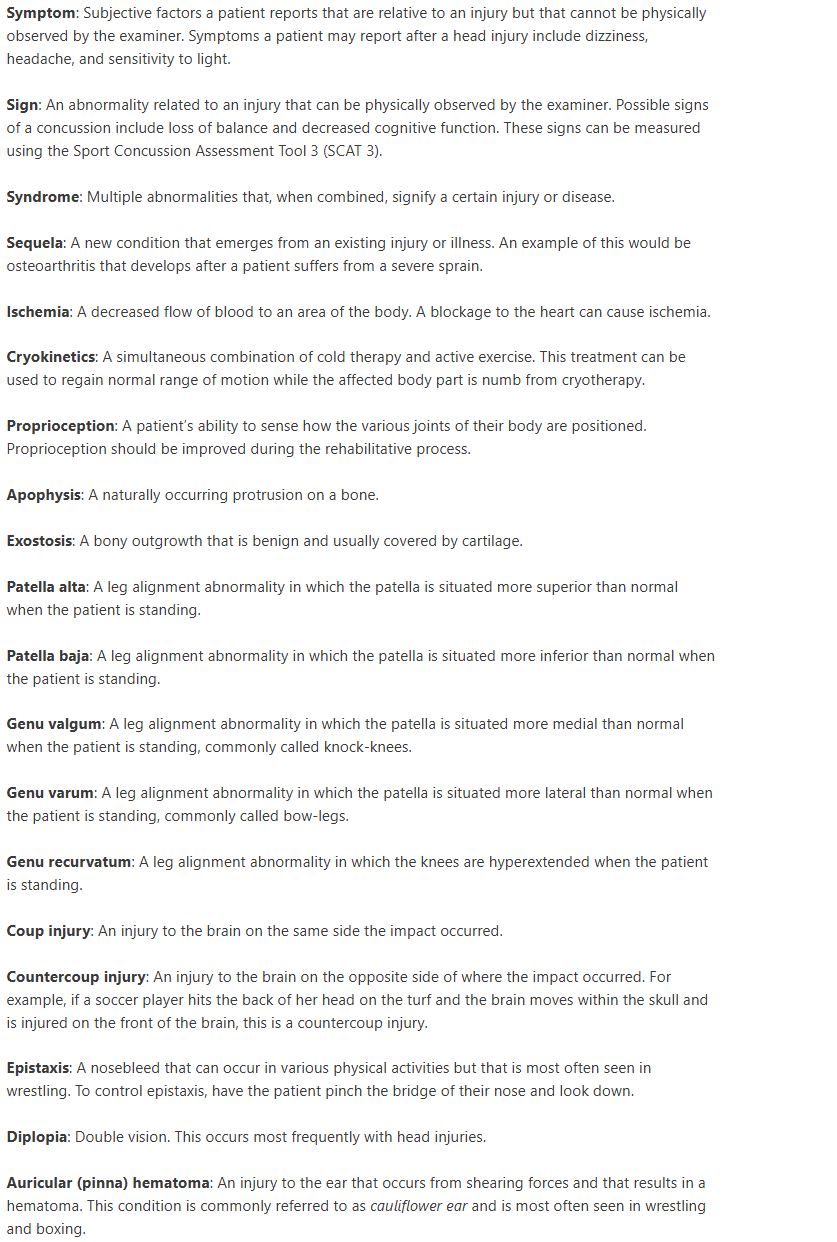
Medical terminology, define: symptom, sign, syndrome, sequela, ishemia, cryokinetics, proprioception, apophysis, exostosis, patella alta, patella baja, genu valgum, genu varum, genu recurvatum, coup injury, countercoup injury, epistaxis, diplopia, auricular (pinna) hematoma)
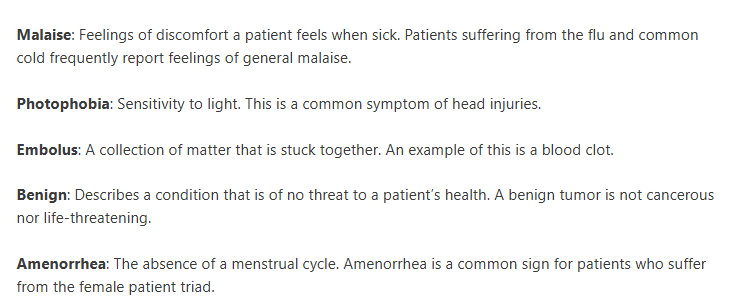
Medical terminology, define: malaise, photophobia, embolus, benign, amenorrhea
Obtaining medical history, guidelines for questioning include
avoid yes/no questions
request descriptions
ask content questions
clarify all reports of injury or illness by asking info about duration and symptoms
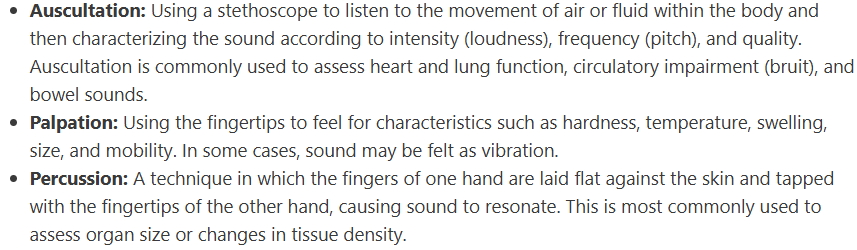
Define auscultation, palpation, percussion