Heart Failure: Pathophysiology and Pharmacology
 Call Kai
 Learn
Learn Practice Test
 Spaced Repetition
 Match
Match Flashcards
 Knowt Play
1/164

There's no tags or description
Looks like no tags are added yet.
Name | Mastery | Learn | Test | Matching | Spaced | Call with Kai | Chat |
|---|
No analytics yet
Send a link to your students to track their progress
165 Terms
What is heart failure (HF)?
A clinical syndrome where the heart cannot pump sufficient blood to meet the metabolic needs of the body
What is the most common cause of heart failure?
Low cardiac output due to cardiac dysfunction
What is high-output heart failure?
A condition where the heart is functionally normal but metabolic demands exceed cardiac output
What causes high-output heart failure?
Excessive increase in the body's metabolic demands that outpaces cardiac output
What are the three main ways heart failure is classified?
• Ejection fraction
• Left or Right ventricle
• Chronic vs acute-decompensated
What is HFrEF?
Heart failure with reduced ejection fraction characterized by EF ≤ 40% and systolic dysfunction
What type of dysfunction is seen in HFrEF?
Systolic (contraction) dysfunction
What is HFpEF?
Heart failure with preserved ejection fraction characterized by EF ≥ 50% and diastolic dysfunction
What type of dysfunction is seen in HFpEF?
Diastolic (filling) dysfunction
What is HFmrEF?
Heart failure with mid-range ejection fraction defined as EF 41-49% with HF symptoms
What is HFrecEF?
Heart failure with recovered ejection fraction where EF > 40% but was previously ≤ 40%
What is the formula for ejection fraction (EF)?
EF = SV / EDV * 100
What does stroke volume (SV) represent in EF calculation?
The amount of blood ejected from the ventricle per beat
What does end-diastolic volume (EDV) represent in EF calculation?
The volume of blood in the ventricle at the end of filling
What is left ventricular failure associated with?
Pulmonary congestion
What are common symptoms of left-sided heart failure?
Shortness of breath and fatigue
What is right ventricular failure associated with?
Systemic congestion
What are common features of right-sided heart failure?
Peripheral and abdominal fluid accumulation
What is the relationship between left-sided and right-sided heart failure?
Failure of one ventricle often leads to failure of the other
What is the most common cause of right-sided heart failure?
- Left-sided heart failure
- Left-to-right cardiac shunt due to atrial or ventricular septal defect
- Cor pulmonale
What is cor pulmonale?
Right-sided heart failure caused by lung disease
What are the most common causes of heart failure?
Coronary artery disease and hypertension
What is the major cause of HFrEF?
Coronary artery disease ((MI) or ischemia)
What are other causes of HFrEF?
- Dilated cardiomyopathies
- Pressure overload
- Volume overload
- Rate and rhythm disorders
What is the primary pathophysiologic issue in HFpEF?
Increased ventricular stiffness and impaired relaxation
What are common causes of HFpEF?
- Ventricular hypertrophy
- Infiltrative myocardial diseases
- MI or ischemia
- Mitral or tricuspid valve stenosis
- Pericardial disease
What triggers neurohumoral activation in heart failure?
Decreased cardiac output
What are neurohumoral responses in heart failure?
Compensatory mechanisms activated to maintain perfusion
What role does angiotensin II play in HF?
Causes vasoconstriction and contributes to pathophysiology
What system releases norepinephrine and epinephrine in HF?
Sympathetic nervous system (SNS)
What is the main beneficial neurohumoral response in HF?
Natriuretic peptides
What is the overall purpose of neurohumoral responses in HF?
To compensate for decreased cardiac output and maintain perfusion
What is the most important compensatory mechanism in heart failure?
Myocardial hypertrophy
What is the initial benefit of myocardial hypertrophy in HF?
Helps maintain cardiac performance
What are key features of ventricular remodeling?
Dilation of the cardiac wall and structural changes in myocardium
Which neurohormones drive ventricular remodeling?
Angiotensin II, norepinephrine, aldosterone, and vasopressin
Where is ANP produced?
Atria (and to some extent ventricles)
What triggers the release of ANP?
Atrial stretching due to increased filling
Where is BNP primarily produced?
Ventricles
What triggers the release of BNP?
Left ventricular dysfunction or early heart failure
What is the effect of natriuretic peptides on blood vessels?
Vasodilation leading to decreased blood pressure
What is the effect of natriuretic peptides on sodium balance?
Increased natriuresis (sodium excretion)
What is the effect of natriuretic peptides on cardiac remodeling?
Antifibrotic and anti-remodeling effects
What is a key physiological trigger for natriuretic peptide release?
- Atrial wall stretch (volume overload)
- Changing from the standing to the supine position
- Exercise
What are the pathological triggers for natriuretic peptide release?
- Heart failure
- Primary aldosteronism
- Chronic renal failure
- Inappropriate ADH secretion syndrome
What enzyme degrades ANP and BNP?
Neprilysin
What is the effect of neprilysin on beneficial HF hormones?
Reduces levels of ANP and BNP

What other molecule does neprilysin break down besides natriuretic peptides?
Angiotensin II
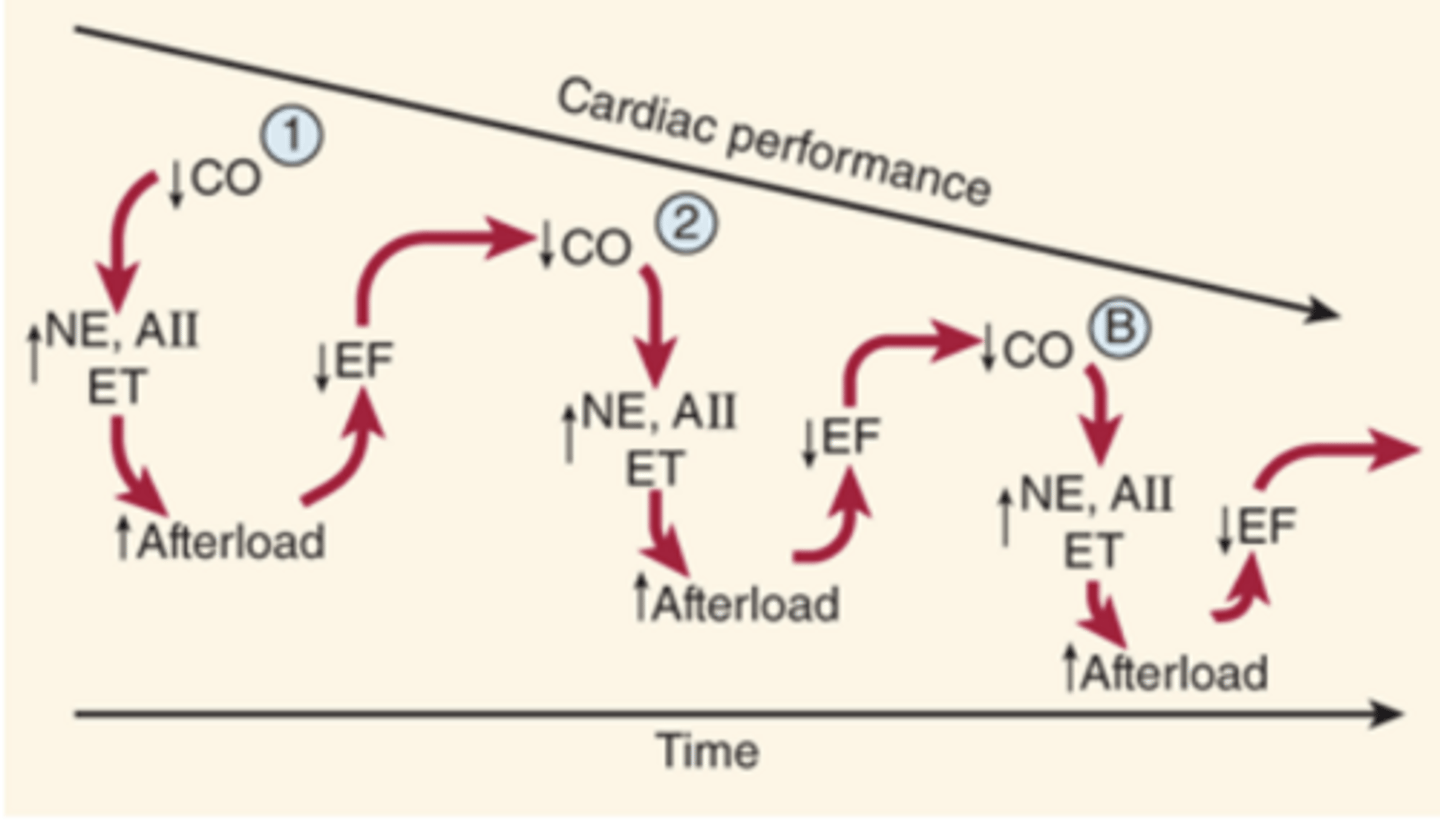
Progression of heart failureL
• Progressive decline in cardiac performance
• Decreased cardiac output
• Increased neurohormones: norepinephrine, angiotensin II, endothelin
• Vasoconstriction → increased afterload
• Increased afterload → decreased ejection fraction
• Decreased EF → further reduced cardiac output
• Creates a vicious cycle of worsening heart failure
What are common symptoms of left-sided heart failure?
- Dyspnea on exertion
- Orthopnea
- Paroxysmal nocturnal dyspnea
- Exercise intolerance
- Tachypnea
- Cough
What are common symptoms of right-sided heart failure?
- Abdominal pain
- Anorexia
- Nausea
- Bloating
- Early satiety
- Ascites
What are signs of left-sided heart failure?
Pulmonary rales and pulmonary edema
What are signs of right-sided heart failure?
- Peripheral edema
- Jugular vein distention
- Hepatojugular reflux
- Hepatomegaly
What are common laboratory/diagnostic tests used in HF?
- ECG
- Thyroid function tests
- Serum creatinine
- Echocardiogram
- BNP/NT-proBNP
What is the role of BNP in HF diagnosis?
Released from the heart in HF and used as a biomarker
Can BNP be used alone to diagnose HF?
No, it must be used as an adjunct
What conditions other than HF can elevate BNP?
- Older age
- Renal dysfunction
- Pulmonary embolism
- Chronic pulmonary disease
How does Sacubitril/Valsartan affect BNP levels?
Increases BNP but not NT-proBNP
What does the NYHA classification focus on?
Symptom severity and functional limitation
What does the ACC/AHA staging system focus on?
Disease progression and structural heart changes
What NYHA classes are typically associated with ADHF?
Class III and Class IV
What is acute decompensated heart failure (ADHF)?
Sudden worsening of HF symptoms requiring urgent care or hospitalization
What symptom pattern is seen in ADHF?
Symptoms at minimal exertion or at rest
What are the key features of ADHF?
- Volume overload (congestion)
- Low cardiac output (hypoperfusion)
- Pulmonary edema
- Possible renal failure
- Hypotension
What is cardiac index?
Cardiac output normalized to body surface area used to assess tissue perfusion
What is pulmonary capillary wedge pressure (PCWP)?
An indirect estimate of left atrial pressure
What does PCWP assess in HF?
Left ventricular filling, mitral valve function, and volume status
What is the primary goal of heart failure treatment?
Diagnose and treat the underlying cause of heart failure
What are the short-term goals of HF treatment?
- Improve hemodynamics
- Avoid hypokalemia
- Prevent renal dysfunction
- Avoid symptomatic hypotension
- Correct neurohumoral activation
What are the long-term goals of HF treatment?
- Control hypertension
- Prevent MI and atherosclerosis
- Reduce hospitalizations
- Improve survival and quality of life
What are the three main components of HF treatment?
- Dietary and lifestyle changes
- Drugs
- Surgery
What hemodynamic effects do ACEIs and ARBs have in HF?
Reduce preload and afterload
How do ACEIs and ARBs affect ventricular remodeling?
Prevent harmful remodeling
What is the overall benefit of ARNI in HF?
Enhances beneficial natriuretic peptide effects while blocking RAAS
What happens to BNP levels with neprilysin inhibition?
BNP levels increase
Why must neprilysin inhibitors be combined with an ARB?
To counteract increased angiotensin II levels
What is a major adverse effect of Sacubitril/Valsartan?
Hypotension
What washout period is required when switching from an ACE inhibitor to ARNI?
36 hours
What is the main rationale for using beta blockers in HF?
Antagonize harmful effects of the sympathetic nervous system and slow disease progression
What are the benefits of beta blockers in HF?
• Antiarrhythmic effects
• Block/reverse ventricular remodeling
• Reduce myocyte death (↓ catecholamine-induced apoptosis/necrosis)
• Improve left ventricular systolic function
• Decrease heart rate and myocardial oxygen demand
• Inhibit plasma renin release
How long does it typically take to see benefits from beta blockers in HF?
A few months
Why might symptoms worsen initially with beta blocker therapy?
Negative inotropic effect reduces cardiac output initially
What are examples of aldosterone antagonists used in HF?
Spironolactone and eplerenone
What is the role of aldosterone in HF?
Causes fluid retention, fibrosis, and electrolyte abnormalities
How do aldosterone antagonists affect cardiac remodeling?
Reduce fibrosis and ventricular remodeling
What additional beneficial effects do aldosterone antagonists have?
Decrease inflammation, atherogenesis, and oxidative stress
What is the main rationale for using diuretics in HF?
Relieve congestion caused by sodium and water retention
What do diuretics primarily reduce in HF?
Preload
Which type of diuretics are relatively weak and used for mild fluid retention?
Thiazide diuretics
In which patients are thiazide diuretics preferred?
Mild fluid retention with elevated blood pressure
Why are thiazides less effective in renal insufficiency?
Reduced tubular secretion when CrCl < 30 mL/min
Which thiazide-like diuretic remains effective in renal insufficiency?
Metolazone
Which diuretics are typically required in HF for volume control?
Loop diuretics
When is combination diuretic therapy used?
In diuretic resistance (loop + thiazide)
What is the mechanism of action of Sodium Nitroprusside?
Nitric oxide donor that increases cGMP causing vascular smooth muscle relaxation
What type of vasodilation does Sodium Nitroprusside cause?
Both arterial and venous dilation
What is the effect of sodium nitroprusside on preload/afterload?
Decreases preload and afterload
How does Sodium Nitroprusside affect cardiac output in severe LV dysfunction?
Increases cardiac output
What are the major adverse effects of Sodium Nitroprusside?
- Hypotension
- Cyanide toxicity
- Thiocyanate toxicity
- Methemoglobinemia
What is the onset of action of Sodium Nitroprusside?
Almost immediate (~30 seconds)