Chapter 2 Psych
 Call Kai
 Learn
Learn Practice Test
 Spaced Repetition
 Match
Match Flashcards
 Knowt Play
1/41

There's no tags or description
Looks like no tags are added yet.
Name | Mastery | Learn | Test | Matching | Spaced | Call with Kai | Chat |
|---|
No analytics yet
Send a link to your students to track their progress
42 Terms
nervous system
network of all cells that carries info to and from all parts of the body
neuron (what's its charge)
a cell that sends messages
charged at -70 mV (at rest)
the inside of the cell is 70mV more negative than the outside
dendrite
RECIEVES messages from other cells
attached to the soma
soma
neuron’s cell body that contains the nucleus and keeps entire cell alive
axon
CARRIES messages to other cells
branches into axon terminals
axon terminals
communicate with other nerve cells
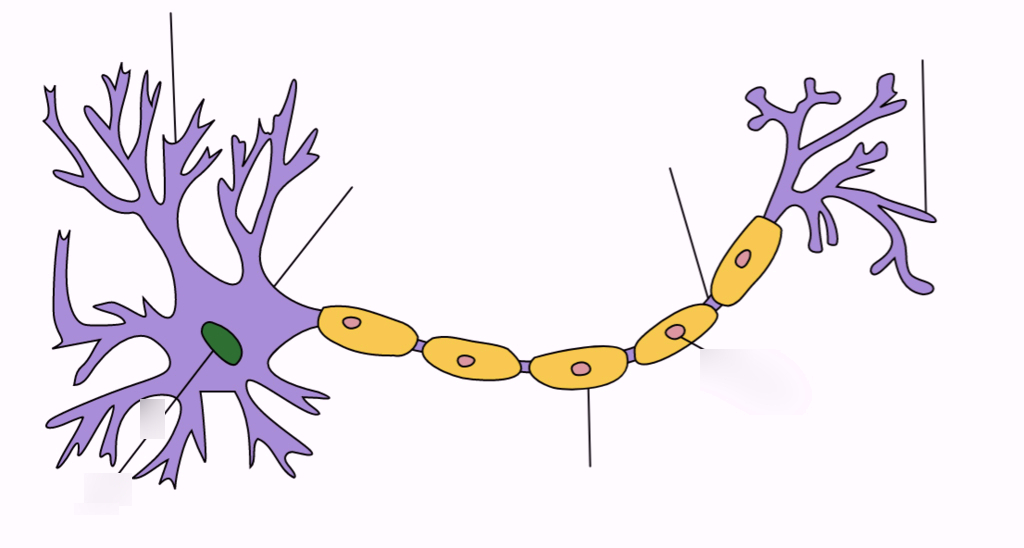
Label each part of the neuron
myelin
layer of fatty substances
glial cells
also a significant cell in the brain (other than neurons)
homeostasis in the nervous system
partner cells with neurons
oligodendrocyte
type of glial cell
produces myelin for neurons in the brain and spinal cord
schwann cells
type of glial cell
produce myelin for the neurons of the body (peripheral nervous system)
damaged nerve cells can reconnect and repair themselves with the myelin being produced in these types of cells (can’t in oligodendrocytes)
tracts
myelinated axons in the central nervous system
nerves
bundle of myelinated axons in the peripheral nervous system
myelin
serves as insulation and protection of the neuron
speeds up the process of neural messages traveling down the axon
nodes
spaces not covered by myelin
electrical impulses are regenerated at each node and jumps to node to node
only need to send impulses here
completely skip over myelin
electrical potential
outside positive ions are trying to come inside but can’t because of semi permeability
inside ions are negative and want to leave and push against the cell membrane
then there is an attraction between the outside positive ions and negative inside ones pulling together
action potential
electrical potential is not in rest anymore but action
when the positive ions (sodium) come rushing in and the neuron becomes more positively charged and do depolarization (become more positive)
small positive ions (potassium) leave to try and remove some positivity and do repolarization (return to normal state)
impulse is sent down once those channels open
SEQUENCE of ion channels closing and resetting
this reversal happens at the axon hillock
axon hillock
closest to the stoma
where the first ion channel will open
hyperpolarization
there is more negative ions inside the neuron than when started
too much potassium leaves and makes it negative
goes beyond original resting potential
neurotransmitters
a chemical suspended in a synaptic vessel
(neuro - inside a neuron, transmitters - will be transporting a message)
merge into cell wall to be released from the axon terminals
synapse
fluid filled gap
composed of dendrite, gap, and axon terminal
presynaptic membrance
vessels at the end of the axon
postsynaptic membrane
surface of dendrite next to axon
excitatory synapse
turning cells on (by the effect of the neurotransmitter that is going onto the receptor site)
the cell becomes more positive inside and then it is more likely to fire
inhibitatory synapse
turning cells off (by the effect of the neurotransmitter that is going onto the receptor site)
opens ion channels that let potassium out, making the inside more negative and causing hyperpolarization
antagonist
blocks/reduces effects of neurotransmitter
agonist
mimics of enhances the effects of a neurotransmitter
acteylcholine
first neurotransmitter
helps contract heart muscle
if blocked then acts like curare
glutamate
NS’s major excitatory neurotransmitter
endorphins
pain controlling neurotransmitter
reuptake
neurotransmitters are taken back into the presynaptic synapse
SSRI
keep the serotonin in the synapse longer (inhibit the reuptake process and from the serotonin from going back up)
experimental control
control group, nothing is manipulated
more negative or positive in a RESTING neuron?
more negative :)
random SAMPLING
prior to experiment you are choosing people
random assignment
choosing randomly WITHIN your group
standard normal distribution
if make random groups they will normally distribute themselves and the groups will be no different
ethic principles
a. beneficence and nonmaleficence (we shouldn’t hurt people, try to benefit those we are working with)
b. fidelity and responsibility (trying to have a good relationship)
c. integrity (be as truthful as possible)
d. justice (everyone should be able to have access to the study, not just for the wealthy)
e. respect for people’s rights and dignity
f. deception = if it is justified by significant science then you can deceive people.
How is intensity conveyed?
speed of firing
# of neurons firing
presynaptic vessel
the neurotransmitters that are still in their vessels inside the axon terminal that have not yet merged with the cell membrane
serotonin
sleep, impulsivity, aggression, mood, appetite
dopamine
learning, attention, movement
too little
parkinson’s
too much
schizophrenia
controls involuntary movement