IMAT
 Call Kai
 Learn
Learn Practice Test
 Spaced Repetition
 Match
Match Flashcards
 Knowt Play
1/14

There's no tags or description
Looks like no tags are added yet.
Name | Mastery | Learn | Test | Matching | Spaced | Call with Kai | Chat |
|---|
No analytics yet
Send a link to your students to track their progress
15 Terms

A real gas can be approximated to an ideal gas when
when the pressure is low (and therefore the particles are far from each other) and the temperature is high (the particles have high kinetic energy and therefore are not affected by each other).


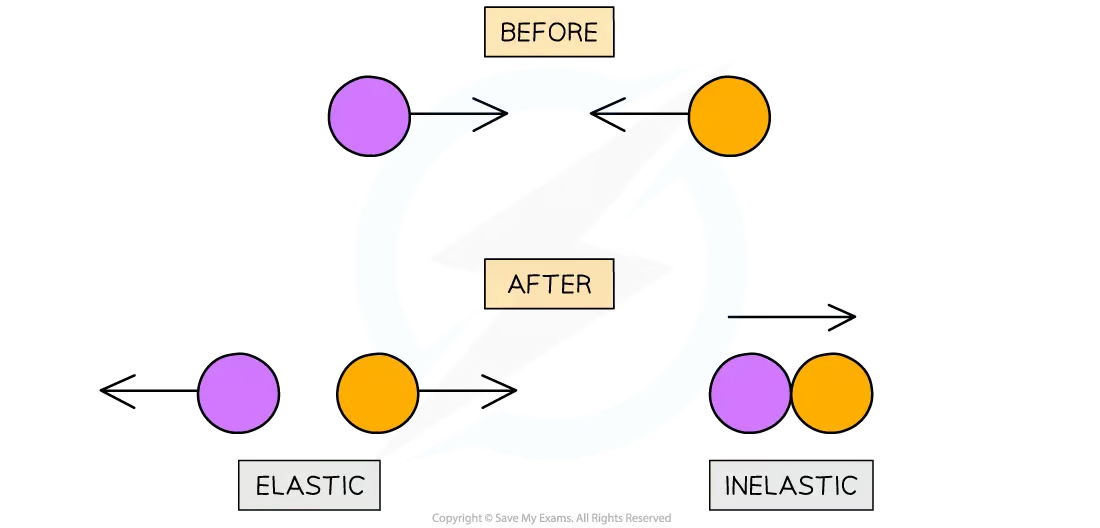
Collisions between particles of an ideal gas are collisions of type
They collide elastically and therefore without losing kinetic energy

ALL gases occupy
ALL the space and must always be compressed to enter.

Molar volume: One mole of ANY gas, according to Avogadro's law
is always 22.4 L under normal conditions (0 C 1 atm) or 24 L under standard conditions (25 C 1 atm)


If in a reaction 2 moles of H2 react with 1 mol of O2, how many would be in ml or L?
MOLES = VOLUMES


for hydrazine, NH2 is its?
empirical formula


isotherma, isobaric, iso…
isochoric


in order the isotherm is? the isobar? is it the isochora?
Boyle, Charles and Gay-Lussac laws


Isochoric transformation, T2 formula

PV=nRT, R=?
R= universal gas constant(0,0821 L*atm/mol * K)
8×10^-2


a cosa serve il prodotto incrociato
a risolvere l’eguaglianza di due frazioni


how many electrons are in ONE f orbital?
only 2

how many lobes the 5 d orbital have?
4, except the dz2(2 lobe and a donut)


What does Heisenberg's atomic model introduce?
the concept of an orbital as a region of space where the electron is most likely to be found
