Module 3: Sensation & Perception
 Call Kai
 Learn
Learn Practice Test
 Spaced Repetition
 Match
Match Flashcards
 Knowt Play
1/74

There's no tags or description
Looks like no tags are added yet.
Name | Mastery | Learn | Test | Matching | Spaced | Call with Kai | Chat |
|---|
No analytics yet
Send a link to your students to track their progress
75 Terms
Sensation
Is stimulation of sensory receptors and transmission of sensory information to the central nervous system
Perception
Is process by which sensations are organized and interpreted to form an inner representation of the world
Absolute Threshold
weakest amount of a stimulus that can be distinguished from no stimulus at all.
Detected 50% of the time
Vision
Hearing
Taste
Smell
Touch
What are the absolute threshold (5)
Vision
Absolute Threshold
a candle flame viewed from about 48km on a clear night
Hearing
Absolute Threshold
a watch ticking from about 20 feet away in a quiet room
Taste
Absolute Threshold
1 teaspoon of sugar dissolved in 7.5L of water
Smell
Absolute Threshold
about one drop of perfume diffused though a small house
Touch
Absolute Threshold
the pressure of the wing of a fly falling on a check about a distance of about 0.4 inch
Subliminal stimulation
Absolute Threshold
Sensory stimulation that is below a person’s absolute threshold for conscious perception
Visual stimuli flashed too briefly to be processed
Auditory stimuli played a volume to low to consciously hear or played backward
Difference threshold
Minimum difference in magnitude of two stimuli required to tell them apart
Detected 50% of the time
Weber’s Constant: Standard of difference of 2%
Just Noticeable Difference (JND): Minimum difference a person can detect
Weber’s Constant
Difference Threshold
Standard of difference of 2%
Just Noticeable Difference
Difference Threshold
Minimum difference a person can detect
Signal-Detection Theory
Stimulus characteristics and psychological factors interact to influence whether a stimulus is detected
Psychological factors: Learning, motivation, psychological states, (Fatigue, alertness)
Sensitization
Desensitization
Sensory Adaptation (2)
Sensitization
Sensory Adaptation
Positive Adaptation: Process by which we become more sensitive to stimuli of low magnitude
Desensitization
Sensory Adaptation
Negative Adaptation: Process by which we become less sensitive to stimuli that remains the same
Visible Light Spectrum
Is the section of the electromagnetic radiation spectrum that is visible to the human eye
Wavelength (Nanometers)
Eye
Light enters through a narrow opening
Cornea
Iris
Pupil
Cornea
Eye
Transparent eye cover
Iris
Eye
Muscle; colored part of the eye
Pupil
Eye
Opening in the iris
Sensitive to light and emotion
Lens
Eye
Changes in thickness for focusing
Image is projected onto retina
Light sensitive surface
Eye
Retina
Photoreceptors
Rods, Cones, Bipolar, and ganglion cells
Optic Nerve
Eye
Axons of Ganglion neurons form optic nerve
Conducts sensory input to brain (Occipital Lobe)
Cones
Eye
Most densely packed in center of retina (Fovea)
Provide color vision
Rods
Eye
Provide vision in black and white
More sensitive to dim light than cones
Visual Acuity
Greatest in the fovea
Blind spot: point in retina where ganglion cells converge
Nearsightedness
Farsightedness
Presbyopia
Trichromatic Theory
Opponent-Process Theory
Theories of Color (2)
Trichromatic Theory
Theories of Color
Three types of cones
Respond to red, green, or blue
Opponent-process Theory
Theories of Color
Three types of color receptors
respond to red or green, blue or yellow, or light or dark
Cannot respond to both at simultaneously
Trichromat
Monochromat
Dichromat
Color Blindness (3)
Trichromat
Color Blindness
Normal color vision
Monochromat
Color Blindness
totally color blind
Dichromat
Color Blindness
Partial color blindness
Discriminate between two colors
More common in males (Sex linked trait)
Visual Perception
Process used to organize sensory impressions caused by the light that strikes our eyes
Sensation is a mechanical process
Perception is an active process: Involves knowledge, expectations, and motivation
Perceptual Organization
Figure: Ground perception
Ambiguous, unstable figures
Proximity
Similarity
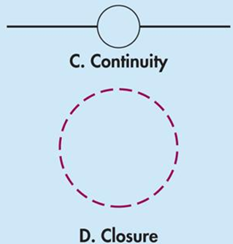
Continuity
Gestalt Rules For Perceptual Organization (3)
Proximity
Gestalt Rules For Perceptual Organization
Nearness of objects

Similarity
Gestalt Rules For Perceptual Organization
Similarity of objects

Continuity
Gestalt Rules For Perceptual Organization
Series of points having unity
Sound waves
require a medium; air or water
compress and expand molecules of the medium, creating vibrations
a single cycle of compression and expansion is one wave of sound
Human ear is sensitive to sound waves with frequencies of 20 to 20,000 cycles per sound
Pitch
Frequency (# of cycles per second)
Expressed in Hertz (Hz)
Pitch of women’s voice is higher than men’s
Loudness
Height (Amplitude) of sound waves
Expressed in decibels (DB)
Ear
Shaped and structured to:
Capture sound waves
Vibrate in sympathy with them
Transmit auditory information to the brain
Outer ear
Middle ear
Inner ear
Auditory nerve
Parts of the Ear (4)
Outer ear
Part of the Ear
Funnels sound waves to the eardrum
Middle ear
Part of the Ear
Eardrum, hammer, anvil and stirrup
Acts as an amplifier
Oval window - Round window
Inner ear
Cochlea
Basilar membrane
Organ of Corti
Loudness and sequence
Locating Sounds
___________ in which sounds reach the ear provide cues
May turn head to clarify information
Conductive deafness
Damage to middle ear
Hearing aids can help
Sensorineural Deafness
Damage to inner ear or auditory nerve
Conductive deafness
Sensorineural deafness
Type of deafness (2)
Auditory nerve
Cochlear implants may help with damage to inner ear, but not _____________
Smell
Taste
The chemical senses (2)
Olfactory membrane
Smell
Odors trigger receptor neurons in ________
Odors are sample molecules of substances in the air
Olfactory nerve
Smell
Sensory information about odors is sent to the brain through the _________
Odor contributes to flavor of foods
Receptor Neurons
Taste is sensed through taste cells
_________ on taste buds
Sweet
Sour
Salty
Bitter
Four Primary Taste Qualities
Umami
Fifth basic taste - savory
Odor
Texture
Temperature
Taste
Flavor of food depends on: (4)
sensitivities
Individuals have taste _________
fire
Touch and Pressure
Skin sensory receptors _______ when skin surface is touched
Active touching
Nerve endings
Touch and Pressure
Some areas of the body are more sensitive
________ are more densely packed
More sensory cortex is devoted to perception of sensations in those areas.
increases
decreases
Temperature
Receptors are located just beneath the skin
Skin temperature ________ - receptors for warmth fire
Skin temperature ________ - receptors for cold fire
Sensations for temperature are relative
Nociceptors
Pain
Pain
________ in skin are stimulated
________ is usually sharpest where nerve endings are densely packed
Pain can be felt deep within the body
No nerve endings for pain in the brain
Prostaglandins
Facilitate transmission of pain message
Heighten circulation to injured area (inflammation)
Pain-relieving drugs inhibit production of prostaglandins
Emotional response and response to stress affect degree of pain
Kinesthesis
Sense that informs you about the position and motion of your body
Sensory information is sent to the brain from sensory organs in joints, tendons, and muscles.
Vestibular sense
Housed mainly in semicircular canals in your ears
Monitor your body’s motion and position in relation to gravity
Extrasensory Perception - ESP
Perception through means other than sensory organs
Precognition
Psychokinesis
Telepathy
Clairvoyance
Precognition
Psychokinesis
Telepathy
Clairvoyance
What are the Extrasensory Perception - ESP
Precognition
Existence of ESP
Foretelling of future events
Psychokinesis
Existence of ESP
Ability to affect the physical world through thoughts
Telepathy
Existence of ESP
Ability to send messages through the mind
Clairvoyance
Existence of ESP
Ability to perceive events with no direct stimuli