BIO172 Exam 3 Mateiral
 Call Kai
 Learn
Learn Practice Test
 Spaced Repetition
 Match
Match Flashcards
 Knowt Play
1/254

There's no tags or description
Looks like no tags are added yet.
Name | Mastery | Learn | Test | Matching | Spaced | Call with Kai | Chat |
|---|
No analytics yet
Send a link to your students to track their progress
255 Terms
Function of the Excretory System
serves to filter blood and remove metabolic waste, toxins, and excess water. It works to maintain homeostasis.
Main Organs of Excretory System
Kidney
Urters
Urinary Bladder
Urethra
Kidney
Filter waste, drugs, and excess water from blood to form urine
Ureters
Two thin muscular tubes that transport urine from kidneys (renal pelvis) to the bladder
Bladder
A muscular hollow organ that stores urine
Urethra
Carries urine from bladder to outside the body, sphincter controls the tube
Differentiate Isomotic, Hypoosmotic, and Hyperosomotic
Isosmotic: Equal solute concentrations with no net water movement (equilibrium)
Hypoosmotic: Lower solute concentration in the environment compared to the cell leads to swelling (lysis) because water enters the cell
Hyperosmotic: Higher solute concentration in the environment compared to the cell, causing water to leave cell, resulting in cell shrinkage
Diffentirate Euryhaline and Osmoconformers
Euryhaline Organisms: Aquatic species capable of living in various salinities (e.g., switching between fresh and salt water)
Osmoconformers: Organisms that don’t adjust their osmotic pressure have isosmotic body fluid compared to the environment.
Differentiate Ammonotelic and Urotelic
Ammonotelic: Excretes nitrogenous waste as ammonia (requires a lot of water)
Ex. Freshwater fish
Urotelic: Converts ammonia into urea in the liver (requires little water)
Ex. Mammals
Excretory System Variations (Simple)
No special organs, waste diffuse across membranes into water
Excretory System Variations (Flatworms)
Protonephridia with flame cells, filter body fluids and remove any excess water
Excreotry System Variations (Annelids)
Use Nephridia, which filter the coelomic fluid and reabsorb the useful substances
Excretory System Variation (Mollusks)
Use Metanephridia which is a more advanced version of the system present in annelids, associated with the circulatory system
Excretory System Variations (Arthopods)
Use Malpighian tubes (insects/spiders) or green glands (crustaceans) to remove nitrogenous waste and regulate water
Excretory System Variation (Vertebrates)
Use kidneys (nephrons) to filter blood, regulate ions, and balance pH
What organ filters blood in humans?
The kidney
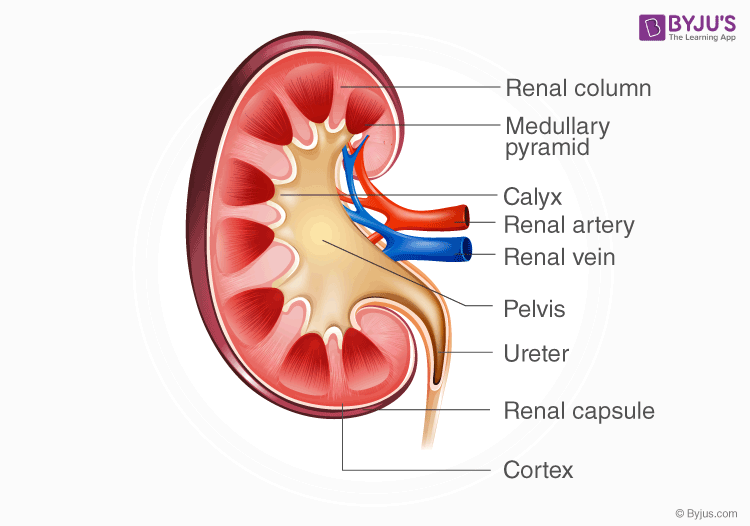
What is this image?
Main strucutres of the kidney
Functional unit of the kindey?
The nephron
Where does filtration occur in the nephron?
The glomerulus a network of capillaries inside the renal corpuscle
What carries urine from the kidneys to the bladder?
The ureters
What is the function of the Henle Loop?
Concentrate urine and reabsorb water and ions from the tubular fluid
Function of the fallopian tubes
Capture the released egg and the site of fertilization
Role of the uterus in reproduction?
The site where the egg develops into the fetus, and where the fetus remains during the duration of pregnancy.
What is oogenesis?
Formation, development, and maturation of female gametes from oogonia. It occurs in the ovaries.
What is spermatogenesis
Production of mature, haploid male gametes (spermatozoa) from undifferentiated male germ cells (spermatogonia). Occurs in the testes.
Function of Ovaries
Produce eggs (Oocytes) and produces estrogen and progesterone
Function of testes
Produce sperm and testosterone
Primary Female Rpeorductive Organs
- Ovaries: Produce eggs (Oocytes) and produce estrogen and progesterone
- Fallopian Tubes: Capture the released egg and the site of fertilization
- Uterus: Where the egg develops into a fetus
- Cervix: Produces mucus and is the gatekeeper during labor
- Vagina: Canal where the penis enters during sex, additionally is the birth canal
- Vulva: Protects internal organs and glands, maintains lubrication
Primary Male Reproductive Organs
- Testes: Produce sperm and testosterone
- Epididymis: the place where sperm mature and are stored
- Vas deferens: transports sperm from the epididymis to the urethra
- Seminal vesicles: secrete fluid that makes up semen
- Prostate gland: adds enzymes and other fluid to semen
- Bulbourethral glands: Lubricate the urethra with fluid pre ejaculation
- Penis: delivers semen to the female
- Urethra: carries semen to the penis
What are the main functions of the reproductive system?
It produces gametes, secretes sex hormones, and ensure survival of species
Function of the Urinary Bladder
The function is a temporary place for urine storage before it leaves the body. It is lined with transitional epithelium
What is the function of the prostate gland?
Produce, store, and secrete a fluid that is 25-30% of the composition of semen
What is the role of the scrotum?
Protects the testicles, acting as a “climate control system.” Maintains optimal temperature for sperm production.
What is fertilization, and where does it usually occur?
Fertilization is when the sperm and egg form the zygote. It occurs in the fallopian tube during internal fertilization.
What is the function of the placenta during pregnancy?
Facilitates nutrient/oxygen delivery, waste removal, hormone production, and immune protection.
What hormone triggers ovulation in females?
Luteinizing hormone (LH)
What hormone is primarily responsible for secondary male sex characteristics?
Testosterone
What hormone prepares the uterus for possible pregnancy?
Progesterone
What is the difference between internal and external fertilization?
Internal fertilization occurs when the sperm and egg join inside the female body, whereas external fertilization is the process that occurs outside the female body.
What is the function of the epididymis?
Where sperm go for storage, maturation, and transport sperm cells.
What is the function of the vas deferens?
Transport mature sperm in preparation for ejaculation.
What hormones are released by the hypothalamus and pituitary gland to regulate reproduction?
Gonadotropin-releasing hormone (GnRH) from the hypothalamus and Follicle-stimulating hormone (FSH) and Luteinizing hormone (LH) from the pituitary gland.
What is the role of gonadotropin-releasing hormone (GnRH)?
Signals the anterior pituitary to produce FSH and LH
What are the functions of luteinizing hormone (LH) and follicle-stimulating hormone (FSH) in males?
- LH: stimulates Leydig cells in the testes to produce testosterone
- FSH: acts on Sertoli cells to support the maturation of sperm
What are the functions of LH and FSH in females?
- LH: Triggers ovulation and the development of the corpus luteum
- FSH: Stimulate ovarian follicle growth and estrogen productions
How do estrogen and progesterone regulate the menstrual cycle?
Estrogen: Builds the uterine lining and triggers ovulation
Progesterone: Stabilizes the uterine lining for pregnancy
What happens during ovulation, and which hormone triggers it?
The release of a mature egg from the ovary to the fallopian tube is triggered by an increase in LH
What is the function of testosterone in males?
Developing male sexual characteristics, maintaining muscle mass, bone density, libido, and sperm production.
How is sperm production regulated by negative feedback?
Maintains stable levels of testosterone and inhibin
What is the role of the corpus luteum?
Produces high levels of progesterone prepare the uterus for pregnancy
What hormonal changes occur during pregnancy?
- Human Chorionic Gonadotropin (hCG): Produced only during pregnancy, it spikes in the first trimester, causing nausea.
- Progesterone: Crucial for relaxing muscles and ligaments to accommodate the growing fetus, which can lead to joint loosening.
- Estrogen: Levels skyrocket to 100 times pre-pregnancy levels by the third trimester. It helps develop the uterus and mammary glands.
- Human Placental Lactogen (hPL): Facilitates nutrient supply to the fetus.
- Relaxin: Loosens joints, specifically in the pelvis, to prepare for labor
Prolactin:Increases significantly to prepare for breastfeeding
How does the hormone hCG (human chorionic gonadotropin) function in early pregnancy?
Maintains the corpus luteum in the early stages of pregnancy, which produces progesterone to preserve the uterine lining
What is the function of inhibin in the reproductive system?
Negatively regulates follicle-stimulating hormone secretion, crucial in the control of sperm production and follicular development/ovulation.
What is the difference between spermatogenesis and oogenesis in terms of timing and outcome?
- Spermatogenesis: Produces multiple mobile sperm and is continuous, starting at puberty and lasts the male’s whole life
- Oogenesis: Produces a single ovum, its discontinuous and occurs in a cycle. Starting at the fetal stage, pausing until puberty, and end at menopause.
How does meiosis contribute to gamete formation?
It creates a new combination of genetic material in the four daughter cells.
What happens to the zygote after fertilization?
It becomes a genetically unique single-cell organism that immediately begins dividing (mitosis) while traveling through the fallopian tube.
What is implantation, and where does it take place?
The uterus
How are nutrients and gases exchanged between the mother and the fetus?
The placenta
What is the function of the umbilical cord?
Delivers oxygenated, nutrient-rich blood to the fetus
What is the difference between an embryo and a fetus?
Embryo: Fertilization to week 8–10 of pregnancy (1st trimester)
Fetus: Week 9–11 to birth.
What hormones are involved in childbirth (parturition)?
Oxytocin and Prostaglandins
Male and Female sex chromosomes
Male: XY
Female: XX
oviparity
females lay undeveloped/early staged development eggs (ex. birds)
ovoviviparity
eggs develop and hatch in the body, then are born live
oviviparity
embryo development inside the mother’s body, specifically the reproductive tracts
protogyny
sequential hermaphrodism, starts female, becomes male
protandry
sequential hermaphrodism, starts male and becomes female
budding
new organisms develop by an outgrowth on the parent's body
fission
single parent divides into 2+ parts
parthenogenesis
embryo develops from an unfertilized egg, no male contribution
fragmentation
organisms breaks off pieces of its body and offspring develops from these fragments
Pros and Cons of Asexual Reproduction
- Pros: enabling rapid population growth in stable environments due to its high speed and energy efficiency
- Cons: lack of genetic diversity
Pros and Cons of Sexual Reproduction
- Pros: allows species to adapt to changing environments, resist diseases, and eliminate harmful mutations
- Cons: high energy and time requirements to find a mate, the necessity of two parents, slower reproduction rates, and the risk of passing on negative mutations
What are hormones, and how are they related to the hypothalamus?
Chemical messengers secreted by glands that regulate bodily functions. The hypothalamus is the controller of the endocrine system, releasing or inhibiting them.
Humoral Stimulus
Hormone release caused by altered levels of specific critical ions or nutrients in the blood.
Hormonal Stimulus
Hormone release triggered by other hormones, known as tropic hormones or tropins.
Neural Stimulus
Hormone release is caused by direct neural input (nerve fibers).
What are the factors that shape the hormone effects on an animal’s body and behavior?
Genetic makeup, developmental stage, social environment, and environmental stresses
Endocrine
glands and tissues that produce and release hormones directly into the bloodstream to regulate growth, metabolism, and reproduction.
Paracrine
A cellular signal where a cell produces a signal to induce a change in adjacent cells
Autocrine
Cell secretes a hormone or chemical messenger that binds to receptors on the same cell, triggering a response
Synaptic
Gap between two nerve cells or a neuron and a muscle/gland cell where nerve impulses are transmitted
Neuroendocrine Signaling
Specialized neurons receive nervous system signals and respond by releasing hormones in the bloodstream.
What is the main difference between hormones and pheromones?
Hormones act internally to regulate bodily functions within a single organism, whereas pheromones act externally to trigger behavioral or physiological responses in other individuals of the same species.
What are the two main classes of hormones?
- Peptide: protein-based
- Steroid: lipid-derived
What are the main differences between the water-soluble and lipid-soluble hormone pathways?
Water soluble can’t directly pass through the membrane; the receptor location is on the cell surface, it is a second messenger system, it’s fast, and the transport is free. Lipid soluble can pass through the membrane, their receptors are intercellular, and they do direct gene activation; they are slow and bound to proteins.
What differentiates an endocrine gland from an exocrine gland?
Endocrine glands have no ducts, while exocrine glands do.
What are the roles of the anterior hypophysis (pituitary gland)?
Regulates growth, metabolism, reproduction, and stress responses by producing and releasing six major hormones
Innate Immune System
The body’s rapid, non‑specific defense: skin and mucous barriers, immune cells, and soluble factors) that recognize many pathogens immediately and kick‑start the adaptive immune response.
Adaptive Immune System
The slower, highly specific defense that uses B‑cells (and T‑cells to target particular pathogens and retain memory for faster, stronger responses upon re‑exposure. How do immune cells recognize pathogens?
Innate Immune Cells
- Neutrophils
- Macrophages
- Dendritic cells (myeloid
- Natural‑killer (NK) cells- Eosinophils- Basophils / Mast cells:.
- Monocytes
Neutrophils
First responders that phagocytose bacteria and fungi; release enzymes and reactive oxygen species to kill microbes and form extracellular traps (NETs).
Macrophages
Large phagocytes that ingest pathogens, dead cells, and debris; secrete cytokines to recruit other immune cells and present antigens to initiate adaptive responses.
Dendritic cells (myeloid)
Capture antigens in peripheral tissues, migrate to lymph nodes, and present processed antigens to naïve T cells, bridging innate and adaptive immunity.
Natural‑killer (NK) cells
Recognize and kill virus‑infected or stressed cells lacking normal MHC‑I; release perforin, granzymes, and cytokines (e.g., IFN‑γ) to shape immunity.
Eosinophils
Combat large parasites (helminths) and contribute to allergic inflammation; release toxic granule proteins and cytokines.
Basophils / Mast cells
Contain granules rich in histamine and heparin; trigger inflammation and vascular permeability during allergic reactions and parasite defense.
Monocytes
(circulating precursors of macrophages and some dendritic cells) – Patrol blood, migrate into tissues to become macrophages or dendritic cells when needed.
Adaptive Immune Cells
- lymphocytes (B cells)
- Helper T cells (CD4⁺ T cells)
- Cytotoxic T lymphocytes (CD8⁺ T cells)- Regulatory T cells (Tregs)
- Memory B and T cells
Lymphocytes (B cells)
Mature in bone marrow; upon activation differentiate into plasma cells that secrete antibodies specific to a particular antigen; some become memory B cells for rapid recall responses.