Movement Disorders and Parkinson’s Disease
 Call Kai
 Learn
Learn Practice Test
 Spaced Repetition
 Match
Match Flashcards
 Knowt Play
1/57

There's no tags or description
Looks like no tags are added yet.
Name | Mastery | Learn | Test | Matching | Spaced | Call with Kai | Chat |
|---|
No analytics yet
Send a link to your students to track their progress
58 Terms
What are some causes of Parkinson’s disease?
Aging
Genetic factors
Free radicals- loss of anti-oxidant defiance mechanism
Environmental factors
Pesticides (rotenone and Paraguat)
What are the genetic influences of Parkinson’s disease?
Alpha-synuclein: mutation or over expression
Levy bodies: abnormal build of proteins
PARK2 gene mutation: loss of function of Parkin proteins- neuronal cell death
What is the pathological hallmark of Parkinson’s disease?
Loss of dopaminergic neurons of the substantial nigra pars compacta
What are the major pathways of dopaminergic neurons?
Nigrostriatal system (substantia nigra to striatum)
Ventral regimental area (VTA)
Tubero-infundibular pathway (hypothalamus to median eminence)
Area postrema
Describe the nigrostriatal system
Contains about 80% of brains dopamine
Degeneration results in abnormalities of movement
Describe Ventral regimental area (VTA)
Neurons that project from the ventral regimental area to the limbic system and prefrontal cortex
Inner ate forebrain areas, cerebral cortex, nucleus accumbens and other limbic structure- motivation, goal, directed thinking, positive reinforcement
Degeneration of this pathway- schizophrenia
Describe Tubero-infundibular pathway
Neurons that originate in the hypothalamus, and project axons to the median eminence with the anterior pituitary gland
Inhibits release of prolactin by pituitary lactotrophs
Describe Area postrema
High contents of class D2 receptors
These dopamine receptors activate the vomiting centers of the brain and is one of the causes of emesis
(D2) Dopamine receptors are used to treat nausea and vomiting
Describe Striatum
Information processing center of basal ganglia
Cortical input to striatum are excitatory and use glutamate as a transmitter
The striatum is also the target of the dopaminergic nigrostriatal pathway
Compare the direct and indirect pathway
Dopamine inhibits indirect pathway and stimulates the direct pathway
Direct pathway: enables movement
Indirect pathway: inhibits movement
D1- direct pathway (Ca2+ mobilization)
D2- indirect pathway (K+ currents)
Effect of Parkinson’s disease on dopaminergic pathways that regulate movement
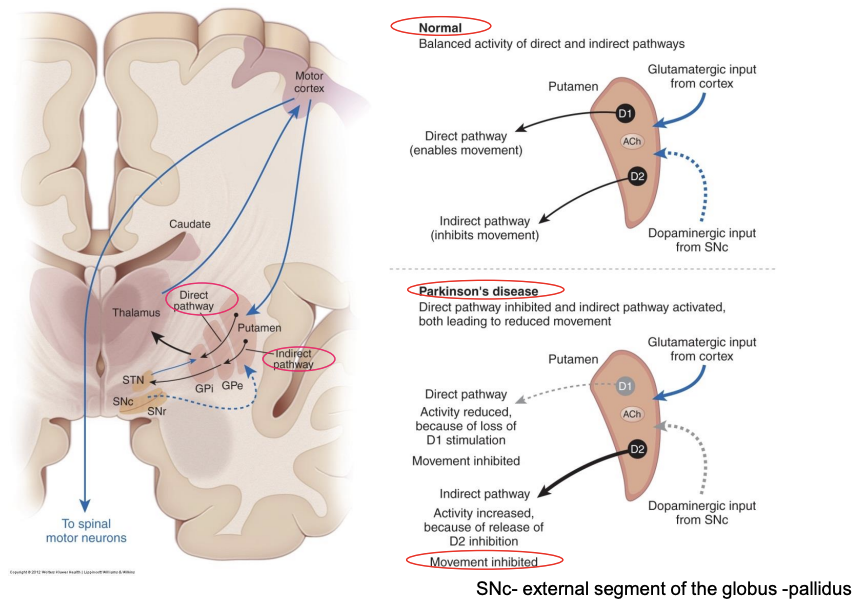
Direct pathway vs. Indirect pathway
Direct pathway - D1 receptors expressing neurons (turn up motor activity)
Indirect pathway - D2 receptor expressing neurons (turn down motor activity)
Normal proper movement
Normal level of dopamine in the striatum
Activate the D1 expressing neurons in the direct pathway and inhibiting the D2 expressing neurons in the indirect pathway
Parkinson’s disease
Reduced movement → dopamine deficiency
Direct pathway is inactive and indirect pathway is overactive
Catecholamine synthesis
Pic
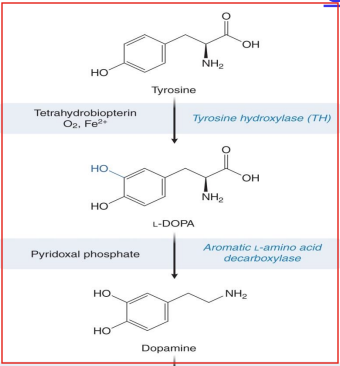
Tyrosine: - mainly from diet - small proportion is synthesized in liver from phenylalanine
Explain dopaminergic neurotransmission
Catecholamine reuptake pump
Monoamine Oxidase
Catecholamine reuptake pump
DAT couples with Na+ /K+ -ATPase pump
Monoamine oxidase (MAO) or catechol-O-methyl transferase ( COMT) – Enzymes responsible to degrade dopamine
MAO-A in brain and periphery
MAO-B responsible for catabolizing CNS dopamine
What are the pharmacologic classes for the treatment of Parkinson’s?
Dopamine precursors
Dopamine receptor agonists
Inhibitors of dopamine degradation
What do the current treatments of Parkinson’s do?
Treat symptoms but not alter the underlying degenerative process
Not respond to nonmotor symptoms (cognitive impairment and dementia)
What is the MOA of Levodopa?
Replenish dopamine
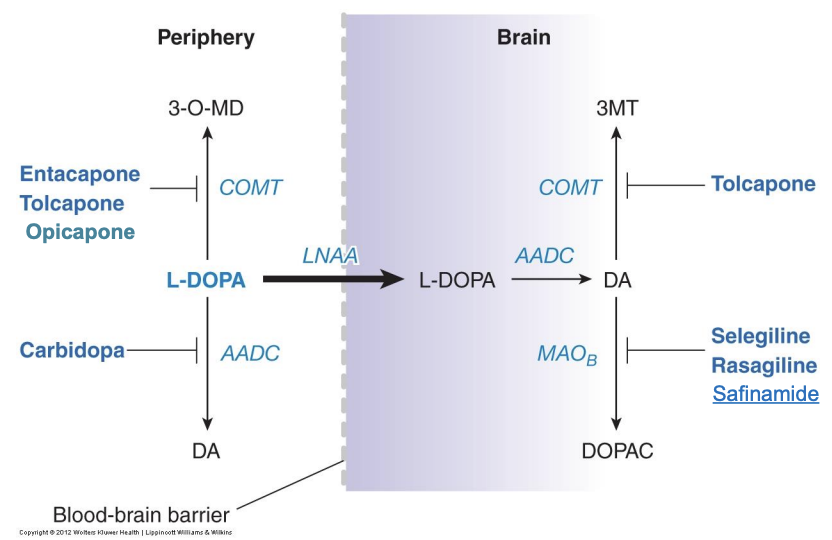
L-DOPA is readily transported across BBB by neural amino acid transporter
Oral administration: Levodopa is readily converted into dopamine by AADC in the gastrointestinal tract
Amino acid decarboxylase inhibitor
Diminishes the amount of L-DOPA that can reach BBB for transport into CNS 2.
Increases the peripheral adverse effects that result from the generation of dopamine in the circulation
Levodopa -1-3% reaches CNS
Carbidopa
AADC inhibitor (periphery)- administered in combination with L-DOPA
prevents the conversion of levodopa to dopamine in the periphery
availability of L-DOPA to CNS - 10
Why is Levodopa- Carbidopa an effective combination therapy?
Decreases levodopa dosage requirements by 70–80%
Reduces the incidence of peripheral adverse effects (nausea and vomiting)
Relief from akinesia, rigidity, and tremor •
Continued therapy - tolerance and sensitization - requires more drug (narrowing of the therapeutic window)
Carbidopa/levodopa ratio
1:4 or 1:10
Sinemet
10/100 -10 mg Carbidopa and 100 mg Levodopa 25/100 -25 mg Carbidopa and 100 mg Levodopa 25/250 -25 mg Carbidopa and 250 mg Levodopa
Duopa
Intestinal suspension
a gel suspension of levodopa/carbidopa
for the management of patients in advanced stage
Crexont
Combination extended- and immediate-release treatment
Levodopa- adverse effect
Off” periods and “On” Periods
Dyskinesias
Off” periods and “On” Periods
Fluctuation in motor function - periods of freezing and increased rigidity (“off” periods) alternating with periods of normal or even dyskinetic movement (“on” periods)
“Off” periods- plasma levels of Levodopa decline- compensated by higher drug dosage
“On” periods- large amount of dopamine is delivered to the striatum overcome by smaller drug dose
Dyskinesias
High dose - uncontrollable rhythmic movement of the head, trunk, and limbs
Levodopa long term treatment- declines in therapeutic response
Dopamine receptor agonists derivatives
Ergot derivatives
Nonergot agonis
Dopamine receptor agonists MOA
Activates dopaminergic neurotransmission
Dopamine receptor agonists Clinical Use
1) Initial stage of the disease
2) Younger individuals - initial treatment (monotherapy)
Dopamine Receptor agonist ADE
nausea, hypotension, cardiac conduction abnormalities, hallucinations, confusions
Dopamine dysregulation syndrome
Pathological gambling - compulsive eating and hyper sexuality (require discontinuation of medication)
Contraindicated in patients with psychiatric illness
Ergot derivatives
Bromocriptine (D2 agonist)
Nonergot agonists
Rotigotine (D2) (Neupro)
Pramipexole (D3>D2) (Mirapex)
Ropinirole (D3>D2) (Requip)
Apomorphine (D1 and D2 agonist)
Inhibitors of Dopamine Metabolism
Inhibitors of MAO-B and COMT (catechol-O-methyl transferase)
MAO-B inhibitors Drugs
Selegiline (Carbex,Eldepryl)
Rasagiline (Azilect)
Safinamide (Xadago)
MAO-B inhibitors Use
Monotherapy or in combination with other medications (Levodopa and Carbidopa)
Improve motor function for patients experiencing dyskinesia and “off” periods
MAO-B inhibitors disadvantages
effective for monotherapy - not as effective as Levodopa - does not interfere with MAO-A
Safinamide: (Xadago)
Selective monoamine oxidase B inhibitor
Inhibits glutamate release
Blockade of voltage-dependent Na+ and Ca2+ channels
Adverse Effects of MAO-B inhibitors
Involuntary movement
CNS depression
Serotonin syndrome
Selegiline vs. Rasagiline
Selegiline: potentially toxic metaboliteamphetamine (cause sleeplessness and confusion)
Rasagiline: more potent, no toxic metabolite
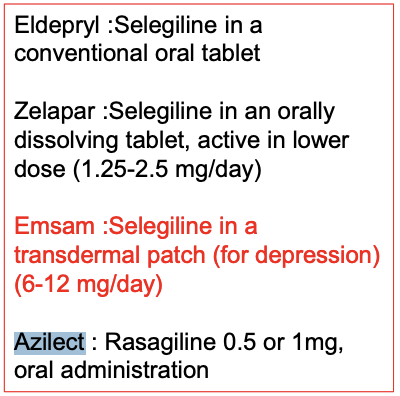
Formulations
Eldepryl
Zelapar
Emsam
Azilect
COMT inhibitors
Tolcapone
Entacapone
Opicapone
Stalevo
COMT inhibitors MOA
inhibits catechol-O-methyl transferase
inhibits the degradation of levodopa as well as dopamine Opicapone: (Ongentys)
inhibits only peripheral COMT enzymes
Reduce ‘off’ periods that are associated with decreasing plasma levodopa levels
Tolcapone: (Tasmar)
cross the BBB
inhibits central as well as peripheral COMT
associated with hepatic toxicity
Entacapone (Comtan
inhibits peripheral COMT
most widely used COMT inhibitor
Opicapone: (Ongentys)
inhibits only peripheral COMT enzymes
Stalevo
combined with Carbidopa, Entacapone, and Levodopa
Which inhibitors should not be given together?
COMT inhibitors should not be given with non-selective MAO inhibitors
Peripheral and central metabolism of levodopa
Nondopaminergic Pharmacology
Amantadine
Trihexyphenidyl
Benztropine
Amantadine
MOA
Therapeutic Action
MOA: Block of excitatory NMDA (N-methyl D-aspartate) receptors
Therapeutic Action: Prescribed in combination with levodopa-carbidopa - used to treat levodopa induced dys
Symmetrel vs. Osmolex
Symmetrel : Immediate-release amantadine Osmolex ER: Extended release formulation
Anticholinergic drugs
Trihexyphenidyl
Benztropine
For Anticholinergic drugs:
What is the Therapeutic Action?
ADE
Contraindication?
Muscarinic receptor antagonist - adjuvant therapy with levodopa- carbidopa
Regulate interactions of direct and indirect pathway neurons - effective for treating tremor in young patients
dry mouth, urinary problem, impairment of memory and cognition
Patients with glaucoma, GI obstruction