Sono Physics & Instrumentation (Sound Test)
 Call Kai
 Learn
Learn Practice Test
 Spaced Repetition
 Match
Match Flashcards
 Knowt Play
1/32

There's no tags or description
Looks like no tags are added yet.
Name | Mastery | Learn | Test | Matching | Spaced | Call with Kai | Chat |
|---|
No analytics yet
Send a link to your students to track their progress
33 Terms
What is the horizontal axis letter?
X-axis
What is the vertical axis letter?
Y-axis
What does unrelated mean? E.X: hair color and shoe size
Two items that are not associated
What does directly related or directly proportional mean? E.X: clothing size and weight
Two items that are associated such that when one item increases, the other increases.
What does related or proportional mean? E.X: weight and dieting
Two items that are associated or affiliated. However, the relationship between the items does not have to be specific
What does inversely related or inversely proportional mean? E.X: golf score and skill
Two items are associated such as that when one item increases, the other decreases.
What occurs with a reciprocal relationship and what are they? Give examples
When two numbers with a reciprocal relationship are multiplied together, the result is one. Reciprocal numbers are inverse because when in increases the other decreases. E.X: 2 and ½
What does ambiguous mean?
All numerical values must have corresponding units. A number alone without units is ambiguous. For example, if you ask the question “How old is Justin Bieber? You can’t simply say 25. Is it 25 hours, 25 days, 25 years, or 25 decades.
What is length measured in?
cm and feet
What is area measured in?
Cm2 and ft2 (this is squared)
What is volume measured in?
cm3 and ft3 (this is cubed)
What is not a unit?
Percent
What does increase by a factor and decrease by a factor mean?
Increase: multiply by that number (E.X: by a factor of 6 means six times larger) Decrease: divide by that number (E.X: by a factor of 3 means six 1/3)
What does a number with a positive exponent have? What does a number with a negative exponent have? What does a number with an exponent of 0 have? How do you correctly calculate the number?
A greater value than 10; A value less than 1; A value between 1 and 10
To calculate: 1. Shift the decimal point so the resulting number is between one and ten 2. Multiply by the appropriate power of 10
For Example: If you have the number 1742 if would turn into 1.742 × 10 to the 3rd power
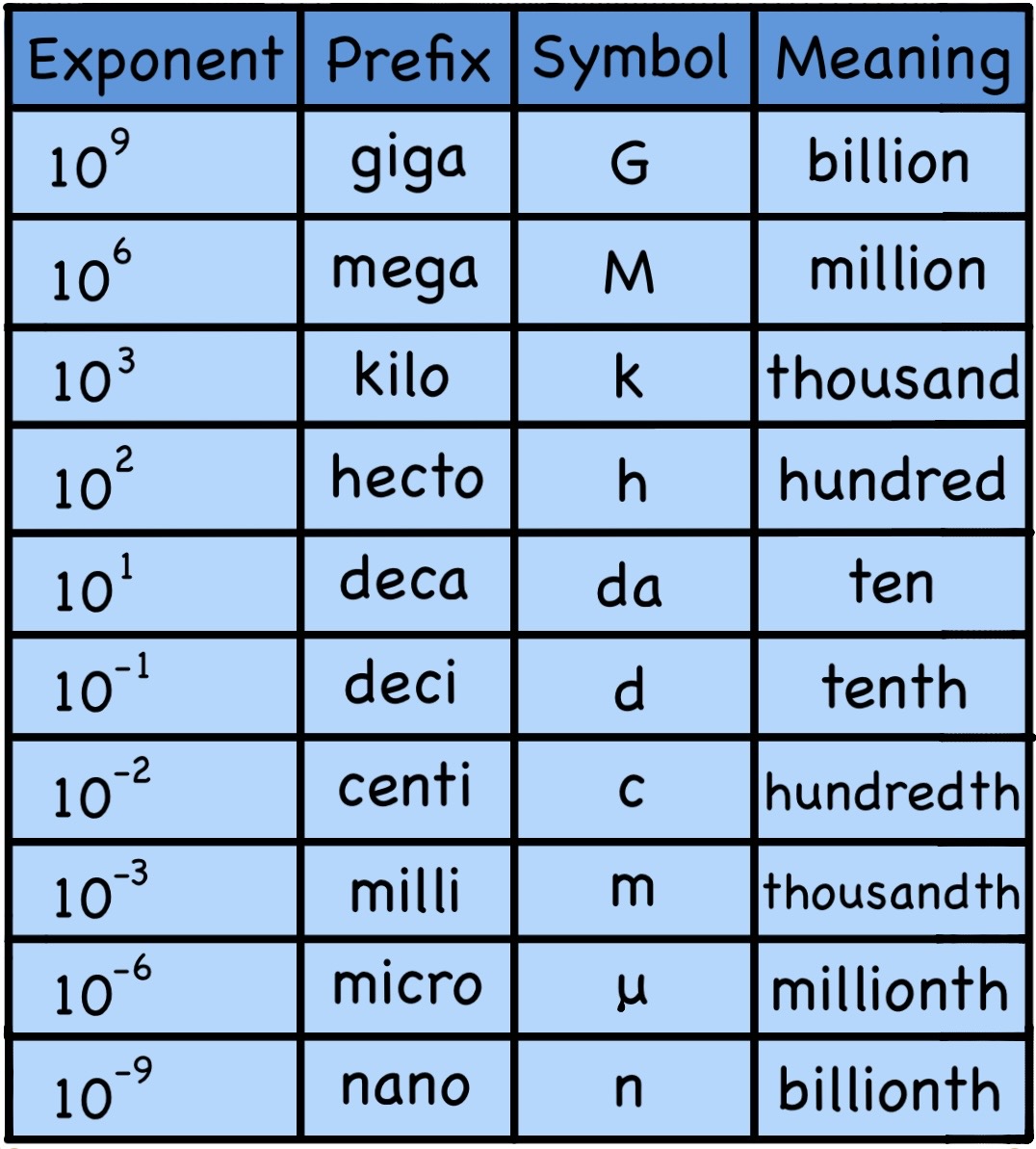
What is the metric table?
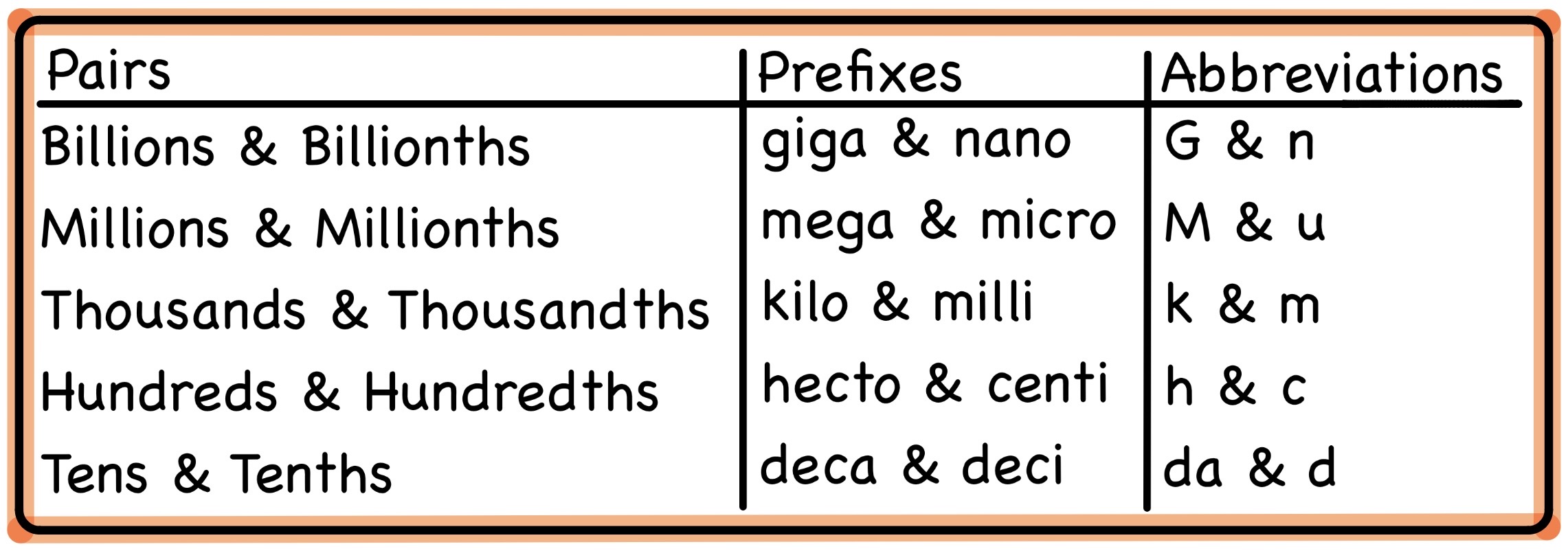
Saying to help remember… Good men know how da dance cause mom yells nightly
What are the pairs?
How does sound work in ultrasound? What do waves carry?
Sound pulses created by a transducer tracker through tissue, or media. Reflections arising from boundaries between structures in the body return to the transducer and are processed into images. Waves carry energy
Define sound
Sound is a mechanical wave that carries energy, not matter, from place to place. It is created by the vibration of a moving object and consists on a series of compressions and rarefactions.
What are compressions?
Compressions are areas of increased pressure or density (squeezed together)
What is acoustic propagation properties?
It is the effect of the medium upon the sound wave.
What is are the biological effects?
The effects of the sound wave upon the biological tissue; limited to no effects as of today
What are rarefactions?
Rarefactions are areas of decreased pressure or density (stretched apart)
Sound must travel through a _________, cannot travel through a __________. What type of wave is sound and how does it travel?
Medium, vacuum. Sound is a mechanical, longitudinal wave and travels in a straight line.
How are sound waves identified and define these variables?
Sound waves are identified by oscillations in acoustic variables. There are 3 acoustic variables…
1.) Pressure: concentration of force within an area [measured in pascals]
2.) Density: concentration of mass within a volume [measured in kg/cm3]
3.) Distance: measure of particle motion [measured in cm, ft, miles]
After a wave is identified as a sound wave, it is importance to describe the wave’s features. What are the 7 acoustic parameters used to describe the characteristics of a sound wave?
Period, Frequency, Amplitude, Power, Intensity, Wavelength, and Propagation speed (Pretty females are proud in white and paint slow]
How do particles in a transverse wave move and which direction is the sound wave going?
The particles are perpendicular (up and down) and the sound wave is moving left to right.
How do particles move in a longitudinal wave?
Particles move in the same direction as the sound wave (left to right).
What does it mean when a pair of waves are considered in-phase?
The waves are considered in-phase when their peaks occur at the same time and at the same location.
What does it mean when a pair of waves are considered out-of-phase?
The waves are considered out-of-phase when their peaks occur at different times and so do their troughs.
In phase relationships, what does interference mean?
Interference is when two waves overlap at the same location and at the same instant in time, they combine into one new wave.
In phase relationships, what does constructive interference mean?
Constructive interference occurs when the amplitude of the new, combined wave is greater than the original two waves. (In-phase waves interfere constructively)
In phase relationships, what does destructive interference mean?
Distinctive interference is when the amplitude of the new wave is less than one of the original waves. (Out-of-phase waves interfere destructively)
What happens when waves of different frequencies interfere?
When this happens they will in-phase part of the time and out-of-phase part of the time. This means the wave with be both constructive and destructive.