AST + common terms
 Call Kai
 Learn
Learn Practice Test
 Spaced Repetition
 Match
Match Flashcards
 Knowt Play
1/169

There's no tags or description
Looks like no tags are added yet.
Name | Mastery | Learn | Test | Matching | Spaced | Call with Kai | Chat |
|---|
No analytics yet
Send a link to your students to track their progress
170 Terms
Bunion
Hallux valgus, abnormal enlargement of the big join at the base of the great toe
popliteal
describes the posterior space behind the knee where the ligaments, vessels, and muscles related to this joint are located.
acetabulum
hip socket
Asymphysis
a place where two bones are closely joined
Lamina
posterior portion of a veretebra
sprain
when a ligament connects bone to a join is wrenched or torn
luxation
dislocation, total displacement of a bone from its joint
subluxation
partial displacement of a bone from its joint
capsul
talipes
clubfoot. Congential deformity of the foot involving the talus(ankle bones)
exostosis
outgrowth of tissue
Osteoporotic
pertaining to or caused by the porous condition of bones
comminuted
crushed into small pieces
Crepitation
the grating sound heard when ends of broken bones move together
autologous
originating within an individual
Cortical bone
Type of bone tissue that is hard and dense, and that surrounds the marrow cavity; also referred to as compact bone.
Cancellous bone
A type of bone tissue found at the ends of bone and lining the medullary marrow cavity; composed of columns of trabeculae with large spaces in between; also referred to as spongy bone due to its appearance.
Periosteum
thing fibrous two-cell layer of tissue surround bone
Endosteum
Thin fibrous layer of tissue like periosteum that lines the channels along the bones and fill the interstitial space of the cancellous bone and the Haversian canals. Initiates bonr growth and provides nutritional substance to bone
Calcitonin
hormone secreted by the thyroid gland that acts on the osteclasts to inhibit their activity and decrease absorption of calcium from the bones.
Diaphysis
shaft of the long bone
Epiphyses (singular, epiphysis)
the ends of bone shaft
Bursa
small synovial fluid sacs in the joints such as the shoulder
Endochondral ossification
the process of new bone forming
Sesamoid
round bones
Flat bones
ribs, scapula, sternum, cranial bones
Synarthrosis
immovable joint. IE the suture line of the cranial bones
Amphiarthrosis
joints that are slightly movable. IE cartilage that connects the vertebrae and disk of cartilage
diarthrosis (synovial joints)
freely movable joint.
Condyle
smooth, round, knuckle-like knob at the end of bone that forms a joint with another bone
Sinus
open space within a bone
Sulcus
depression within a bon
Process
Prominent project or bump on a bone
Tendons
fibrous tissue that connects muscle to bone
Lateral decubitus
orientation where patient lies on their side with body perpendicular to the imaging table or bed
avulsion
tear
EUA
Examination Under Anesthesia
osteophyte
smooth, bony lump that grows along the edges of joints or where bones meet
Streptococcus pyogenes
Causes toxic shock syndrome, necrotizing fasciitis, streptococcal pharyngitis, impetigo,
Streptococcus aureus
Staph infection.
Mycobacterium leprae
causes Hansen’s dieases, commonly known as leprosy.
Clostridium perfringens
causes myonecrosis (gas gangrene)
Candida albicans
Yeast-like resident microflora in the mouth and gastrointestinal tract
Treponema pallidum
Causes syphilis
Borrelia burgdorferi
Bacterium that causes Lyme disease
Trypanosoma cruzi
Causes Chagas disease. Spread by triatomine or ‘kissing bugs;.
Plasmodium falciparum
Causes Malaria
Kitnner sponge
Small tightly wound cylindrical cotton or rayon sponge. Used for neurology
pledgets
small squares of teflon
gelfoam
absorbable gelatin
Avitene
Absorbable collagen
First intention healing
(primary union). Dead space has been eliminated and wound edges have been approximated.
Second Intention healing
(granulation). Wound cannot be directly apprixmated or in which infection has caused breakdown of a sutured wound. Necrotic tissue is debidged and wound is left open and allowed to heal from the inner layer to the outside surface.
proud flesh
Excessive granulation tissue
Third intentional healing
(delayed primary closure). Infection-free wound is closed and allowed to finish healing process through first intention. A combination of both first and second healing.
nosocomial infection
an infection acquired at. HFC (HAI).
Dehiscence
Partial or total separation of a layer or layers of tissue after closure
Edema
The condition of an abnormally large fluid volume in tissues between the body’s cells
Gerota’s fascia
The smooth exterior fibrous capsule that surrounds the kidneys
Shunt
divert fluid from part to another
CABG
coronary artery bypass graft for a Myocardial infarction
hallux valgus
The outward turning of the great toe away from the midline.
Hallux varus
The inward turning of the great toe toward the midline.
coxa valga
outward turning of the hip joint
coxa vara
inward turning of the hip joint
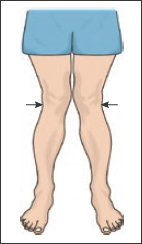
genu valgum
The knees are in close position and the space between the ankles is increased, referred to as “knock-kneed”
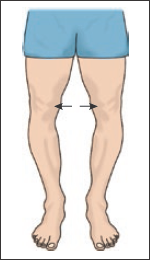
Genu varum
Bowlegged; the space between the knees is abnormally increased and the lower leg bows outwardly
Talipes valgus
Outward turning of the foot away from the midline
talipes varus
i
Colles’ fracture
A fracture of the distal radius that occurs at the epiphysis within 2.54 cm of the wrist joint, forcing the hand into a dorsal and lateral position.
Caused by a direct force, such as when falling and stretching out the hand to break the fall.
Bucket handle
Dual vertical fractures on the same side of the pelvis. Caused by direct force or anterior compression of the pelvis.
Ewing’s tumor
Malignant tumor of bone affecting mostly boys between 5 and 15 years of age. The cure rate is currently greater than 60 percent with chemotherapy, radiation therapy, and surgery.
agglutination
clumping of red blood cells
RhoGAM
RhoGAM is an injectable medication used to prevent Rh disease, a condition that occurs when an Rh-negative mother's immune system attacks the blood cells of an Rh-positive baby. It is given to pregnant mothers at 28 weeks, after delivery, and following any trauma or pregnancy loss
Retroperitoneal
Referring to the space between the peritoneum and the posterior abdominal wall.
Wilm’s tumor
Also called nephroblastoma; Mixed-cell tumor that originates in the kidney and if not treated eventually replaces most of the involved kidney and affects the renal vein causing hemorrhaging and thrombosis. The most common pediatric tumor of the abdomen that affects the kidney.
glenoid fossa
The socket in which the head of the humerus articulates to form the shoulder joint; a ball-and-socket joint.
temporomandibular joint
The joint formed by the mandible that articulates with the glenoid fossa in each temporal bone.
Condyle
Rounded projection/process at the epiphysis of a bone that articulates with another bone; serves as the point of attachment for ligaments.
Malar bones
Form the prominences of the cheeks and a portion of the inferior and lateral wall of the orbit.
oculus dexter
right eye
oculus uterque
Each eye
oculus sinister
Left eye
oculi uterque
Both eyes
canthus
the angle where the upper and lower eyelids meet
conjunctiva
transparent mucous membrane that lines the underside of each eyelid and continues to form a protective covering over the exposed surface of the eyeball. The plural of conjunctiva is conjunctivae
optic
pertaining to the eye sight
Sclera
The white of the eyes
choroid
the opaque middle layer of the eyeball that contains many blood vessels and provides the blood supply for the entire eye
retina
receives nerve impulses and transmits them to the brain via the optic nerve
Humor
describes any clear body liquid or semifluid substance.
uvea
is the pigmented layer of the eye
Chalazion
nodule or cyst, usually on the upper eyelid, caused by obstruction of a sebaceous gland
Hordeolum
Also known as a stye, is a pus-filled and often painful lesion on the eyelid resulting from an acute infection in a sebaceous gland.
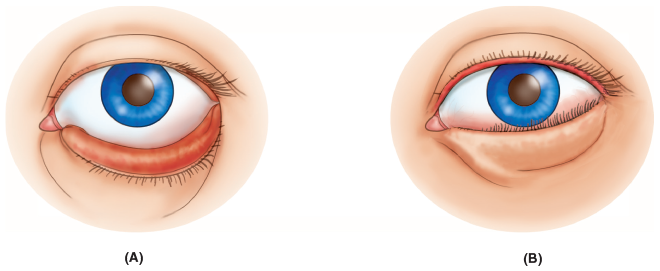
ectropion
eversion of the edge of an eyelid
mydrias
diluation of the pupil
Diplopia
Double vision
Nyctalopia
night blindness
Presbyopia
Condition of common changes in eyes that occur with aging