nurses role in quality and safety week 3
 Call Kai
 Learn
Learn Practice Test
 Spaced Repetition
 Match
Match Flashcards
 Knowt Play
1/43

There's no tags or description
Looks like no tags are added yet.
Name | Mastery | Learn | Test | Matching | Spaced | Call with Kai | Chat |
|---|
No analytics yet
Send a link to your students to track their progress
44 Terms
What are the 6 aims of quality health care (STEEEP)?
Safe – avoid harm
Timely – reduce harmful delays
Effective – evidence-based care
Efficient – avoid waste
Equitable – same quality for all
Patient-centered – respect patient values/preferences
What does quality health care mean?
Care that is genuinely good for the patient—not simply care that gets delivered.
It should be safe, timely, effective, efficient, equitable, and patient-centered
What is the nurse's role in quality improvement and quality care?
Advocate for safety/preferences
Use evidence-based practice
Use ADPIE
Participate in QI projects
Report errors/near misses
Maintain skills through lifelong learning
How does ADPIE support quality improvement?
Assess → Diagnose → Plan → Implement → Evaluate. Each step protects quality and helps nurses identify errors early
What is a Just Culture?
A safety culture focused on fixing system problems rather than simply blaming individuals, while maintaining accountability for reckless behavior
Ex: root cost analysis(why did it happen), near miss(stopping before patient),
How does Just Culture respond to human error, at-risk behavior, and reckless behavior?
Human error: coach + redesign system
At-risk: coach + remove temptation
Reckless: accountability applies
What is a sentinel event?
An unexpected death or serious harm unrelated to the natural course of the patient's illness.
What is a near miss, and should it be reported?
An error that is caught before reaching the patient.
Yes—near misses should still be reported
What is Root Cause Analysis (RCA)?
A safety approach that asks “Why did this happen?” rather than “Who did this?” to identify causes of an error
What should a nurse do after discovering an error or near miss?
Report it honestly every time. A culture of safety depends on speaking up and reporting both errors and near misses
What is patient safety?
Freedom from harm or danger and feeling secure enough to heal.
Patient safety is the responsibility of every healthcare team member
What are the major National Patient Safety Goals?
Correct patient identification
Staff communication
Medication safety
Alarm safety
Infection prevention
Identify safety risks
Prevent surgical mistakes
How should a nurse correctly identify a patient?
Always use 2 patient identifiers. Never use the patient's room number as an identifier.
What strategies improve medication safety?
Label medications, double-check, and reconcile medications.
Medication safety is a National Patient Safety Goal.
What nursing actions improve communication and alarm safety?
Communication: report critical results promptly.
Alarms: keep alarms on, audible, and respond to them.
Which patient factors increase the risk for safety problems?
Developmental stage
Impaired mobility
Sensory changes
Cognitive impairment
Emotional stress
Unfamiliar environment
What are the major predictors/risk factors for falls?
High-yield predictors include age ≥65, previous falls, and confusion. Other risks include sensory deficits, impaired mobility, medications, and unfamiliar surroundings.
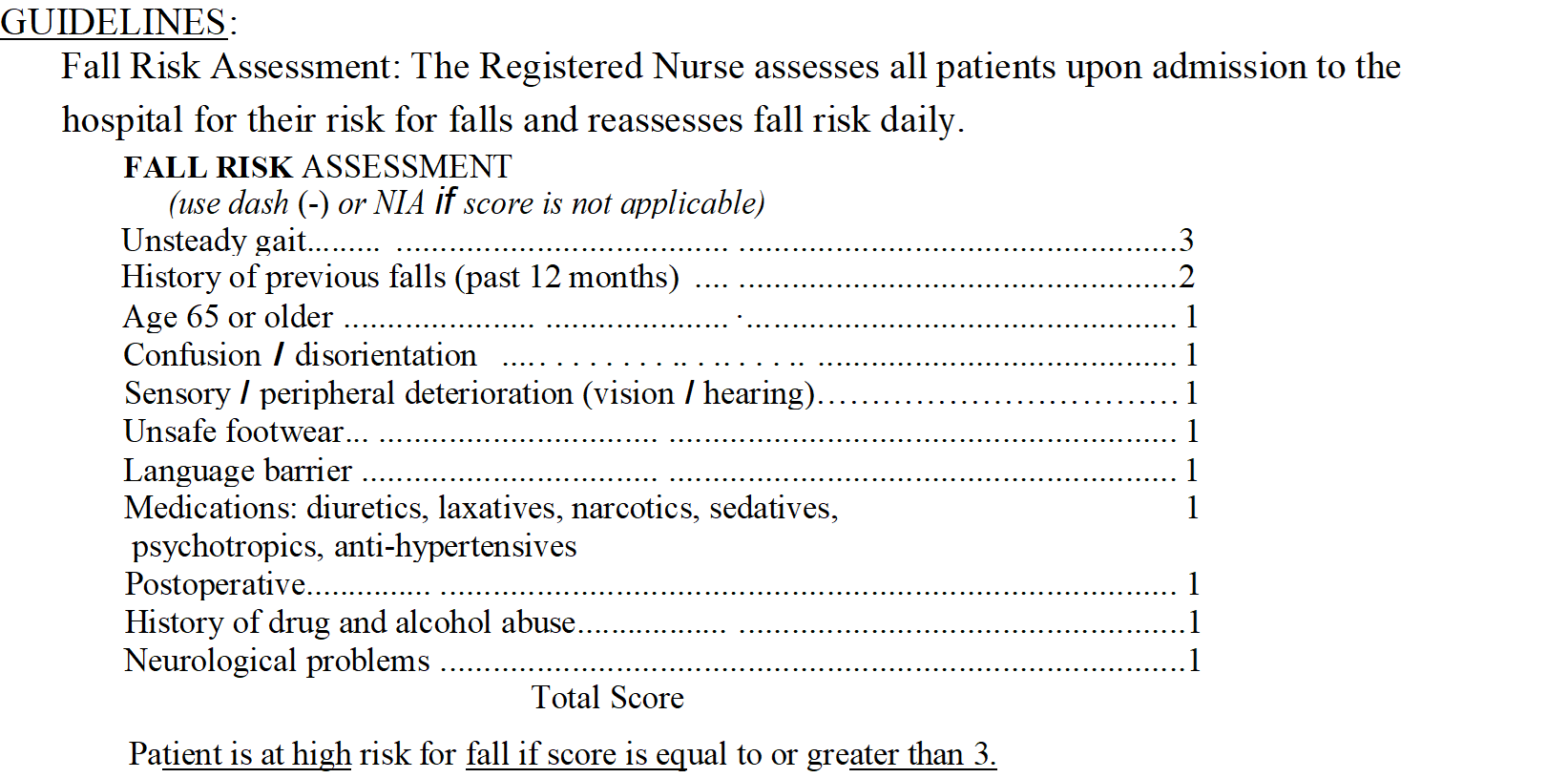
When should an RN assess a hospitalized patient's fall risk?
On admission and daily thereafter. In the lecture's fall-risk assessment, a score of ≥3 = high fall risk.
What nursing interventions should be used for a patient at risk for falls?
Fall-risk identification,
room near nurses' station,
orientation,
call bell/items within reach,
alarms,
nonskid footwear,
“Call, Don't Fall!”
Which patient should the nurse prioritize for immediate safety intervention?
most immediate risk of harm—e.g., the lecture prioritizes an 82-year-old with dementia trying to get out of bed due to immediate fall risk.
What does RACE stand for in fire safety?
R – Rescue patients near fire
A – Activate alarm
C – Confine: close doors/windows
E – Extinguish if safe
What does PASS stand for when using a fire extinguisher?
P – Pull pin
A – Aim at base
S – Squeeze handle
S – Sweep side to side
What should a nurse do during and immediately after a seizure?
Turn patient to side + time seizure.
Never restrain or place anything in mouth.
Afterward, assess airway, breathing, and injury.
What are the key safety rules for restraints?
Last resort; least restrictive alternative first;
provider order required;
never for convenience/punishment;
assess skin/circulation and release per policy, at least q2h
What safety principle should guide NCLEX-style questions?
Choose the answer that removes the hazard, rather than an intervention that only treats the injury after it occurs
A nurse is reviewing the six aims of quality health care. Which nursing action best demonstrates patient-centered care?
A. Using the least expensive supplies available
B. Following the same care plan for every patient
C. Incorporating the patient's values and preferences into care
D. Completing all nursing interventions as quickly as possible
Correct Answer: C. Incorporating the patient's values and preferences into care
Rationale: Patient-centered care means respecting the patient's values and preferences. The six quality aims are Safe, Timely, Effective, Efficient, Equitable, and Patient-Centered (STEEEP).
A nurse administers the wrong medication but recognizes the error before the medication reaches the patient. How should this event be classified?
A. Sentinel event
B. Near miss
C. Reckless behavior
D. Expected outcome
Correct Answer: B. Near miss
Rationale: A near miss is an error that is caught before it reaches the patient. Near misses should still be reported because they can reveal safety problems within the healthcare system.
Following a serious patient safety event, the healthcare team performs a Root Cause Analysis (RCA). What is the primary purpose of RCA?
A. Determine which nurse should be disciplined
B. Determine why the event occurred
C. Identify which patient caused the event
D. Determine whether the event should be documented
Correct Answer: B. Determine why the event occurred
Rationale: Root Cause Analysis asks, “Why did this happen?” rather than “Who did this?” The goal is to identify underlying causes that contributed to the safety event
Which action by a nurse best demonstrates a Just Culture approach after a staff member makes an unintentional human error?
A. Immediately terminate the employee
B. Ignore the error because it was unintentional
C. Coach the employee and examine how the system can be redesigned
D. Punish the employee to prevent future errors
Correct Answer: C. Coach the employee and examine how the system can be redesigned
Rationale: In a Just Culture, human error → coaching and system redesign. At-risk behavior is addressed through coaching/removing temptation, while reckless behavior involves accountability.
Which action by the nurse follows the National Patient Safety Goal for correct patient identification?
A. Asking the patient's room number and diagnosis
B. Using the patient's room number and last name
C. Using two patient identifiers before providing care
D. Asking another nurse to visually identify the patient
Correct Answer: C. Using two patient identifiers before providing care
Rationale: Nurses should always use two patient identifiers and should never use the patient's room number as an identifier.
The nurse receives report on four patients. Which patient should the nurse assess first?
A. A healthy 25-year-old recovering from an appendectomy
B. An 82-year-old with dementia attempting to get out of bed
C. A 40-year-old with a broken arm
D. A 19-year-old waiting for discharge paperwork
Correct Answer: B. An 82-year-old with dementia attempting to get out of bed
Rationale: This patient has an immediate risk for injury from falling. Older age, confusion, and impaired safety awareness increase fall risk. NCLEX safety questions prioritize removing or addressing the immediate hazard.
Which patient would the nurse identify as having the greatest fall risk based on the lecture's fall-risk assessment?
A. A 40-year-old with unsafe footwear
B. A 55-year-old taking an antihypertensive
C. A 68-year-old with an unsteady gait
D. A 30-year-old postoperative patient
Correct Answer: C. A 68-year-old with an unsteady gait
Rationale: In the lecture's assessment, unsteady gait = 3 points and age ≥65 = 1 point, giving this patient at least 4 points. A score ≥3 indicates high fall risk
A hospitalized patient is identified as being at high risk for falls. Which nursing intervention is appropriate?
A. Keep personal belongings away from the bedside
B. Encourage the patient to ambulate independently
C. Keep the call bell and personal items within reach
D. Apply restraints whenever the nurse leaves the room
Correct Answer: C. Keep the call bell and personal items within reach
Rationale: Fall-prevention strategies include keeping the call bell and personal belongings within reach, orienting the patient, using fall-risk identification, nonskid footwear, and bed/chair alarms as needed.
A patient begins having a seizure while lying in bed. Which action should the nurse take?
A. Insert an oral airway immediately
B. Hold the patient's extremities still
C. Turn the patient onto the side and time the seizure
D. Place an object between the patient's teeth
Correct Answer: C. Turn the patient onto the side and time the seizure
Rationale: During a seizure, turn the patient onto the side and time the seizure. Never restrain the patient or place anything in the mouth. Afterward, assess airway, breathing, and injuries.
A nurse discovers a fire in a patient's room. According to RACE, what is the nurse's first action?
A. Activate the fire alarm
B. Close all doors and windows
C. Rescue patients near the fire
D. Attempt to extinguish the fire
Correct Answer: C. Rescue patients near the fire
Rationale: RACE determines the order of actions:
R — Rescue patients near the fire
A — Activate the alarm
C — Confine by closing doors/windows
E — Extinguish if safe
what does a red wristband mean?
allergy
what does a yellow wristband mean?
fall risk
what does a purple wristband mean?
DNR
what does a pink band mean?
limb alert do not use
what are activities of daily living? (ADL)
bathing
dressing
grooming
eating
toileting
transferring

what are instrumental activities of daily living?
cooking
cleaning
managing finace
grocery shopping
managing medications

what give the highest points for fall risk?
unsteady gait: 3
History of previous falls: 2
PATEINT IS HIGH RISK IF GREATER THAN 3

what is the fall risk assessment system?
point system to establish fall risk
unsteady gait: 3
History of previous falls: 2
age 65 or older: 1
confusion/disorientation: 1
sensory/ peripheral deterioration(vison+hearing): 1
unsafe footwear: 1
language barrier: 1
medications (diuretics, narcs, laxatives, sedatives): 1
post op: 1
history of drug and alcohol abuse: 1
neurological problems: 1
HIGH RISK IF GREATER THAN 3
