2CHEM organics
 Call Kai
 Learn
Learn Practice Test
 Spaced Repetition
 Match
Match Flashcards
 Knowt Play
1/13

There's no tags or description
Looks like no tags are added yet.
Name | Mastery | Learn | Test | Matching | Spaced | Call with Kai | Chat |
|---|
No analytics yet
Send a link to your students to track their progress
14 Terms

Two molecules are shown below and labelled as A and B. Identify whether each one of these could exist as geometric isomers and justify your answer.
Define Geometric isomers:
A geometric isomer is a molecule with the same molecular formula and same structural formula, but have a different arrangement of atoms in space.
State the requirement for a geometric isomer to form
To form geometric isomers, the molecule must contain a double bond c=c to prevent rotation of atoms around the bond. It also requires that each carbon in the c=c bond is bonded to 2 different groups.
Do the compounds meet the requirement? Explain why/why not.
Molecule A and B both contain a c=c double bond to prevent rotation. However, molecule A does not have 2 different groups attached to th C in the c=c. The second C in the c=c is bonded to two CH3 groups. So it canot form a geometric isomer.
In molecule B, the first C in the C=C is bonded to a H and a CH3 , both are different groups. The 2nd C is bonded to a CH3 and a CH2CH3 , which are also different groups. It therefore forms a geometric isomer.
Explain what would have a higher boiling point: ethanol or hexanol
Boiling point is determined by the size of the molecule and the strength of attraction between particles. Hexanol (C6H13) is a much larger molecule than Ethanol (C2H5). As it is large it has stronger intermolecular forces, which means that more heat energy(higher temperature) is required to overcome the attraction during melting. So Hexanol will have a higher boiling point.
ALknae chain is a non-polar group
in order for the organic compound to be soluable there should be a polar group attached to it.

Two molecules are shown below and labelled as A and B. Identify whether each one of these could exist as geometric isomers and justify your answer.
Geometric isomers have the same molecular and structural formula, but a different arrangement in space.
For a given molecule to exist as geometric isomers, it must have:
A double bond between two C atoms. The double bond prevents any rotation around its axis, meaning that the groups bonded to each C atom in the double bond will be locked in place.
Two different groups attached to both C atoms in the double bond.
Molecule A does have a C=C double bond, but one of the carbon atoms is bonded to two CH₃ groups. This means this molecule can’t exist as geometric isomers. Different ways of drawing it will be the same molecule flipped over.
Molecule B has a C=C double bond, and both C atoms in the bond are attached to two different groups: H and CH₃ on the left carbon, and CH₃ and CH₂CH₃ on the right carbon. This means this molecule can exist as geometric isomers.
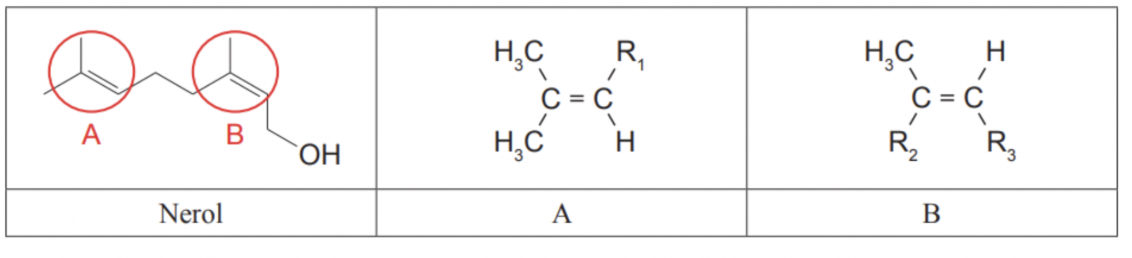
Pōhutukawa flowers contain many terpene compounds (volatile organic compounds) that contribute to their fragrance. An example of a terpene, nerol, is shown below.
Two functional groups, A and B, have been circled and shown to the right. The label R has been used in place of the complex remainder of the molecule. Note that the R₁, R₂, and R₃ groups are all different.
(i) Identify which of A and B will exist as geometric isomers.
B will exist as geometric isomers.
(ii) Justify your choice by explaining the requirements for geometric isomerism.
For geometric isomerism to occur:
The molecule must contain a C=C double bond, which prevents rotation.
Each carbon atom in the double bond must be attached to two different groups.
Although A also contains a C=C double bond, it does not meet the second requirement because one of the carbon atoms is bonded to two identical CH₃ groups. Therefore, A cannot form geometric isomers.
In B, one carbon atom is attached to H and R₃, while the other is attached to CH₃ and R₂. Since each carbon has two different groups attached, B can exist as geometric (cis/trans) isomers.
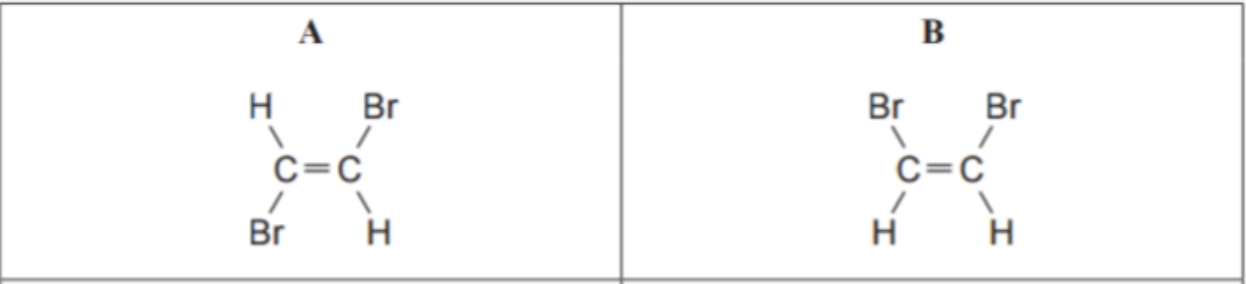
Elaborate on the stucture of organic compound 1,2 diromoethene to explain why it is able to form cisa nd trans geometric isomers
In order for geometric isomers to form, it must have an double bond to prevent rotation and each carbo atom must have a different atom/group of atom attched to it.
1,2-Dibromoethene can form cis and trans isomers because it contains a C=C double bond. The double bond between the two carbon atoms prevents rotation around the bond.
In addition to the double bond, each carbon atom in the double bond must have two different atoms or groups attached. In 1,2-dibromoethene, both carbon atoms are bonded to one H atom and one Br atom, so this requirement is met.
When these two requirements are satisfied, the alkene can have the same molecular formula and structural formula, but a different arrangement of atoms in space (different 3D arrangement). Therefore, 1,2-dibromoethene exists as cis and trans (geometric) isomers.
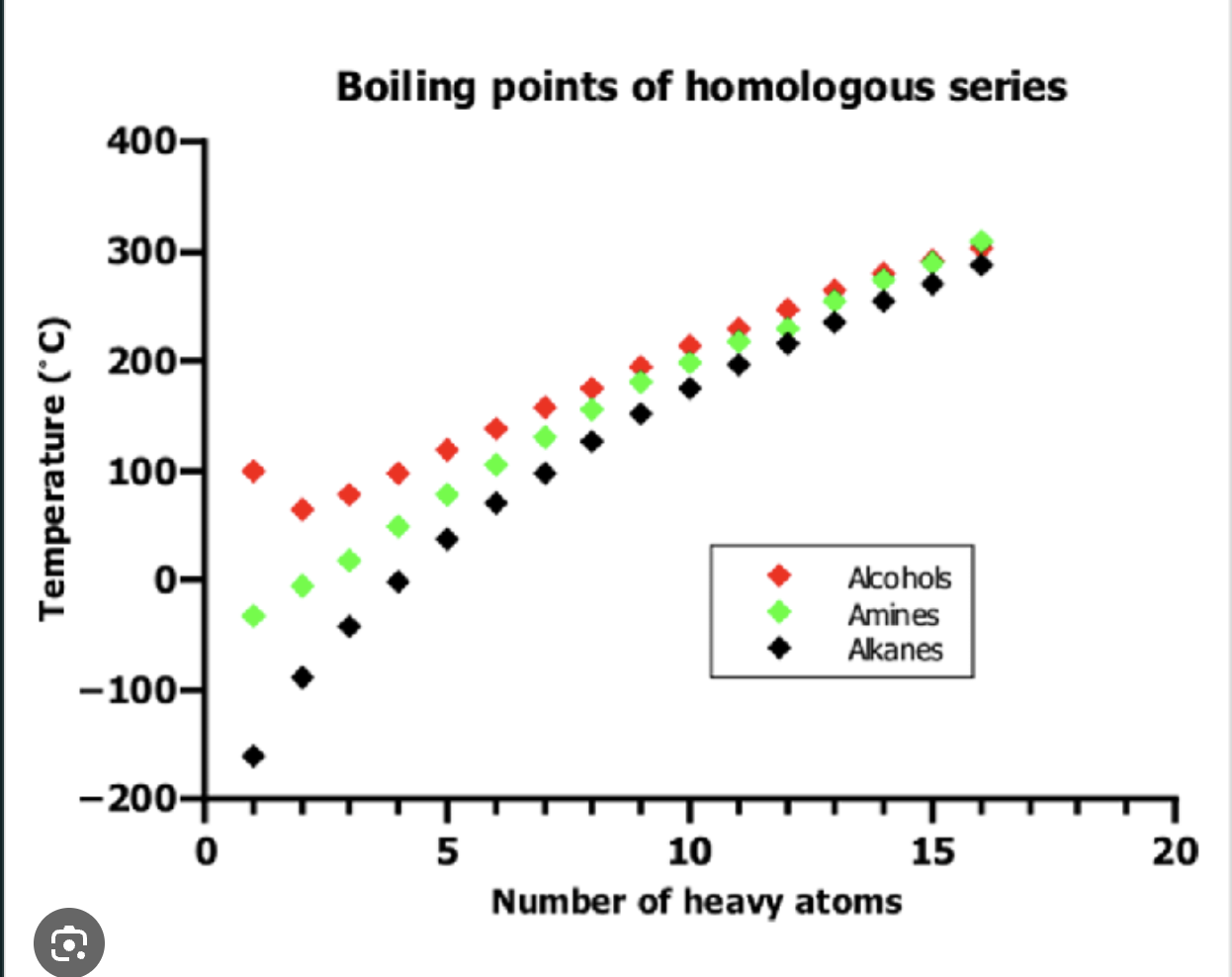
Above is a graph illustrating the boiling points of alcohols with a different number of carbon atoms in the carbon chain. use the keywords below, explain the trend seen in the graph:
Key words
Intermolecular attractions
Size
Strong
break/overcome
Heat energy
Boiling point
From the graph, I can see that the boiling point of alcohols increase from 60 degrees for 1 carbon atom to 140 degrees for 5 carbon atoms. This makes sense as the number of carbon atom increases, the number of electrons increases, resulting in the intermolecular forces between the molecules to be stronger. As the intermolecular forces are stronger, more heat heat energy are required to overcome the attraction. So the trend of the graph would go upwards.
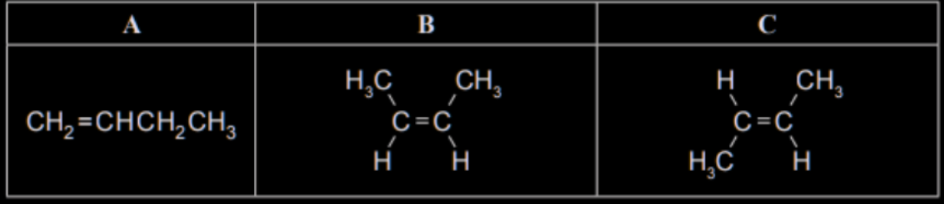
The C₄H₈ (butene) molecule can display different forms of isomerism.
(i)
Circle the form of isomerism that exists between molecules A and B:
(ii)
Circle the form of isomerism that exists between molecules B and C:
(iii)
Compare and contrast the two forms of isomerism.
In your answer, you should:
Explain the requirements for each form of isomerism.
Refer to molecules A, B, and C above.
(ii)
Constitutional/Structural
(iii)
Geometric
Constitutional isomers have the same molecular formula but a different arrangement or sequence of bonded atoms.
All three molecules have the molecular formula C₄H₈, but molecule A has its double bond beginning at the first carbon, while molecules B and C have their double bond between the second and third carbon atoms. Therefore:
Molecule A is but-1-ene.
Molecules B and C are but-2-ene.
Therefore, molecules A and B are constitutional/structural isomers.
For geometric isomerism to occur:
A carbon-carbon double bond is required.
Each carbon atom in the double bond must be bonded to two different atoms or groups.
The carbon-carbon double bond is rigid and does not allow rotation. This allows different spatial arrangements to form.
Both B and C have a CH₃ group and an H atom attached to each carbon atom in the double bond.
In molecule B, the two CH₃ groups are on the same side of the double bond. This is cis-but-2-ene.
In molecule C, the two CH₃ groups are on opposite sides of the double bond. This is trans-but-2-ene.
Therefore, molecules B and C are geometric isomers.
Molecule A cannot form geometric isomers because the first carbon atom in its double bond is attached to two identical hydrogen atoms.
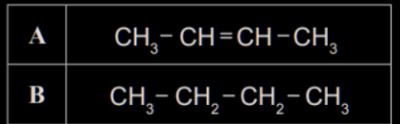
Refer to the compounds in the table below to answer the questions.
(i) Draw and name the two geometric, or cis-trans, isomers of compound A.
(ii) Explain why compound A exists as geometric isomers while compound B does not.
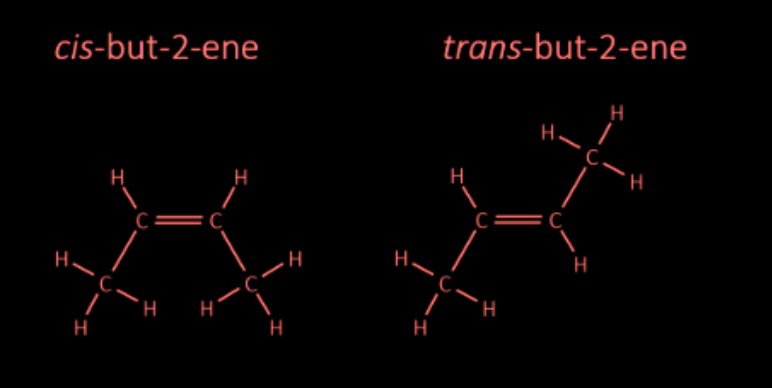
(i) The two geometric isomers are:
cis-but-2-ene
trans-but-2-ene
In cis-but-2-ene, the two CH₃ groups are on the same side of the C=C double bond.
In trans-but-2-ene, the two CH₃ groups are on opposite sides of the C=C double bond.
(ii) Compound A can form geometric isomers because it has the two required features:
It contains a C=C double bond, which prevents rotation.
Each carbon atom in the double bond is attached to two different groups: one CH₃ group and one H atom.
These groups can therefore have different arrangements in space, producing cis and trans isomers.
Compound B cannot form geometric isomers because it does not contain a C=C double bond. Its carbon-carbon single bonds can rotate freely, so fixed cis and trans arrangements cannot form.
Draw four constitutional isomers of C4H9Br
?
Devise a procedure you could use to distinguish between ethanol, propan-1-ol, and pent-1-ene, using only their physical properties.
Physical identification is limited to differences in melting point, boiling point, or solubility.
All three substances are liquids at room temperature.
Procedure
Test the solubility of each liquid in water.
Add a small amount of each liquid to separate test tubes containing water and shake.
Pent-1-ene is insoluble and forms a separate layer because it is non-polar.
Ethanol and propan-1-ol are soluble because their hydroxyl (–OH) groups allow them to form hydrogen bonds with water.
Measure the boiling points of the two liquids that dissolve in water.
Ethanol has the lower boiling point (about 78 °C).
Propan-1-ol has the higher boiling point (about 97 °C) because it has a larger molecule, resulting in stronger London dispersion forces while still hydrogen bonding.
Identification
Insoluble in water → Pent-1-ene
Soluble, boils at ~78 °C → Ethanol
Soluble, boils at ~97 °C → Propan-1-ol
Why this works
Pent-1-ene is non-polar, so it does not dissolve in polar water.
Ethanol and propan-1-ol both contain an –OH group, making them polar enough to dissolve in water.
Between the two alcohols, propan-1-ol has a longer carbon chain and stronger intermolecular forces, so it has a higher boiling point than ethanol.
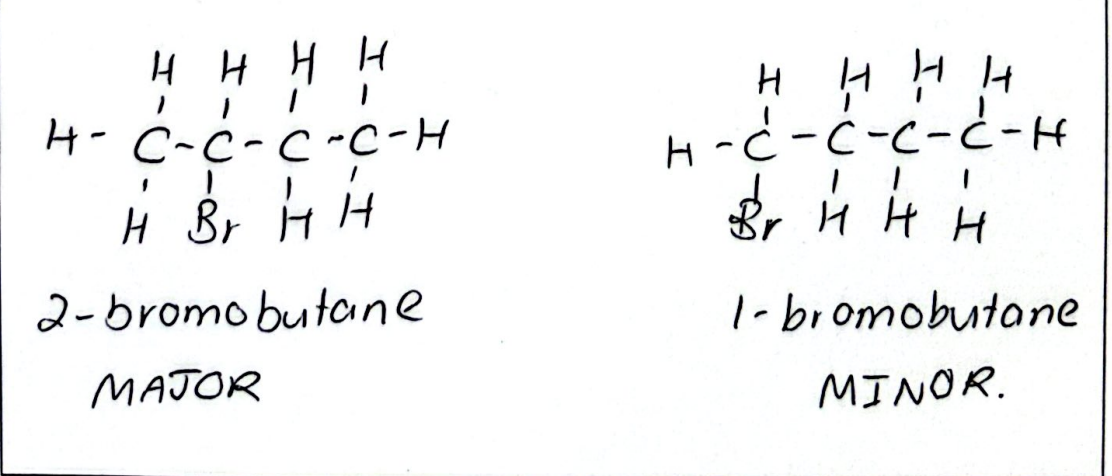
When but-1-ene is reacted to form bromobutane - C4H9Br, two organic products are formed.
Analyse this reaction by:
Stating the reagent required
Identifying the type of reaction and justifying your choices
Explain why there is a mixture of oraganic compound
This is an addition reaction as the C=C in but-1-ene is being broken and leaving leaving a c-c to which H and Br will bond. THerefore the reagent needed is Hbr.
This reaction will form 2 product because but-1-ene is a asymmetrical alkene and because Hbr contains 2 different atoms - the H and the Br - which bond in two different ways. If the H is added to C1, the major product will form because C1 will now have most H atoms bonded to it ( 3 H atoms).
THe minor product would form if the H atom from the HBr is bonded to C2 , which has the least amount of H atoms bonded to it. And this would produce the minor product.
Alkanes and alkenes can be identified by their reactions with a solution of bromine water, Br2 (aq).
Contrast the types of reactions an alkane and an alkene will undergo with an orange solution of bromine water.
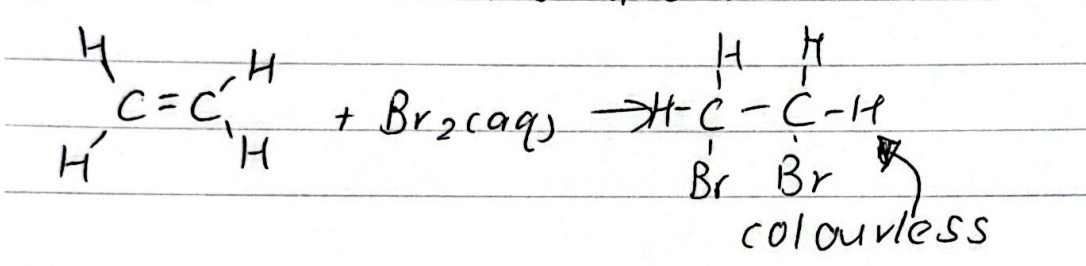
When an alkene reacts with Br2(aq), it reacts immediately with it, declouring it to colourless very quickly. No catalyst is required. This is an addition reaction where the C=C bond is broken and the two Br atoms are added.
When a alkane reacts with Br2(aq), it reacts slowly to it, and require the presence of UV light. The orange Br2 (aq) will decolourise very slowly. This is a subsitution reaction where one H from the alkane is replace with a Br from the Br2(aq)
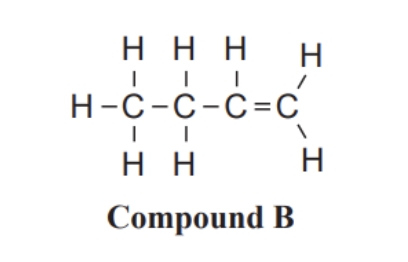
When Compound B reacts with hydrochloric acid, HCl, without heat, two products are formed in differing amounts.
Compound B:
CH₃–CH₂–CH=CH₂ (but-1-ene)
Discuss the reaction of Compound B with hydrochloric acid.
In your answer you should:
name and explain this type of reaction
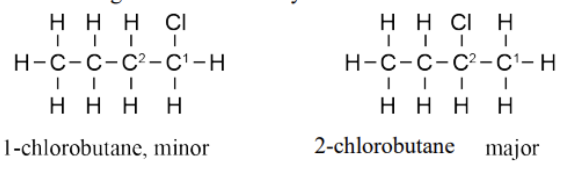
draw the structures of both products, in the appropriate box for the major and minor products
justify your choice of major and minor products.
Whiteboard Answer
This is an addition reaction because the C=C double bond is broken to leave a single bond where the H and Cl from HCl can bond onto each carbon from the original double bond.
The major product forms when the H from the HCl is added to the carbon in the C=C with the most H's bonded to it originally. In this case, the H will be bonded to C₁. The Cl will bond to C₂, forming 2-chlorobutane.
The minor product forms when the H from HCl is added to the carbon in the C=C with the least H's. In this case C₂. The Cl is added to C₁, forming 1-chlorobutane.
Marking Schedule / Model Answer
In this addition reaction the C=C double bond breaks open and a single bond forms in its place. This leaves one more bonding space around each of the carbon atoms involved in the original double bond, in this case C₁ and C₂. The reagent, HCl, is added across the double bond, with one carbon forming a bond with the H atom and the other forming a bond with the Cl atom. There are two products formed, as this new bonding can happen two ways round.
Products:
1-chlorobutane – minor product
2-chlorobutane – major product
According to Markovnikov's rule, the major product will form when the carbon in the double bond that originally had the most hydrogen atoms bonded to it gains the H atom during the addition reaction; in this case C₁. Hence the major product is 2-chlorobutane, as the Cl atom then joins C₂. When the bonding occurs the other way round, it forms the minor product, 1-chlorobutane.
Achievement Criteria
Achievement
Correct structures for products (major/minor can be incorrectly assigned)
OR
States there are two ways that HCl can be added.
Partial explanation of the addition reaction.
Merit
Explains major and minor products (but may miss aspects of the explanation).
Correct structures.
Excellence
Explains how to identify the major and minor products, and why they occur, including correct structures.