Ana prac 1: Palate and muscles of mastication
 Call Kai
 Learn
Learn Practice Test
 Spaced Repetition
 Match
Match Flashcards
 Knowt Play
1/19

Name | Mastery | Learn | Test | Matching | Spaced | Call with Kai | Chat |
|---|
No analytics yet
Send a link to your students to track their progress
20 Terms
What is the definition of the palate?
The partition between oral and nasal cavities
What are the parts of the palate?
1) Hard palate:
Boney part, anterior 2/3, and formed of bone
2) Soft palate:
Muscular part, posterior 1/3, and it has a muscular fold

What is the hard palate formed of? (in detail)
It is formed by the palatine processes of the maxillae and the horizontal plates of the palatine bones, covered with a mucus membrane.
(M = maxilla, P = palatine)

What is the definition of the soft palate?
The movable soft part that separates the oropharynx and nasopharynx.

Where is the uvula?
It is suspended from the middle lower border of the palate, where a cone shaped projection called the uvula hangs.

What are the muscles of the palate?
1. Tensor palati muscle.
2. Levator palati muscle.
3. Palatoglossus muscle.
4. Palatopharyngeus muscle.
5. Musculus uvulae.

What are the names of the muscular folds?
Two muscular folds extend downward on both sides:
1. The anterior fold is called the palatoglossal arch.
2. The posterior fold is called the palatopharyngeal arch.
Between these two arches is the tonsillar fossa.

Where does the nerve supply for the palate come from?
1) Sensory nerve supply = from maxillary nerve branches
2) Motor nerve supply = All muscles supplied by pharyngeal plexus EXCEPT TENSOR PALATI SUPPLIED BY MANDBIULAR NERVE

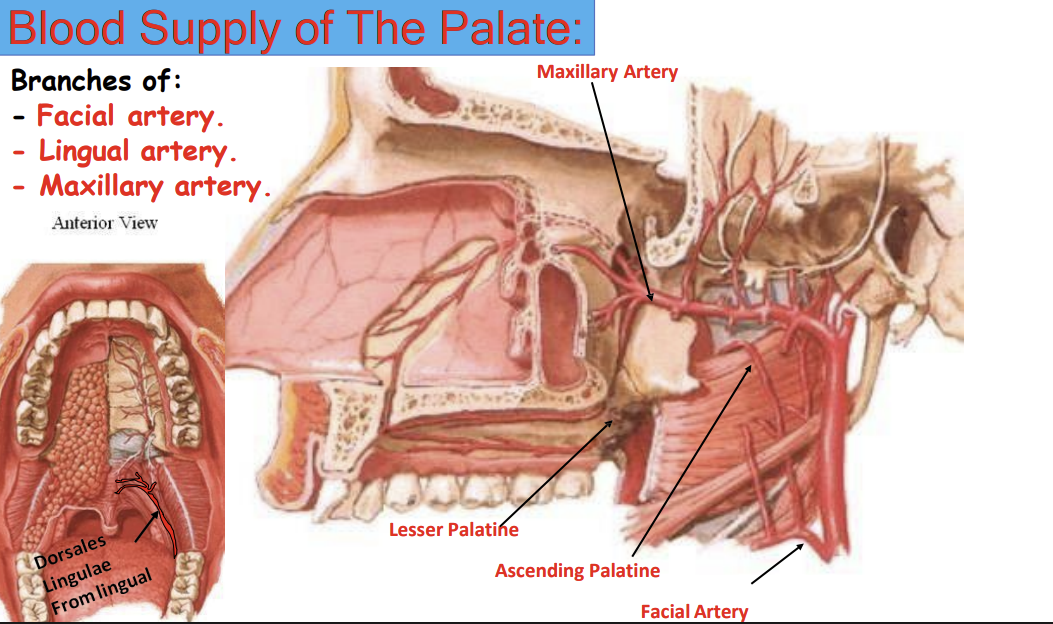
What arteries supply the palate with blood?
Branches of the facial, lingual and maxillary arteries
What type of joint is the tempromandibular joint and its movements?
It is a synovial joint, condylar and hinge-type, contains intraarticular disc.
Movements are:
1. Elevation & depression.
2. Protrusion & retraction.
3. Side to side movement.

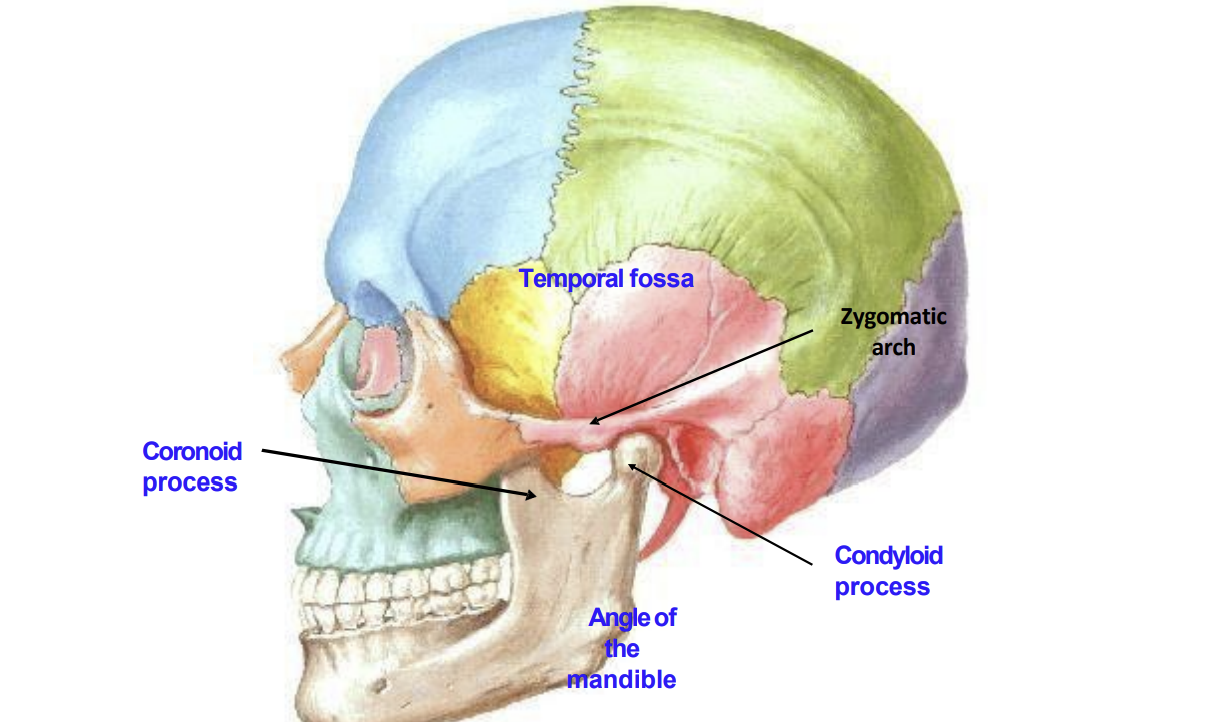
What are the articular surfaces of the tempromandibular joint?
1) Head of the mandible, below
2) Mandibular fossa of temporal bone, above
What type of joint is the tempromandibular joint and its movements?
Type: Synovial joint, condylar and hinge type.
- It contain intraarticular disc.
Movements:
1. Elevation & depression.
2. Protrusion & retraction.
3. Side to side movement.

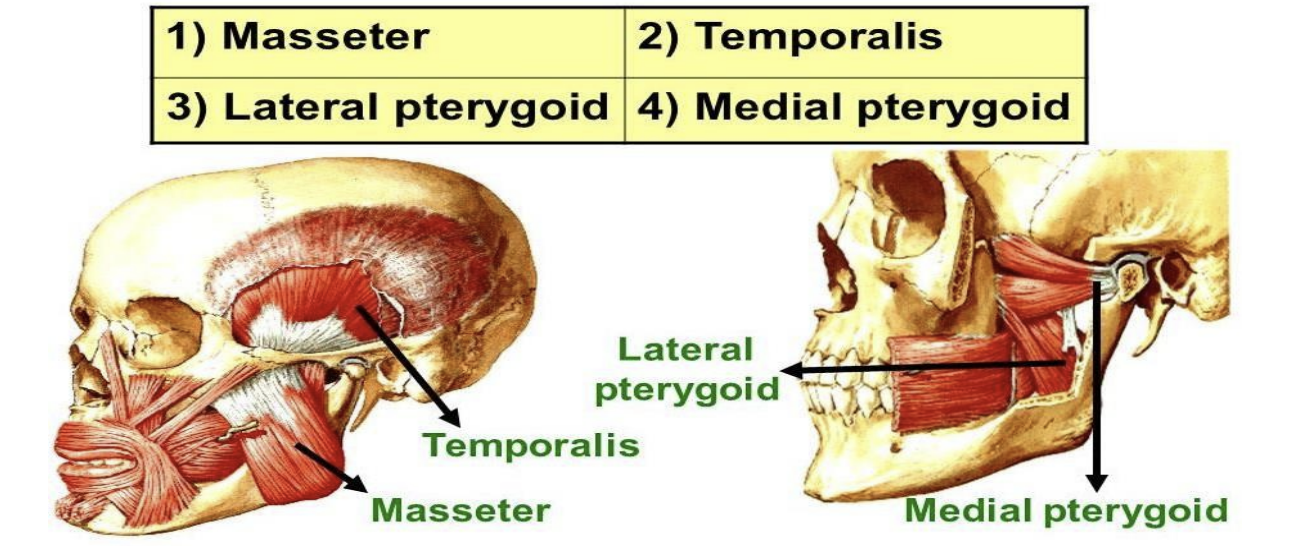
Define the muscles of mastication and list them.
The muscles of mastication move the mandible during mastication and speech
They are:
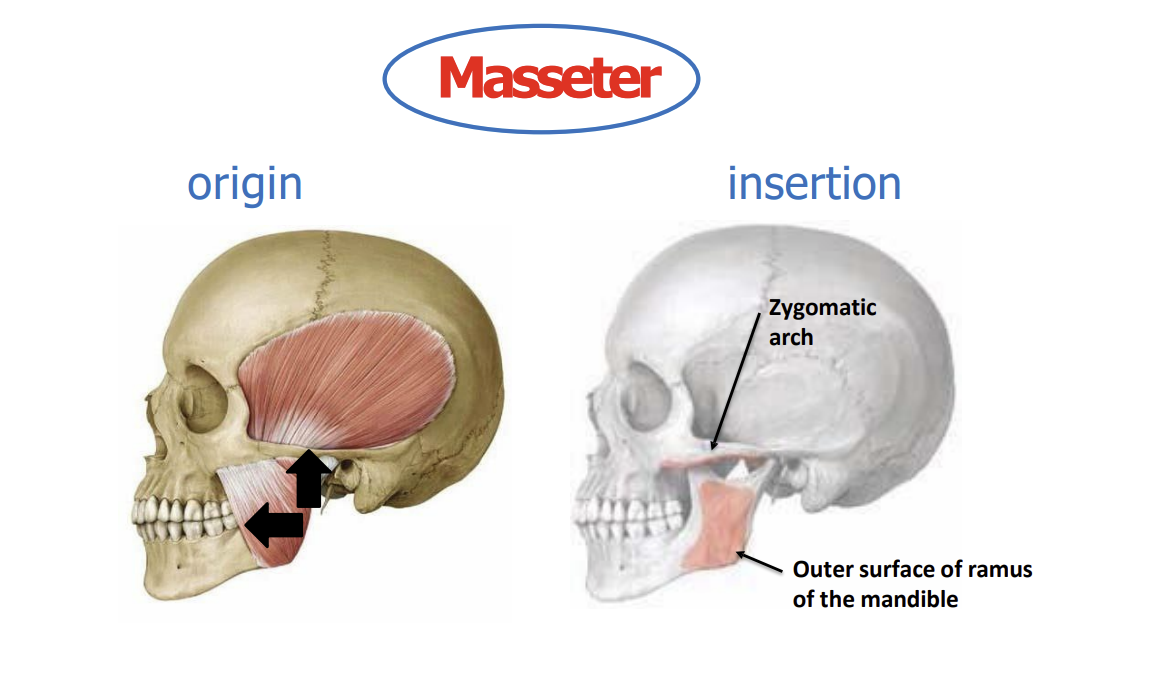
1) Masseter
2) Temporalis
3) Lateral pterygoid
4) Medial pterygoid


What delivers the nerve supply?
Mandibular branch of trigeminal nerve.
What are the actions of the muscles?
All produce elevation of mandible (close the mouth) EXCEPT lateral pterygoid muscle which depress the mandible (open the mouth).
All produce protraction of mandible EXCEPT temporalis muscle which retract the mandible.
Lateral &medial pterygoid produce side to side movement of mandible.