Retirement Planning and Social Security Vocabulary Flashcards
 Note
Note Call Kai
 Learn
Learn Practice Test
 Spaced Repetition
 Match
Match Flashcards
 Knowt Play
1/16

Earn XP
Description and Tags
Vocabulary flashcards generated from lecture notes on retirement planning, inflation adjustment calculations, annuity options, and Social Security benefit rules.
Name | Mastery | Learn | Test | Matching | Spaced | Call with Kai | Chat |
|---|
No analytics yet
Send a link to your students to track their progress
17 Terms
Real Rate of Return (Inflation-Adjusted Interest Rate)
The rate of return calculated as [(1+inflation rate1+after-tax return)−1]×100, used in financial planning when annual retirement needs are expressed in today's dollars.
Fully Insured Status
A Social Security status achieved when a worker accumulates 40 credits of coverage (maximum 4 credits per calendar year), granting permanent eligibility for both survivor and retirement benefits.
Currently Insured Status
A Social Security status attained with 6 credits of coverage, which qualifies eligible dependents for a $255 lump-sum death benefit, surviving spouse benefits with children under age 16, and dependent benefits.
Primary Insurance Amount (PIA)
The fundamental dollar unit used by Social Security to calculate the monthly benefit payable to a worker or beneficiary upon retirement, disability, or death.
Full Retirement Age (FRA)
The age at which a worker becomes eligible to receive unreduced, full Social Security retirement benefits, set at age 67 for individuals retiring in 2027 and later.
Early Retirement Reduction Factor (First 36 Months)
A benefit reduction factor of 95 of 1% (or 1801) applied to a worker's Primary Insurance Amount (PIA) for each of the first 36 months benefits commence prior to Full Retirement Age (FRA).
Early Retirement Reduction Factor (37 to 60 Months)
An additional benefit reduction factor of 125 of 1% (or 2401) per month applied to a worker's Primary Insurance Amount (PIA) for months 37 through 60 prior to Full Retirement Age (FRA).
Provisional Income
The benchmark calculated as Adjusted Gross Income (AGI) plus tax-exempt interest (such as municipal bond interest) plus 21 of Social Security benefits, used to determine whether Social Security benefits are taxable.
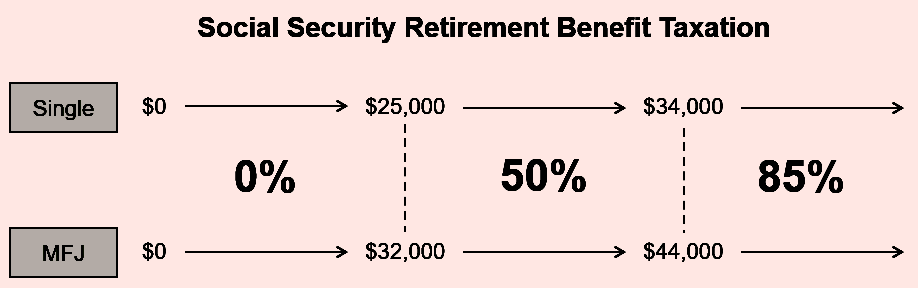
Social Security Retirement Benefit Taxation Thresholds
Income thresholds based on provisional income determining Social Security taxability: Single filers face up to 50% taxability above $25,000 and 85% above $34,000; Married Filing Jointly (MFJ) filers face up to 50% taxability above $32,000 and 85% above $44,000.
Pure Life Annuity
An annuity payout option offering the highest monthly benefit for the retiree's lifetime, which terminates entirely upon the retiree's death and provides no ongoing benefits for a surviving spouse.
Joint and Survivor Annuity
An annuity payout structure that provides smaller monthly payments than a pure life annuity during the retiree's life, but continues income payments to a surviving spouse or named beneficiary after death.
Pension Maximization Strategy
A retirement technique where a retiree elects a pure life annuity option to maximize monthly income and uses the extra cash flow relative to a joint and survivor annuity to buy life insurance for the surviving spouse.
Serial Payment Approach
A retirement savings technique where annual savings contributions increase each year based on expected inflation, allowing for lower initial savings amounts compared to a level payment plan.
Social Security Disability Eligibility
Qualification rules requiring a worker to be insured, under age 65, disabled for at least 12 months (or face a terminal condition), and complete a mandatory 5-month waiting period before receiving benefits.
Social Security Earnings Test (Under FRA)
A rule applicable to beneficiaries younger than Full Retirement Age for the entire year, deducting $1 from benefits for every $2 earned above the yearly limit ($24,480 in 2026).
Withdrawal of Social Security Application
A one-time right that enables a fully insured worker to cancel an initial Social Security benefit claim within 12 months of filing, provided all received benefits are fully repaid without interest.
Social Security Spousal Benefit
A benefit entitling a spouse or qualified divorced spouse (married for at least 10 years and currently unmarried) to collect up to 50% of the primary worker's Primary Insurance Amount (PIA) if higher than their own benefit.