B3.2 Heart and Circulation
 Call Kai
 Learn
Learn Practice Test
 Spaced Repetition
 Match
Match Flashcards
 Knowt Play
 Podcast
1/39

There's no tags or description
Looks like no tags are added yet.
Name | Mastery | Learn | Test | Matching | Spaced | Call with Kai | Chat |
|---|
No analytics yet
Send a link to your students to track their progress
40 Terms

#1
right Atrium

#3
Left Atrium
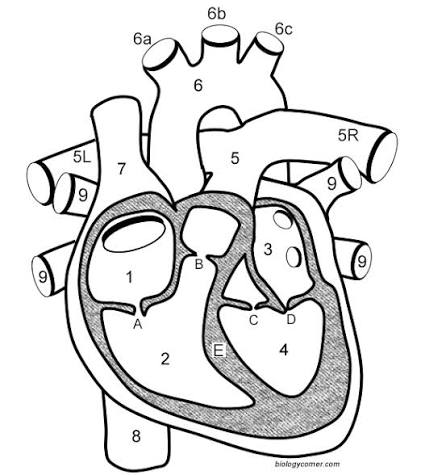
#2
Right Ventricle

#4
Left Ventricle

E
septum

#5
pulmonary artery

#9
pulmonary veins

#6
aorta
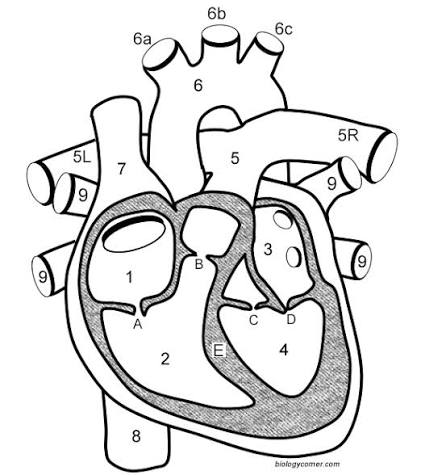
A
AV tricuspid valve

D
AV Bicuspid/mitral valve

B
SL pulmonary valve

C
SL aortic valve

What is this?
Artery

What is this?
vein

What is this?
capillary
Artery Structure + Function
carry blood AWAY from the heart to organs and tissues, can with stand high blood pressure.
thick wall, thick muscle, narrow lumen (helps keep high bp)
vein structure + Function
carry blood TO the heart from organs and tissues, lower blood pressure.
thin wall, less muscle, wider lumen (allows for blood flow). (needs compression)
capillaries structure + function
connects arteries to veins, to exchange materials between blood and cells (through diffusion) (extra: Microscopic blood vessels that permit nutrient and gas exchange)
large surface area, narrow branches, narrow/thin lumen
Systemic circulation
(The part of the circulatory system that carries oxygenated blood away from the heart to the body and returns deoxygenated blood back to the heart.) It begins at the left ventricle to the body and ends at the right atrium, starts oxygen rich to oxygen poor.
pulmonary circulation
(The part of the circulatory system that carries deoxygenated blood from the heart to the lungs and returns oxygenated blood back to the heart.) It begins at the right ventricle and ends at the left atrium. starts oxygen poor (goes to lungs) to oxygen rich
What does blood contain/carry?
Blood contains red blood cells, white blood cells, platelets, and plasma. It carries oxygen, nutrients, hormones, carbon dioxide, and waste products throughout the body.
myogenic
does not depend on central nervous system or brain to stimulate activity
systolic
contraction of heart muscle
diastolic
relaxation of heart muscle
SA node
initiates stimulus to cause contraction. Action Potential from ( ) causes ventricle to enter systole
Pulse
caused by beating of heart. can feel beat because of contraction pushing blood out
fenestration
small pores in capillaries that allow fluid to pass
lymph fluid/vessel
tissue fluid that does not directly re-enter blood, is taken up by lymph ducts
What is a important component of the cardiac cycle?
pressure
Cardiac cycle order? (4)
atrial diastole
atrial systole
ventricle systole
ventricular diastole
atrial diastole
(The phase of the cardiac cycle where the atria relax and fill with blood from the veins, allowing pressure to decrease in the atria before contraction.)
atria relaxed AV valve opens
blood enters atrium from (vena cava or pul. veins)
(SA node fires (Action Potential causes atrium to enter systole) )
atrial systole
(The phase of the cardiac cycle where the atria contract to push blood into the ventricles, increasing atrial pressure and closing the AV valves.)
atria contract
blood enters ventricle (from atrium)
(AV node fires
impulse travels through AV bundle and into purkinje fibers
receives impulse to contract from purkinje fibers)
ventricle systole
(The phase of the cardiac cycle where the ventricles contract to pump blood out of the heart, increasing ventricular pressure and closing the AV valves.)
ventricles contract = pressure increase
AV valves close (1st sound)
higher pressure in ventricle than atrium = SL valves open
blood moves in aorta or pulmonary artery
ventricular diastole
(The phase of the cardiac cycle where the ventricles relax and fill with blood from the atria, decreasing pressure in the ventricles before the next contraction.)
ventricle enters diastole
pressure decreases
higher pressure in aorta/ pul. artery than ventricle
SL valves open (2nd sound)
when pressure decreases in atrium AV valves open
Atherosclerosis
hardening and narrowing of arteries due to build up of cholesterol, triglycerides, and other substances on artery walls
coronary arteries occluded (blocked) = death of heart tissue/ heart attack
inner lining of artery damaged because of increase blood pressure
macrophages= fibrous tissue growth- consume cholesterol = form plaque = block = clot
Atherosclerosis uncontrollable risk factors
genetics
age (older)
gender (males more likely)
Atherosclerosis controllable risk factors
obesity
physical inactivity
smoking
diet
Explain release of tissue fluid in capillaries
blood leaves artery (high pressure) and enters capillary. increase blood pressure filters blood plasma through the gaps in capillaries forming tissue fluid
Explain reuptake of tissue fluid in capillaries
blood pressure decrease as blood moves along capillary plasma proteins decrease the osmotic potential of blood. most tissue fluid returns to the blood by osmosis due to oncotic pressure (is higher than hydrostatic pressure)
contrast circulation of Bony fish to mammals
Bony Fish:
single circulatory system (2 chambers)
ventricle pumps blood to gills
oxygen and carbon dioxide exchanged as blood passes through capillaries in the gills
oxygenated blood leaves gills and transports to tissues
deoxygenated blood returns to heart
Mammals:
double circulatory system (4 chambers)
right side of heart pumping blood to lungs
oxygen and carbon dioxide exchanged as blood passes through capillaries in the lungs
oxygenated blood returns to left side of heart and pumped to body
deoxygenated blood returns to right side of heart