[GENERAL CHEMISTRY] Periodic Table and Trends
 Call Kai
 Learn
Learn Practice Test
 Spaced Repetition
 Match
Match Flashcards
 Knowt Play
1/148

Earn XP
Description and Tags
Proverbs 16:3
Name | Mastery | Learn | Test | Matching | Spaced | Call with Kai | Chat |
|---|
No analytics yet
Send a link to your students to track their progress
149 Terms
d. Electrochemistry
Study of the production of electricity from energy released during spontaneous and nonspontaneous chemical reactions.
a. Voltametry
b. Polarimetry
c. Potentiometry
d. Electrochemistry
e. None
[ELECTROCHEMISTRY]
True about spontaneous chemical reactions except:
a. Voltaic cells/ galvanic cells
b. Redox reaction
c. Anode oxidation and cathode reduction
d. Electrons migrate from anode to cathode
e. None
a. Spontaneous
[ELECTROCHEMISTRY]
Voltaic cells / galvanic cells
a. Spontaneous
b. Nonspontaneous
a. Spontaneous
[ELECTROCHEMISTRY]
Voltaic cells / galvanic cells
a. Spontaneous
b. Nonspontaneous
a. Spontaneous
[ELECTROCHEMISTRY]
Redox reaction (Anode – oxidation; Cathode – reduction)
a. Spontaneous
b. Nonspontaneous
a. Spontaneous
[ELECTROCHEMISTRY]
Electrons migrate from anode to cathode
a. Spontaneous
b. Nonspontaneous
d. Electrons migrate from anode to cathode - this is for spontaneous chemical reactions.
[ELECTROCHEMISTRY]
True about nonspontaneous chemical reactions except:
a. Electrolytic cells
b. Electroplating
c. Electric current is applied to remove e- and transfer to another cell
d. Electrons migrate from anode to cathode
e. None
b. Nonspontaneous
Electrolytic cells
a. Spontaneous
b. Nonspontaneous
b. Nonspontaneous
Electric current is applied to remove e- and transfer to another cell
a. Spontaneous
b. Nonspontaneous
b. Nonspontaneous
Electroplating
a. Spontaneous
b. Nonspontaneous
a. Electroplating
[ELECTROCHEMISTRY]
Electric current is applied to remove e- and transfer to another cell.
a. Electroplating
b. Electrotransfer
c. Electrotransition
d. Electrogaining
d. I, III, IV, V, VI
Metals:
I) Basic oxide
II) Good REDUCING agent
III) Good heat and electricity conductor
IV) Malleable and ductile
V) Has metallic luster
VI) Mostly solid at room temperature
[PERIODIC TABLE]
Metals:
I. Basic oxide
II. Good oxidizing agent
III. Good heat and electricity conductor
IV. Malleable and ductile
V. Has metallic luster
VI. Mostly solid at room temperature
a. I, II, III, IV, V, VI
b. I, II, III, IV, V
c. II, III, IV, V, VI
d. I, III, IV, V, VI
e. I, II, IV, V, VI
b. Nonmetals
[PERIODIC TABLE]
Acidic oxides
a. Metals
b. Nonmetals
b. Nonmetals
[PERIODIC TABLE]
Good oxidizing agent.
a. Metals
b. Nonmetals
b. Nonmetals
[PERIODIC TABLE]
Not conductor of heat and electricity.
a. Metals
b. Nonmetals
b. Nonmetals
[PERIODIC TABLE]
Brittle
a. Metals
b. Nonmetals
b. Nonmetals
[PERIODIC TABLE]
Not ductile and not malleable.
a. Metals
b. Nonmetals
b. Nonmetals
[PERIODIC TABLE]
Most do not have metallic luster (except Iodine)
a. Metals
b. Nonmetals
c. Iodine
Nonmetals do not have metallic luster except ____
a. Carbon
b. Sulfur
c. Iodine
d. Bromine
b. Nonmetals
[PERIODIC TABLE]
Exist as solid, liquid, or gas in room temperature.
a. Metals
b. Nonmetals
a. Metals
[PERIODIC TABLE]
Exist as Solid
a. Metals
b. Nonmetals
b. Mercury (Hg)
[PERIODIC TABLE]
Metals exist as solid except ____
a. Gallium (Ga)
b. Mercury (Hg)
c. Cesium (Cs)
d. Bromine (Br)
b. Malleability
[PERIODIC TABLE]
Ability to be pounced into thin sheets.
a. Conductivity
b. Malleability
c. Ductility
d. Electronegativity
c. Ductility
[PERIODIC TABLE]
Ability to be drawn into wires.
a. Conductivity
b. Malleability
c. Ductility
d. Electronegativity
b. Mercury (Hg)
[PERIODIC TABLE]
The only liquid metal at room temperature.
a. Gallium (Ga)
b. Mercury (Hg)
c. Gold (Au)
d. Silver (Ag)
a. Gallium (Ga)
[PERIODIC TABLE]
The liquify at 30°C.
a. Gallium (Ga)
b. Mercury (Hg)
c. Gold (Au)
d. Silver (Ag)
d. Iodine
[PERIODIC TABLE]
Nonmetal with metallic luster.
a. Fluorine
b. Chlorine
c. Bromine
d. Iodine
a. MgO - this is a basic oxide.
[PERIODIC TABLE]
Amphoteric oxide which can act both as an acid or base except:
a. MgO
b. PbO
c. Al2O3
d. ZnO
e. None
d. ZnO - this is amphoteric oxide.
[PERIODIC TABLE]
Basic oxide except:
a. MgO
b. NaO
c. CuO
d. ZnO
e. None
e. None
[PERIODIC TABLE]
Acidic oxide except:
a. SO2
b. CO2
c. SO3
d. Cl2O7
e. None
f. None
[PERIODIC TABLE]
Acidic oxide except:
a. P2O5
b. N2O5
c. CrO3
d. Mn2O7
e. V2O5
f. None
b. 118
[PERIODIC TABLE]
How many total elements are in the periodic table?
a. 108
b. 118
c. 128
d. 98
c. Periods
[PERIODIC TABLE]
Horizontal rows in the periodic table are called:
a. Groups
b. Families
c. Periods
d. Series
d. 18
[PERIODIC TABLE]
How many groups (vertical columns) does the periodic table have?
a. 7
b. 8
c. 16
d. 18
b. Groups or Families
[PERIODIC TABLE]
Vertical columns in the periodic table are also known as:
a. Periods
b. Groups or Families
c. Rows
d. Blocks
d. 120 elements, 7 periods, 18 groups
[PERIODIC TABLE]
Which of the following correctly describes the periodic table?
a. 118 elements, 7 periods, 18 groups
b. 108 elements, 8 periods, 16 groups
c. 118 elements, 18 periods, 7 groups
d. 120 elements, 7 periods, 18 groups
a. Groups A
[PERIODIC TABLE]
Representative elements
a. Groups A
b. Groups B
c. Actinides and Lanthanides
b. Groups B
[PERIODIC TABLE]
Transition elements
a. Groups A
b. Groups B
c. Actinides and Lanthanides
c. Actinides and Lanthanides
[PERIODIC TABLE]
Inner transition elements
a. Groups A
b. Groups B
c. Actinides and Lanthanides
c. Actinides and Lanthanides
[PERIODIC TABLE]
f block
a. Groups A
b. Groups B
c. Actinides and Lanthanides
b. Groups B
[PERIODIC TABLE]
d block
a. Groups A
b. Groups B
c. Actinides and Lanthanides
a. Groups A
[PERIODIC TABLE]
s and p block
a. Groups A
b. Groups B
c. Actinides and Lanthanides
Nihonium (Nh)
Moscovium (Mc)
Tennessine (Ts)
Oganesson (Og)
New Elements in Periodic Table:
a. Ionization energy
[PERIODIC TABLE]
Energy needed to remove outermost electron in neutral atom to make the atom positive.
a. Ionization energy
b. Electron affinity
c. Electronegativity
d. Atomic radius
e. Metallic property
b. Electron affinity
[PERIODIC TABLE]
Energy given off when neutral atom gains extra electron making it more negative.
a. Ionization energy
b. Electron affinity
c. Electronegativity
d. Atomic radius
e. Metallic property
c. Electronegativity
[PERIODIC TABLE]
Ability of an atom to attract electron pair to itself, forming covalent bond.
a. Ionization energy
b. Electron affinity
c. Electronegativity
d. Atomic radius
e. Metallic property
a. F
[PERIODIC TABLE]
Most electronegative thus the most potent and reactive oxidizing agent.
a. F
b. Cl
c. Br
d. I
b. O
[PERIODIC TABLE]
2nd most electronegative element.
a. C
b. O
c. Cl
d. Br
d. Atomic radius
[PERIODIC TABLE]
½ difference between nucleus of 2 atoms.
a. Ionization energy
b. Electron affinity
c. Electronegativity
d. Atomic radius
e. Metallic property
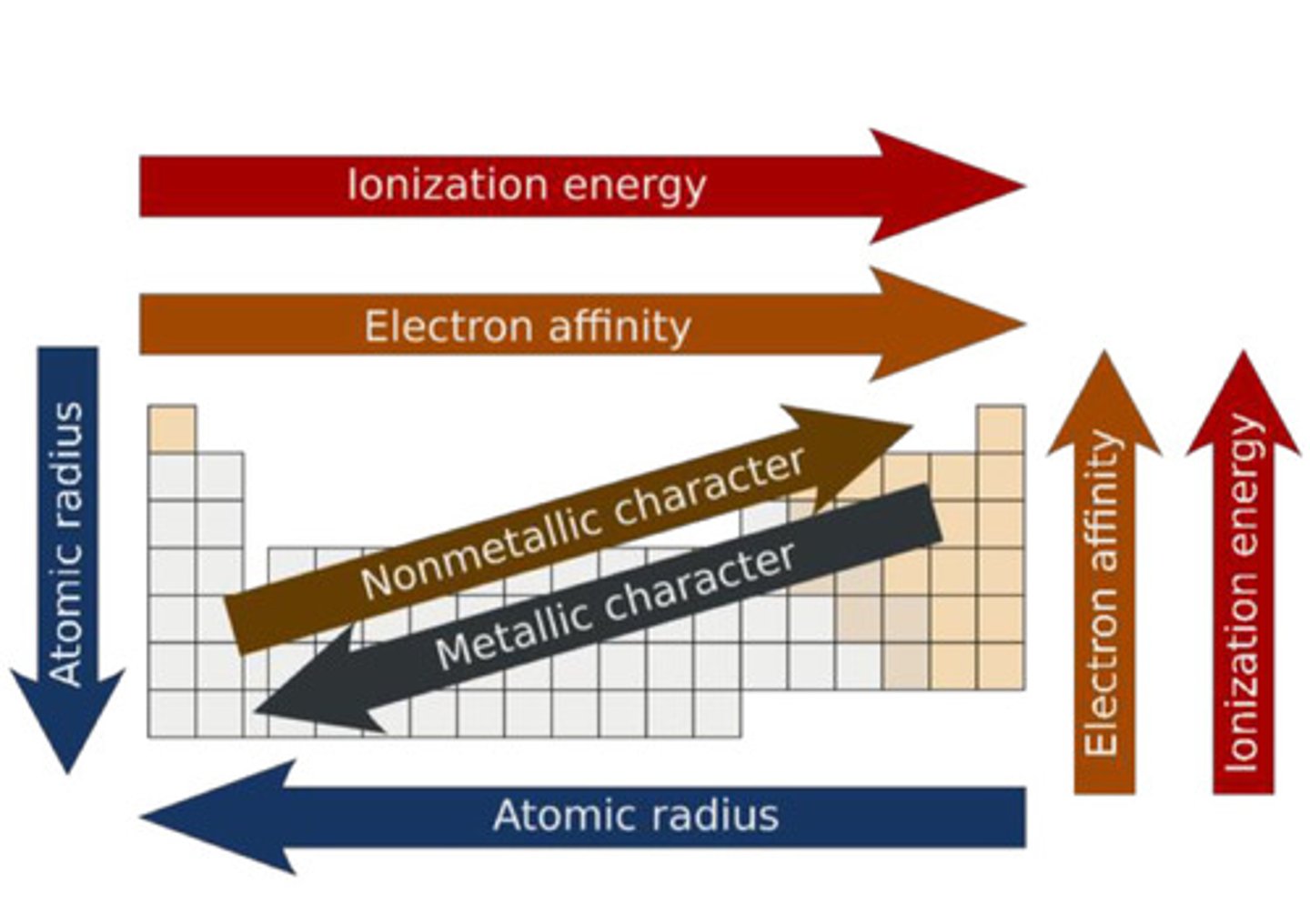
[PERIODIC TABLE]
Periodic trend
a. Increases to the right and upward
[PERIODIC TABLE]
Ionization energy trend on periodic table.
a. Increases to the right and upward
b. Increases to the left and downward
a. Increases to the right and upward
[PERIODIC TABLE]
Electron affinity trend on periodic table.
a. Increases to the right and upward
b. Increases to the left and downward
a. Increases to the right and upward
[PERIODIC TABLE]
Electronegativity trend on periodic table.
a. Increases to the right and upward
b. Increases to the left and downward
b. Increases to the left and downward
[PERIODIC TABLE]
Atomic radius trend on periodic table.
a. Increases to the right and upward
b. Increases to the left and downward
b. Increases to the left and downward
[PERIODIC TABLE]
Metallic property trend on periodic table.
a. Increases to the right and upward
b. Increases to the left and downward
a. Antoine Lavoisier
[PERIODIC TABLE]
Made the first extensive list of approximately 33 elements
a. Antoine Lavoisier
b. Johan Wolfgang Dobereiner
c. John Newlands
d. Dmitri Mendeleev
a. Antoine Lavoisier
[PERIODIC TABLE]
Compared properties of metals and nonmetals.
a. Antoine Lavoisier
b. Johan Wolfgang Dobereiner
c. John Newlands
d. Dmitri Mendeleev
a. Johan Wolfgang Dobereiner
[PERIODIC TABLE]
Arrange elements according to law of triads:
a. Johan Wolfgang Dobereiner
b. John Newlands
c. Dmitri Mendeleev
d. Henry Moseley
e. Glenn Seaborg
b. John Newlands
[PERIODIC TABLE]
Arrange the elements according to law of octaves:
a. Johan Wolfgang Dobereiner
b. John Newlands
c. Dmitri Mendeleev
d. Henry Moseley
e. Glenn Seaborg
b. John Newlands
[PERIODIC TABLE]
Arrange the elements according to periods:
a. Johan Wolfgang Dobereiner
b. John Newlands
c. Dmitri Mendeleev
d. Henry Moseley
e. Glenn Seaborg
c. Dmitri Mendeleev
[PERIODIC TABLE]
"Father of Modern Periodic Table"
a. Johan Wolfgang Dobereiner
b. John Newlands
c. Dmitri Mendeleev
d. Henry Moseley
e. Glenn Seaborg
c. Both
[PERIODIC TABLE]
They arrange elements based on increasing atomic mass or weight:
a. Dmitri Mendeleev
b. Lothar Meyer
c. Both
d. None
a. Dmitri Mendeleev
[PERIODIC TABLE]
Arrange elements based on chemical properties:
a. Dmitri Mendeleev
b. Lothar Meyer
c. Both
d. None
b. Lothar Meyer
[PERIODIC TABLE]
Arrange elements based on physical properties:
a. Dmitri Mendeleev
b. Lothar Meyer
c. Both
d. None
d. Henry Moseley
[PERIODIC TABLE]
Created modern periodic table.
a. Johan Wolfgang Dobereiner
b. John Newlands
c. Dmitri Mendeleev
d. Henry Moseley
e. Glenn Seaborg
f. Lothar Meyer
d. Henry Moseley
[PERIODIC TABLE]
Determined that property varies with increasing atomic number.
a. Johan Wolfgang Dobereiner
b. John Newlands
c. Dmitri Mendeleev
d. Henry Moseley
e. Glenn Seaborg
e. Glenn Seaborg
[PERIODIC TABLE]
Discovered transuranic elements.
a. Johan Wolfgang Dobereiner
b. John Newlands
c. Dmitri Mendeleev
d. Henry Moseley
e. Glenn Seaborg
b. Unstable proton-to-neutron ratio
[PERIODIC TABLE]
Uranium and actinides (below lanthanides) exhibit radioactivity due to an _______.
a. Stable electron configuration
b. Unstable proton-to-neutron ratio
c. High electronegativity
d. Complete valence shell
e. None
[PERIODIC TABLE]
True about transuranic elements except:
a. Atomic number greater than Uranium
b. Actinides below lanthanides
c. Exhibit radioactivity
d. Has unstable proton-to-neutron ratio
e. None
e. Jacob Berzelius
[PERIODIC TABLE]
Developed a table of atomic weights and introduced letters to symbolize elements
a. Johan Wolfgang Dobereiner
b. John Newlands
c. Dmitri Mendeleev
d. Henry Moseley
e. Jacob Berzelius
a. Law of octaves
[PERIODIC TABLE]
When elements are arranged in increasing order of atomic mass, the properties of every eighth element starting from any element are a repetition of the properties of the starting element.
a. Law of octaves
b. Octet rule
a. True
[PERIODIC TABLE]
H, F, Cl are examples of elements that follow the law of octaves.
a. True
b. False
b. Octet rule
[PERIODIC TABLE]
Elements (Atomic number nos. 1-20) with <8 electron react to achieve 8 electrons to be stable.
a. Law of octaves
b. Octet rule
a. Valence e-
[PERIODIC TABLE]
Electron found in outermost shell.
a. Valence e-
b. Valence
b. Valence
[PERIODIC TABLE]
Charge.
a. Valence e-
b. Valence
a. Alkali metals
[PERIODIC TABLE]
Group 1A
a. Alkali metals
b. Boron group
c. Alkaline Earth metals
d. Carbon group
c. Alkaline Earth metals
[PERIODIC TABLE]
Group 2A
a. Alkali metals
b. Boron group
c. Alkaline Earth metals
d. Carbon group
b. Boron group
[PERIODIC TABLE]
Group 3A
a. Alkali metals
b. Boron group
c. Alkaline Earth metals
d. Carbon group
d. Carbon group
[PERIODIC TABLE]
Group 4A
a. Alkali metals
b. Boron group
c. Alkaline Earth metals
d. Carbon group
a. Nitrogen group
[PERIODIC TABLE]
Group 5A
a. Nitrogen group
b. Halogens
c. Oxygen group
d. Inert/Noble/Stable gases
c. Oxygen group
[PERIODIC TABLE]
Group 6A
a. Nitrogen group
b. Halogens
c. Oxygen group
d. Inert/Noble/Stable gases
c. Group 6A
[PERIODIC TABLE]
Chalcogens
a. Group 1A
b. Group 5A
c. Group 6A
d. Group 4A
b. Halogens
[PERIODIC TABLE]
Group 7A
a. Nitrogen group
b. Halogens
c. Oxygen group
d. Inert/Noble/Stable gases
d. Inert/Noble/Stable gases
[PERIODIC TABLE]
Group 8A
a. Nitrogen group
b. Halogens
c. Oxygen group
d. Inert/Noble/Stable gases
d. Inert/Noble/Stable gases
[PERIODIC TABLE]
Group 0
a. Nitrogen group
b. Halogens
c. Oxygen group
d. Inert/Noble/Stable gases
a. 1 - as a Group 1A
[PERIODIC TABLE]
Valence e- of Alkali metals.
a. 1
b. 2
c. 3
d. 4
b. 2 - as group 2A
[PERIODIC TABLE]
Valence e- of Alkaline Earth metals.
a. 1
b. 2
c. 3
d. 4
c. 3 - as group 3A
[PERIODIC TABLE]
Valence e- of Boron group.
a. 1
b. 2
c. 3
d. 4
d. 4
[PERIODIC TABLE]
Valence e- of Carbon group.
a. 1
b. 2
c. 3
d. 4
a. 5 - as group 5A
[PERIODIC TABLE]
Valence e- of Nitrogen group.
a. 5
b. 6
c. 7
d. 8
b. 6 - as group 6A
[PERIODIC TABLE]
Valence e- of Oxygen group.
a. 5
b. 6
c. 7
d. 8
c. 7 - as group 7A
[PERIODIC TABLE]
Valence e- of Halogens.
a. 5
b. 6
c. 7
d. 8
d. 8 - as group 8A
[PERIODIC TABLE]
Valence e- of Inert gases.
a. 5
b. 6
c. 7
d. 8
a. +1
[PERIODIC TABLE]
Valence or charge of Alkali metals.
a. +1
b. +2
c. +3
d. +/-4
b. +2
[PERIODIC TABLE]
Valence or charge of Alkaline Earth metals.
a. +1
b. +2
c. +3
d. +/-4
c. +3
[PERIODIC TABLE]
Valence or charge of Boron group.
a. +1
b. +2
c. +3
d. +/-4
d. +/-4
[PERIODIC TABLE]
Valence or charge of Carbon group.
a. +1
b. +2
c. +3
d. +/-4
a. -3
[PERIODIC TABLE]
Valence or charge of Nitrogen group.
a. -3
b. -2
c. -1
d. 0
b. -2
[PERIODIC TABLE]
Valence or charge of Oxygen group.
a. -3
b. -2
c. -1
d. 0
c. -1
[PERIODIC TABLE]
Valence or charge of Halogen group.
a. -3
b. -2
c. -1
d. 0