Culture, self, and identity
 Studied by 0 people
 Call with Kai
 Learn
Learn Practice Test
 Spaced Repetition
 Match
Match Flashcards
 Knowt Play
1/37

There's no tags or description
Looks like no tags are added yet.
Name | Mastery | Learn | Test | Matching | Spaced | Call with Kai |
|---|
No study sessions yet.
38 Terms
What is another important aspect of self-concept
self-esteem
how we feel about ourselves
What serves as protection against low self-esteem
if an individual is independent and responsible for their successes and failures, then emphasising the positive aspects
What is self-enhancement
it’s another additional aspect of the self with cultural variation
boost our self-esteem
self-enhancement is a universal practice, the way it’s done (individually vs. relationally) differs across cultures
Western view of self-enhancement
public self-enhancement is common and socially accepted
“I got the top grade in my class because I worked really hard and am talented”
Asian view of self-enhancement
public self-promotion is less valued, boosting self-esteem often occurs privately or subtly
“I was able to contribute to my team’s success”
“i’m grateful I could help my family”
Western/individualistic cultures view on self-continuity
people often have decontextualised self-continuity:
they see their past, present and future as connected primarily through their personal traits, goals, and achievements
focus is on internal consistency and personal narrative
the link to family, community, or social roles is less emphasised
Asian/collectivist cultures view on self-continuity
people often have contextualised self-continuity:
they see their past, present, and future as connected through relationships, family, place, or social roles
focus is on interconnectedness and fulfilling social obligations
Phinney (2015) developed the Multigroup Ethnic Identity Measure (MEIM) which is…
examines ethnic identity
includes two sub scales:
exploration (e.g., I have often talked to other people in order to learn more about my ethnic group)
commitment (e.g., I feel a strong attachment towards my own ethnic group)
What are the key takeaways from the correlation between MEIM and selected measures of psychological wellbeing
importance of ethnicity has positive relationships with adaptive outcomes (e.g. coping) and negative relationships with maladaptive ones (e.g. loneliness)
strength of these relationships varies by ethnic group
ethnicity importance appears to play an important role in psychological well-being across diverse cultural groups
What happens to a multicultural individual when adjusting to a new culture
because of the need to fit into different cultural contexts, multicultural individuals normally develop multiple concepts of the self that can be called upon depending on the context
What are the five coping skills that multicultural individuals typically use, Brislin (1981)
non-acceptance
continuing to act according to traditional norms, ignoring cultural differences
substitution
behaving in the most acceptable manner by substituting Normas from the ‘new’ culture for traditional norms
addition
evaluating the situation and depending on judgement using either non-acceptance or substitution
synthesis
combining elements of different cultures
re-synthesis
integrating ideas from various cultures in an original way
Brislin notes, it the more culturally competent example of non-ethnocentric attitudes because no one culture is relied upon as the standard
How do multicultural experiences affect intercultural skills
people with multicultural experiences are more flexible and adaptable in intercultural situations compared to monocultural individuals
What does it mean to have a multicultural mind
means that individuals have a loose network of categories and implicit theories of culture instead of one overall cultural view
they don’t rely on only one cultural meaning system
What dies the five-factor model (FFM) of personality suggest
it suggests that five personality dimensions are common to all humans regardless of culture
What are the five personality dimensions (FFM)
extroversion
neuroticism
agreeableness
conscientiousness
openness
The FFM model may not hold as strongly in what group
less educated or preliterate groups
Church, 2016
Give an explanation for the universality of FFM
evolutionary approach
suggests that these particular traits are naturally selected in order to serve and adaptive function necessary for survival
What is an indigenous personality
personality traits and characteristics found and understood only within the context of a particular culture
contrasts with the universality of FFM because indigenous personality is culture-specific
African model of personal consists of 3 aspects of a person housed by the body:
the first layer located at the core of the person is based upon a spiritual principle
the second layer involves a psychological vitality principle
the third layer contains a physiological vitality principle
What is another example of an indigenous personality concept
amae
a fundamental and distinct feature of the Japanese personality
refers to the passive, childlike dependence of one person or another
What is cultural intelligence
defined as the capacity to function effectively across cultural settings
Successful multicultural interactions often depend on…
personality traits collectively known as “psychological engine adjustment”
What is the psychological engine of adjustment (PEA)
a conceptual model which describes traits that facilitate adjustment
What is important to have in the psychological engine of adjustment
cultural empathy
open-mindness
emotional stability
goal directness
curiosity
flexibility
extraversion
What does cultural intelligence (CQ), emotional (EQ), and social intelligence (SQ) focus on
focuses on effectiveness across diverse cultural settings
How do you measure and develop CQ
researchers created intercultural assessment tools like “Intercultural adjustment potential scale” (ICAPS) and “Multicultural personality questionnaire” (MPQ)
evaluates skills and traits which predict successful adaptation
What is the intercultural adjustment potential scale (ICAP), Matsumoto et al., (2003)
measures skill adjustment to successful adaptation
focuses on:
emotional stability
open-mindedness
flexibility
critical thinking
What is the multicultural personality questionnaire (MPQ), Van der Zee and Van Oudenhoven (2000)
measures personality traits that support functioning in multicultural environments
focuses on:
cultural empathy
open-mindedness
emotional stability
social initiative
flexibility
In Van der Zee and Van Oudenhoven (2000) framework cultural empathy refers to …
the ability to empathise with he feelings, thoughts, and behaviours of members from different cultural groups
In Van der Zee and Van Oudenhoven (2000) framework open-mindedness refers to …
open and unprejudiced attitudes towards members belonging to other cultural groups and their different values and norms
In Van der Zee and Van Oudenhoven (2000) framework emotional stability refers to …
defined as the tendency to remain calm in stressful situations without showing strong emotional reactions in such circumstances
In Van der Zee and Van Oudenhoven (2000) framework social initiative refers to …
the tendency to actively approach social situations and take initiative
In Van der Zee and Van Oudenhoven (2000) framework flexibility refers to …
the ability to embrace new and unknown situations and view them as a challenge and not as a threat
What do ICAPS skills relate to
parental modelling of emotion regulation
exposure to diverse environment
adolescent identity exploration
cognitive development and executive function
social learning (peers, school, media)
What do MPQ traits reflect
stable temperament (childhood into adulthood)
genetic predispositions
socialisation experiences
attachment and early emotional environment
normative personality development
What do MPQ help explain
why some individuals adapt more easily than others
Intercultural adjustment potential scale (ICAPS) vs. Multicultural personality questionnaire (MPQ)
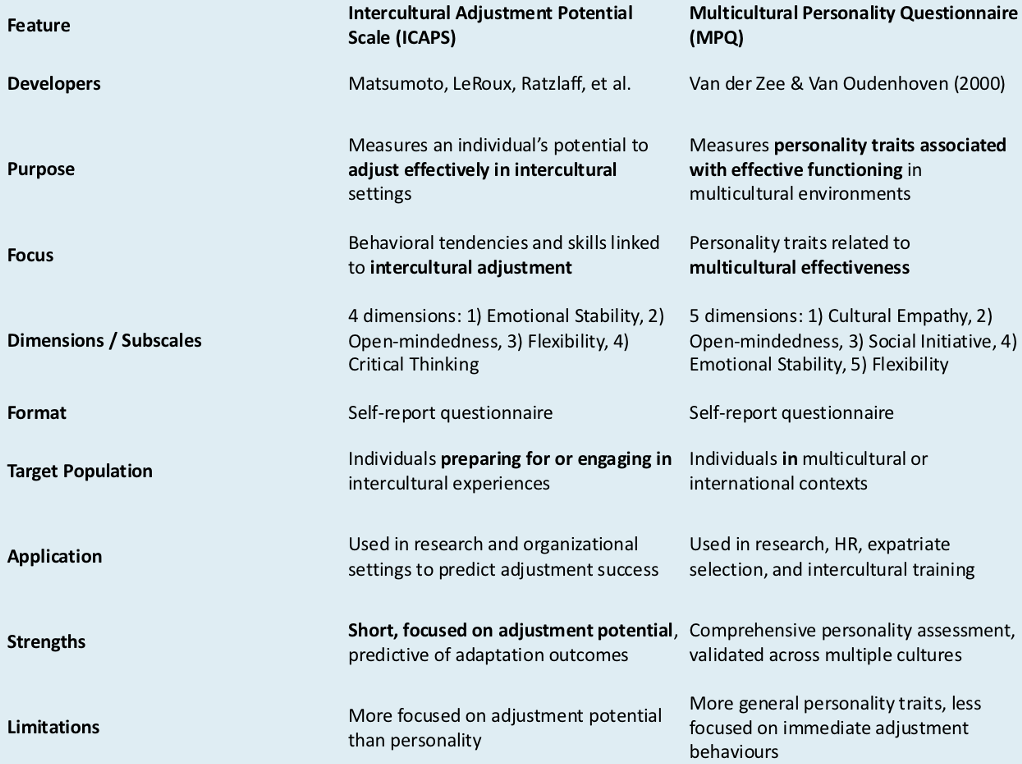
What do you think influences how people adapt to new cultural environments
personality: traits like openness and extraversion can influence adaptability, but personality alone doesn’t explain cultural adjustment fully
learned skills: cultural intelligence, language skills, and coping strategies are strong predictors of successful adaptation
emotions: emotional regulation and resilience matter, but they often interact with other factors
social relationships: support networks and social integration are consistently shown to be among the most influential factors in acculturation and adaptation
life experiences: prior exposure to diverse environments can ease adjustment, but it’s not always decisive