Intermolecular Forces
 Call Kai
 Learn
Learn Practice Test
 Spaced Repetition
 Match
Match Flashcards
 Knowt Play
1/30

There's no tags or description
Looks like no tags are added yet.
Name | Mastery | Learn | Test | Matching | Spaced | Call with Kai | Chat |
|---|
No analytics yet
Send a link to your students to track their progress
31 Terms
Intramolecular Forces
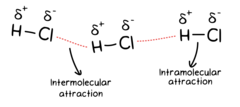
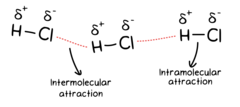
Forces of attraction WITHIN a molecule (covalent structures), metal or alloy (metallic bonding) or lattice (ionic structure). The term intramolecular is a bit confusing as it makes it seem like it's just molecules but the term is more broadly associated with what creates certain structures in the first place.
Intermolecular Forces
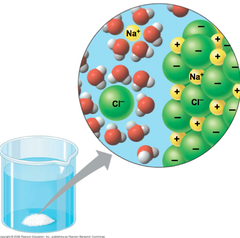
Forces of attraction BETWEEN molecules i.e. what holds molecules together in a pure sample or mixture. Intermolecular forces could also be between an ionic substance and another molecule such as the ions of NaCl attracting to the polar regions of water molecules when the two are mixed. An ionic lattice or metal is sort of a hybrid between intra- and inter- and that's why our examples in class have been intermolecular attractions between covalent molecules or covalent molecules and an ion.
Hydrogen Bonds
The intermolecular force in which a hydrogen atom that is bonded to a highly electronegative atom (N, O or F) is attracted to an unshared pair of electrons of an electronegative atom in a nearby molecule. The small hydrogen atom can get very close to an unshared electrons on an adjacent molecule. Water, ammonia (NH3) and hydrogen fluoride (HF) exhibit hydrogen bonding. Hydrogen bonding can occur within a pure sample, such as water molecules attracted to one another or within a mixture such as water and HF.

Dispersion Forces
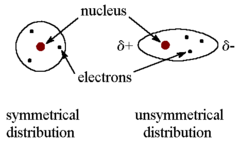
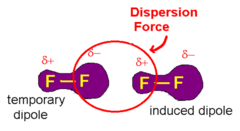
Even noble gas atoms and molecules that are nonpolar exhibit weak intermolecular attractions. In any atom or molecule, the electrons are in constant motion. As a result, at any instant, the electron distribution may be slightly uneven. This momentary, uneven charge creates a positive pole and a negative pole. This temporary dipole can then induce a dipole in an adjacent atom or molecule. The two are held together for an instant by the weak attraction of the temporary dipoles. These are also called London dispersion forces. These forces act between ALL atoms and molecules, but are the ONLY force acting between noble gas atoms or nonpolar molecules.
Dipole-Dipole Forces
Polar molecules act as dipoles because of their uneven charge distribution (region of negative and positive that isn't cancelled out by symmetry). The negative region in one polar molecule attracts the positive region in adjacent molecules and so on throughout the sample.

Hydrophobic
Water hating i.e a substance that does not mix with water. These are nonpolar substances.

Hydrophilic
Water loving i.e .a substance that does mix well with water. These are polar substances.

"Like Dissolves Like"
Polar and ionic solutes will dissolve in polar solvents, nonpolar solutes will dissolve in nonpolar solvents. At the end of the day, if water is attracted to itself via hydrogen bonding, it will be unlikely to attract to a nonpolar molecule (unless it has to say at the interface of oil and water in a bottle where they have separated) because it is much more attracted to itself via powerful hydrogen bonding. If you shake oil and water up you can temporarily disturb the hydrogen bonding interactions of the water molecules, but over time, the constant motion of the molecules will allow the stronger hydrogen bonding attractions to partition the water molecules from the mixture towards itself into a bulk layer of water. We then see, when water and oil are separated that the denser layer of water stays at the bottom.
Strength of Intermolecular v. Intramolecular Forces
Intramolecular > Intermolecular in general. There are ranges of strength and therefore some overlap with these but in general intramolecular are stronger than intermolecular.
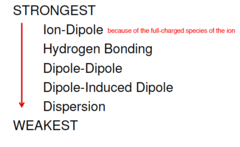
Ion-Dipole Forces
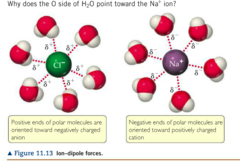
The force that exists between an ion and a polar molecule that possesses a permanent dipole moment.
Induced Dipole
A dipole temporarily created in an otherwise nonpolar molecule, induced by a neighboring charge. The induced dipole can be created by a temporary charge in a neighboring atom or molecule (caused by electron distribution) or by a molecule with a permanent dipole.

Boiling Point Trends & Intermolecular Forces (in the picture, why does iodine have a higher boiling point).
A higher boiling point indicates more energy is needed to evaporate the substance. This would be indicative of stronger intermolecular forces in that sample. Stronger IMFs overall can come from having stronger types of IMFs present such as hydrogen bonds and/or cumulative weaker IMFs present (such as a lot of dispersion forces from multiple atoms) For the picture, diatomic iodine is made up of larger atoms. There is more potential for more loosely bound electrons (shielding!) to become "lopsided" and create temporary dipoles than the smaller fluorine atoms.

Temporary Dipole
An atom or molecule where a temporary imbalance in the electron cloud causes a momentary imbalance of charge. These temporary dipoles lead to dispersion forces in all atoms and molecules by inducing dipoles in nearby atoms or molecules, even those that are atoms like noble gases or nonpolar molecules.
What type of IMFs are present in CH4
CH4 (methane) is a nonpolar molecule overall with no net dipole; therefore it will only experience london dispersion interactions.
What type of IMFs are present in dissolved oxygen (O2) in water (like what happens in our ocean:)
Though O2 is nonpolar, water is permanently polar with hydrogen bonding. The water molecules in the ocean all experience hydrogen bonding with one another; additionally, the permanent dipole of the water molecule will induce a dipole in the oxygen and create a dipole-induced dipole intermolecular attraction. Both the water and oxygen molecules are both always experiencing dispersion attractions to neighboring molecules.
What type of IMFs are present in: NF3
This is nitrogen bonded to three fluorine atoms. Because this molecule has a permanent dipole moment, there will be dipole-dipole IMFs as well as dispersion IMFs.
What type of IMFs are present in: CH3OH
This molecule is called methanol (it is an alcohol). It is one carbon bonded to three hydrogen as well as bonded to an oxygen. That oxygen is then bonded to a hydrogen. What you are looking for here is that -OH group that is characteristic of hydrogen bonding. It is an O to an H so a sample of methanol molecules will experience hydrogen bonding and dispersion forces.
Why do larger atoms have stronger dispersion forces?
When looking at the noble gases, for example, to explain this: a larger noble gas atom will have more polarizability than a smaller one. This is because the valence electrons of the larger noble gas atom are held less tightly to the nucleus. There is a much larger atomic radius and more electron shielding in the larger atom. Therefore, temporary dipoles can form more readily.
What are three ways that dispersion forces can become larger forces?
Bigger atoms, more atoms in the molecule and/or more surface area of atoms in the molecules (i.e. the atoms all bonded in a long chain versus branches and more complicated shapes that could "hide" some of the atoms from nearby molecules).
True or False: Hydrogen bonding is a special type of dipole-dipole force.
True! All hydrogen bonds are a special type of dipole-dipole force. Not all dipole-dipole interactions are hydrogen bonds.
True or False: All intermolecular forces are a result of charges.
True! Whether these charges are from permanent areas of charge due to the unequal sharing or transfer of electrons (i.e. polar covalent or ionic bonds) or charges due to temporary movement of electrons (i.e. pure covalent or individual atoms), the positive and negative charges attracting is ultimately what is creating the interaction.
True or False: All types of intermolecular forces have ranges in terms of strength of the force.
True! For example, a lot of different substances can experience dipole-dipole interactions. The strength of that dipole-dipole interaction will depend on how strong the charges on. Bonds that are more polar (i.e. bigger differences in electronegativity) could lead to higher dipole-dipole interactions. Another example is dispersion forces. Dispersion forces can be very weak (say a very small atom or a molecule with few atoms) but they can also be very powerful (say with larger atoms that have higher polarizability or a molecule with more atoms in it).
What is the word that describes how easy it is for valence electrons to potentially end up "lopsided" i.e. creating a temporary charge that can lead to dispersion forces (also called induced dipole-induced dipole forces)?
Polarizability
Why would NH3 have a higher boiling point than PH3?
Hydrogen bonding is present in NH3. Remember, just having hydrogens present doesn't create a hydrogen bond in a sample of the molecules. The H is bonded to an N, O, or F so PH3 doesn't fit that criteria.
Why would SnH4 have a higher boiling point than CH4?
Sn is a much bigger atom than C leading to stronger dispersion forces.
Ethane (C2H6) has a lower boiling point than methanol (CH3OH). Explain why this might be. Note: on an assessment, I would give you pictures for these. Feel free to look up the Lewis structures of these on the internet to help you.
Methanol has an OH group that will allow it to experience hydrogen bonding. Ethane will only have dispersion forces. This could explain why methanol has a higher boiling point indicating stronger intermolecular forces.
Most of the atom/molecules that make up our atmosphere (like CH4, CO2, Ar, N2, O2) are smaller structures that are a noble gas or non-polar covalent. Why does this make sense?
Our atmosphere is a gas! Meaning that for "Earth" conditions, the substances in the atmosphere would readily be a gas at the temperature/pressure conditions of Earth. It makes sense that these substances which are smaller with mainly dispersion forces (therefore, weak intermolecular forces) would be gases. Note, because our climate varies throughout the planet, some of this behavior can vary (i.e. more or less oxygen in the atmosphere versus say trapped in the ocean) but in general, the idea is that our atmosphere is made up of substances with low IMFs that are easily in the gas state.
Hydrophobic substances involve polar or non-polar compounds?
Non-polar
Hydrophilic substances involve polar or non-polar compounds?
Polar (including ions and polar-covalent)
A sample with stronger IMFs overall is predicted to have a higher or lower boiling point than a sample with weaker IMFs overall.
Higher; it will take more energy to get the molecules moving enough to overcome the stronger IMFs holding them together.
A sample with stronger IMFs overall is predicted to have a higher or lower freezing point than a sample with weaker IMFs overall.
Higher; it doesn't need to be as cold (i.e. energy removed slowing down the molecules) for the molecules to lock into place because they have stronger IMFs attracting them together. Weaker IMFs mean lower freezing points because they need to be even slower (less energy) for their IMFs to keep them together as a solid.