Gases
 Call Kai
 Learn
Learn Practice Test
 Spaced Repetition
 Match
Match Flashcards
 Knowt Play
1/21

There's no tags or description
Looks like no tags are added yet.
Name | Mastery | Learn | Test | Matching | Spaced | Call with Kai | Chat |
|---|
No analytics yet
Send a link to your students to track their progress
22 Terms
rate = (change in concentration of limiting reagent)/(change in time)
formula for rate of reaction
limiting reagent
the reactant that is completely depleted first
What must the data be in the form of to determine rate of reaction?
a graph or table
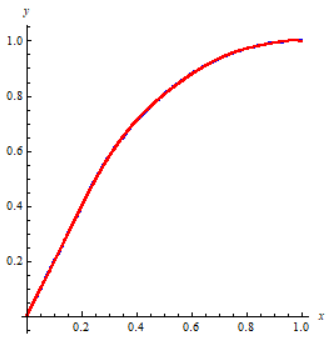
What is this graph?
concentration of product
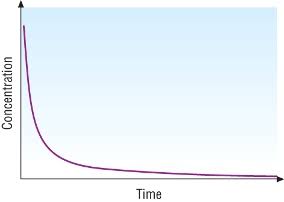
What is this graph?
concentration of reactant
The rate of reaction is the slope that is ___ to the slope that is ___ to one point on the graph showing the change of concentration of a product.
equal; tangent
The rate of reaction is the slope that is ___ to the slope that is ___ to one point on the graph showing the change of concentration of a reactant.
opposite; tangent
k = Ae(-Ea)/(rT)
Arrhenius formula
What is the Arrhenius formula used for?
proving that as temp increases, so does rate of reaction
As temperature ___, the rate of reaction decreases
decreases
What if the value of A is increased in the following equation:
rate = k(Ax)(By)(Cz)
the rate of reaction increases
What does A represent in the equation:
rate = k(Ax)(By)(Cz)
the concentration of substance A
As the concentration of a substance increases, so does the…
reaction rate
As the particles get bigger, the rate of reaction…
decreases
Bigger particles —> less ___ —> ___ reactions
collisions; less
___particles —> more collisions —> ___ reactions
Smaller; more
molecules that create a pathway to reaction
catalyst
What happens to the extra energy when a catalyst is used?
it is put towards increasing the speed of reactions
If the only way for a reaction to start is through using a catalyst, what usually happens to activation energy?
it decreases
More catalysts —> reaction rate ___
increases
The reaction rate is ___ changing
always
What does A, B, C represent in this equation:
rate=k(A