PELVIS (INNOMINATE/PUBIC)

0.0(0)
Studied by 0 people
call kaiCall Kai
Locked
learnLearn
examPractice Test
spaced repetitionSpaced Repetition
heart puzzleMatch
flashcardsFlashcards
GameKnowt Play
Card Sorting

1/22

encourage image

There's no tags or description

Looks like no tags are added yet.

Last updated 4:35 AM on 8/2/26
Name
Mastery
Learn
Test
Matching
Spaced
Call with Kai
Chat

No analytics yet

Send a link to your students to track their progress

23 Terms

1
New cards

dx pelvis

standing flexion test (+ is side where thumb moves first)

pt reseats pelvis (observe anterior and posterior)

  • asis compression test (+ on side with more resistance)

  • locate landmarks (asis, pubic tubercles, medial malleoli. psis)


naming is based off of side of + standing flexion test

use the weird longhorn gang sign to help in naming dx (thumb is psis, index is asis, pinky is pubic tubercle)

2
New cards

hvla of anteriorly rotated innominate

  1. Patient lies dysfunctional side up

  2. Monitor medial to PSIS and flex both hips and knees up until motion is felt

  3. Extends bottom leg

  4. Grasp the patient’s arm that is in contact with the table and rotate their torso away from table until motion is felt

  5. Drop upper leg off the table and held between the physician’s knees

  6. With the patient’s arms crossed, pass the cephalad hand through the patient’s arms and stabilize caudad (thrusting) arm behind greater trochanter

  7. Check lockout

  8. Instruct patient to inhale deeply and exhale fully. At the end of exhalation, exert a quick, rotational, slightly downwards thrust through the iliac crest through the patient’s top leg. Greater thrust with arm on trochanter 

  9. Reassess


<ol><li><p><span style="background-color: transparent;">Patient lies dysfunctional side up</span></p></li><li><p><span style="background-color: transparent;">Monitor medial to PSIS and flex both hips and knees up until motion is felt</span></p></li><li><p><span style="background-color: transparent;">Extends bottom leg</span></p></li><li><p><span style="background-color: transparent;">Grasp the patient’s arm that is in contact with the table and rotate their torso away from table until motion is felt</span></p></li><li><p><span style="background-color: transparent;">Drop upper leg off the table and held between the physician’s knees</span></p></li><li><p><span style="background-color: transparent;">With the patient’s arms crossed, pass the cephalad hand through the patient’s arms and stabilize caudad (thrusting) arm behind greater trochanter</span></p></li><li><p><span style="background-color: transparent;">Check lockout</span></p></li><li><p><span style="background-color: transparent;">Instruct patient to inhale deeply and exhale fully. At the end of exhalation, exert a quick, rotational, slightly downwards thrust through the iliac crest through the patient’s top leg. Greater thrust with arm on trochanter&nbsp;</span></p></li><li><p><span style="background-color: transparent;">Reassess</span></p></li></ol><p></p>
3
New cards

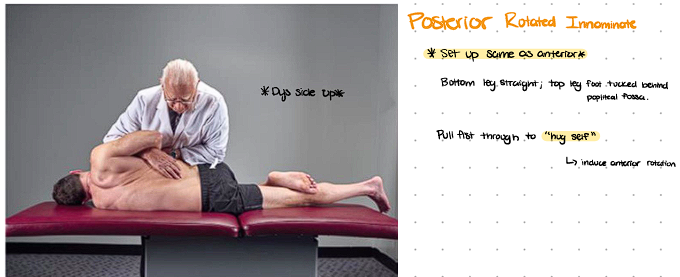
hvla of posteriorly rotated innominate

  1. Patient lies on nondysfunctional side with the posteriorly rotated innominate facing up

  2. Monitor medial to PSIS and flex both hips and knees up until motion is felt at monitoring hand

  3. Patient straightens bottom leg and hooks foot of top leg over the popliteal fossa 

  4. Grab pt arm closest to table  and bring that arm towards you till motion is felt at the monitoring hand over the SI joint

  5. Pt cross arms, weave your hand through to monitor SI joint. Thrusting arm on posterior iliac crest. 

  6. Maintain sufficient rotation localized to level of the somatic dysfunction

  7. CHECK FOR LOCK OUT.

  8. Instruct patient to inhale deeply and exhale fully. At the end of exhalation, exert a quick, rotational thrust through the dysfunctional ilium in an anterior superior direction (LIKE YOU’RE PUNCHING/HUGGING YOURSELF)

  9. Reassess


<ol><li><p><span style="background-color: transparent;">Patient lies on nondysfunctional side with the posteriorly rotated innominate facing up</span></p></li><li><p><span style="background-color: transparent;">Monitor medial to PSIS and flex both hips and knees up until motion is felt at monitoring hand</span></p></li><li><p><span style="background-color: transparent;">Patient straightens bottom leg and hooks foot of top leg over the popliteal fossa&nbsp;</span></p></li><li><p><span style="background-color: transparent;">Grab pt arm closest to table&nbsp; and bring that arm towards you till motion is felt at the monitoring hand over the SI joint</span></p></li><li><p><span style="background-color: transparent;">Pt cross arms, weave your hand through to monitor SI joint. Thrusting arm on posterior iliac crest.&nbsp;</span></p></li><li><p><span style="background-color: transparent;">Maintain sufficient rotation localized to level of the somatic dysfunction</span></p></li><li><p><span style="background-color: transparent;">CHECK FOR LOCK OUT.</span></p></li><li><p><span style="background-color: transparent;">Instruct patient to inhale deeply and exhale fully. At the end of exhalation, exert a quick, rotational thrust through the dysfunctional ilium in an anterior superior direction (LIKE YOU’RE PUNCHING/HUGGING YOURSELF)</span></p></li><li><p><span style="background-color: transparent;">Reassess</span></p></li></ol><p></p>
4
New cards

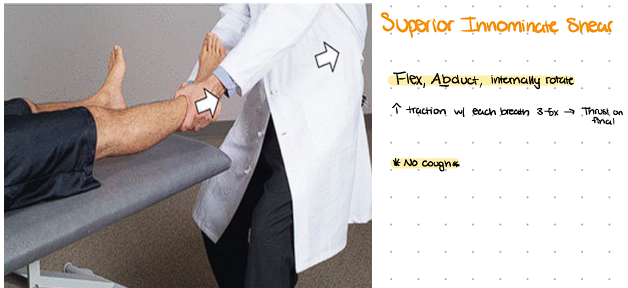
hvla of superior innominate shear

Abd IR

  1. Grasp the tibia and fibula above the ankle on the side of the innominate dysfunction

  2. Abduct and internally rotate the hip and leg until movement is felt at hip

  3. Leaning back gently to provide an axial traction and instruct the patient to inhale and exhale. Provide more traction with each exhale

  4. Repeat this 5-7 times

  5. On the last exhalation tug on the leg

  6. Reassess


<p>Abd IR</p><ol><li><p><span style="background-color: transparent;">Grasp the tibia and fibula above the ankle on the side of the innominate dysfunction</span></p></li><li><p><span style="background-color: transparent;">Abduct and internally rotate the hip and leg until movement is felt at hip</span></p></li><li><p><span style="background-color: transparent;">Leaning back gently to provide an axial traction and instruct the patient to inhale and exhale. Provide more traction with each exhale</span></p></li><li><p><span style="background-color: transparent;">Repeat this 5-7 times</span></p></li><li><p><span style="background-color: transparent;">On the last exhalation tug on the leg</span></p></li><li><p><span style="background-color: transparent;">Reassess</span></p></li></ol><p></p>
5
New cards

hvla of inferior innominate shear

  1. Pt lies with dys side up

  2. Standing in front of the patient, monitoring the lumbosacral junction

  3. Flex the legs and knees until motion at the lumbosacral junction

  4. Induce rotation towards you by pulling pt’s arm

  5. Extend the bottom leg and place the foot of top leg over the popliteal space of other leg

  6. Tell pt to box their arms. Stabilize the trunk while monitoring the sacroiliac joint on the side of the dysfunction

  7. Firmly contact the inferior aspect of the ischial tuberosity with the caudad forearm

  8. Provide a cephalic thrust through the ischial tuberosity parallel to the table toward pts head (basically straight up to the pt’s head)

  9. Reassess


<ol><li><p><span style="background-color: transparent;">Pt lies with dys side up</span></p></li><li><p><span style="background-color: transparent;">Standing in front of the patient, monitoring the lumbosacral junction</span></p></li><li><p><span style="background-color: transparent;">Flex the legs and knees until motion at the lumbosacral junction</span></p></li><li><p><span style="background-color: transparent;">Induce rotation towards you by pulling pt’s arm</span></p></li><li><p><span style="background-color: transparent;">Extend the bottom leg and place the foot of top leg over the popliteal space of other leg</span></p></li><li><p><span style="background-color: transparent;">Tell pt to box their arms. Stabilize the trunk while monitoring the sacroiliac joint on the side of the dysfunction</span></p></li><li><p><span style="background-color: transparent;">Firmly contact the inferior aspect of the ischial tuberosity with the caudad forearm</span></p></li><li><p><span style="background-color: transparent;">Provide a cephalic thrust through the <strong><u>ischial tuberosity</u></strong> parallel to the table toward pts head (basically straight up to the pt’s head)</span></p></li><li><p><span style="background-color: transparent;">Reassess</span></p></li></ol><p></p>
6
New cards

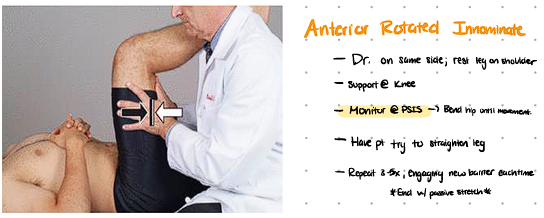
met anteriorly rotated innominate

  1. Pt is supine.

  2. Sit on edge of table.

  3. Pt’s ankle (side of dysfunction) is placed against your shoulder.

  4. Hold onto thigh above knee.

  5. Monitor PSIS on dysfunctional side (not shown in image)

  6. Flex leg up until motion is felt at PSIS (this is the barrier)

    1. Pt resists by pushing leg down against your shoulder

  7. Flex leg further

    1. New barrier is when movement is felt at PSIS again

  8. Repeat 3-5 times + passive stretch

  9. reassess (reseat pelvis right before), can look at ASIS and possible compression test

<ol><li><p><span style="background-color: transparent;">Pt is supine.</span></p></li><li><p><span style="background-color: transparent;">Sit on edge of table.</span></p></li><li><p><span style="background-color: transparent;">Pt’s ankle (side of dysfunction) is placed against your shoulder.</span></p></li><li><p><span style="background-color: transparent;">Hold onto thigh above knee.</span></p></li><li><p><span style="background-color: transparent;">Monitor PSIS on dysfunctional side (not shown in image)</span></p></li><li><p><span style="background-color: transparent;">Flex leg up until motion is felt at PSIS (this is the barrier)</span></p><ol><li><p><span style="background-color: transparent;">Pt resists by pushing leg down against your shoulder</span></p></li></ol></li><li><p><span style="background-color: transparent;">Flex leg further</span></p><ol><li><p><span style="background-color: transparent;">New barrier is when movement is felt at PSIS again</span></p></li></ol></li><li><p><span style="background-color: transparent;">Repeat 3-5 times + passive stretch</span></p></li><li><p><span style="background-color: transparent;">reassess (reseat pelvis right before), can look at ASIS and possible compression test</span></p></li></ol><p></p>
7
New cards

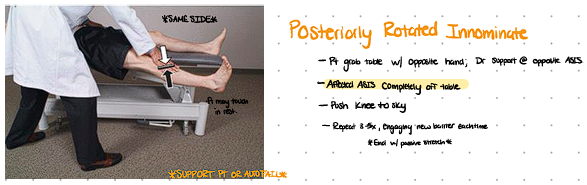
met posteriorly rotated innominate

  1. Pt is supine.

  2. Raise table as needed.

  3. Drop leg (ischial tuberosity of dysfunctional side) off table. Instruct pt to hold onto edge of table with opposite hand. PT FOOT SHOULD NOT TOUCH FLOOR

  4. Hand on opposite ASIS to stabilize.

  5. Push leg DOWN (hand above knee)

    1. Pt resists by pushing leg back up

  6. Repeat 3-5 times + passive stretch


<ol><li><p><span style="background-color: transparent;">Pt is supine.</span></p></li><li><p><span style="background-color: transparent;">Raise table as needed.</span></p></li><li><p><span style="background-color: transparent;">Drop leg (ischial tuberosity of dysfunctional side) off table. Instruct pt to hold onto edge of table with opposite hand. PT FOOT SHOULD NOT TOUCH FLOOR</span></p></li><li><p><span style="background-color: transparent;">Hand on opposite ASIS to stabilize.</span></p></li><li><p><span style="background-color: transparent;">Push leg DOWN (hand above knee)</span></p><ol><li><p><span style="background-color: transparent;">Pt resists by pushing leg back up</span></p></li></ol></li><li><p><span style="background-color: transparent;">Repeat 3-5 times + passive stretch</span></p></li></ol><p></p>
8
New cards

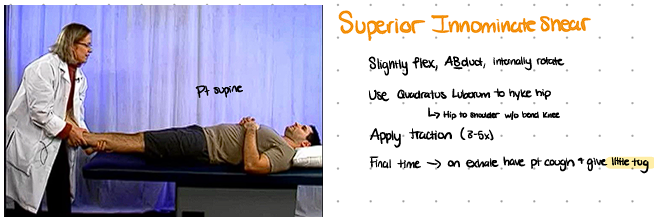
met superior innominate shear

Abd IR

  1. Pt is supine.

  2. One hand holds heel and the other cups the bottom of the foot of side of dysfunction.

  3. ABduct leg until hip is loose packed (feels loose) + internally rotate leg. Add traction by pulling leg toward yourself.

  4. “Bring your foot towards your shoulder without bending knee as you inhale”

    1. Traction is maintained during inhalation. (You lean back to keep the traction)

    2. Traction is ADDED at end of each exhale to reach new barrier

  5. Articulatory component: thrust at the end of the last exhalation.

    1. Give a nice tug as pt coughs “on your final exhale cough”

    2. Respiratory assist method so NO passive stretch

<p>Abd IR</p><ol><li><p><span style="background-color: transparent;">Pt is supine.</span></p></li><li><p><span style="background-color: transparent;">One hand holds heel and the other cups the bottom of the foot of side of dysfunction.</span></p></li><li><p><span style="background-color: transparent;">ABduct leg until hip is loose packed (feels loose) + internally rotate leg. Add traction by pulling leg toward yourself.</span></p></li><li><p><span style="background-color: transparent;">“Bring your foot towards your shoulder without bending knee as you inhale”</span></p><ol><li><p><span style="background-color: transparent;">Traction is maintained during inhalation. (You lean back to keep the traction)</span></p></li><li><p><span style="background-color: transparent;">Traction is ADDED at end of each exhale to reach new barrier</span></p></li></ol></li><li><p><span style="background-color: transparent;">Articulatory component: thrust at the end of the last exhalation.</span></p><ol><li><p><span style="background-color: transparent;">Give a nice tug as pt coughs “on your final exhale cough”</span></p></li><li><p><span style="background-color: transparent;">Respiratory assist method so NO passive stretch</span></p></li></ol></li></ol><p></p>
9
New cards

met inferior innominate shear

  1. Pt is prone.

  2. Pt at edge of table, leg (on side of dysfunction) drops off table with knee bent (rests on your thigh)

  3. Monitor SI joint until you get pt into position THEN move hand to monitor IT.

  4. Monitor SI until movement is felt at joint, then switch hand to IT

  5. Hand pushes ischial tuberosity UP

    1. Ischial tuberosity is pushed further up at the end of each exhale to reach new barrier.

    2. As they inhale, I’m resisting, as they exhale, I’m applying force to pt head for 3-5 seconds

    3. “Inhale deeply and exhale forcefully”

  6. Internal rotation of hip is added by moving knee slightly under table.


<ol><li><p><span style="background-color: transparent;">Pt is prone.</span></p></li><li><p><span style="background-color: transparent;">Pt at edge of table, leg (on side of dysfunction) drops off table with knee bent (rests on your thigh)</span></p></li><li><p><span style="background-color: transparent;">Monitor SI joint until you get pt into position THEN move hand to monitor IT.</span></p></li><li><p><span style="background-color: transparent;">Monitor SI until movement is felt at joint, then switch hand to IT</span></p></li><li><p><span style="background-color: transparent;">Hand pushes ischial tuberosity UP</span></p><ol><li><p><span style="background-color: transparent;">Ischial tuberosity is pushed further up at the end of each exhale to reach new barrier.</span></p></li><li><p><span style="background-color: transparent;">As they inhale, I’m resisting, as they exhale, I’m applying force to pt head for 3-5 seconds</span></p></li><li><p><span style="background-color: transparent;">“Inhale deeply and exhale forcefully”</span></p></li></ol></li><li><p><span style="background-color: transparent;">Internal rotation of hip is added by moving knee slightly under table.</span></p></li></ol><p></p>
10
New cards

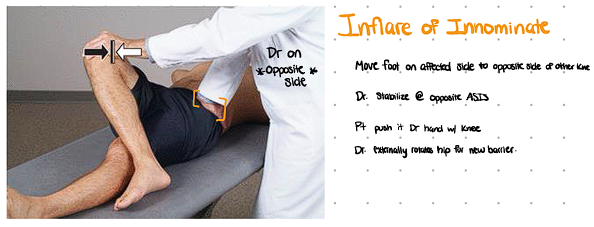
met innominate inflare

  1. Pt is supine. 

  2. Leg (on same side as inflare) is crossed over the other knee.

  3. Can stand on either side of patient. One hand on bent knee and the other on opposite ASIS

    1. Hand on opposite ASIS to stabilize or monitor ASIS on side of dysfunction.

  4. Engage in barrier by pushing knee OUT (toward table)

    1. Pt resists by pushing knee in against your hand. OR BRING THEIR KNEE INWARDS

  5. Leg is pushed out further each time to engage new barrier.

  6. Repeat 3-5 times + passive stretch


<ol><li><p><span style="background-color: transparent;">Pt is supine.&nbsp;</span></p></li><li><p><span style="background-color: transparent;">Leg (on same side as inflare) is crossed over the other knee.</span></p></li><li><p><span style="background-color: transparent;">Can stand on either side of patient. One hand on bent knee and the other on opposite ASIS</span></p><ol><li><p><span style="background-color: transparent;">Hand on opposite ASIS to stabilize or monitor ASIS on side of dysfunction.</span></p></li></ol></li><li><p><span style="background-color: transparent;">Engage in barrier by pushing knee OUT (toward table)</span></p><ol><li><p><span style="background-color: transparent;">Pt resists by pushing knee in against your hand. OR BRING THEIR KNEE INWARDS</span></p></li></ol></li><li><p><span style="background-color: transparent;">Leg is pushed out further each time to engage new barrier.</span></p></li><li><p><span style="background-color: transparent;">Repeat 3-5 times + passive stretch</span></p></li></ol><p></p>
11
New cards

met innominate outflare

  1. Pt is supine.

  2. Leg (on same side as outflare) is crossed over.

  3. Can stand on OPPOSITE side (can stand on same but set up would be harder). Reach out and hold knee.

    1. Hand on opposite ASIS to stabilize (not pictured) or monitor PSIS on side of dysfunction.

  4. Engage in barrier by pushing knee IN

    1. Pt resists by pushing knee OUT against your hand

  5. Leg is pushed in further each time to engage new barrier.

  6. Repeat 3-5 times + passive stretch


<ol><li><p><span style="background-color: transparent;">Pt is supine.</span></p></li><li><p><span style="background-color: transparent;">Leg (on same side as outflare) is crossed over.</span></p></li><li><p><span style="background-color: transparent;">Can stand on OPPOSITE side (can stand on same but set up would be harder). Reach out and hold knee.</span></p><ol><li><p><span style="background-color: transparent;">Hand on opposite ASIS to stabilize (not pictured) or monitor PSIS on side of dysfunction.</span></p></li></ol></li><li><p><span style="background-color: transparent;">Engage in barrier by pushing knee IN</span></p><ol><li><p><span style="background-color: transparent;">Pt resists by pushing knee OUT against your hand</span></p></li></ol></li><li><p><span style="background-color: transparent;">Leg is pushed in further each time to engage new barrier.</span></p></li><li><p><span style="background-color: transparent;">Repeat 3-5 times + passive stretch</span></p></li></ol><p></p>
12
New cards

met superior pubic shear

  1. Same set up as posterior innominate rotation MET EXCEPT:

    1. Ischial tuberosity stays on table (localizes to pubic tubercle)

  2. Pt is supine.

  3. Hand on opposite ASIS to stabilize.

  4. Ischial tuberosity (on side of dysfunction) ON table 

  5. Push leg DOWN (hand above knee)

    1. Pt resists by pushing leg back up and slightly medially (as if they’re trying to get back onto the table)

  6. Repeat 3-5 times + passive stretch

  7. Stand with your hip against pt’s hip to stabilize.


<ol><li><p><span style="background-color: transparent;">Same set up as posterior innominate rotation MET EXCEPT:</span></p><ol><li><p><span style="background-color: transparent;"><strong>Ischial tuberosity stays on table (localizes to pubic tubercle)</strong></span></p></li></ol></li><li><p><span style="background-color: transparent;">Pt is supine.</span></p></li><li><p><span style="background-color: transparent;"><strong>Hand on opposite ASIS to stabilize.</strong></span></p></li><li><p><span style="background-color: transparent;">Ischial tuberosity (on side of dysfunction) <strong>ON</strong> table&nbsp;</span></p></li><li><p><span style="background-color: transparent;">Push leg DOWN (hand above knee)</span></p><ol><li><p><span style="background-color: transparent;">Pt resists by pushing leg back up and <strong>slightly medially </strong>(as if they’re trying to get back onto the table)</span></p></li></ol></li><li><p><span style="background-color: transparent;">Repeat 3-5 times + passive stretch</span></p></li><li><p><span style="background-color: transparent;"><strong>Stand with your hip against pt’s hip to stabilize.</strong></span></p></li></ol><p></p>
13
New cards

met inferior pubic shear

  1. Pt is supine. You stand on opposite side.

  2. Monitor PSIS on dysfunctional side.

  3. Flex pt’s leg up until motion is felt at PSIS (this is the barrier)

  4. Pt resists by pushing up to ceiling

  5. Flex leg further

  6. New barrier is when movement is felt at PSIS again

  7. Repeat 3-5 times + passive stretch


<ol><li><p><span style="background-color: transparent;">Pt is supine. You stand on opposite side.</span></p></li><li><p><span style="background-color: transparent;">Monitor PSIS on dysfunctional side.</span></p></li><li><p><span style="background-color: transparent;">Flex pt’s leg up until motion is felt at PSIS (this is the barrier)</span></p></li><li><p><span style="background-color: transparent;">Pt resists by pushing up to ceiling</span></p></li><li><p><span style="background-color: transparent;">Flex leg further</span></p></li><li><p><span style="background-color: transparent;">New barrier is when movement is felt at PSIS again</span></p></li><li><p><span style="background-color: transparent;">Repeat 3-5 times + passive stretch</span></p></li></ol><p></p>
14
New cards

met pubic compression

  1. Pt is supine.

  2. Hips are flexed at 45 and knees at 90

  3. Make sure pts ankles are touching!

  4. Push knees apart until you feel resistance.

  5. Pt pushes knees back together (toward freedom)

  6. Start with fist between knees, then forearm; gradually increasing distance between knees

    1. Can do with palm, then fist, then additional hand for length IF YOU FIT FOREARM BETWEEN LEGS.


<ol><li><p><span style="background-color: transparent;">Pt is supine.</span></p></li><li><p><span style="background-color: transparent;">Hips are flexed at 45 and knees at 90</span></p></li><li><p><span style="background-color: transparent;">Make sure pts ankles are touching!</span></p></li><li><p><span style="background-color: transparent;">Push knees apart until you feel resistance.</span></p></li><li><p><span style="background-color: transparent;">Pt pushes knees back together (toward freedom)</span></p></li><li><p><span style="background-color: transparent;">Start with fist between knees, then forearm; gradually increasing distance between knees</span></p><ol><li><p><span style="background-color: transparent;">Can do with palm, then fist, then additional hand for length IF YOU FIT FOREARM BETWEEN LEGS.</span></p></li></ol></li></ol><p></p>
15
New cards

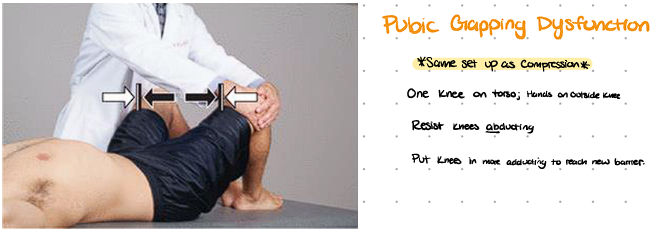
met pubic gapping

  1. Pt is supine.

  2. Other knee against your abdomen

  3. Make sure pts ankles are touching

  4. Push knees together (into barrier)

  5. Pt pushes knees apart (into freedom)

  6. Distance between knees is decreased each time

<ol><li><p><span style="background-color: transparent;">Pt is supine.</span></p></li><li><p><span style="background-color: transparent;">Other knee against your abdomen</span></p></li><li><p><span style="background-color: transparent;">Make sure pts ankles are touching</span></p></li><li><p><span style="background-color: transparent;">Push knees together (into barrier)</span></p></li><li><p><span style="background-color: transparent;">Pt pushes knees apart (into freedom)</span></p></li><li><p><span style="background-color: transparent;">Distance between knees is decreased each time</span></p></li></ol><p></p>
16
New cards

cs of anterior pelvic points

knowt flashcard image
17
New cards

cs iliacus

F ER (hips)

  1. Pt supine

  2. Stand on same side of Tender pt which is located ⅓ from ASIS to midline (straight line across)

  3. Cross ankles opposite over adjacent 

  4. Flex pt hip/knees bilaterally and rest legs on your thigh (FROGGY LEGS)

  5. Finetune with further flexion and external rotation.


<p><span style="background-color: transparent;">F ER (hips)</span></p><ol><li><p><span style="background-color: transparent;">Pt supine</span></p></li><li><p><span style="background-color: transparent;">Stand on same side of Tender pt which is located ⅓ from ASIS to midline (straight line across)</span></p></li><li><p><span style="background-color: transparent;">Cross ankles opposite over adjacent&nbsp;</span></p></li><li><p><span style="background-color: transparent;">Flex pt hip/knees bilaterally and rest legs on your thigh (FROGGY LEGS)</span></p></li><li><p><span style="background-color: transparent;">Finetune with further flexion and external rotation.</span></p></li></ol><p></p>
18
New cards

cs psoas

F St er (hips)

  1. Pt supine

  2. Stand on same side of tender pt

  3. Tender pt is ⅔ distance from ASIS to midline (straight line across)

  4. Cross pt ankles (opposite over adjacent)

  5. Flex pt hips/knees bilaterally and rest legs on your thigh

  6. Bring knees towards me

    1. add slight external rotation and pull knees towards tender pt slightly side bend lumbar spine

  7. Fine tune with more or less hip flexion, side bend and rotation


<p><span style="background-color: transparent;">F St er (hips)</span></p><ol><li><p>Pt supine</p></li><li><p><span style="background-color: transparent;">Stand on same side of tender pt</span></p></li><li><p><span style="background-color: transparent;">Tender pt is ⅔ distance from ASIS to midline (straight line across)</span></p></li><li><p><span style="background-color: transparent;">Cross pt ankles (opposite over adjacent)</span></p></li><li><p><span style="background-color: transparent;">Flex pt hips/knees bilaterally and rest legs on your thigh</span></p></li><li><p><span style="background-color: transparent;"><strong>Bring knees towards me</strong></span></p><ol><li><p><span style="background-color: transparent;">add slight external rotation and pull knees towards tender pt slightly side bend lumbar spine</span></p></li></ol></li><li><p><span style="background-color: transparent;">Fine tune with more or less hip flexion, side bend and rotation</span></p></li></ol><p></p>
19
New cards

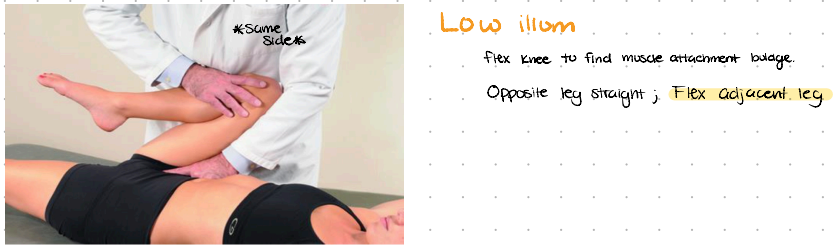
cs low ilium

F

  1. Use iliac crest to find ASIS, then move to AIIS.

  2. Follow from AIIS down inguinal ligament until you feel a bulb OR feel pubic tubercle and go ½ in lateral and ½ in superior

  3. Physician stands on the same side of the tender point

  4. Markedly flex patient’s hip 

  5. Fine tune with more/less hip flexion


<p><span style="background-color: transparent;">F</span></p><ol><li><p><span style="background-color: transparent;">Use iliac crest to find ASIS, then move to AIIS.</span></p></li><li><p><span style="background-color: transparent;">Follow from AIIS down inguinal ligament until you feel a bulb OR feel pubic tubercle and go ½ in lateral and ½ in superior</span></p></li><li><p><span style="background-color: transparent;">Physician stands on the same side of the tender point</span></p></li><li><p><span style="background-color: transparent;">Markedly flex patient’s hip&nbsp;</span></p></li><li><p><span style="background-color: transparent;">Fine tune with more/less hip flexion</span></p></li></ol><p></p>
20
New cards

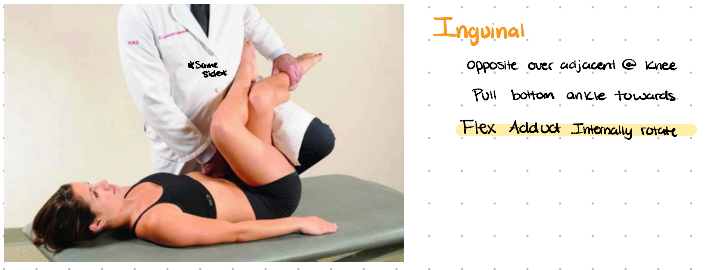
cs inguinal

F ADduct Internally Rotate

  1. Tender point is located on the lateral aspect of the pubic tubercle; associated with the attachment of the inguinal ligament and/or pectineus muscle

  2. Standing on the same side of the tender point

  3. Cross the patient’s thighs opposite over adjacent. flex hips/knees bilaterally and place legs on physician’s thigh

  4. Pull patient’s ipsilateral leg towards physician to induce adduction and internal rotation of the hip

  5. Fine tune with more/less hip flexion, internal rotation and adduction

<p><span style="background-color: transparent;">F ADduct Internally Rotate</span></p><ol><li><p><span style="background-color: transparent;">Tender point is located on the lateral aspect of the pubic tubercle; associated with the attachment of the inguinal ligament and/or pectineus muscle</span></p></li><li><p><span style="background-color: transparent;">Standing on the same side of the tender point</span></p></li><li><p><span style="background-color: transparent;"><strong>Cross the patient’s thighs</strong> opposite over adjacent. flex hips/knees bilaterally and place legs on physician’s thigh</span></p></li><li><p><span style="background-color: transparent;">Pull patient’s ipsilateral leg towards physician to induce adduction and internal rotation of the hip</span></p></li><li><p><span style="background-color: transparent;">Fine tune with more/less hip flexion, internal rotation and adduction</span></p></li></ol><p></p>
21
New cards

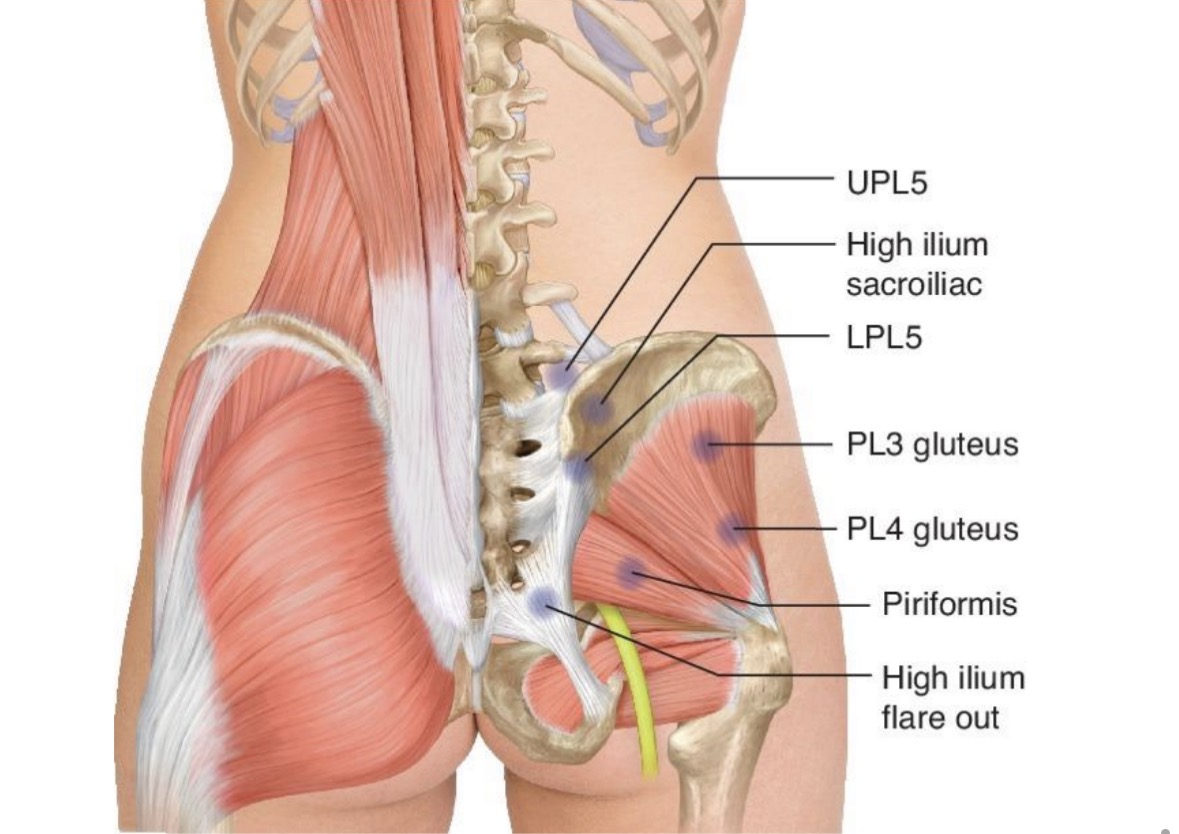
cs of posterior pelvic points

we just need to know UPL5 and Piriformis
<p><span>we just need to know UPL5 and Piriformis</span></p>
22
New cards

cs piriformis (posterior pelvic)

Point is between sacral ILA and greater trochanter

  1. Stand on same side

  2. Ask pt to move to edge of table

  3. Move leg down and hold between your knees

  4. Flex and ABduct leg on affected side

  5. Hold just below ankle and fine tune with internal or external rotation


<p>Point is between sacral ILA and greater trochanter</p><ol><li><p>Stand on same side</p></li><li><p>Ask pt to move to edge of table</p></li><li><p>Move leg down and hold between your knees</p></li><li><p>Flex and ABduct leg on affected side</p></li><li><p>Hold just below ankle and fine tune with internal or external rotation</p></li></ol><p></p>
23
New cards

cs UPL5 (posterior pelvic)

Point is superior and medial to PSIS

  1. Pt is prone

  2. Stand on opposite side

  3. Hold pt leg of the tender point above knee

  4. Extend and ADduct


<p>Point is superior and medial to PSIS</p><ol><li><p>Pt is prone</p></li><li><p>Stand on opposite side</p></li><li><p>Hold pt leg of the tender point above knee</p></li><li><p>Extend and ADduct</p></li></ol><p></p>