ch 13-1 uranus and neptune pt 1
 Call Kai
 Learn
Learn Practice Test
 Spaced Repetition
 Match
Match Flashcards
 Knowt Play
1/33

There's no tags or description
Looks like no tags are added yet.
Name | Mastery | Learn | Test | Matching | Spaced | Call with Kai | Chat |
|---|
No analytics yet
Send a link to your students to track their progress
34 Terms
Uranus and Neptune
ice giants
outer solar system
similar size
similar composition
water, ammonia, methane
rocky core
differ in appearance
voyager fly-by
the discovery of Uranus
1781 by Herschel; first planet to be discovered in more than 2000 years
by accident
studying stars that are too faint to see with naked eye
discovery doubled the known size of the solar system

can you see Uranus with the naked eye?
just above limit to see faintly with naked eye
moved in front of stars
what was Uranus mislabelled as?
a comet or nebula star
how much detail of Uranus can we see from Earth?
little detail
3 moons
faint greenish-blue, star-like
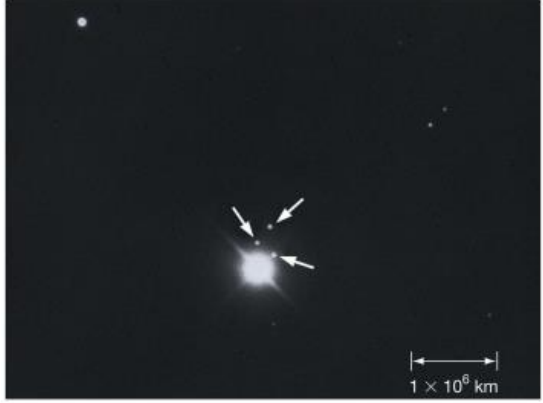
where are the moons of Uranus located?
constellation Aries
what does Voyager 2 provide us when viewing Uranus
slightly more detailed images at a distance of 1 million km that increased our knowledge
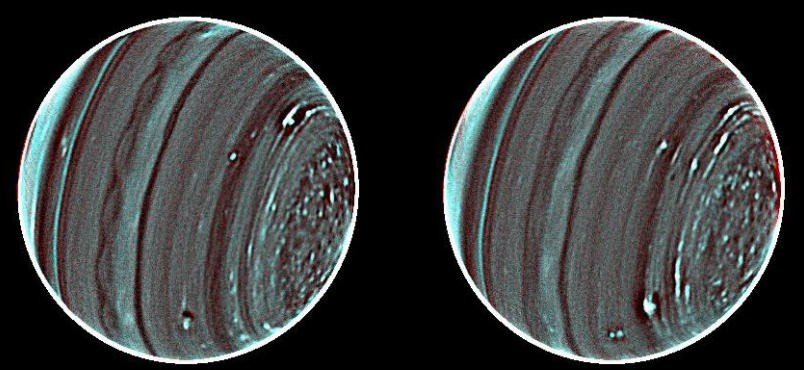
few wispy clouds in Northern Hemisphere
natural colour


lots of activity
circulating clouds hurricanes and strange convection period
viewing Uranus
broad bands covers latitude range to equator to 10°N
scalloped wave pattern due to horizontal wind speed
small dark-spot with bright companion
the discovery of Neptune
1846 after analysis of Uranus’s orbit indicate its presence
first through mathematical predictions
didn’t follow navigation path → unknown gravitational pull
can you view Neptune from Earth?
details cannot be made out
further than Uranus
never visible to the naked eye
faint tinted blue star-like object

Neptune’s elliptical
couldn’t find elliptical to match trajectory
later realized there has to be another plane perturbing Uranus motion
1989 Voyager 2 view of Neptune
first to observer Neptune up close
100 km NP
11 km/h wind
storm: great dark spot
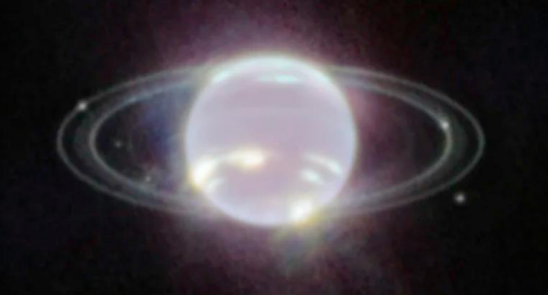
rings
6 moons
how was Neptune’s rings viewed?
with James Webb Space Telescope 2022
infrared
fainter dust bands
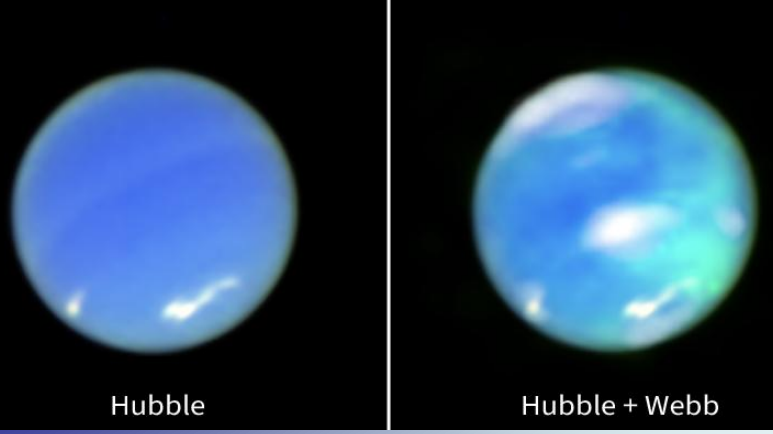
Neptune’s Auroras
JWST 2023
particles from sun trapped in object magnetic field
energy release causes flow
orbital and physical properties of Uranus and Neptune
very similar
smallest of the Jovian’s but 4x of Earth
water, ammonia, methane ice
small rocky core
ice giants
chaotic magnetic field
what does the densities of Uranus and Neptune imply/
rocky core constitutes a greater fraction of the planet’s masses than Jupiter and Saturn
Uranus rotation
short rotation period
days are about 10-20 hours
atm. rotates faster at poles
Uranus properties
mass: 14.5 x Earth
radius: 4.0 x Earth
density: 1300 kg/m3
Neptune’s properties
mass: 17.1 x Earth
radius: 3.9 x Earth
density: 1600 kg/m3
denser
high proportion of rocky material and compressed ices
What is unusual about Uranus's axis of rotation?
Uranus is tilted about 98° from perpendicular to its orbital plane, so its axis of rotation lies almost in the plane of its orbit.
Peculiarity of Uranus
axis of rotation lies almost in the plane of its orbit
seasonal variations are extreme
rotates on its side
likely caused by massive collision

Outer atmosphere of Uranus and Neptune
are similar to those of Jupiter and Saturn
Uranus and Neptune are cold enough that?
ammonia freezes; methane dominates and gives the characteristic blue color
Uranus atmosphere
very cold; clouds only in lower. warmer layers
thicker more stagnant atm. haze and appear lighter
hydrogen, helium, methane → blue green colour
what is Uranus atmosphere composed of?
water ice at bottom, followed by ammonia hydrosulfide, hydrosulfide layers
Uranus internal heat source
lacks significant internal heat source, decreases surface temp.
coldest planet → -22°C
Neptune’s atmosphere
deeper blue
thinner haze and warmer atm.
atmosphere of Neptune
band structure is more visible; it has a “Dark Spot” similar to Jupiter’s storms (now vanished)
abundance of gaseous ammonia and methane vary systematically
mass, short lived, anticyclonic storms
what is unique about Neptunes atm.
rotates more slowly than its interior
an increase in the amount of methane absorbs….
long-wavelengths largely responsible for blue coloration
absorbs long wavelength, red light quiet efficiently
excess methane helped insulate the planet maintaining initially warm interior
How might diamond rain form on Neptune? (hypothesis)
Extreme pressures break apart methane (CH₄), releasing carbon atoms. The carbon atoms crystallize into diamonds, which then sink toward Neptune's core.
most stable form of C under high pressure
Why is "diamond rain" thought to occur on Neptune?
High pressures turn carbon from methane into diamond crystals that sink deeper into the planet.
what happens to the dense carbon crystals during “diamond rain” on Neptune
sink towards core and would accumulate
denser than methane, ammonia, and water