663 Benign tumors, Malignant diseases
 Call Kai
 Learn
Learn Practice Test
 Spaced Repetition
 Match
Match Flashcards
 Knowt Play
1/44

There's no tags or description
Looks like no tags are added yet.
Name | Mastery | Learn | Test | Matching | Spaced | Call with Kai |
|---|
No analytics yet
Send a link to your students to track their progress
45 Terms
What are benign tumors?
= Abnormal masses of tissue that develop as a result of uncontrolled cell proliferation
- tend to resemble tissue of origin
- grow slowly, spread locally, and do not metastasize
Radiographic signs most benign tumors have in common:
- Shape
- Margins
- Effect on surrounding structures
- Shape: round or scalloped
- Margins: well-defined and corticated
- Effect on surrounding structures: displacement, thinning, expansion
Benign tumors of the jaws can be divided into 2 main categories:
- what are 3 subcategories?
Odontogenic and non-odontogenic
Sub-categories:
- Ectodermal
- Mixed
- Mesodermal
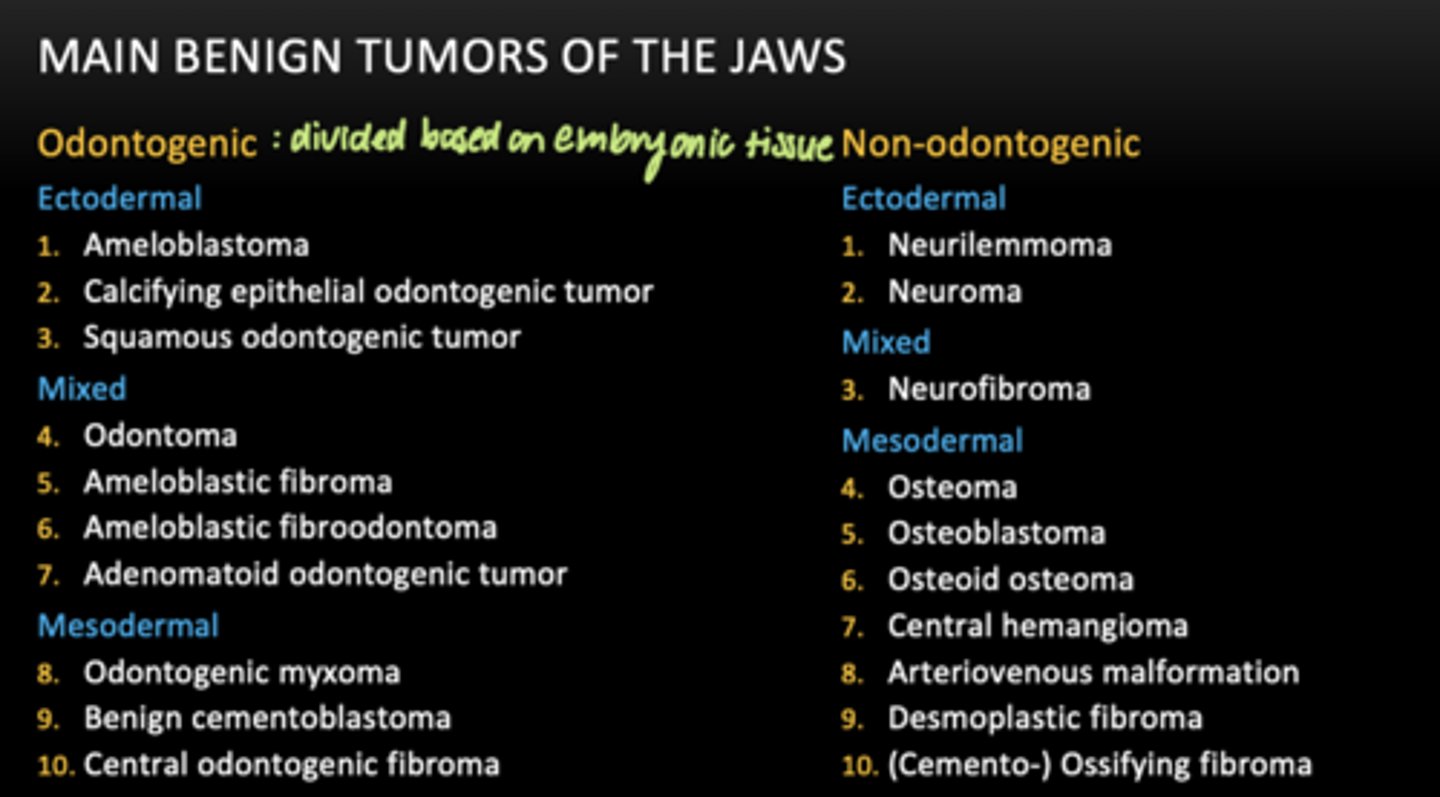
Ameloblastoma has a predilection for what location?
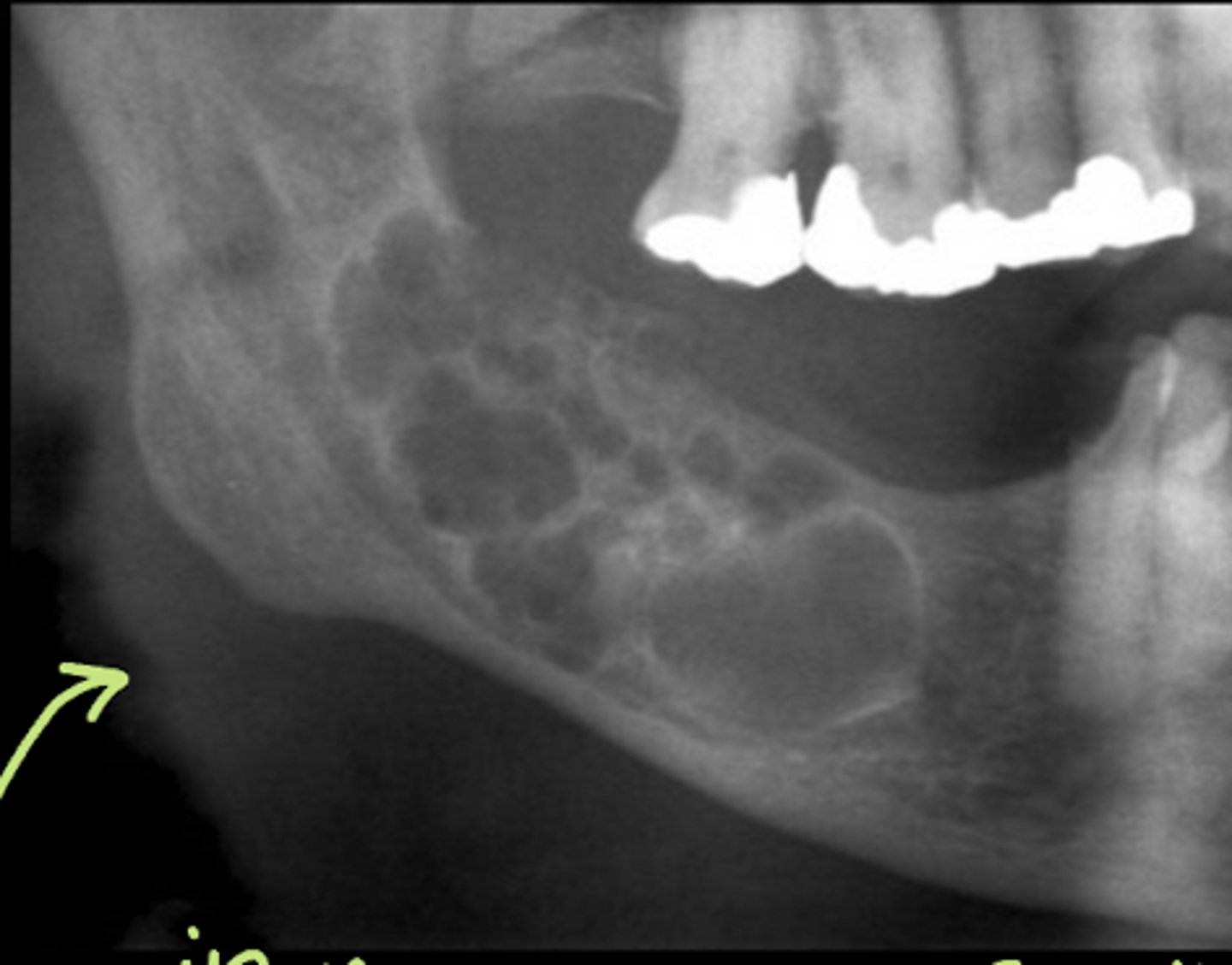
posterior mandible
Ameloblastoma
- Density
- Internal architecture
- Effect on surrounding structure
- Density: radiolucent
- Internal architecture: unilocular or multilocular
- Effect on surrounding structure: root resorption
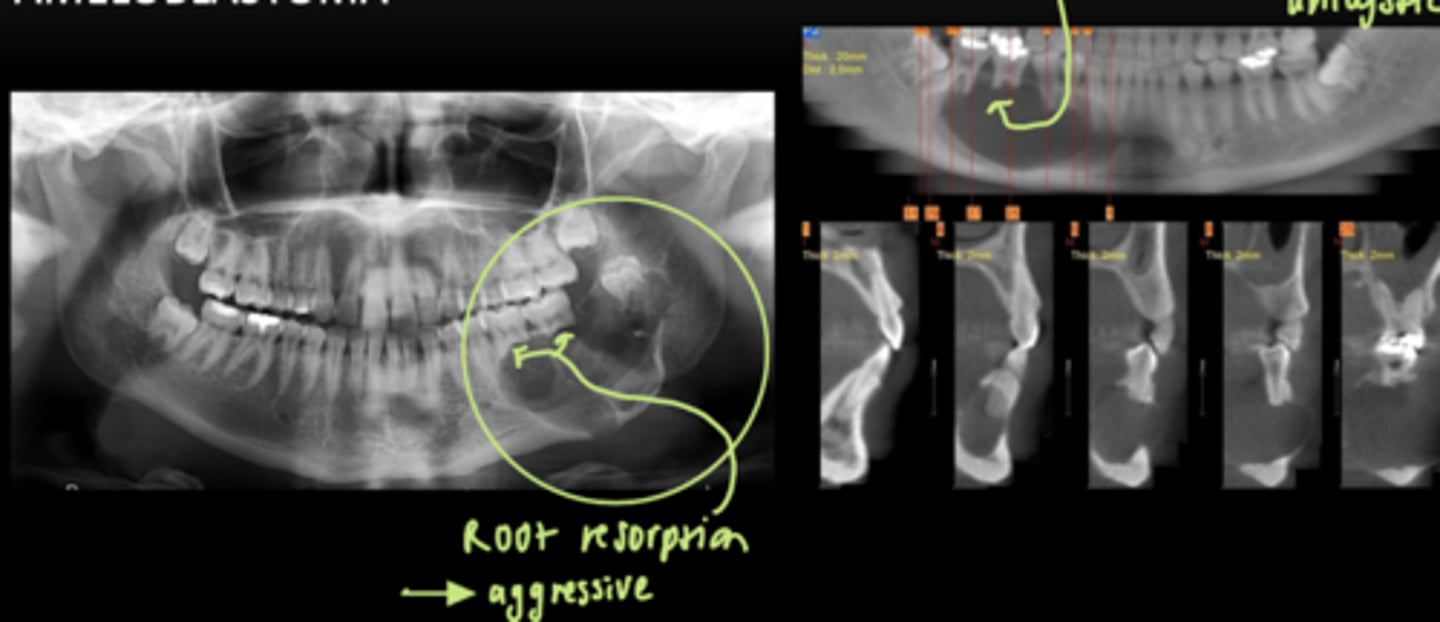
Ameloblastoma ex
- Root resorption
- Expansive
- Multilocular
Odontoma - unique features
- Density
- Internal architecture
- Density: mixed RL-RP
- Internal architecture: amorphous or tooth-like
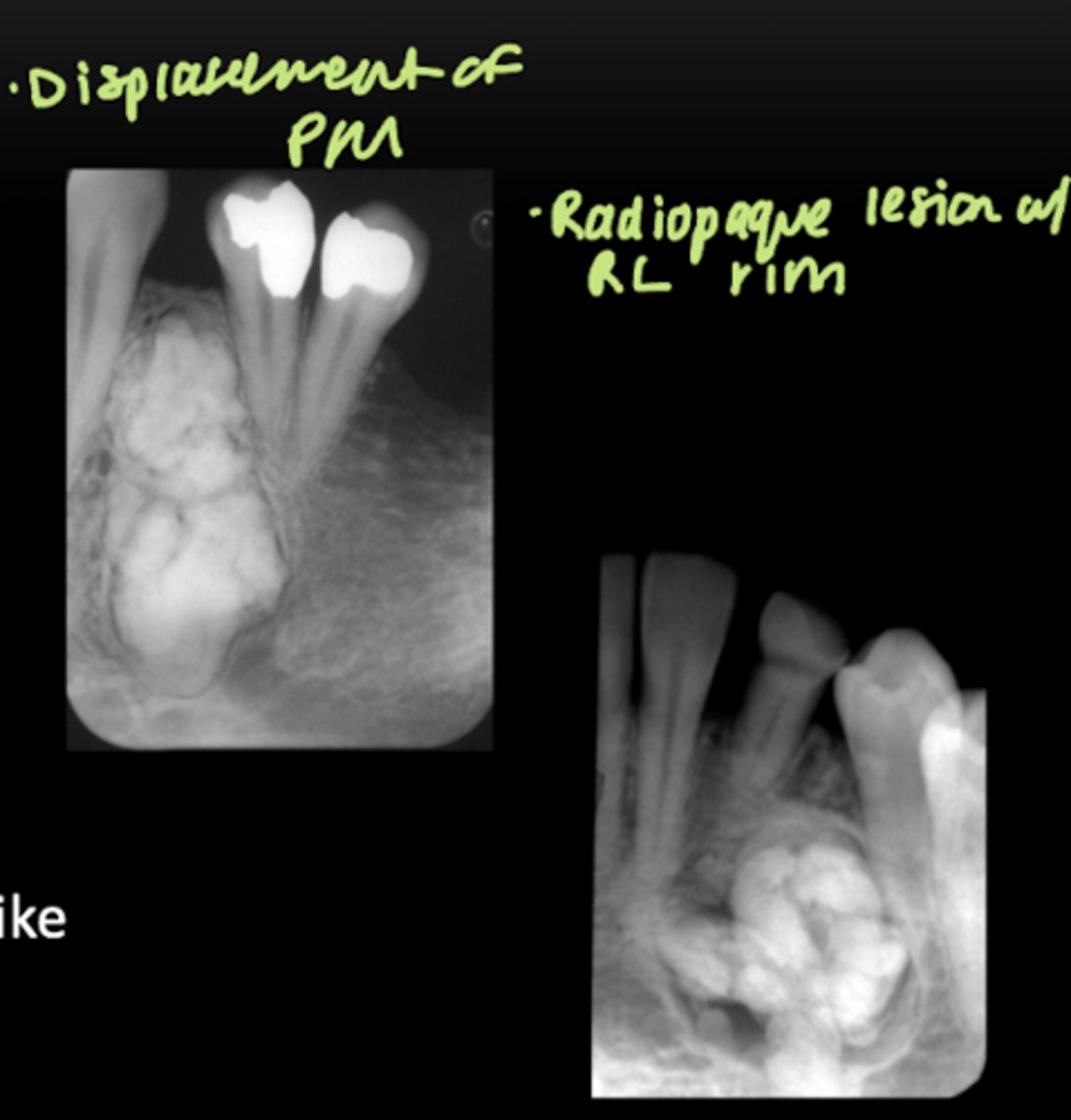
Compound vs complex odontoma
Complex: does not show any tooth-like structures
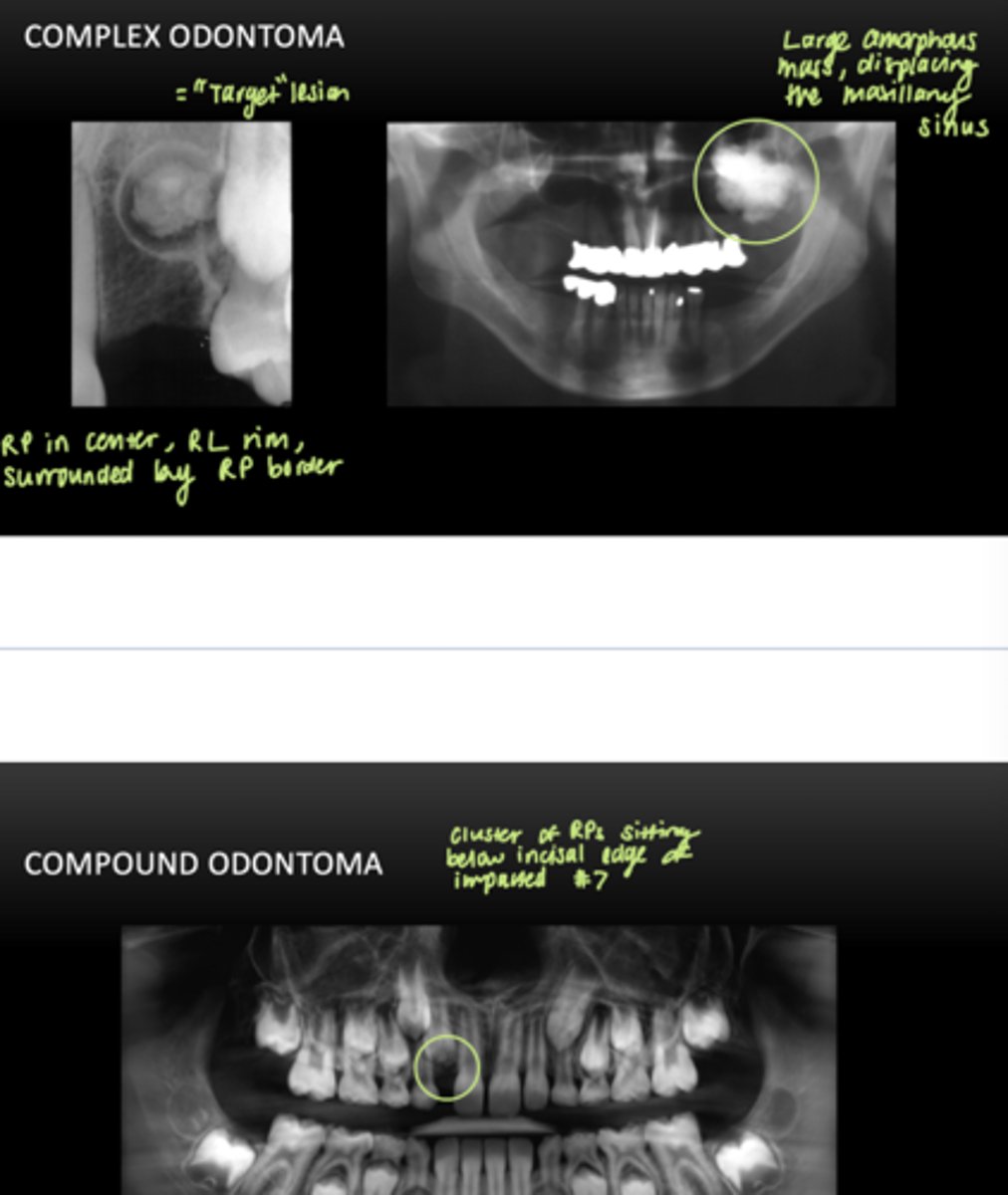
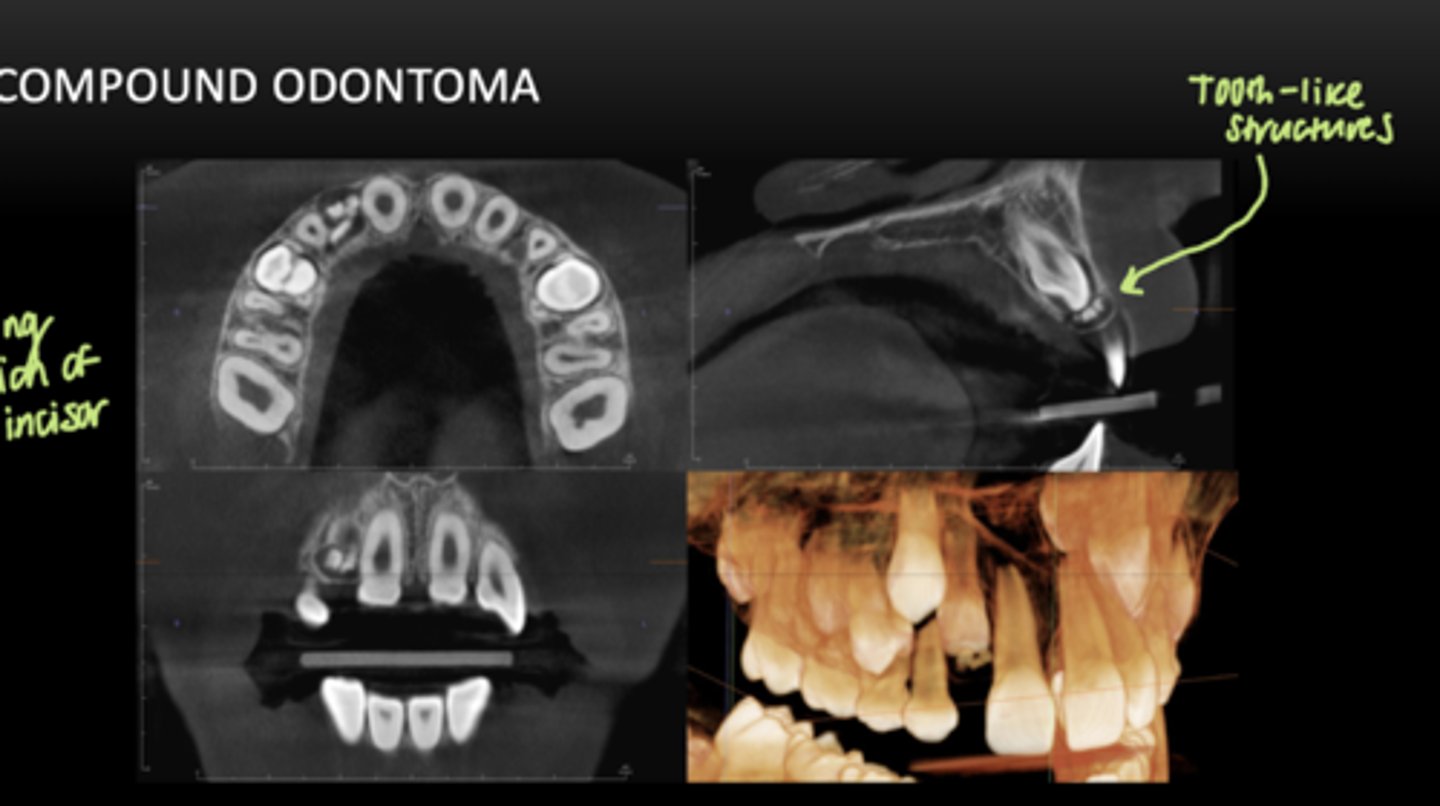
Compound odontoma ex
Little tooth-like structures
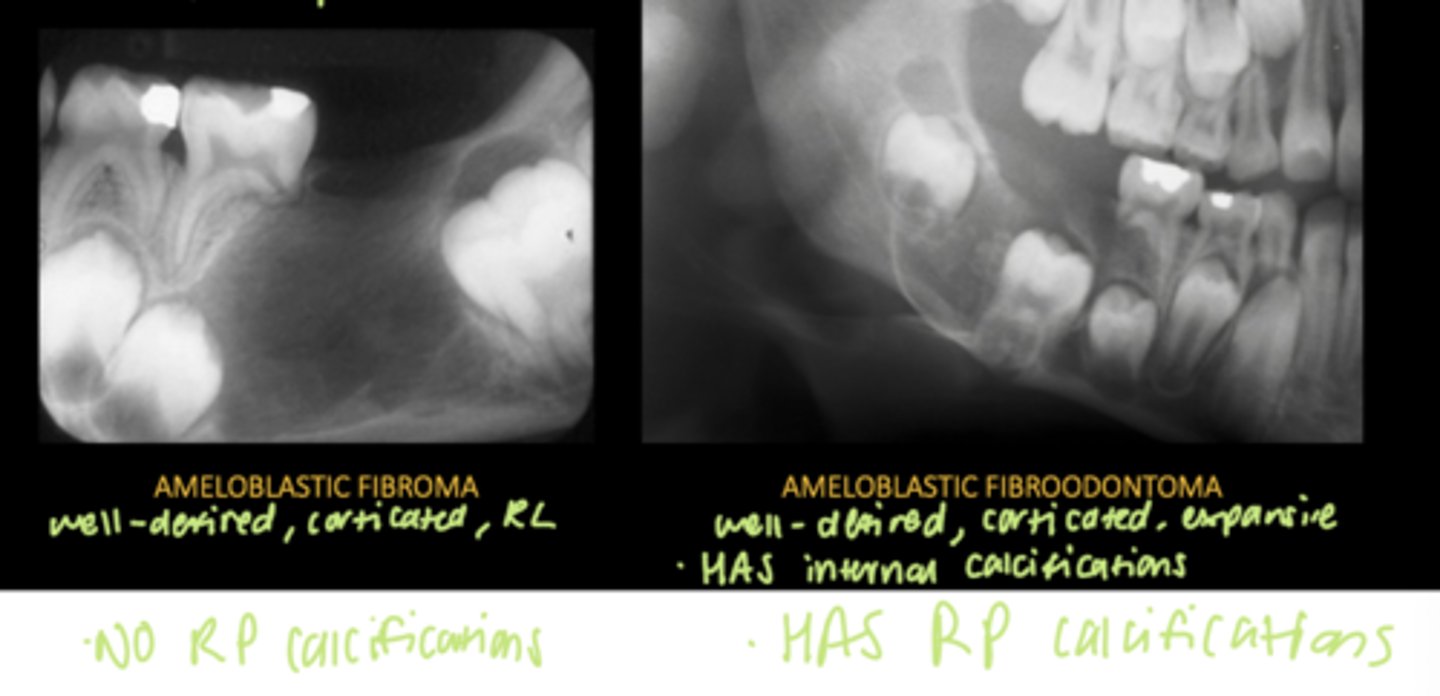
Difference between ameloblastic fibroma and ameloblastic fibroodontoma
Ameloblastic fibroma:
- NO RP calcifications
Ameloblastic fibroodontoma:
- HAS RP calcifications
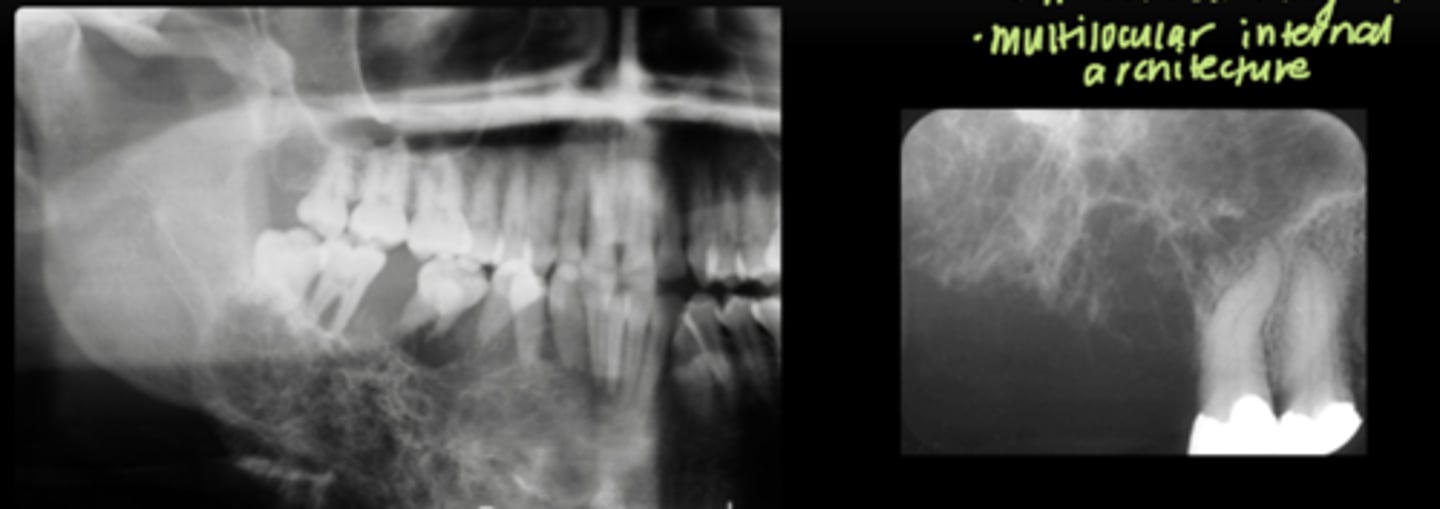
Odontogenic myxoma - unique features
- Margins
- Density
- Internal architecture
- Margins: well-defined or ill-defined
- Density: radiolucent
- Internal architecture: unilocular or multilocular
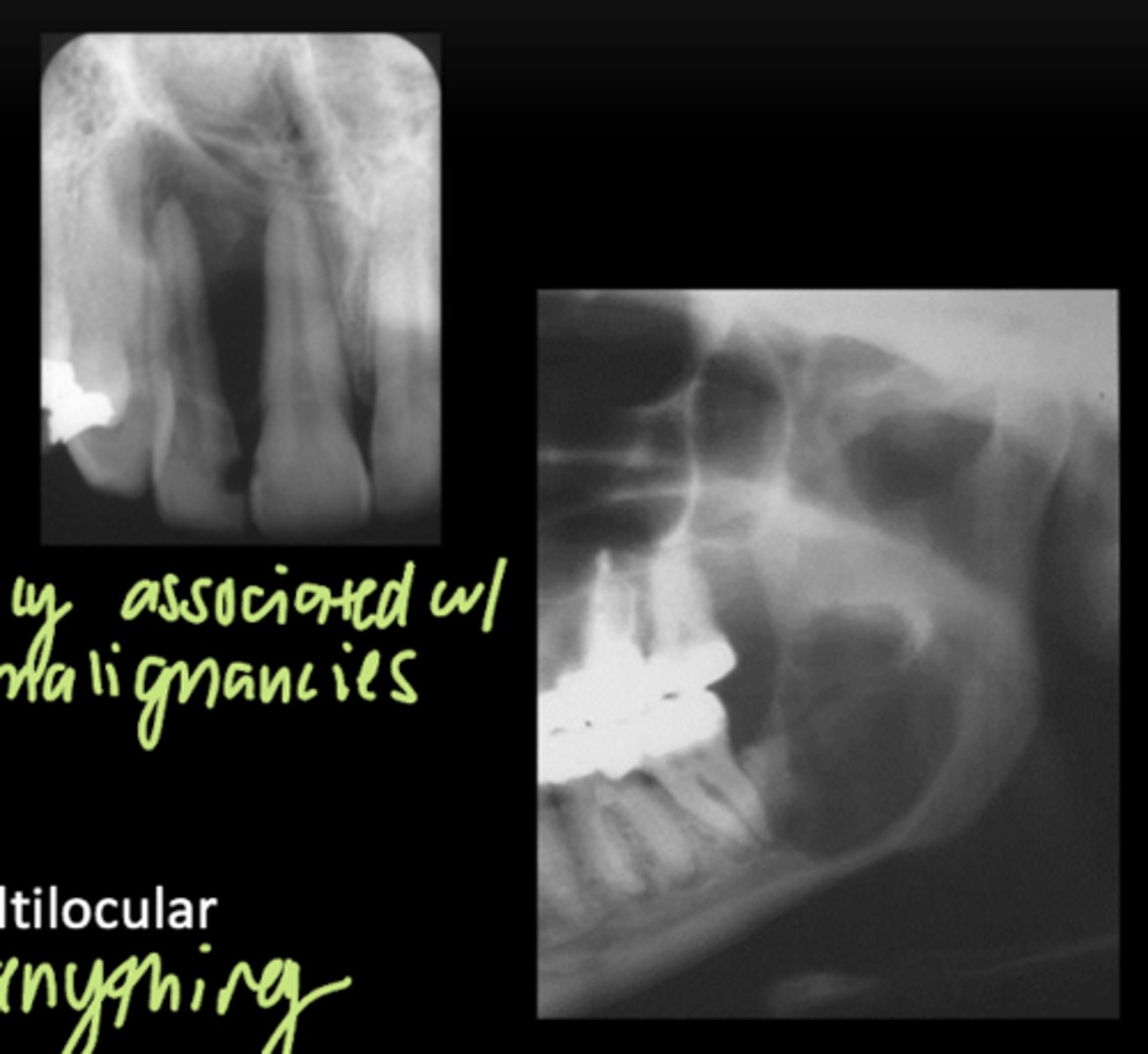
Odontogenic myxoma - distinct feature
Many very fine septae throughout
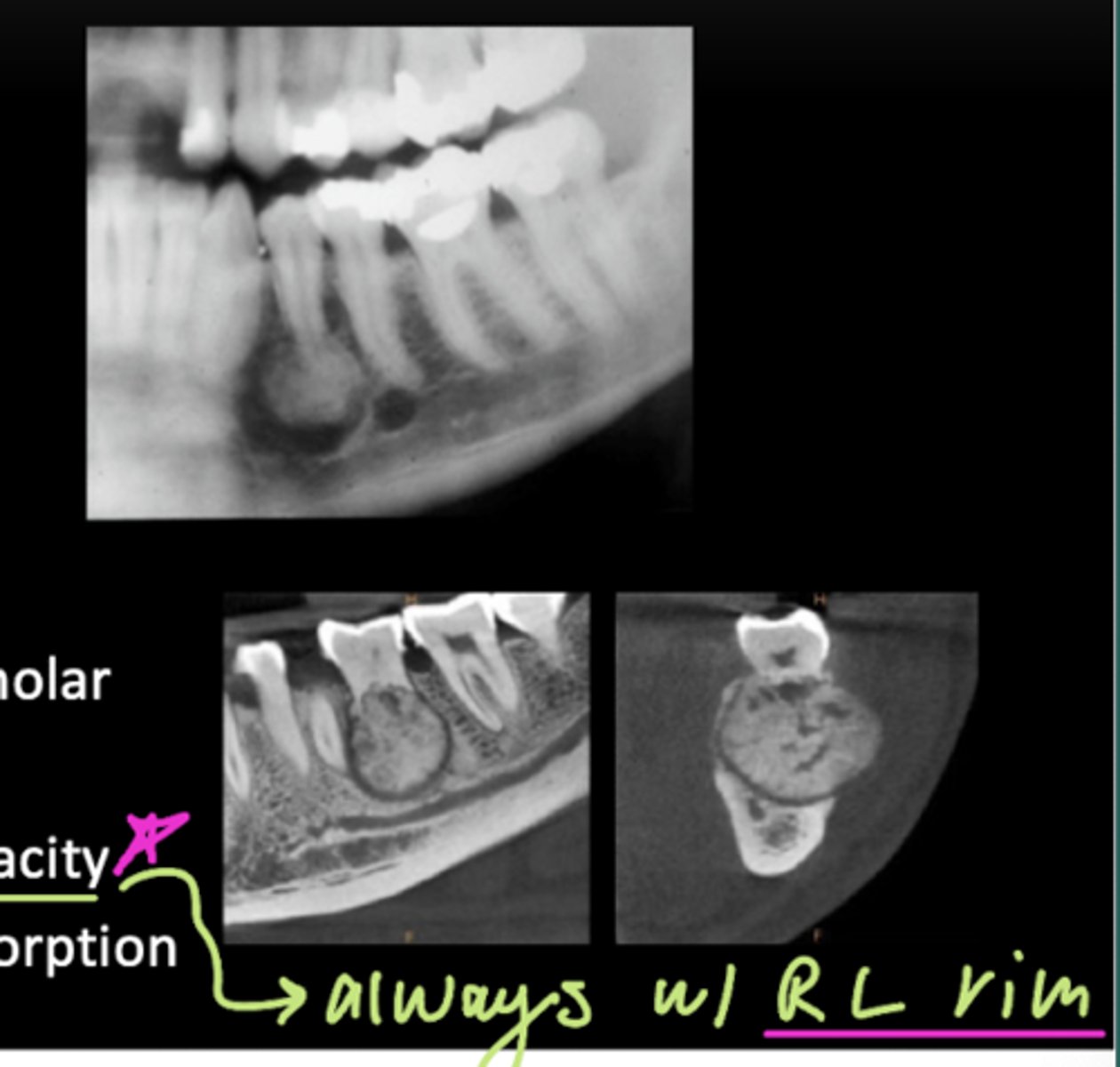
Benign cementoblastoma - unique features
- Location
- Density
- Internal architecture
- Effect on surrounding structures
- Location: often mandibular molar or premolar
- Density: mixed RL-RP
- Internal architecture: large central radiopacity
- Effect on surrounding structures: root resorption
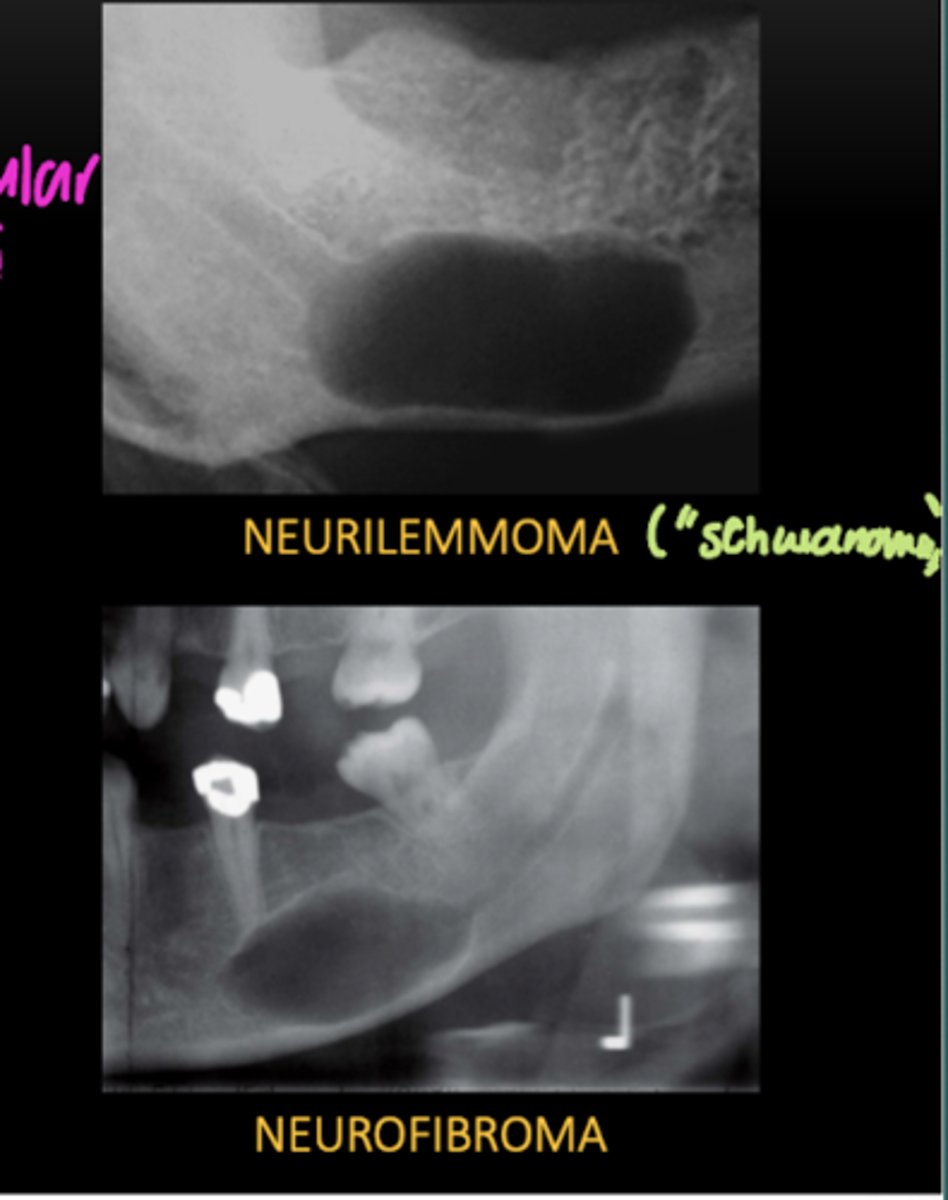
Benign neural tumors are usually located where?
in the mandibular canal
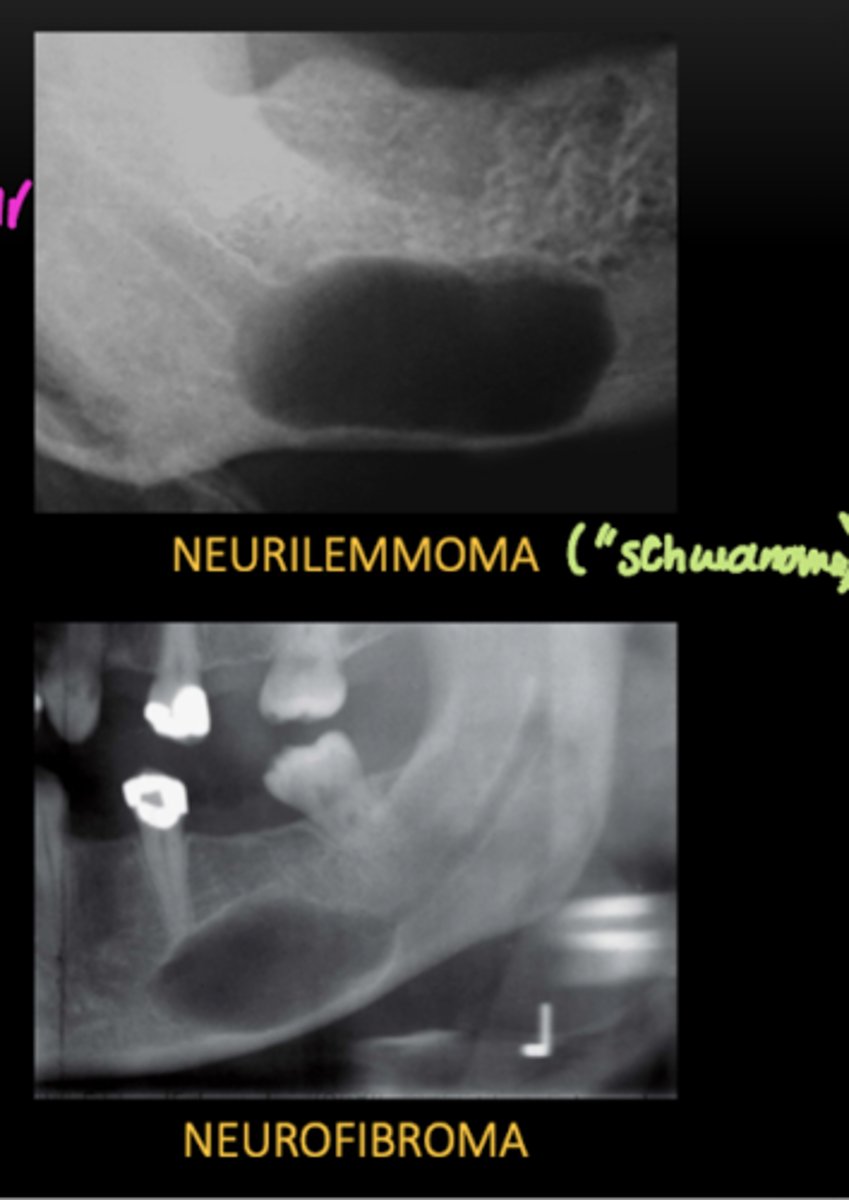
Benign neural tumors - unique features
- Density
- Internal architecture
- Effect on surrounding structures
- Density: radiolucent
- Internal architecture: unilocular
- Effect on surrounding structures: canal expansion
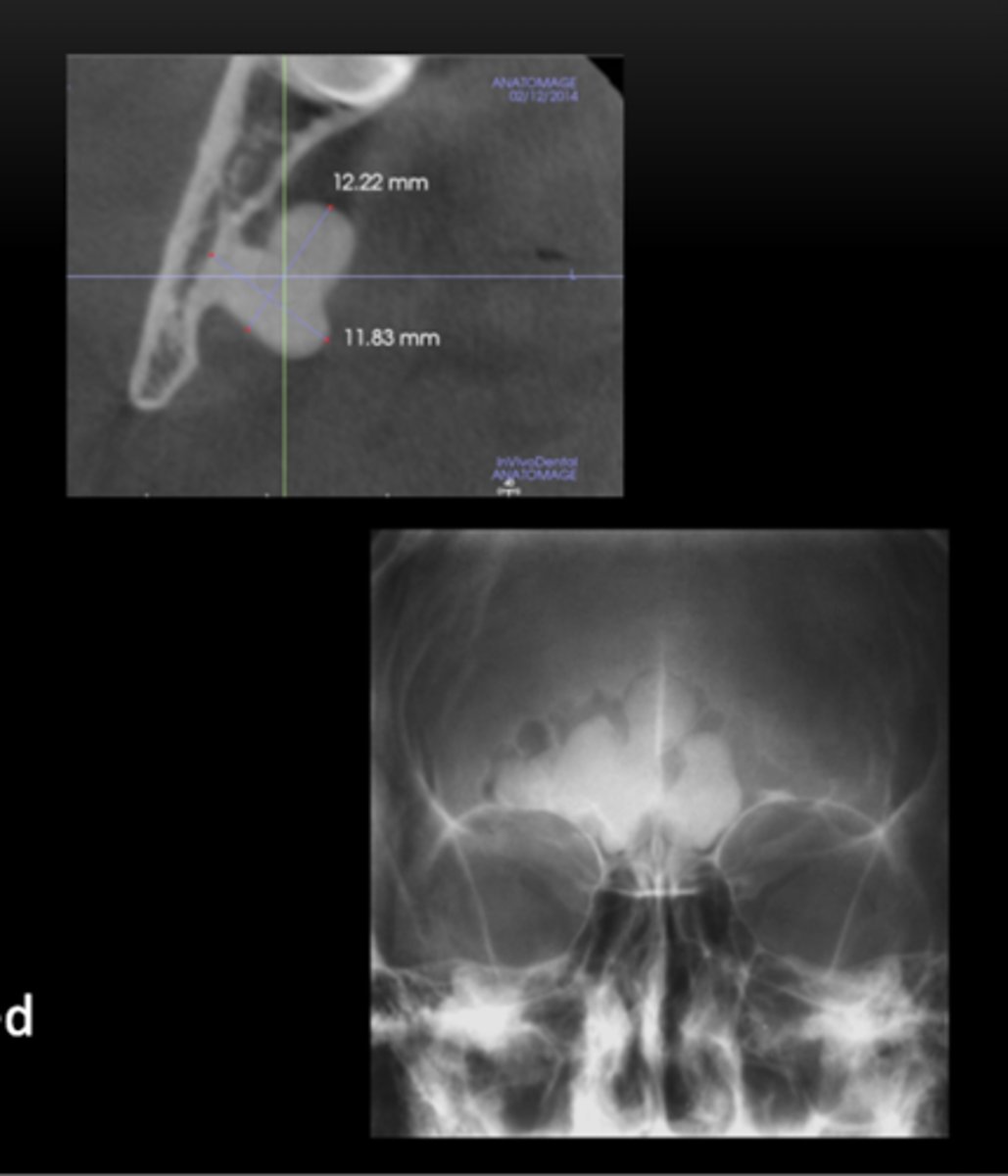
Osteoma - most common location? (2)
- On medial surface of ramus
- In the paranasal sinuses
Osteoma
- density
- internal architecture
- density: RP or mixed
- internal architecture: homogeneous or mixed
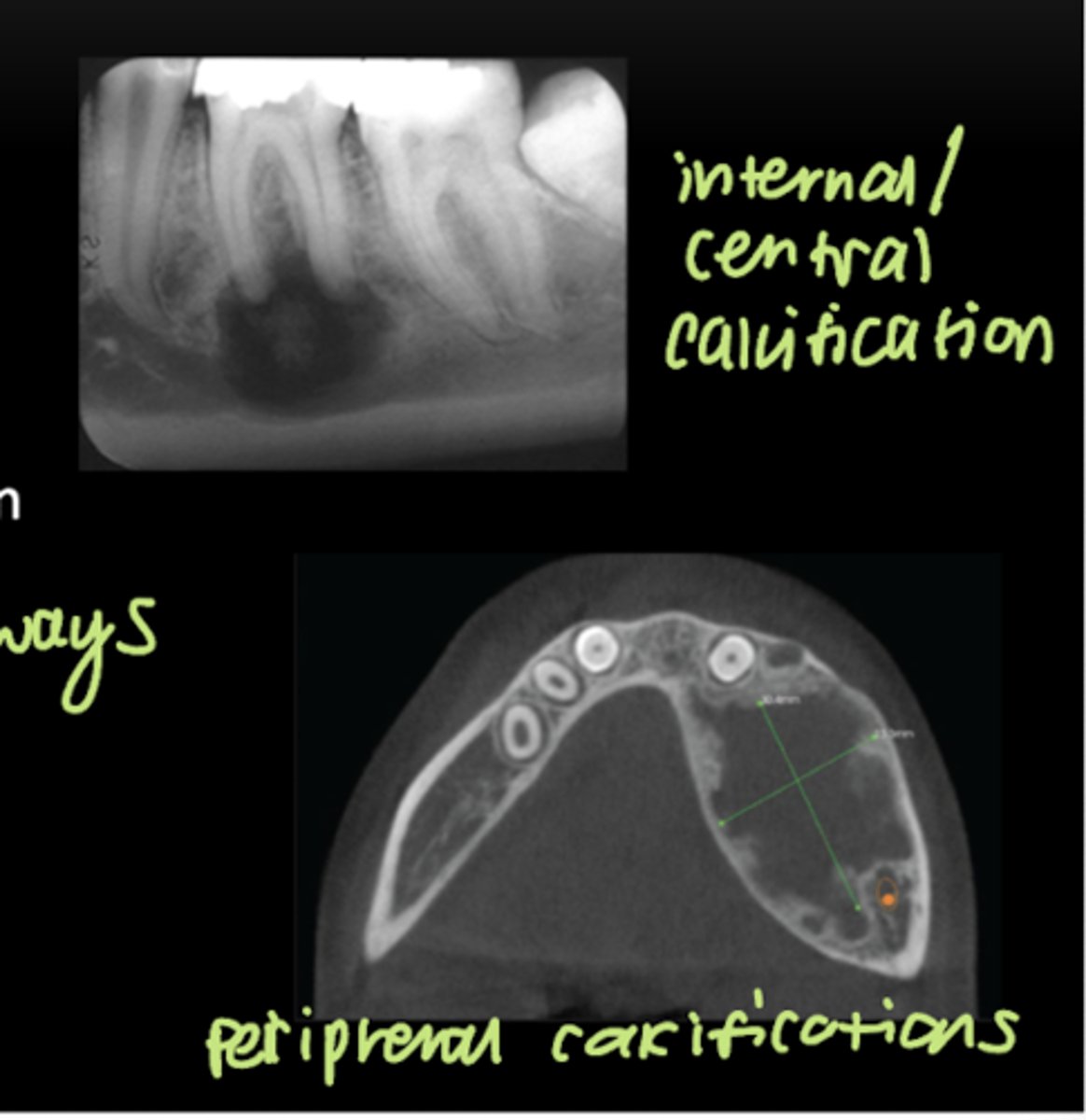
Ossifying fibroma - unique features
- Density
- Internal architecture
- Density: mixed RL-RP
- Internal architecture: variable
What are malignant diseases?
= Abnormal growths of tissue that develop as a result of uncontrolled and unlimited cell proliferation
- show aggressive growth patterns
- invade adjacent normal tissues
- can metastasize via lymphatic or vascular systems or through perineural spread
Radiographic signs most malignant diseases have in common:
- Shape
- Margins
- Density
- Effect on surrounding structures
- Shape: irregular
- Margins: ill-defined
- Density: radiolucent
- Effect on surrounding structures: erosion, destruction
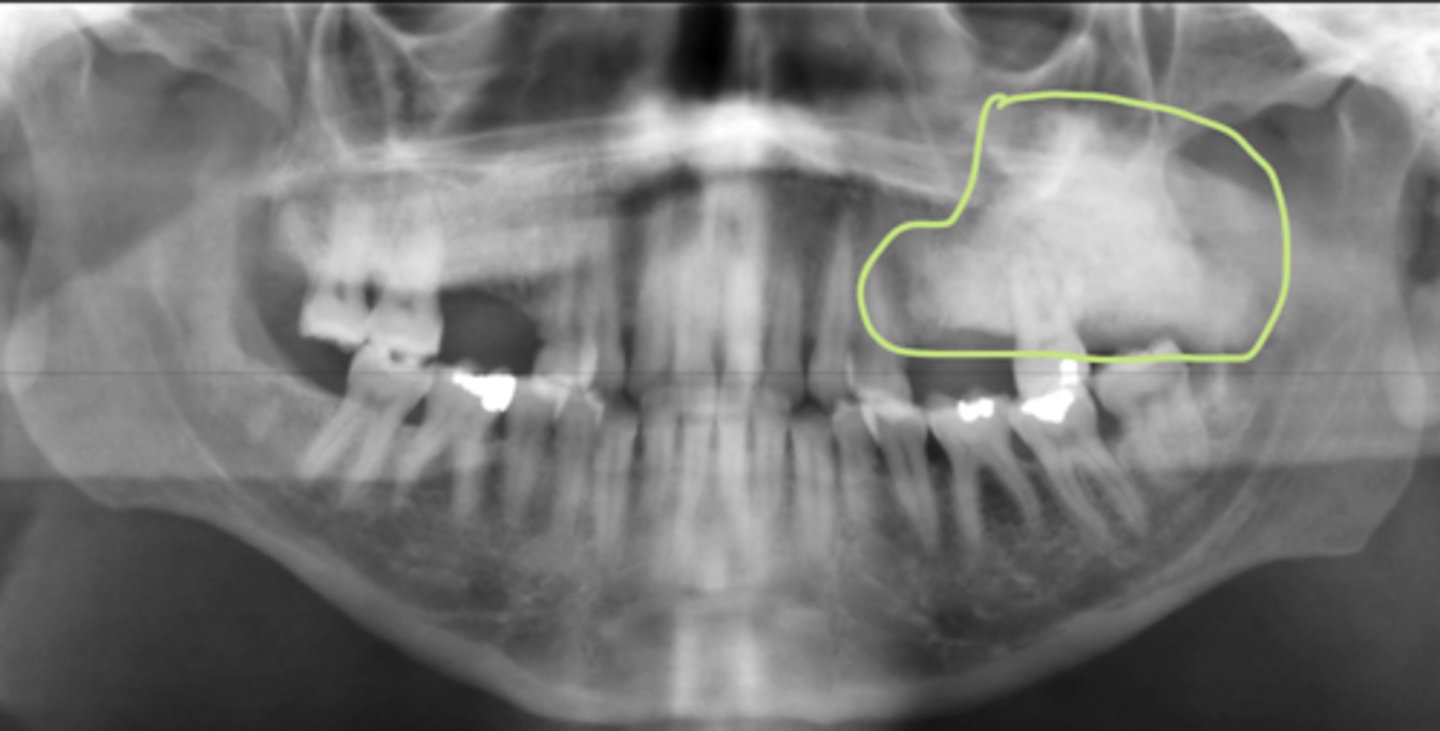
Squamous cell carcinoma - unique features
- location?
Peripheral or central (starts inside bone)
Which metatstaic disease often shows "floating teeth?"
Squamous cell carcinoma
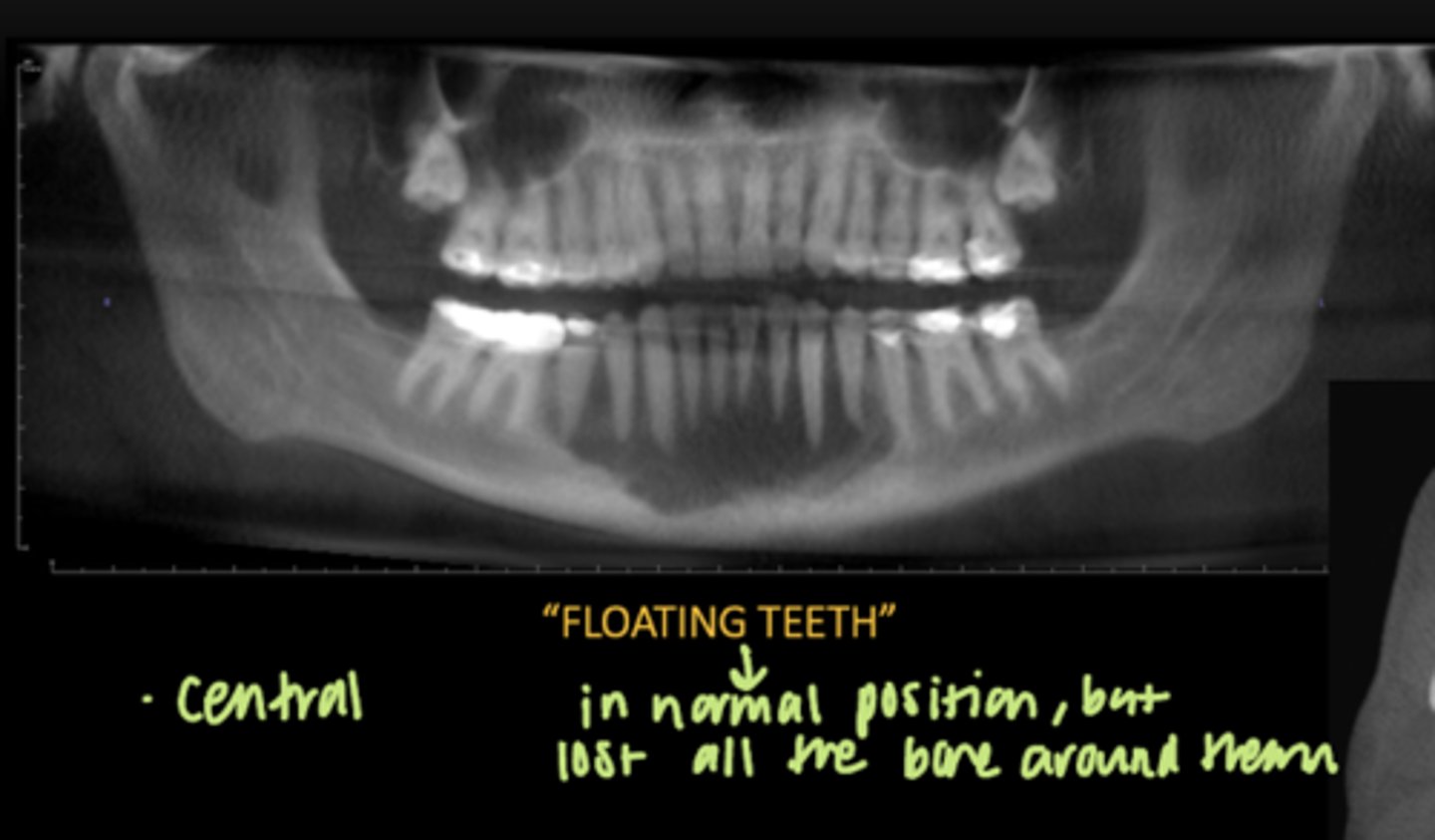
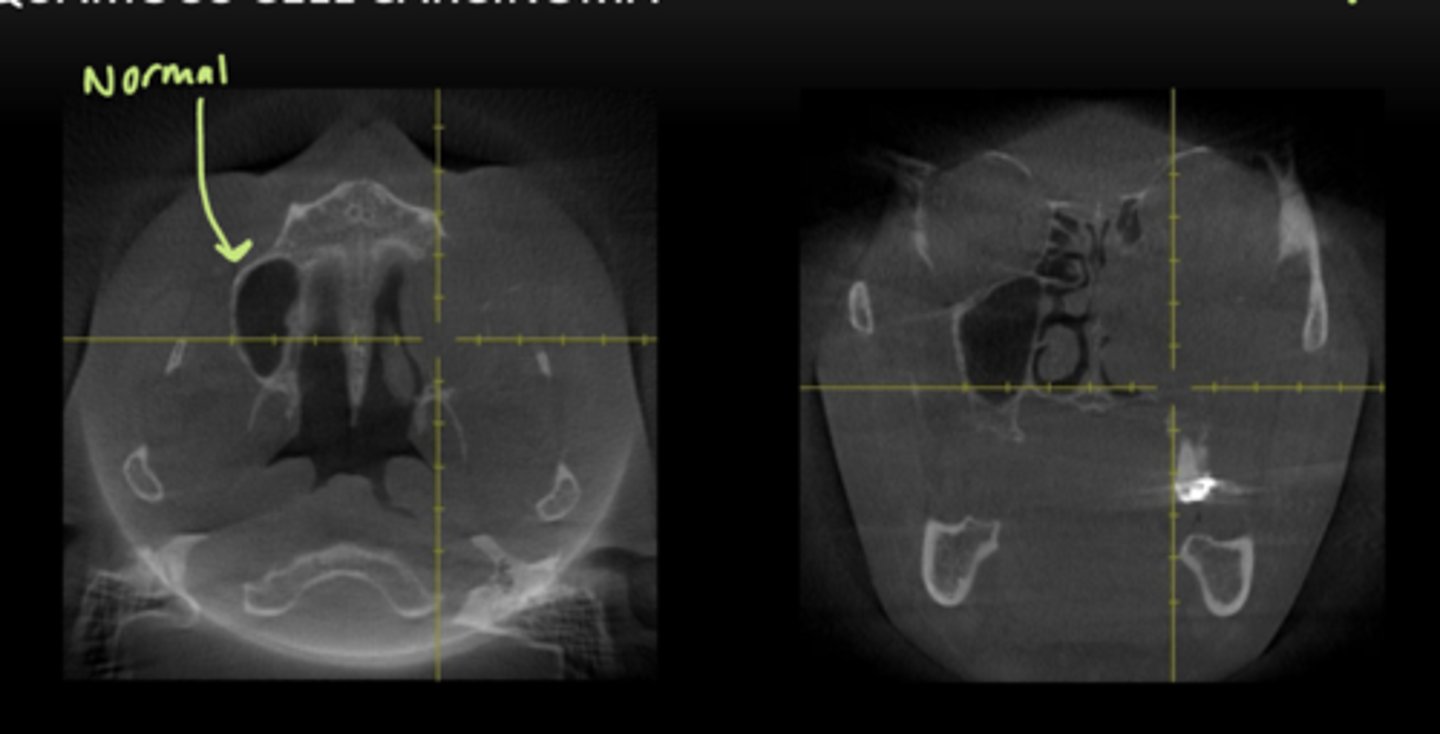
Squamous cell carcinoma ex
Soft tissue mass has destroyed everything around it --> very aggressive
An adenoid cystic carcinoma comes from...
salivary glands
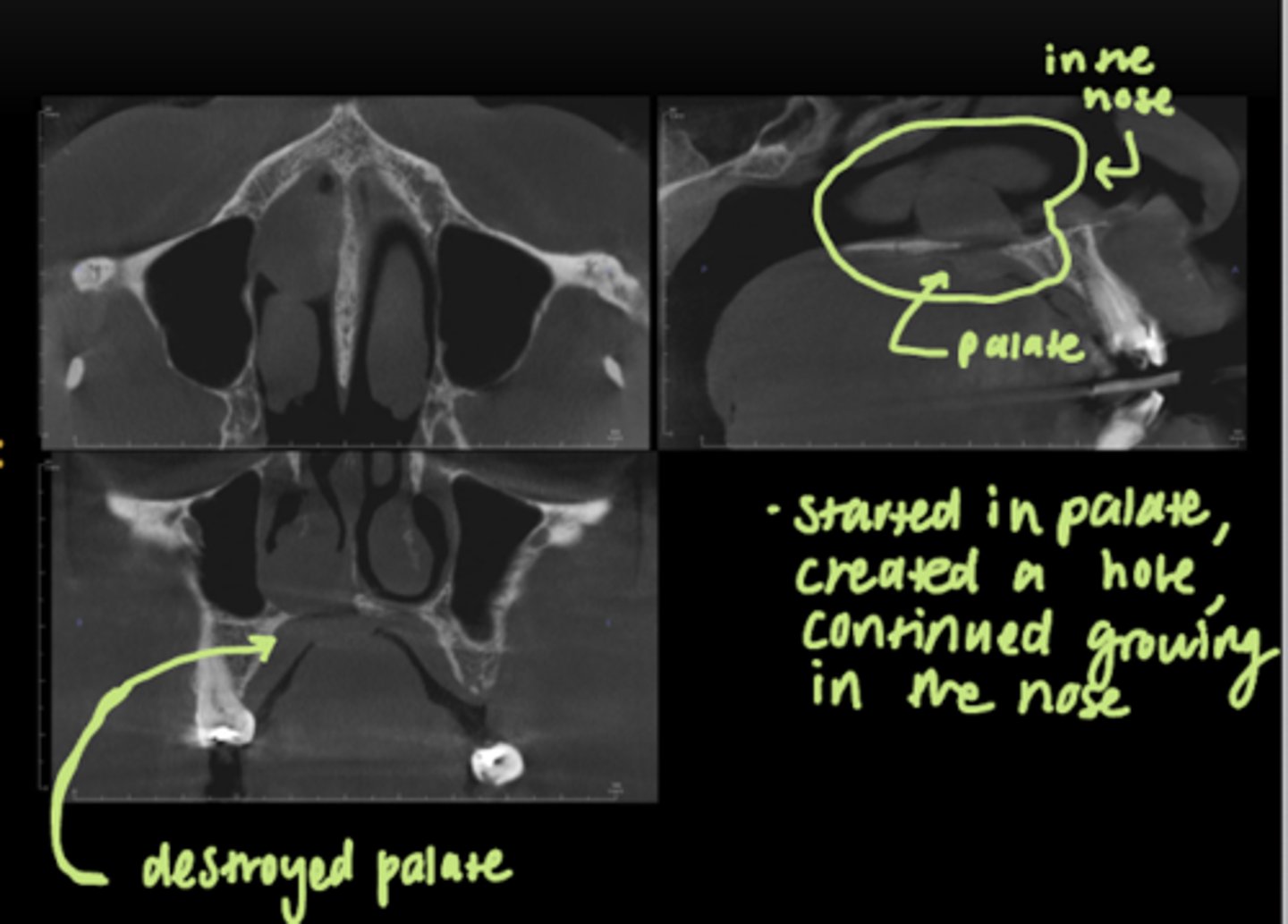
Adenoid cystic carcinoma
- location
Palate
Which malignant disease is known to have a sun-ray periosteal reaction?
Osteosarcoma
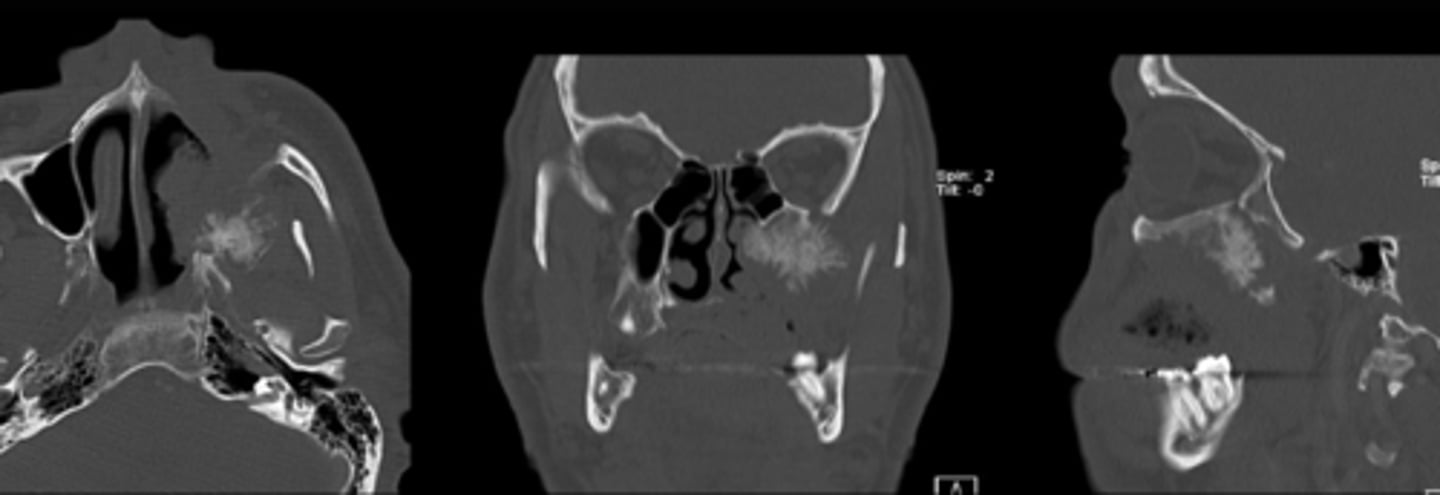
Osteosarcoma - density?
Radiolucent or mixed RL-RP
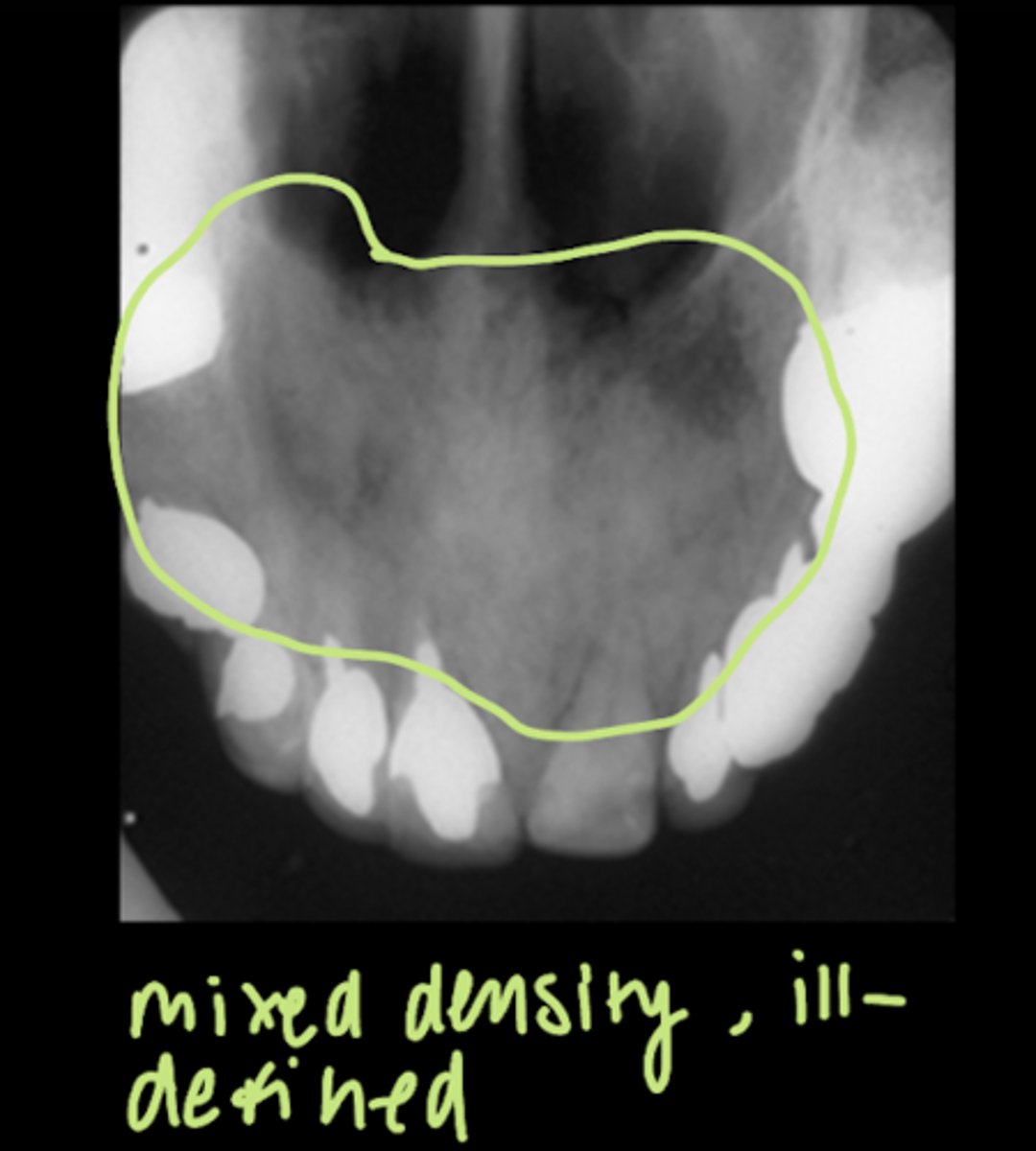
Osteosarcoma
- effect on surrounding structures?
- sun ray periosteal reaction
- low-grade lesions appear more benign
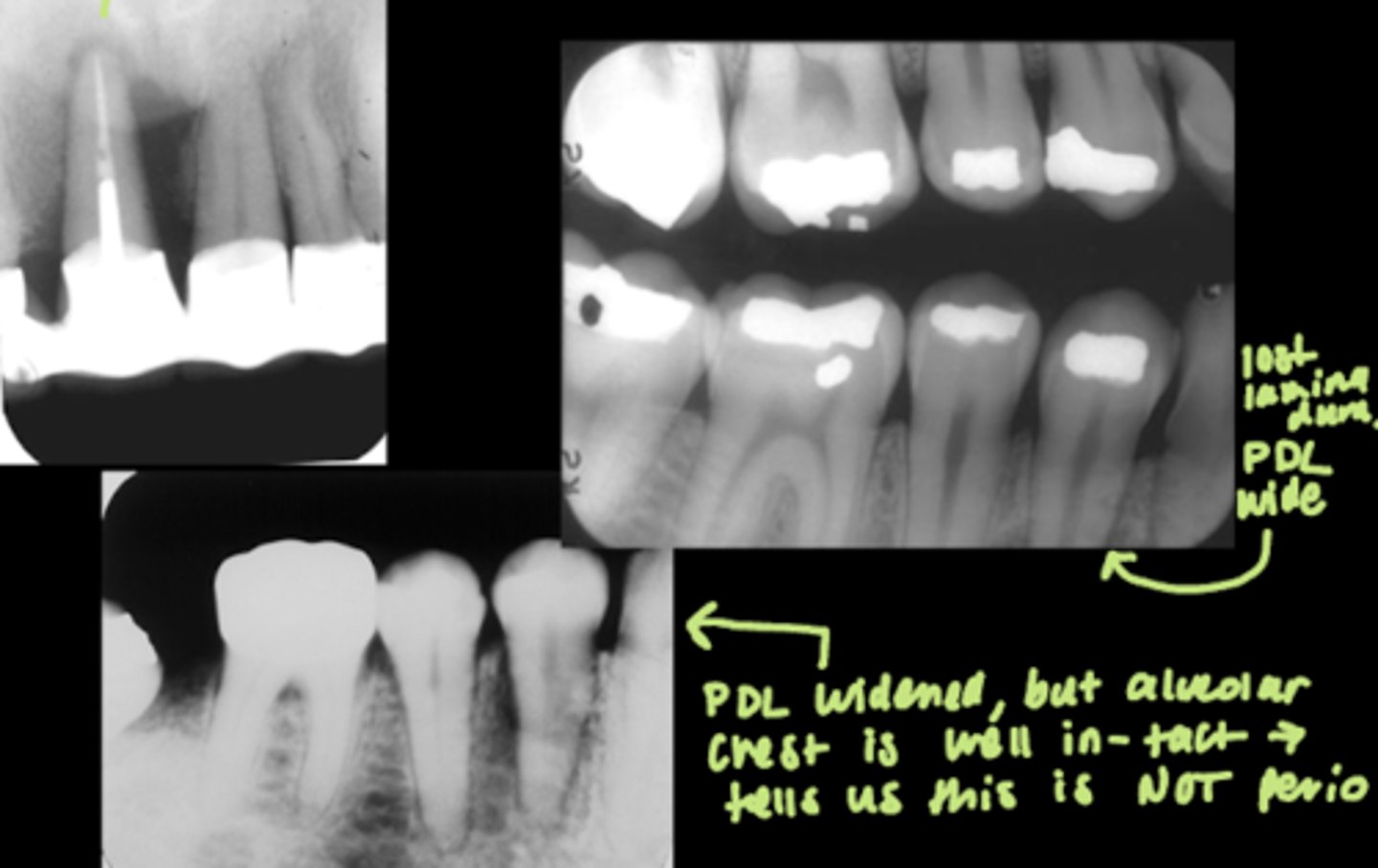
- asymmetric, irregular widening of the PDL space
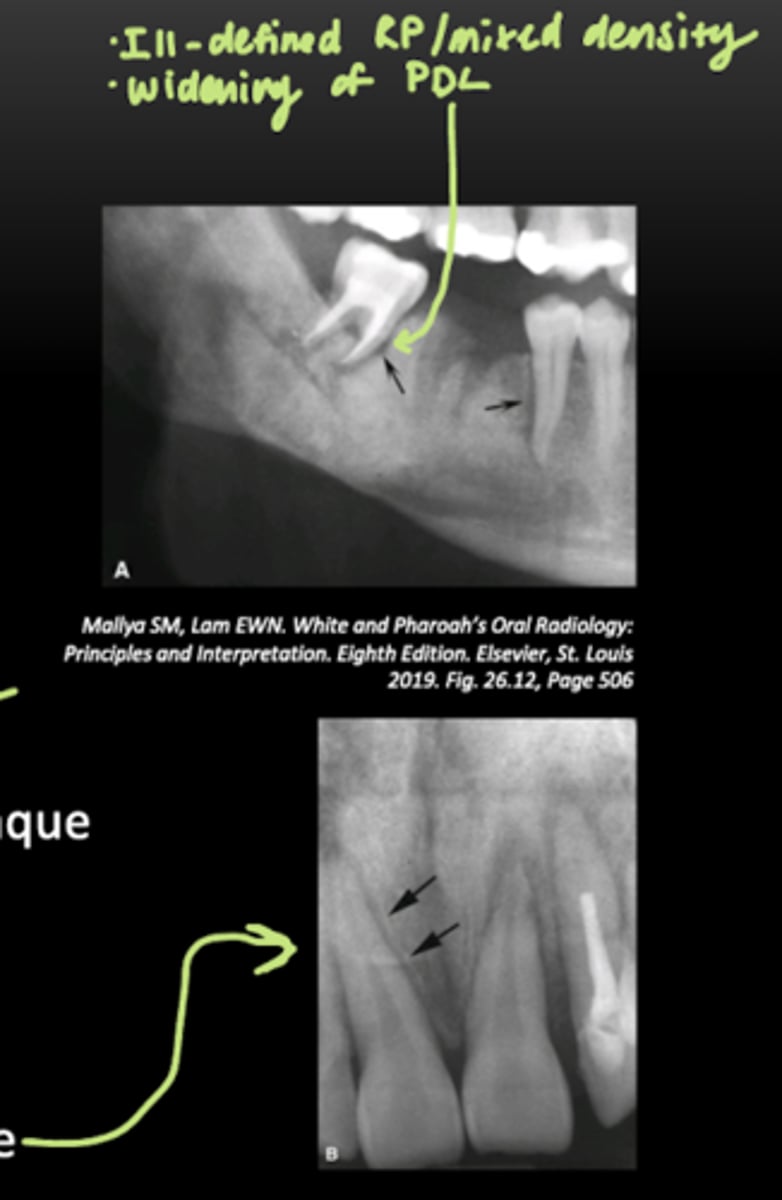
Osteosarcoma ex
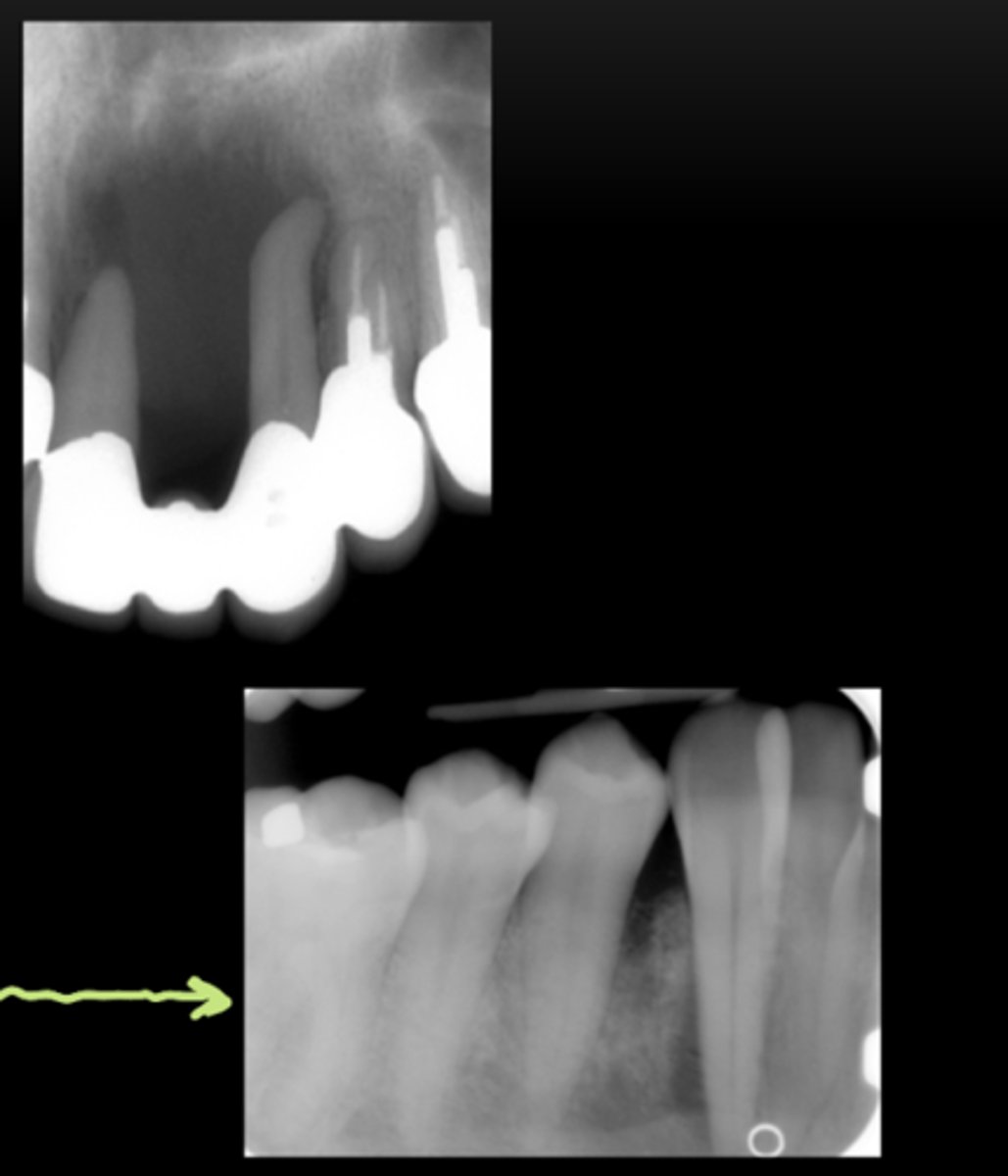
Lymphoma - unique features
- location?
Can spread in the PDL space
--> can easily be mistaken for PARL
- if there is no inflammatory etiology, need to consider lymphoma
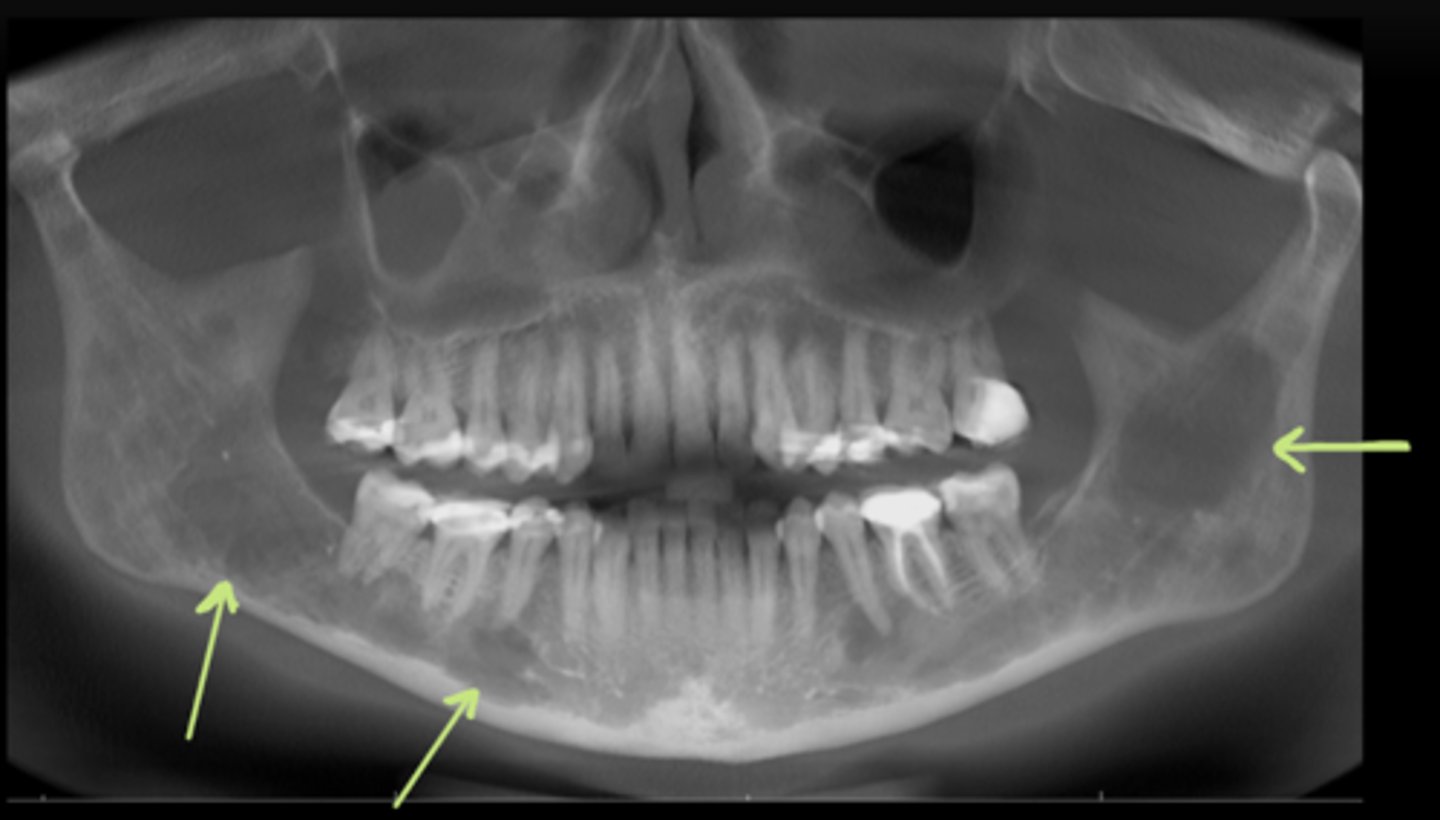
Multiple myeloma - unique features
- location?
- shape?
- margins?
- Location: multi-focal
- Shape: round
- Margins: well defined, non-corticated ("punched-out")
--> RL dots throughout
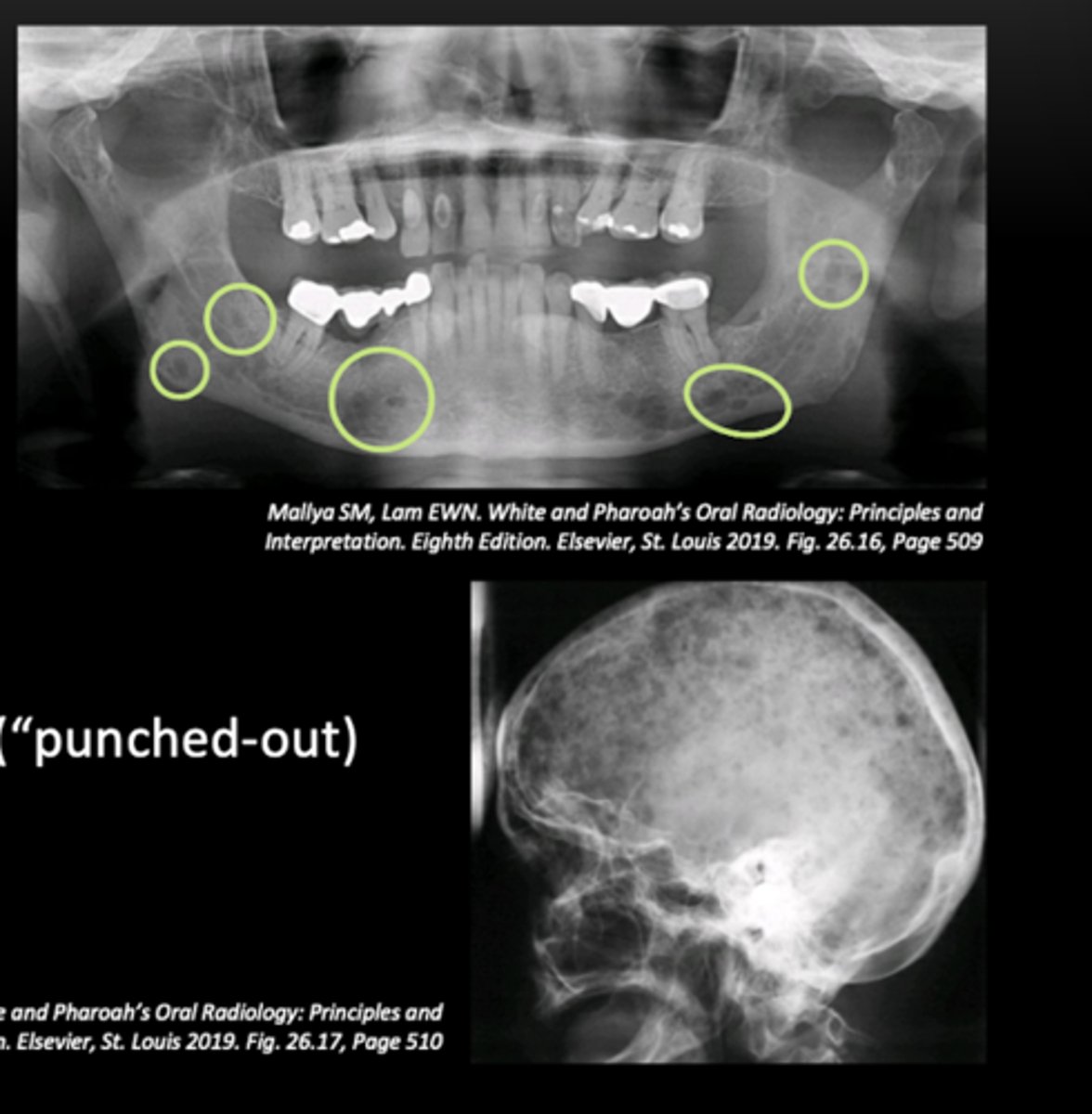
Multiple myeloma ex
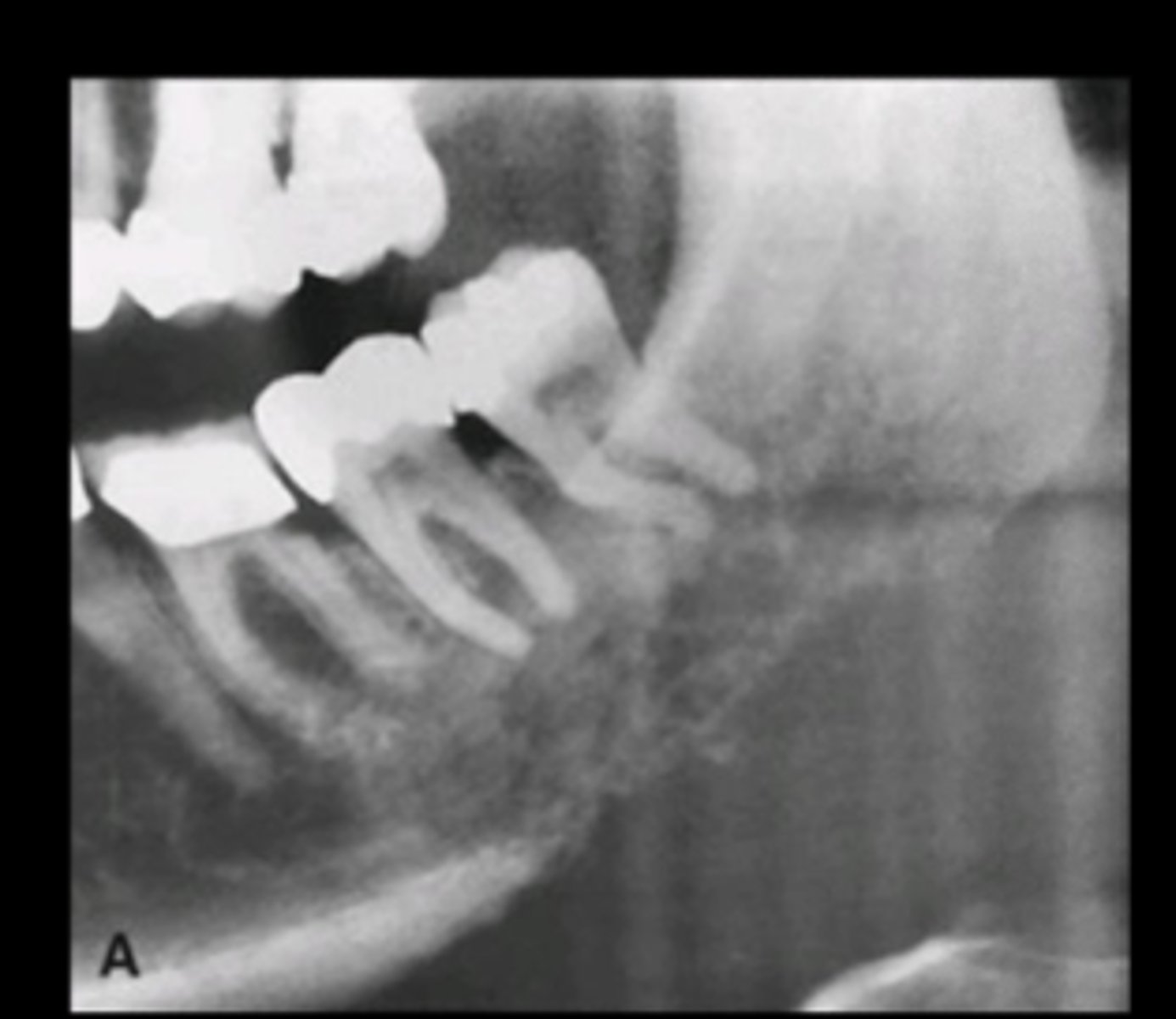
Metastatic carcinoma - where is it commonly located?
More likely in the body of the mandible (bc largest vascular supply here)
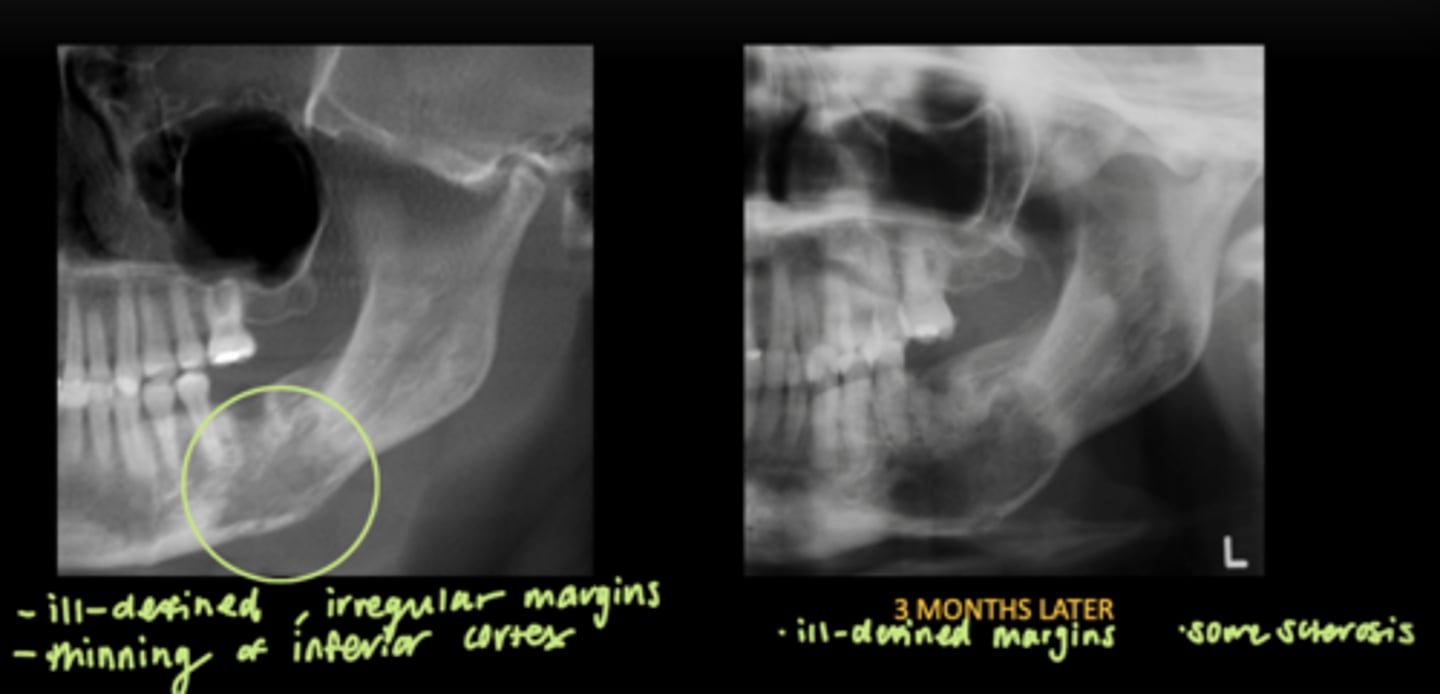
Metastatic carcinoma - unique features
- Density?
Radiolucent
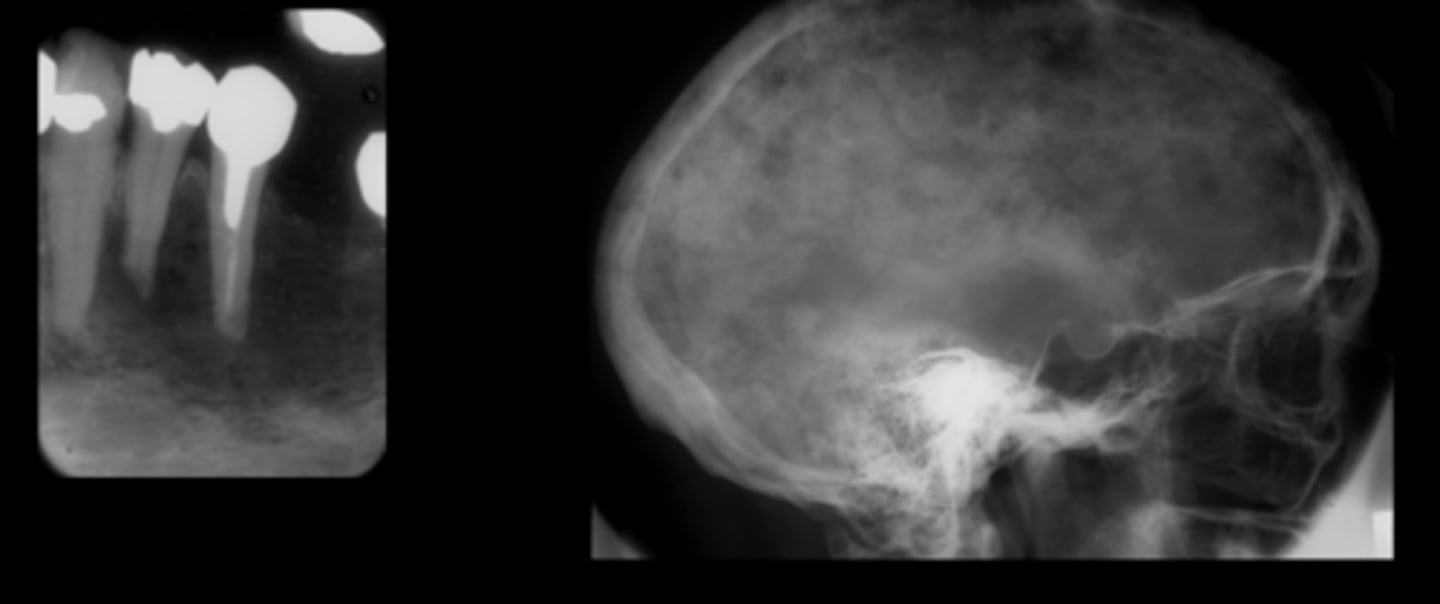
- but breast and prostate metastases can cause calcification (ex is metatstatic breast cancer)
Metastatic carcinoma - ex
- Ill-defined
- RL
- Irregular borders
- Resorbing roots
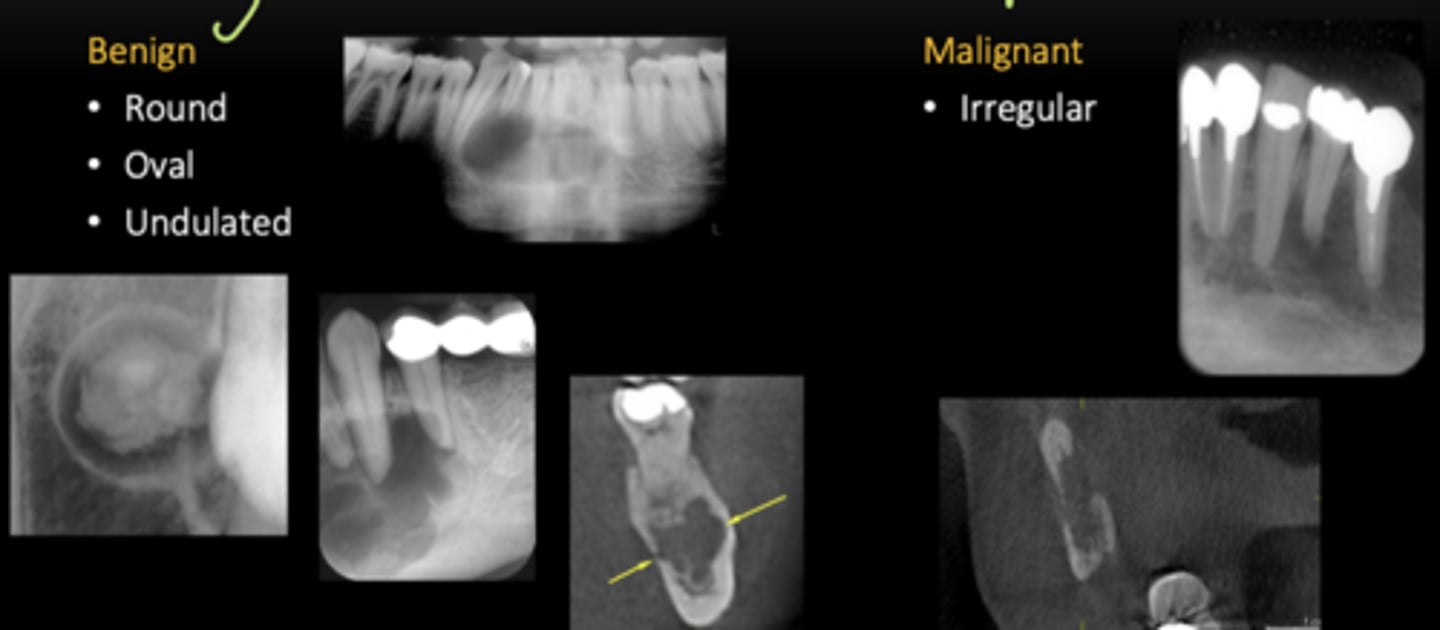
How does SHAPE differ for benign vs malignant diseases?
Benign: has some kind of shape
- round
- oval
- undulated
Malignant: no shape
- irregular
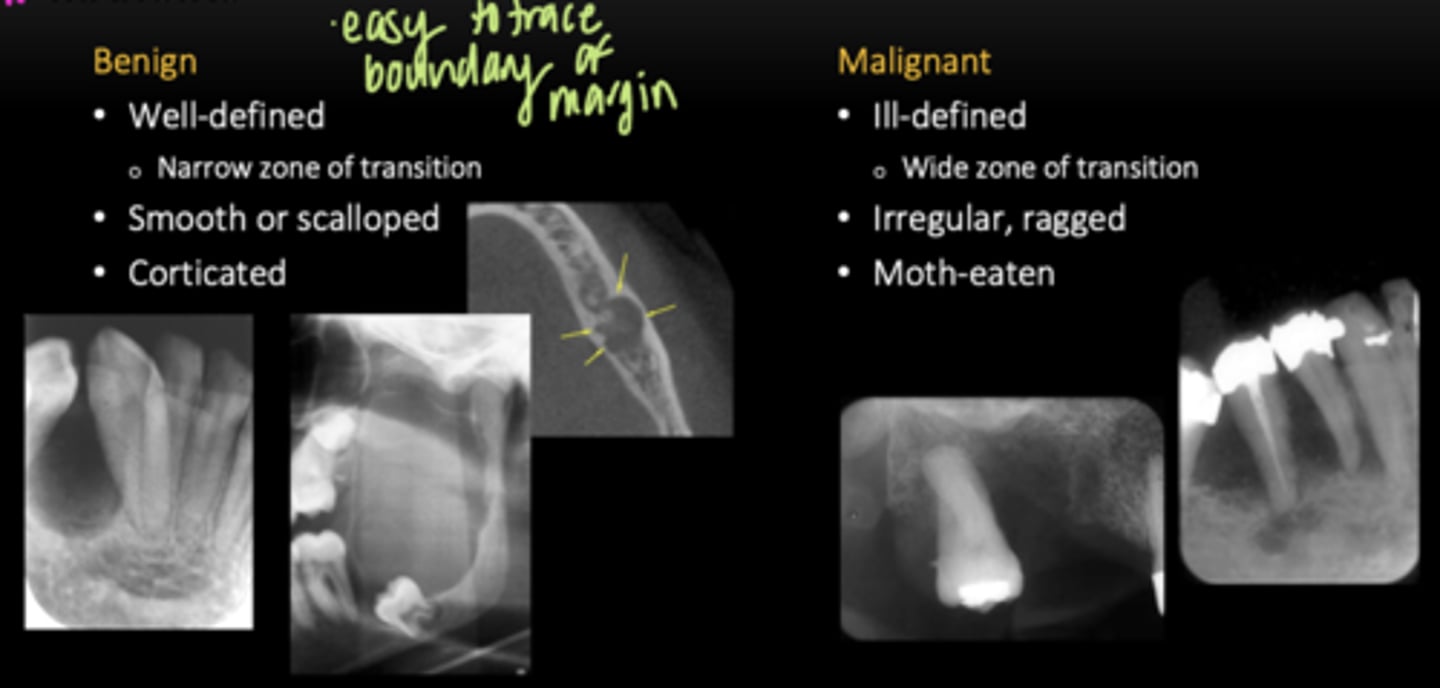
How do MARGINS differ for benign vs malignant diseases?
Benign:
- Well-defined, narrow zone of transition
- Smooth or scalloped
- Corticated
- Easy to trace boundary
Malignant:
- Ill-defined, wide zone of transition
- Irregular, ragged
- Moth-eaten
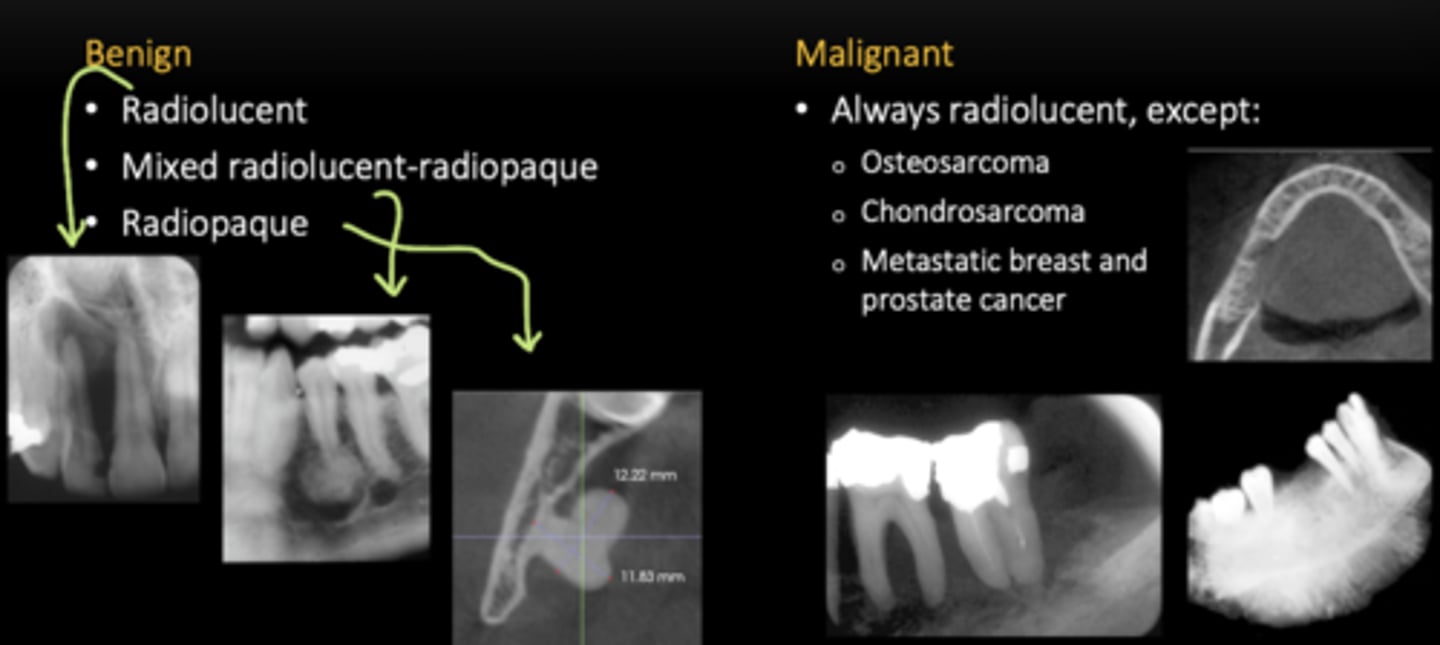
How does DENSITY differ for benign vs malignant diseases?
Benign: can be any of...
- Radiolucent
- Mixed RL-RP
- Radiopaque
Malignant: ALWAYS radiolucent, except...
- Osteosarcoma
- Chondrosarcoma
- Metastatic breast and prostate cancer
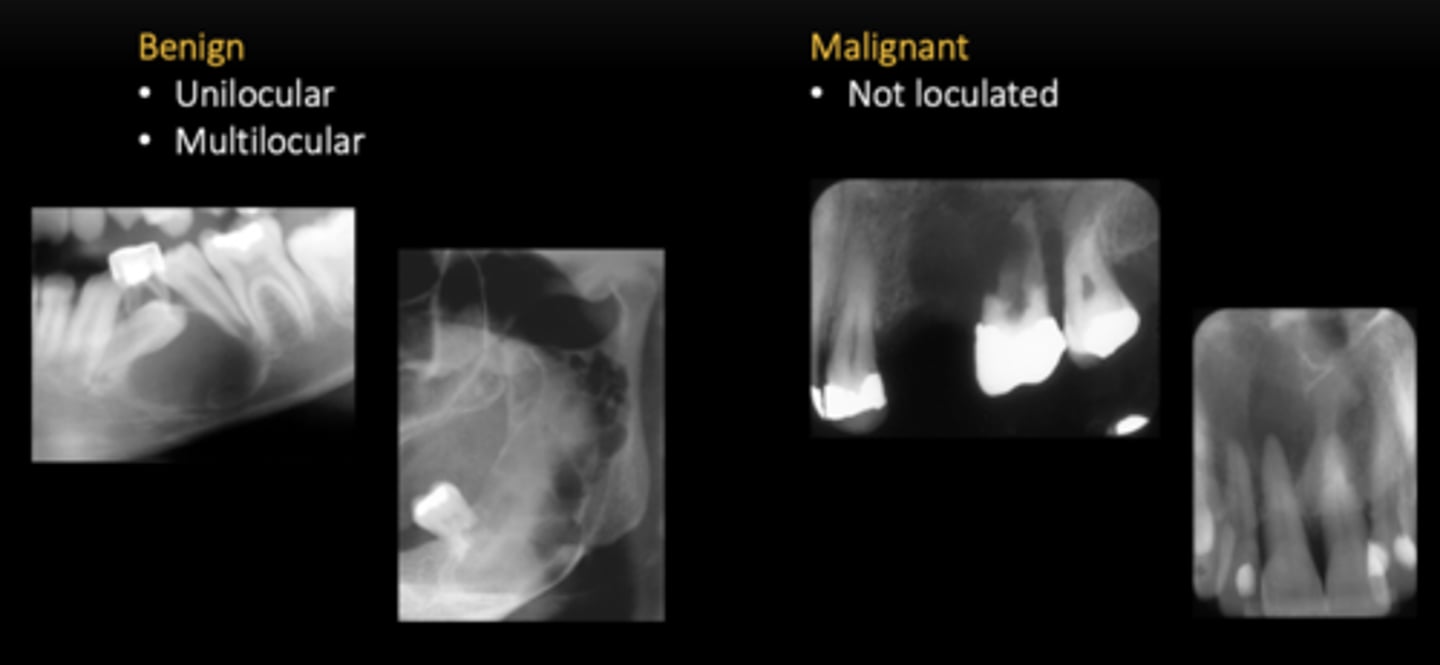
How does INTERNAL ARCHITECTURE differ for benign vs malignant diseases?
Benign:
- Unilocular
- Multilocular
Malignant:
- Not loculated
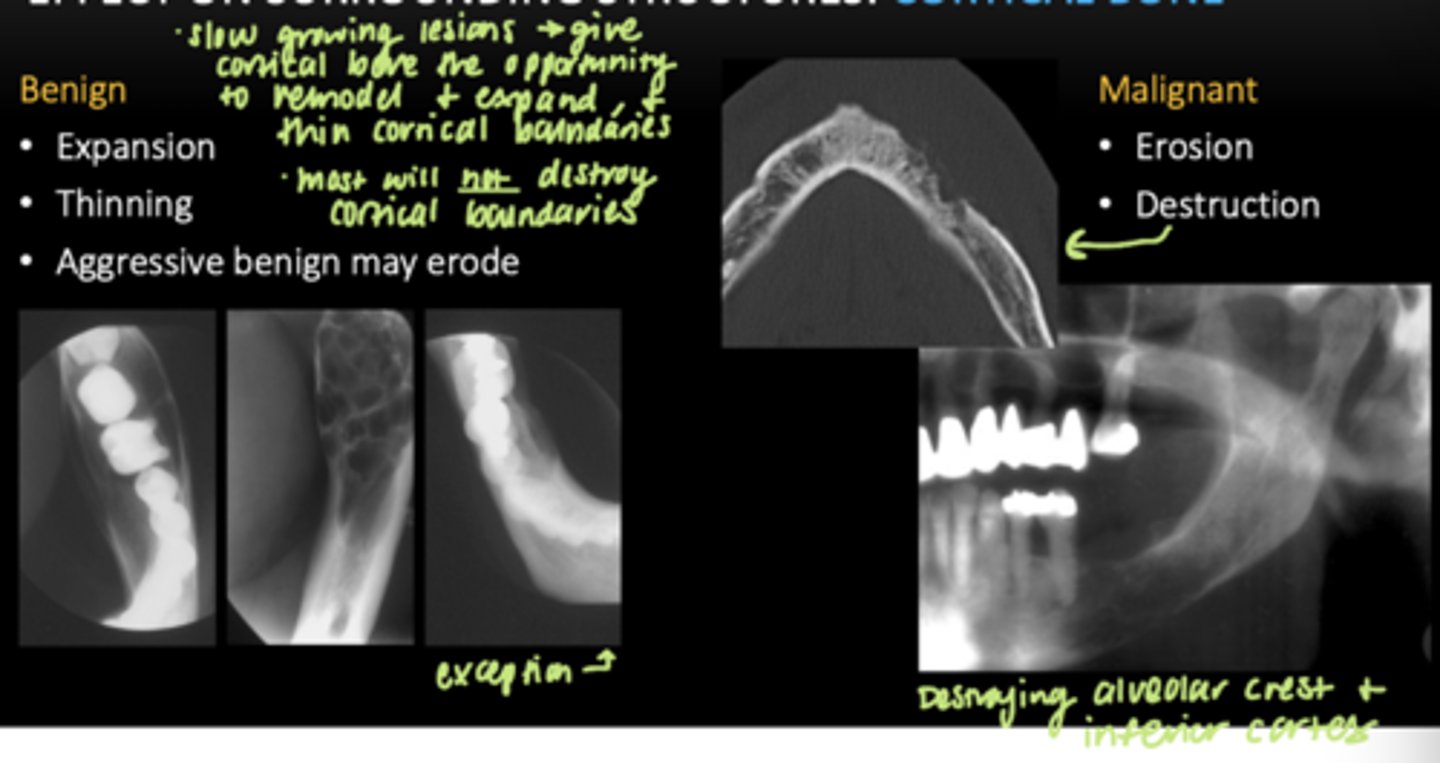
How does EFFECT on CORTICAL BONE differ for benign vs malignant diseases?
Benign:
- Expansion
- Thinning
-- these are slow growing lesions, which gives cortical bone the opportunity to grow and expand, thin cortical boundaries
- Aggressive benign may erode
Malignant:
- Erosion
- Destruction
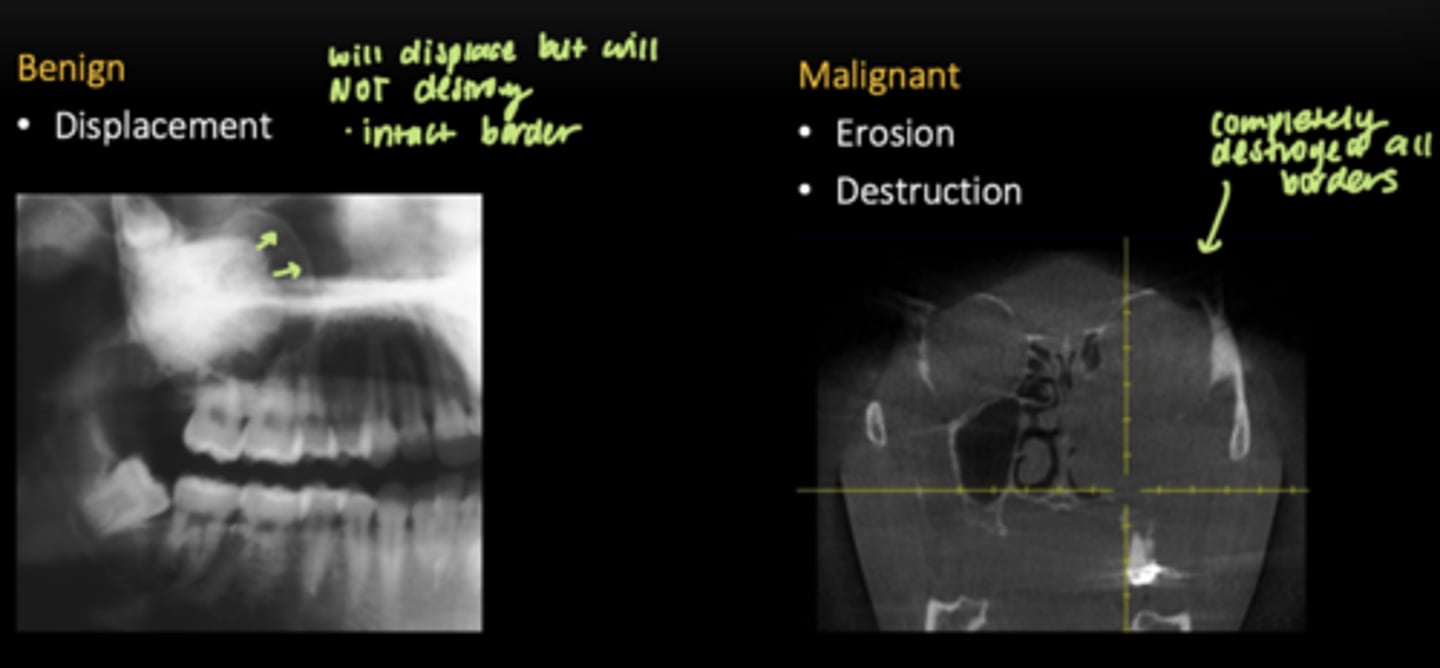
How does EFFECT on MAXILLARY SINUS differ for benign vs malignant diseases?
Benign:
- Displacement
Malignant:
- Erosion
- Destruction
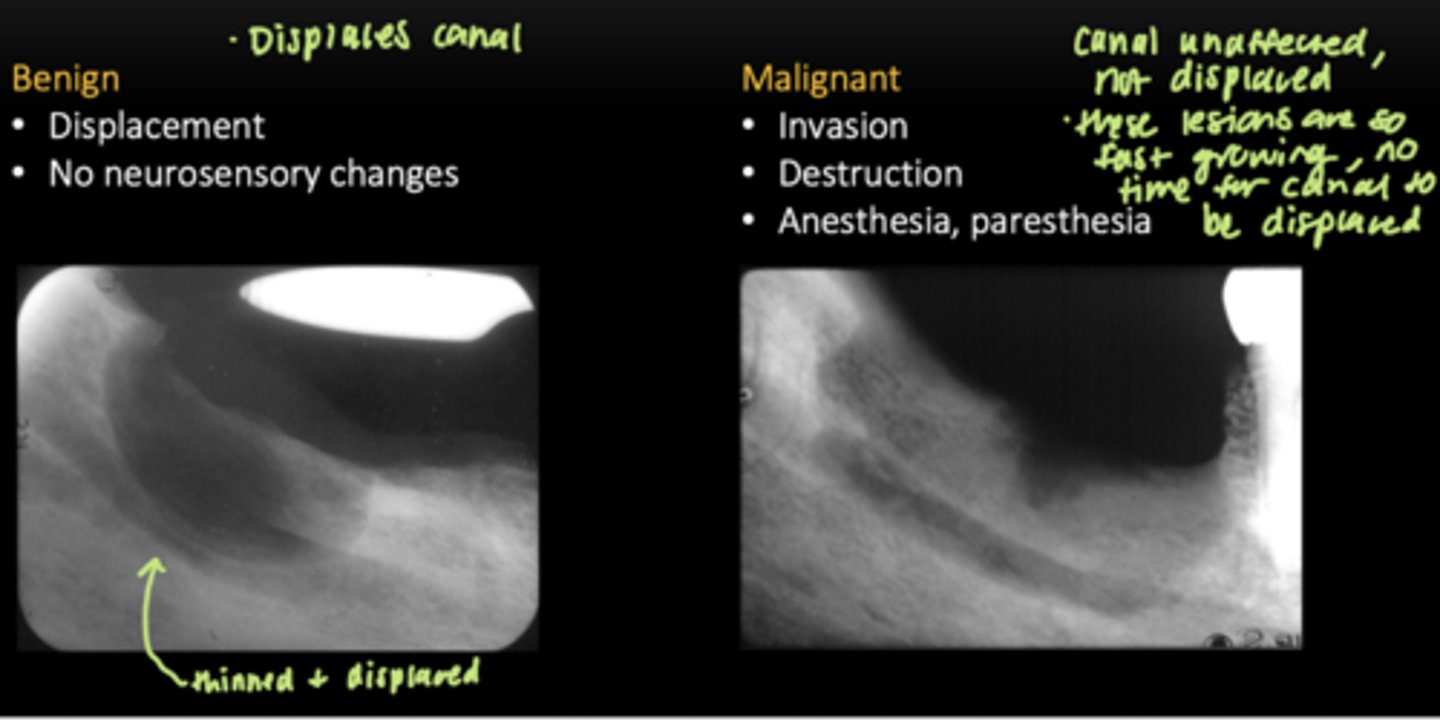
How does EFFECT on MANDIBULAR CANAL differ for benign vs malignant diseases?
Benign:
- Displacement
- No neurosensory changes
Malignant:
- Invasion
- Destruction
- Anesthesia, paresthesia
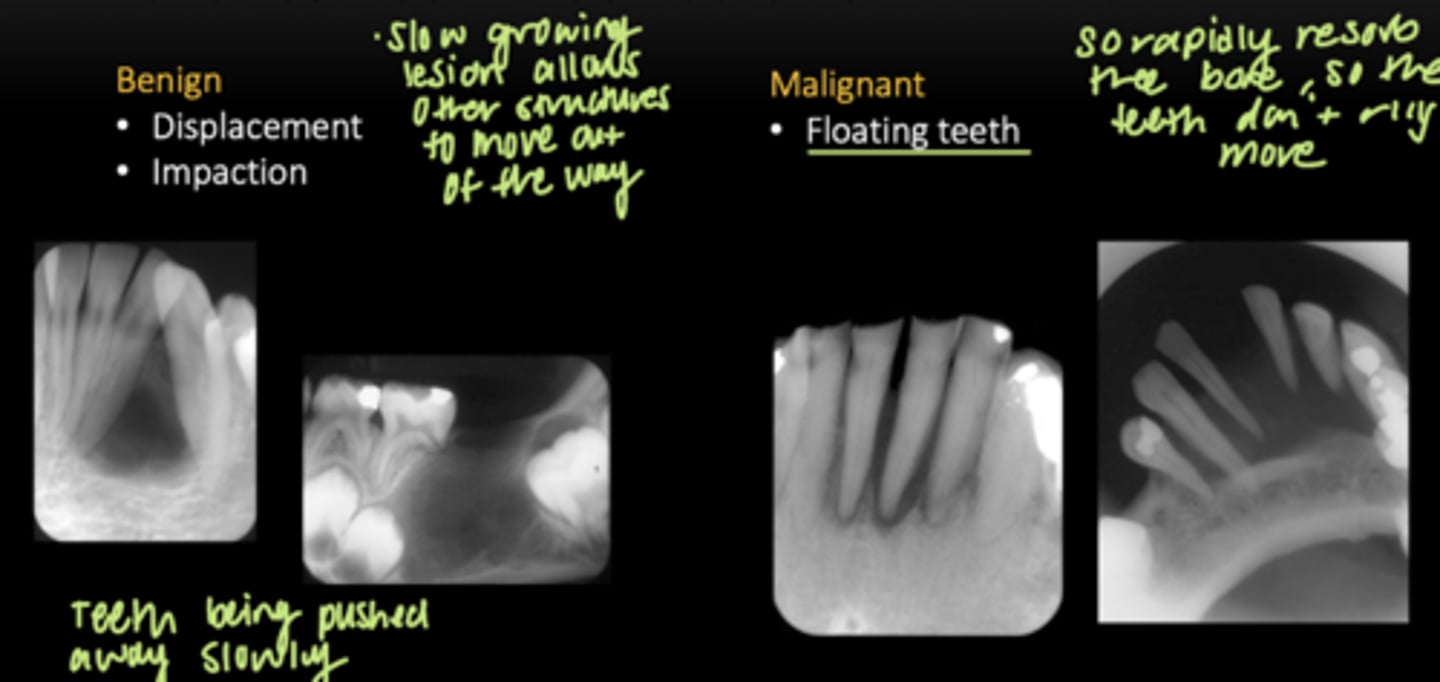
How does EFFECT on TOOTH POSITION differ for benign vs malignant diseases?
Benign:
- Displacement
- Impaction
Malignant:
- FLoating teeth
How does EFFECT on TOOTH ROOT differ for benign vs malignant diseases?
Benign:
- No resorption
- Horizontal resorption
Malignant:
- No resorption
- Spiked (vertical) resorption
- Destruction
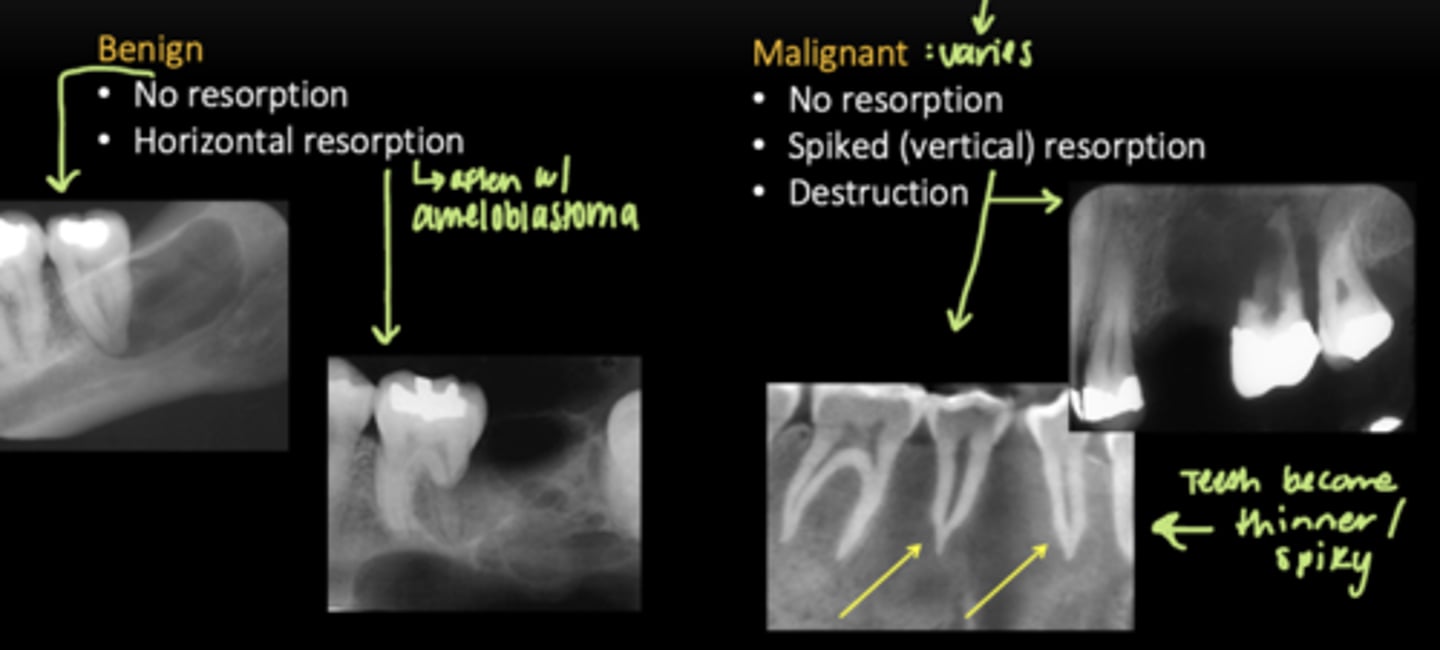
How does EFFECT ON PDL and LAMINA DURA differ for benign vs malignant diseases?
Asymmetric widening of the PDL space and loss of lamina dura can be a sign of a malignant tumor, such as:
- Osteosarcoma
- Chondrosarcoma
- Lymphoma