NR546 Advanced Pharmacology: Psychopharmacology for Psychiatric-Mental Health Nurse Practitioner with accurate verified solutions + rationales ( GUARANTEED SUCCESS )
 Studied by 0 people
 Call Kai
 Learn
Learn Practice Test
 Spaced Repetition
 Match
Match Flashcards
 Knowt Play
1/435

There's no tags or description
Looks like no tags are added yet.
Name | Mastery | Learn | Test | Matching | Spaced |
|---|
No study sessions yet.
436 Terms
Week 1
When prescribing medications, what must the psychiatric mental health nurse practitioner (PMHNP) consider?
The patients:
symptoms
age
physical health
previous response to treatment
lifestyle
What is the priority data used to determine a treatment plan for mental health disorders?
Patient symptoms
Changes or losses in grey matter can be associated with psychiatric diagnoses such as?
Alzheimer's disease, schizophrenia, and major depressive disorder.
Many psychotropic medications can cause weight gain. True of False.
True, caution is taken when prescribing to obese patients.
Which lifespan group respond differently to drugs than adults, have heightened drug sensitivity, show greater individual variation, and have increased risk for adverse drug reactions? Dosage selection can be challenging because their brains and bodies are still developing.
Pediatric patients
Which lifespan group have several psychotropic drugs that are not safe to use, certain drugs resulting in birth defects and certain drugs presenting in breastmilk, affecting the breastfed child, or affecting milk production?
Pregnancy/breastfeeding patients
The physiologic changes associated with aging impact the drug processes of absorption, distribution, metabolism, and excretion of medications, so lower than normal dosages may be needed. The most recent Beers Criteria should be reviewed to avoid prescribing potentially inappropriate medications to this lifespan group.
Older adult patients
Brain tissue composed of gray matter includes?
The cerebellum, cerebrum, brain stem, and butterfly-shaped portion of the central spinal cord.
The gray matter of the brain focuses on?
Psychiatry and neurology and is associated with learning.
Brain tissue composed of white matter includes?
Nerve fibers that connect neurons from different regions into functional circuits.
Why is white matter considered the transit system?
Necessary for electrical impulse transmission. If there are breaks in the system, it can affect neural communication, affecting behavior. Damage to the myelin can impair transmission which can impact not only sensory and motor function, but also cognition.
White brain matter is associated with which disease processes?
Autism and vascular dementia.
Frontal Lobe
Associated with movement, intelligence, abstract thinking. the ability to organize, personality, behavior, and emotional control. Traumatic brain injuries can result in personality changes, difficulty controlling emotions, and other cognitive functions.
Parietal Lobe
Middle part of the brain
Responsible for proprioception.
Helps a person to identify spatial relationships, interpret pain and touch in the body, and identify and give meaning to objects.
Damage to the anterior portion of the parietal lobe may cause asterogenesis, the loss of ability to recognize objects via the sense of touch.
May be experienced post cerebral vascular accidents.
Temporal Lobe
Located on the sides of the brain
Involved in short-term memory, speech, auditory signals, and smell recognition.
Identifies "what" things are - object identification.
Contains the limbic system, amygdala, and hippocampus.
A dominant temporal lobe lesion can present as Wernicke's aphasia.
Temporal Lobe Disorders
Temporal lobe disorders include dementia, affective disorders, and attention deficit hyperactivity disorders (ADHD).
Occipital Lobe
Back part of the brain and controls visual processing. Damage to this lobe results in the inability to form visual memories.
Bilateral lobe damage results in the inability to recognize items by sight even though vision is normal.
Occipital lobe seizures can cause hallucinations, such as lines of color.
Dorsal Striatum
Complex motor actions and linkage of cognition to motor actions.
Main input area for the basal ganglia and is activated when anticipating or engaging in pleasure.
Corpus Callosum
Controls the communication between the two brain hemispheres.
Involved in attention, impulse control, and emotion regulation.
Integrates impulses from both sides of the brain.
Persons with an underdeveloped or missing corpus collosum may have intellectual impairment.
Thalamus
An egg-shaped structure involved in sensory organ and motor command processing.
All sensory systems except for the olfaction process through the thalamus, which is responsible for processing all external information.
Associated with symptoms related to schizophrenia and post-traumatic stress disorder (PTSD).
Basal Ganglia
Involved in voluntary motor movements, cognition, and emotion. Involved in facilitating voluntary movement.
Basal ganglia movement disorders include?
Include Parkinson's disease, obsessive-compulsive disorder (OCD), and Tourette syndrome.
Limbic System
Associated with pleasure, reward, and reinforcing behavior. Drug abuse affects the limbic system, disrupting emotions and feelings associated with normal behavior.
Nucleus Accumbens
This is involved in the reward circuit and reinforces addictive behaviors.
Amygdala
Located deep in the temporal lobes and involved in emotional regulation and perception of odors.
All smells travel directly to the amygdala.
Cooking smells can elicit memories of childhood events and holidays.
A traumatic event can result in the formation of the fear response, causing the fight or flight reflex within the autonomic nervous system and affects the hypothalamic-pituitary-adrenal (HPA) axis causing the release of stress hormones (e.g. cortisol).
The amygdala also is involved in the interpretation of facial expressions and sexual stimuli.
Hippocampus
Located deep in the temporal lobes and is involved in anxiety and memory, and shifting short-term to long-term memory.
Hippocampal function is impaired in schizophrenia and dementia. There is ongoing research into the role the hippocampus plays in anxiety and decision making.
What are epigenetic modifications
Affect how genes are turned on or off, influencing the production of proteins that carry out various functions in the body.
Can be influenced by a variety of factors, including environmental stimuli, lifestyle, and experiences.
Normal and abnormal genes both contribute to disease and drug efficacy.
Epigenetics can contribute to the risk of any disorder or disease.
Psychiatric disorders can also be due to normal genes that are "on" that should be "off."
How does reviewing the genetic makeup of a client help guide the PMHNP in selecting medication for clients?
Provide information on:
How clients may respond to certain psychotropic medications
How a client may break down and metabolize medications based on the cytochrome P450 system
If there may be an environmental exposure that turned a gene "on" that should have been "off"
Visit Note
Provide
The chief complaint
Context of the visit, and/or special circumstances where additional time was needed beyond what is considered "usual".
Note serves as a tool for the recall of memory when more information is requested.
Prescription Drug Monitoring Programs (PDMPs)
Electronic databases enable providers to access information regarding a client's prescription history of controlled substances.
Central Sulcus
Separates the frontal lobe from the parietal lobe
Frontal lobe
Associated with movement, intelligence, abstract thinking etc.
Broca's area
Speech
Temporal lobe
Involves object identification and auditory signals
Cerebellum
Coordination
Wernicke's area
Speech comprehension
Occipital lobe
Primary visual area
Parietal lobe
Keeps us alert to what is going on around us (think proprioception)
Sensory cortex
Pain heat and other sensations
Motor cortex
Movement
Hippocampus
Involved in both memory and anxiety
Nucleus accumbens
Involved in the reward process
Thalmus
Involved in sensory organs and motor command processing
Striatum
Involved in complex motor actions also links cognition to motor activities
Limbic System
Includes circuits that are associated with pleasure and reward
Basal Ganglia
Group of structures involved in voluntary muscle movements
Amygdala
Involved in emotional regulation and perception of odors
Corpus Callosum
Controls the communication between the two brain hemispheres
White Matter
Contains nerve fibers that connect neurons from different regions into functional circuits
Gray Matter
Contains nerve cells and dendrites
Brain Tissue
Made up of gray and white matter
Week Two
Phase I of Metabolism
Drug is ingested
Phase 1 Metabolism - oxidation, reduction, hydrolysis
Three possible outcomes - drug becomes completely inactive, partially inactive, or drug is not pharmacologically active
Inhibitors
Decrease medication metabolism
Inhibitors
Valproate
Isoniazid
Sulfonamides
Amiodarone
Chloramphenicol
Ketoconazole
Grapefruit Juice
Quinidine
Remember: VISA credit card debt inhibits spending on designers like CK to look GQ.

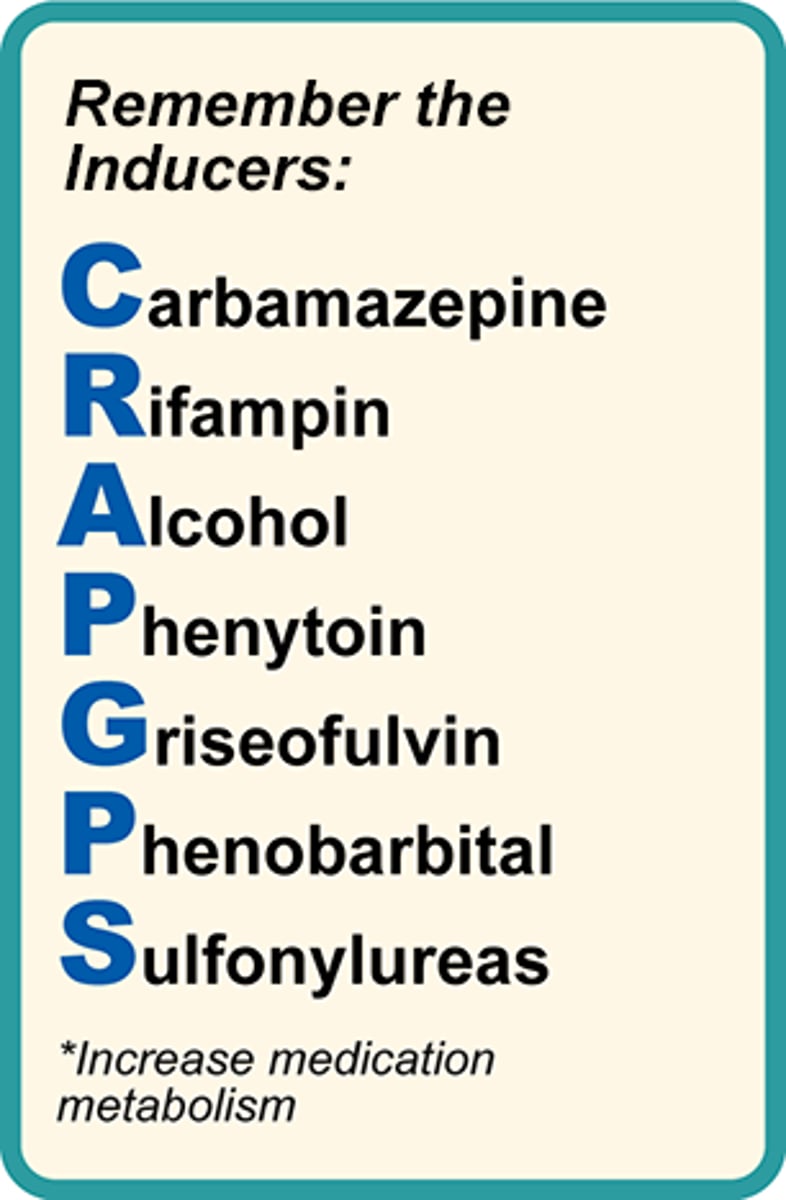
Inducers
Increase medication metabolism
Inducers
Carbamazepine
Rifampin
Alcohol
Phenytoin
Griseofulvin
Phenobarbital
Sulfonylureas
Increase medication metabolism
Neurotransmitters
Chemicals released by neurons to send communication across synaptic clefts to other neurons
The neurotransmitters that most impact mental health can be classified into four major categories.
Cholinergics (acetylcholine)
Monoamines (norepinephrine, dopamine, serotonin, and histamine)
Amino acids (gamma- amino-butyric acid and glutamate), Neuropeptides
GABA (gamma-aminobutyric acid).
The chief inhibitory neurotransmitter (NT)
The opposite of Glu
GABA (gamma-aminobutyric acid).
Bring "chill" to the party
Decrease neuroexcitability
Help people relax, destress, and get some sleep
When people don’t have enough GABA, they may experience anxiety or even schizophrenia.
Can help with sleep
GABA (gamma-aminobutyric acid).
Caution with alcohol and benzodiazepines can slow down everything, even breathing, and affect the executive function and motor coordination, increasing risk for accidents.
Norepinephrine (NE)
Monoamine neurotransmitter
Flight, fight or fright response (with excess)
Norepinephrine (NE)
Helps with alertness and orientation, focus and productivity
Pep in your step
Excess can come from stress, medications, caffeine and other stimulants. Can make you antsy, nervous, and affect your ability to focus.
Norepinephrine (NE)
Can apply to both physical and mental health, including mood, cognition, cardiac functioning, sleep, and arousal.
Acetylcholine ACH
One of the key neurotransmitters that psychotropic drugs target.
Within the central nervous system, affects arousal, motivation, attention, learning, and REM sleep
Works within the parasympathetic nervous system also.
Can make you sweat and salivate.
Acetylcholine ACH
The link between the brain and muscles.
With ACH deficiency can be involved in Alzheimer’s and Parkinson’s disease.
Increased ACH can help with symptoms, be cautious, to avoid addiction. Dr. Stahl refers to me as “the brain’s own nicotine” when he talks about my role in addiction.
Best receptors are nicotinic and muscarinic receptors.
Serotonin (5HT)
Help to regulate mood, the "happy hormone," (not a hormone at all; serotonin (5HT) is a monoamine neurotransmitter.
Serotonin (5HT)
Amino Acid
Helps you feel relaxed, comfortable, and less stressed.
Help to regulate sleep, arousal, libido, aggression, and pain perception. Same action in medications.
Dopamine (DA)
One of the key monamine neurotransmitters that regulate mood.
Associated with executive function, ability to perform well, be organized, and emotional intelligence.
Works in the prefrontal cortex.
Essential to your movement and coordination.
Dopamine (DA)
Balance is very important.
Too low you’ll lose pleasure, interest, alertness, and even self-confidence.
Low levels are also found in clients who have Parkinson’s disease.
Too much can lead to the hallucinations you see in schizophrenia and psychosis.
Works in your reward center.
The reward properties can lead to addictions.
Has its own pathways
Glutamate (Glu)
An amino acid and THE excitatory neurotransmitter.
The workhorse of the brain because glutamate affects almost every neuron in the brain.
Affects energy, memory, learning, and neural plasticity.
Relays sensory information and regulate spinal and motor reflexes.
If levels are too high, associated with schizophrenia, epilepsy, and mania.
Receptors, NMDA and AMPA, work across many regions.
The cytochrome P450 enzyme system
Responsible for metabolizing many psychotropic medications
Outcomes of drug metabolism
Accelerate renal excretion
Inactivate drug
Increase therapeutic action
Activate prodrugs
Increase toxicity
Decrease toxicity
Citalopram
Maximum dose is 20 mg due to increased risk of QT prolongation.
Vortioxetine
Maximum dose is 10 mg for a 2D6 poor metabolizer
Aripiprazole, Brexpiprazole, Iloperidone
Maximum dose is half of the normal maximum dose for a 2D6 poor metabolizer.
If prescribed with a CYP 3A4 inhibitor, the dose should be ¼ of the recommended maximum dose.
Atomoxetine
A 5-fold higher peak concentration for a 2D6 poor metabolizer
A client who is a poor metabolizer
Has a lower concentration of the necessary enzyme to metabolize a drug, which results in higher blood concentrations of the drug.
Higher concentrations of drugs increase the risk of side effects and adverse reactions.
Selective Serotonin Reuptake Inhibitors (SSRIs)
Inhibits the reuptake of serotonin, which can cause nausea, agitation, headache, and sexual dysfunction.
Serotonin and Norepinephrine Reuptake Inhibitors (SNRIs)
Inhibits the reuptake of serotonin and norepinephrine, which can cause nausea, sweating, insomnia, tremors, sexual dysfunction
Tricyclic
Inhibits the reuptake of serotonin and norepinephrine, which can cause sexual dysfunction
Blocks norepinephrine receptors, which can cause hypotension and tachycardia
Blocks histamine receptors, which can cause sedation and weight gain
Blocks acetylcholine receptors, which can cause dry mouth, constipation, blurred vision, and urinary retention
Monoamine Oxidase Inhibitors (MAOIs)
Increases norepinephrine and serotonin by inhibiting the enzyme that inactivates it, which can cause sedation, dizziness, sexual dysfunction, and hypertensive crisis
Benzodiazepines
Increases the receptor affinity for GABA, which can cause dependence and confusion
Bupropion
Inhibits the reuptake of norepinephrine and dopamine, which can cause insomnia, dry mouth, tremors, and seizures
The most common action of psychotropic drugs
To modify the actions of G-protein-linked receptors, which occurs on a spectrum.
The agonist spectrum
Antagonist, which blocks the action of a neurotransmitter Agonists, which fully stimulate G-protein-linked receptors. Partial agonists, which stimulate receptors to a lesser degree than an agonist or natural neurotransmitter
Increases serotonin levels
Serotonin and norepinephrine reuptake inhibitor
Selective serotonin reuptake inhibitor
Tricyclic antidepressant
No effect on serotonin levels
Benzodiazepine
Is nicotine an inducer or an inhibitor of the CYP 1A2 enzyme?
Inducer
Nicotine is an inducer of the CYP 1A2 enzyme, so it lowers the concentration of drugs.
Therefore, a higher dose of olanzapine may be needed to control his symptoms.
Facts
Selective serotonin reuptake inhibitor blocks the reuptake of serotonin, leaving a larger amount of serotonin available.
Increasing the amount of serotonin regulates feelings of fear and anxiety. Reducing the occurrence of fear reduces the release of norepinephrine.
A serotonin and norepinephrine reuptake inhibitor prevents the reuptake of norepinephrine, which would not reduce the level of norepinephrine as needed.
Benzodiazepines increase the levels of GABA and do not impact norepinephrine.
A monoamine oxidase inhibitor would increase levels of norepinephrine.
The nurse should assess for sexual dysfunction and anticipate the potential need for a phosphodiesterase inhibitor such as sildenafil (Viagra). After 4 to 6 weeks of taking?
SSRIs
Herbal medication contraindicated with SSRIs
St. John's Wort it can cause serotonin syndrome.
Week Three
Symptoms of psychosis include?
Hallucinations, delusions, disorganized speech, disorganized behavior, and distortions of reality.
Inappropriate or very strong emotions or apathy
Withdrawn behavior
Sudden decline in self-care
Difficulty concentrating or thinking clearly
Diagnosis requiring the presence of psychosis include?
Schizophrenia
Substance-induced psychotic disorders
Schizophreniform disorder
Schizoaffective disorder
Delusional disorder
Brief psychotic disorder
Psychotic disorder d/t a medical condition
Diagnosis with psychosis as a feature include?
Mania
Depression
Cognitive disorders
Dementia
Prevalence of schizophrenia and related psychotic disorders in the U.S.
Between 0.25% and 0.64%