Module 9 - Stage of anesthesia
 Call Kai
 Learn
Learn Practice Test
 Spaced Repetition
 Match
Match Flashcards
 Knowt Play
1/31

There's no tags or description
Looks like no tags are added yet.
Name | Mastery | Learn | Test | Matching | Spaced | Call with Kai | Chat |
|---|
No analytics yet
Send a link to your students to track their progress
32 Terms
Surgeon
Assistant Surgeon – responsible for “aftercare” after surgery (siya daw ung magbabalik ng organ sabi ni doc)
Scrub Nurse – responsible for cleaning all the equipment before and after surgery.
Circulating Nurse – responsible for assisting the surgeon and Assistant surgeon
Anesthesiologist – most important role, monitors the patient before and after
• Roles in OR
Assistant Surgeon
responsible for “aftercare” after surgery (siya daw ung magbabalik ng organ sabi ni doc)
Scrub Nurse
responsible for cleaning all the equipment before and after surgery.
Circulating Nurse
responsible for assisting the surgeon and Assistant surgeon
Anesthesiologist
most important role, monitors the patient before and after
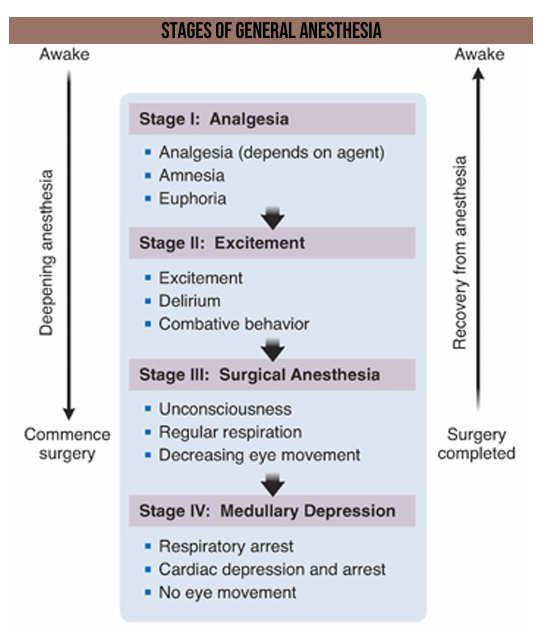
Stage I: Stage of Voluntary excitement
Stage II: Stage of involuntary excitement/Stage of Delirium
Stage III: Stage of Surgical Anesthesia
Stage IV: Medullary Paralysis
Stages of General Anesthesia
Stage I: Stage of Voluntary excitement
Ø Animal is awake
Ø Voluntary Excitement, vigorous paddling movement
Ø Also called as the Stage of Analgesia (loss of pain)
Stage I: Stage of Voluntary excitement
Ø Animal is _____
Ø _______ Excitement, ______ paddling movement
Ø Also called as the Stage of _______ (loss of pain)
Stage II: Stage of involuntary excitement/Stage of Delirium
Ø Analgesia
Ø Asleep
Ø Excitement, vigorous paddling movement
Ø Nystagmus (orbital movement)
Ø Irregular heart beat
Ø “Rock the boat” respiration
Stage II: Stage of involuntary excitement/Stage of Delirium
Ø _____
Ø ______
Ø Excitement, vigorous paddling movement
Ø _______ (orbital movement) “tumitirik”
Ø ______ heart beat
Ø “____ the _____” respiration
After Stage II.
When is Pre-anesthetic medication is given?
Stage of induction
A stage seen in both stage 1 and stage 2
Stage of Induction
It means the drug is already taking effect.
Plane 1 and 2: Light Surgical Anesthesia
Plane 3 and 4: Deep Surgical Anesthesia
Stage III: Stage of Surgical Anesthesia
2 stages
Light Surgical Anesthesia:
- + papillary reflex – using penlight
- + palpebral reflex – observe the eyelid
- + swallowing reflex – when us take out the tongue you can observe the patient swallowing.
- + aural reflex – observe by touching the ear
- - pedal reflex – using forceps to clip inter-digital pads to confirm
Light Surgical Anesthesia:
- + _______ reflex – using penlight
- + _______ reflex – observe the eyelid
- + ________ reflex – when us take out the tongue you can observe the patient swallowing.
- + _____ reflex – observe by touching the ear
- - _____ reflex – using forceps to clip inter-digital pads to confirm
Light Surgical Anesthesia:
- + papillary reflex – using penlight
- + palpebral reflex – observe the eyelid
- + swallowing reflex – when us take out the tongue you can observe the patient swallowing.
- + aural reflex – observe by touching the ear
- - pedal reflex – using forceps to clip inter-digital pads to confirm
Light Surgical Anesthesia:
- + papillary reflex – using _____
- + palpebral reflex – observe the _____
- + swallowing reflex – when us take out the _____ you can observe the patient ________.
- + aural reflex – observe by touching the ___
- - pedal reflex – using ______ to clip inter-digital ____ to confirm
Pedal reflex
pag hinila yung pad - stage 2
pag di hinila - light anesthesia
Pedal reflex
pag hinila yung pad - stage ?
pag di hinila - what anesthesia
Deep Surgical Anesthesia:
- All reflexes are gone
- This is the time to start performing surgery
- Maintain plane/stage 3 while performing surgery
Deep Surgical Anesthesia:
- All ______ are gone
- This is the time to ____ performing _____
- Maintain plane/stage _ while performing surgery
Never go back to plane 1 & 2 and never reach plane 4.
Never go back to plane _ & _ and never reach plane _
death
Stage IV: Medullary Paralysis
This leads to?
Stage IV: Medullary Paralysis
Check the following:
- Respiration Rate (irregular)
- Heart Beat
- Mucous Membra
Stage IV: Medullary Paralysis
Check the following:
- ________ Rate (_____)
- ______ Beat
- _____ Membrane
Weak heart beat
Weak pulse
Cyanosis (purple mucous membrane)
Loss of function of sphincter muscle of urethra and rectum
Signs the you reach/entering Stage IV
After surgery patient is brought to the Post Intensive Care Unit (PICU), the temperature of the room is higher.
After surgery patient is brought to the ____ _______ ____ ____ (PICU), the temperature of the room is _____.
All organs should function after surgery before the patient is discharged
All organs should _______ after surgery before the patient is discharged
Give oxygen therapy and CNS stimulants (epinephrine, doxaprans, nikethamide)
Give ______ therapy and ____ stimulants (______, ______, _______)
Epinephrine increase myocardial contraction but some anesthetic contradicts with epinephrine.
Epinephrine increase ______ contraction but some anesthetic _____ with epinephrine.
Epinephrine increase myocardial contraction but some anesthetic contradicts with epinephrine.
________ increase myocardial contraction but some anesthetic contradicts with epinephrine.
Nikethamide is hard to find and is expensive
________ is hard to find and is expensive
Aesthetic (scheduled Surgery)
Emergency Surgery
Types of Surgical Procedures:
Aesthetic (scheduled Surgery – Pre operative Procedure (POP) are done. Like fasting for 24 hours, no water for at least 3 6 hours depending to the weather, 1 before operation let the patient walking to urinate or to defecate.
Aesthetic (scheduled Surgery – ___ operative Procedure (POP) are done. Like _____ for __ hours, no ____ for at least _-6 hours depending to the weather, 1 before operation let the patient walking to _____ or to _____.
Aesthetic (scheduled Surgery – Pre operative Procedure (POP) are done. Like fasting for 24 hours, no water for at least 3 6 hours depending to the weather, 1 before operation let the patient walking to urinate or to defecate.
________ (scheduled Surgery – Pre operative Procedure (POP) are done. Like fasting for 24 hours, no water for at least 3 6 hours depending to the weather, 1 before operation let the patient walking to urinate or to defecate.
Emergency Surgery – no POP is done, but emetic were given.
Emergency Surgery – no ___ is done, but _____ were given.
Emergency Surgery – no POP is done, but emetic were given.
_________ ______ – no POP is done, but emetic were given.