History Term 3 exam
 Call Kai
 Learn
Learn Practice Test
 Spaced Repetition
 Match
Match Flashcards
 Knowt Play
1/69

There's no tags or description
Looks like no tags are added yet.
Name | Mastery | Learn | Test | Matching | Spaced | Call with Kai | Chat |
|---|
No analytics yet
Send a link to your students to track their progress
70 Terms
Define the following concept Colonization
Define the following concept Indigenous
THe first people native to the land
Define the following concept nomadic
people who move around from place to place to find food for themselves and their livestock
Define the following concept herders
who were the 3 indigenous people of the Cape?
Explain what happened to their way of life after the Dutch started to establish permanent farms. You must mention two facts
The Khoikhoi lost all their livestock because there was no grazing land left for them.
Some Khoikhoi moved further north, and others joined the San.
Some Khoikhoi started to work for the free burghers
Construct a list of three things Jan van Riebeeck had to establish at the Cape?
Build a fort for protection.
Plant fruits and vegetables.
Build a hospital for the sick sailors.

Which source tells us that the VOC relied on slaves? Motivate your answer.
Source C – Jan Van Riebeeck describes the reasons why they need slaves at the refreshment station

Write two sentences to describe how Source D shows that slaves were often mistreated by their owners.
Source D clearly describes how slaves were brutally punished and then chained to the wagons. The source also explains how the masters killed the slaves when they were punished. Several masters also forced their slaves to watch while another slave was punished.
The refreshment station grew from a small outpost to a colony under Jan van Riebeeck’s rule as governor. Use the PEEL method to write a paragraph to explain how his decisions could be seen as the start of a colony. (Use the rubric below as a guidline.)
Jan van Riebeeck’s decisions at the refreshment station can be seen as the start of a colony because he made several mistakes. He brought slaves to the Cape without the VOC’s permission, and this allowed the station to produce more crops. Later he allowed some of his men to become free burghers and the owned land at the Cape. This led to an increase in the Dutch population because more VOC members returned to the Cape to live there as permanent farmers. In 1672 he also allowed the French Huguenot to establish their own towns and farms around the Cape. These decisions finally led to the establishment of a fully functional colony.
Which trading company used this trading route?
VOC
Select a possible reason for the VOC’s decision to use the Cape as a stopping point.
it is exactly haflway between the Netherlands and Batavia
State in which year they established a refreshment station at the Cape?
1652
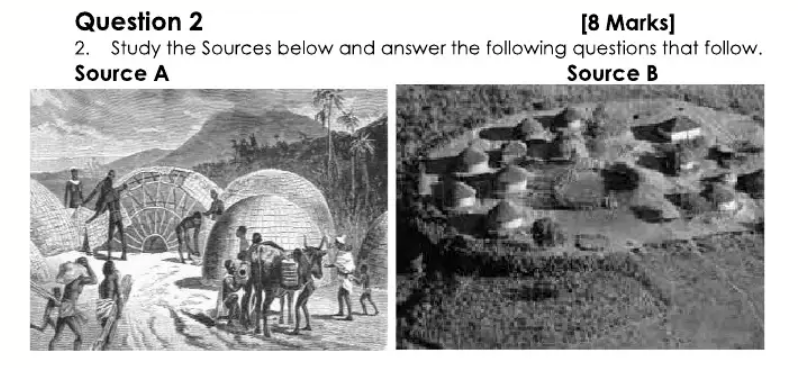
Look at the features of each of the above pics. How do Pic A tell us about the lifestyle of the Khoikhoi people?
The people are using reed mats to build huts. The khoikhoi also used their oxen to carry loads and to ride
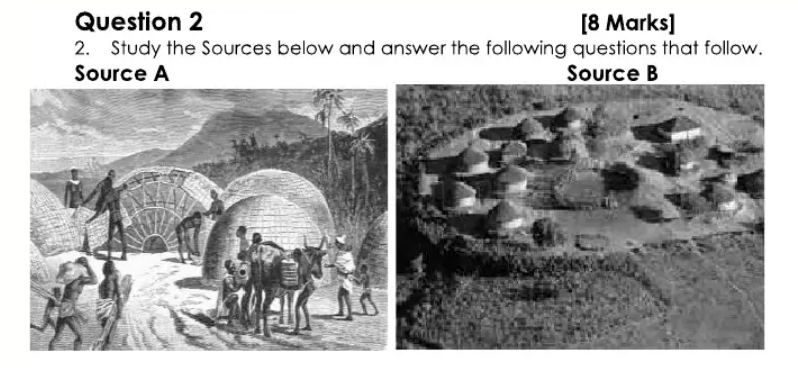
Identify any 3 features of the early African Farmers homestead in pic B
Circular houses made of bricks with grass roofs. Cattle kraal in the centre of the homestead
Cultivated field
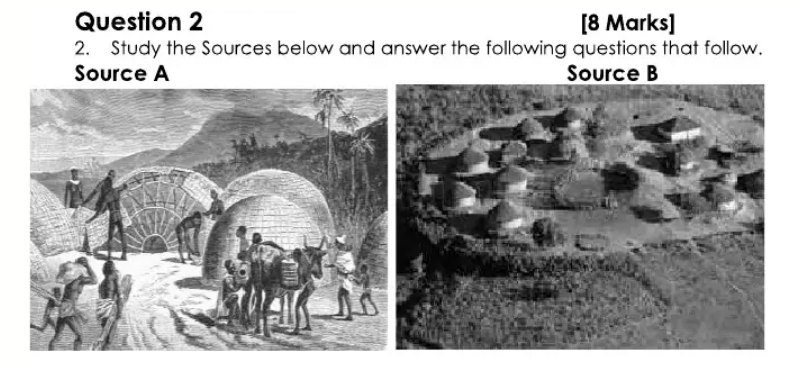
In which province will you find these farmers?
Eastern Cape

Discuss the reasons that made them to fight with the Europeans.
When European farmers came into this region, they clashed over the use of land

What symbolised wealth and status in the early African farming communities
Having many cattle
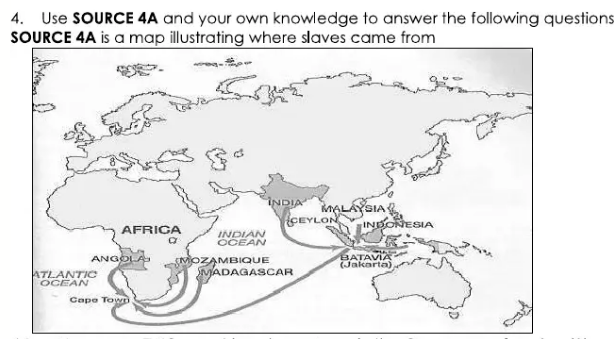
Name any 2 countries where slaves in the Cape came from
Mozambique
Madagascar
India
Sri Lanka
Indonesia

why were these slaves brought into the cape?
to work in the homes of the dutch and also in their farms
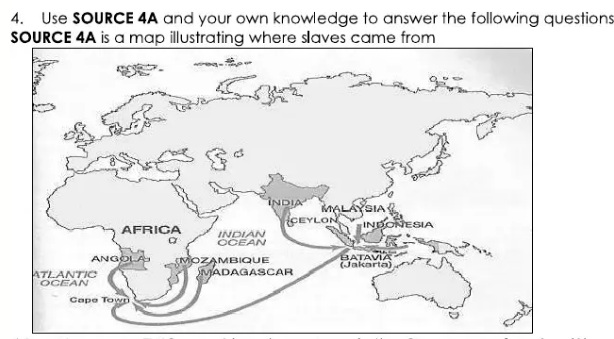
why did the dutch not use the indigenous people to work for them
the indigenous people refused to work for them because they were self-sufficient with their way of life as hunter-gatherers and herders.Jan van riebeeck was forbidden by the dutch to enslave any of them local people.
list things that the slaves contributed and remained as their legacy at the cape
traditional cape malay foods and recipes
the religion of islam from the east
development of the afrikaans language
The cape dutch buildings and architecture built at that time
Explain why the VOC started a settlement at the Cape in the 17th century
Who came with Jan van Riebeeck at the Cape?
In which year did Jan van Riebeeck arrive at the Cape?
Jan van Riebeeck arrived at the Cape in 1652.
What was the first structure the men built?
The first structure the men built was a fort for protection.
Name two materials used to build the original fort.
Two materials used: mud, clay, timber, stone, cement
Why was the refreshment station important for both the settlers and ships at the ships?
The refreshment station was important because it supplied fresh food and water to passing ships and ensured settlers had enough resources.
Do you think the Castle is still important today? Give two reasons for your answers?
Yes, the Castle is still important today because it is a historical landmark and a symbol of Cape history/heritage.
How does the castle show that the Dutch planned to stay permanently at the Cape?
The Castle shows permanence because it was a permanent stone building, not temporary, proving the Dutch intended to stay.
Imagine you were one of the indigenous people living at the Cape and the settlers arrived. How do you think this affected the indigenous people?
Indigenous people were displaced from their land, lost cattle, and faced conflict with settlers.
Which people were the first to be asked to work for the Dutch at the Cape?
The Khoikhoi.
What type of work did the Khoikhoi do for the Dutch settlers at first?
They did manual/physical work like gardening.
Why did the Dutch decide to bring slaves to the Cape?
Because the Khoikhoi refused to work, the Dutch needed labourers.
Explain why the Khoikhoi were not always available to work for the Dutch.
They were not always available because they were cattle herders and moved with their livestock.
Differentiate between settlers and the Indigenous people.
Settlers were foreign people who came to live at the Cape, indigenous people were original inhabitants of the land.
Describe how the relationship between the Khoikhoi and the Dutch changed overtime.
At first the Khoikhoi worked with the Dutch, but later they mistrusted them and refused to work.
Give reasons why the Dutch chose to use slaves instead of the Khoikhoi for work.
The Dutch chose slaves because they were permanent, controlled, and reliable labourers.
Do you think the Khoikhoi were right not to work for the Dutch? Explain your answer.
Yes, they were right, because the Dutch took their land and treated them unfairly. (
If you were a Khoikhoi leader, how would you advise your people about working for the Dutch?
Advise: Protect cattle, avoid being exploited, resist unfair labour demands.
Name 6 places from which slaves were captured and brought to the Cape.
Angola, India, East Indies, Mozambique, Madagascar, Japan, Guinea.
Explain why did the slaves had to learn the Dutch language.
They had to learn Dutch so they could communicate with their masters and follow instructions.
Discuss how the slaves had to live their lives when they were brought to the cape
They lived under harsh conditions, separated from families, forced labour, and had to adapt to new cultures.
State whether the following statement is true or false: Slaves were allowed to get married
False
Name 4 skilled jobs that were done or performed by slaves.
Builders, cabinet-makers, plasterers, dressmakers, bricklayers, carpenters
In a paragraph of 5-7 lines discuss how the slaves were treated by their slave masters and the rules they had to keep as slaves.
slaves were treated harshly
forced to obey strict rules
had no freedom
were punished for disobedience
and were expected to work long hours without pay