Glycogen Metabolism (Edited)
 Call Kai
 Learn
Learn Practice Test
 Spaced Repetition
 Match
Match Flashcards
 Knowt Play
1/58

There's no tags or description
Looks like no tags are added yet.
Name | Mastery | Learn | Test | Matching | Spaced | Call with Kai | Chat |
|---|
No analytics yet
Send a link to your students to track their progress
59 Terms
Glycogen
- Storage form of glucose in animals
- Stored in the liver and muscles
Glycogen: Structure
- Extensively branched polysaccharide consisting of repeating units of glucose
- Straight links: alpha(1,4) bonds
- Branches: alpha(1,6) bonds;

How do muscles utilize glycogen?
- Stores glycogen so that the muscle ITSELF can make ATP
Doesn't share w/ rest of body
Steps of Glycogen use in muscle
- Glycogen → Glucose-1-P → Glucose-6-P → Glycolysis → ATP
How does the liver utilize glycogen?
- The liver's job is to maintain blood [glucose] for other tissues, especially between meals (fasting)
- Able to transport glucose in/out of cells via GLUT2
Steps of Glycogen use in the liver
- Glycogen → Glucose-1-P → Glucose-6-P → Free glucose → BLOOD
What enzyme is found in the liver that can make free glucose?
- Glucose-6-Phosphatase
- Allows G6P → Glucose → enters bloodstream to be used as energy for other tissues
Can muscles facilitate Glucose-6-P → Free glucose?
- No, lacks glucose-6-phosphatase for the conversion
- Can only breakdown glycogen → G6P to utilize in glycolysis and generate ATP
α(1-4) Linkage
- Glycosidic bond between carbon 1 and 4 → makes straight chains of glucose within glycogen

α(1-6) Linkage
- Glycosidic bond between carbon 1 and 6 → allows complex branching of glucose off the straight chains

Why is it important that glycogen is branched?
- Makes it more soluble
- Makes it possible for the body to store more glucose (in the form of glycogen)
Glycogen synthesis is an offshoot of what?
- Glycolysis, more specifically Glucose-6-Phosphate (Glucose → G6P)

What paths can Glucose-6-Phosphate take inside the cell?
- Can continue with glycolysis or be shunted towards glycogen synthesis
How is Glucose-6-Phosphate converted into glycogen for storage? What are the overall steps?
- A 4 step rxn mediated by 4 enzymes
- G6P → G1P → UDP-Glucose → Unbranched Glycogen → Branched Glycogen
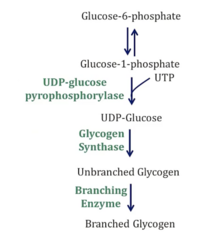
What enzyme facilitates Glucose-6-Phosphate ↔ Glucose-1-Phosphate? What occurs during this rxn?
- Phosphoglucomutase
- Changes where the phosphate is bonded (from 6C' → 1C')
Reversible

What enzyme facilitates Glucose-1-Phosphate → UDP-Glucose? What occurs during this rxn?
- UDP-Glucose Pyrophosphorylase
- Takes molecule of Uridine Triphosphate and reacts it w/ glucose → resulting molecule is a Uridine Diphosphate linked w/ glucose

What enzyme facilitates UDP-Glucose → Unbranched Glycogen? What occurs during this rxn?
- Glycogen Synthase
- Lops off the UDP and attaches the glucose molecules via α(1-4) Linkages (results in straight chains)

What enzyme facilitates Unbranched Glycogen → Branched Glycogen? What occurs during this rxn?
- Branching Enzyme
- Creates α(1-6) Linkages → allows branching of glycogen

When would Glycogen be broken down by the body?
- Low blood [glucose], fasting, exercise
- Needs to make up for lack of glucose, so it starts breakdown its stores
Glycogen Breakdown: What Enzyme Facilitates Branched Glycogen → Unbranched Glycogen? What occurs during this rxn?
- Debranching Enzyme
- Disrupts α(1-6) Linkages

Does Unbranched glycogen need to be converted back into UDP-Glucose during glycogen breakdown?
- No, can skip directly back to Glucose-1-Phosphate (UDPs were removed previously, no need to reattach)
Glycogen Breakdown: What enzyme facilitates Unbranced Glycogen → Glucose-1-Phosphate? What occurs during this rxn?
- Glycogen Phosphorylase
- Disrupts α(1-4) Linkages

How is Glucose-1-Phosphate converted back into Glucose-6-Phosphate?
- Phosphoglucomutase catalyzes reversible G1P ↔ G6P
- Moves/repositions the phosphate from carbon 1 to carbon 6

What is the fate of Glucose-6-Phosphate after glycogen has been broken down?
Dependent on the tissue:
- Muscle: Lacks Glucose-6-Phosphatase; cannot convert G6P → Glucose // Shunted towards glycolysis for energy inside the cell
- Liver: Has Glucose-6-Phosphatase; can convert GP6 → Glucose to be released to maintain blood sugar levels during times of fasting, used by other tissues
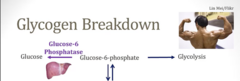
How can Unbranched Glycogen (α1,4) be converted directly into Glucose?
- α1,4 Glucosidase found in lysosomes
- Lysosomes collect/digest debris in cells, can also collect glycogen → direct breakdown into glucose
Why is α1,4 Glucosidase an important enzyme?
- If deficient, can cause glycogen storage disease
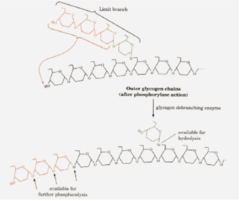
How does Glycogen Phosphorylase breakdown glycogen? When does it stop?
- Removes glucose molecules from polymer by cleaving the α(1,4) links → creates glucose-1-phosphate
- It continues until it gets 2-4 glucose residues away from the α(1,6) link, then it stops (creates limit dextrins)
What is Glycogen Phosphorylase stabilized by?
- Vitamin B6
How does the Debranching enzyme take over when Glycogen Phosphorylase has to stop
- Cleaves the limit dextrins (the 2-4 linked and branching glucose molecules) → attaches them to the straight chain where they can be further processed by Glycogen Phosphorylase
- The remaining glucose molecule attached by α(1,6) is cleaved → creating a free glucose molecule
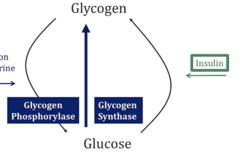
When are Glucagon/Epinephrine elevated?
- Glucagon: ↑ During fasting
- Epinephrine: ↑ During fight or flight
Do Glucagon and Epinephrine increase glycogen breakdown or glucose storage?
- Glycogen breakdown → glucose
When is Insulin elevated?
- During the fed state, when blood [glucose] is high
Does Insulin increase glycogen breakdown or glucose storage?
- Glucose storage → glycogen bc/ blood [glucose] is high
How do Glucagon/Epinephrine influence the process of glycogen breakdown?
- Via Enzyme Phosphorylation of Glycogen Phosphorylase + Glycogen Synthase

What effect does phosphorylation have on Glycogen Phosphorylase + Glycogen Synthase?
- Phosphorylase: ↑ in activity → BREAKS down more glycogen into glucose
- Synthase: ↓ in activity → cells STOP making glycogen
How does Insulin influence the process of glycogen breakdown/storage?
- Dephosphorylates Glycogen Phosphorylase + Glycogen Synthase
What effect does dephosphorylation have on Glycogen Phosphorylase + Glycogen Synthase?
- Phosphorylase: ↓ in activity → STOPS glycogen breakdown
- Synthase: ↑ in activity → cells START making glycogen
STEPS of how Epinephrine/Glucagon affects Glycogen Phosphorylase
1. Epi/Glucagon bind to receptors → activates Adenyl Cyclase
2. Activated Adenyl Cyclase RAISES [cAMP] inside cell → cAMP activates Protein Kinase A
3. PKA phosphorylates an GPKinase A → phosphorylates Glycogen Phosphorylase → Glycogen BREAKDOWN
![<p>1. Epi/Glucagon bind to receptors → activates Adenyl Cyclase</p><p>2. Activated Adenyl Cyclase RAISES [cAMP] inside cell → cAMP activates Protein Kinase A</p><p>3. PKA phosphorylates an GPKinase A → phosphorylates Glycogen Phosphorylase → Glycogen BREAKDOWN</p>](https://assets.knowt.com/user-attachments/7a1e4727-ff1e-46ac-b1d2-fd432f42df75.png)
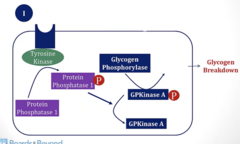
STEPS of how Insulin affects Glycogen Phosphorylase
1. Insulin binds to tyrosine kinase receptor
2. Tyrosine kinase phosphorylates an enzyme called protein phosphatase 1
3. Protein phosphatase 1 removes phosphate group from GPKinase A
4. When phosphate is removed from GPKinase A, Glycogen Phosphorylase cannot be activated → Glycogen breakdown
STEPS of how Epinephrine/Glucagon affects Glycogen Synthase
1. Epi/Glucagon bind to receptors → activates Adenyl Cyclase
2. Activated Adenyl Cyclase RAISES [cAMP] inside cell → cAMP activates Protein Kinase A
3. PKA phosphorylates Glycogen Synthase → inhibits the synthase → inhibition of glycogen synthesis
![<p>1. Epi/Glucagon bind to receptors → activates Adenyl Cyclase</p><p>2. Activated Adenyl Cyclase RAISES [cAMP] inside cell → cAMP activates Protein Kinase A</p><p>3. PKA phosphorylates Glycogen Synthase → inhibits the synthase → inhibition of glycogen synthesis</p>](https://assets.knowt.com/user-attachments/634c489e-93a9-4383-8a4f-9712f465de2a.png)
STEPS of how Insulin affects Glycogen Synthase
1. Insulin binds to tyrosine kinase receptor
2. Tyrosine kinase phosphorylates an enzyme called protein phosphatase 1
3. Protein phosphatase 1 removes phosphate group from Glycogen Synthase → ACTIVATES IT → Glycogen synthesis

How is Glycogen Phosphorylase activated within muscle in the absence of hormones? (During contraction)
1. When you begin exercising, you want glycogen breakdown to occur immediately. You do not want to wait for hormone levels to become elevated
2. Calcium:Calmodulin complex that is generated why active muscles can directly activate GPKinase A
3. Activated GPKinase A phosphorylates Glycogen Phosphorylase → Activates it → Glycogen Breakdown

What molecules inside the cell inhibit Glycogen Phosphorylase? Its result?
- ATP/Glucose → Inhibit Phosphorylase → Unable to breakdown glycogen → cell favors glucose storage in form of glycogen
ATP/Glucose signify high energy, no need to breakdown glycogen
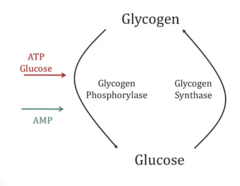
What molecules inside the cell activate Glycogen Phosphorylase? Its result?
- AMP (signifies low energy) → Activates phosphorylase → glycogen broken down into glucose for energy/ATP
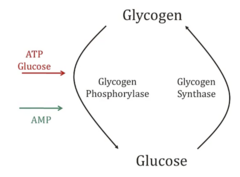
What molecules inside the cell activate Glycogen Synthase? Its result?
- Glucose-6-Phosphate → activates synthase → glucose is stored as glycogen

How long can glycogen last as fuel for the body?
1. In less than 8hrs, you use up all the glucose you've ingested in final meal prior to fasting
2. At that point, the use of glycogen for fuel begins to increase, but the glycogen can only last about a day or so prior to being depleted
3. After glycogen is depleted, any glucose found in bloodstream is the result of gluconeogenesis (via proteins/fatty acids)

How do the liver/muscles store dietary glucose? What increases storage of glucose?
- As glycogen
- Insulin
What is the role of Hexokinase/Glucokinase in gluconeogenesis?
- Converts Glucose → Glucose-6-Phosphate to be used for either glycolysis or glujconeogeneis
Hexokinase/Glucokinase: Which one is stimulated by insulin?
- Glucokinase
What is the role of Glycogenin
- Initiates glycogen synthesis by "autoglucosylating" itself to form a short "primer" structure of 7-10 glucose molecules
What are the forms of Glycogenin in humans?
- Glycogenin-1 (GYG1) → Muscles (myocytes)
- Glycogenin-1 (GYG2) → Liver (hepatocytes)
Deficiencies in Glycogenin result in what?
- Abnormal glycogen formation
How can Galactose be utilized for gluconeogenesis?
1. Galactose → Galactose-1-P via Galactokinase
2. Galactose-1-P → UDP-Galactose via Galactose-1-P Uridyltransferase
3. UDP-Galactose → UDP-Glucose via UDP-Galactose Epimerase
4. UDP glucose can use normal pathway for glycogen synthesis
Galactosemia
- Cannot make glycogen from galactose
How can Mannose be utilized for gluconeogenesis?
1. Mannose → Mannose-6-P via Hexokinase
2. Mannose-6-P → Fructose-6-P via Phosphomannose Isomerase
How can Fructose be utilized for gluconeogenesis?
1. Fructose → Fructose-1-P via Fructokinase (liver)
2. Fructose-1-P → Glyceraldehyde-3-P + Dihydorxyacetone-P via Aldolase B (Liver)
3. Glyceraldehyde-3-P → Pyruvate → Gluconeogenesis
How can Glycerol be utilized for gluconeogenesis?
1. Glycerol → Glycerol-3-P via Glycerol Kinase
2. Glycerol-3-P → Dihydroxyacetone-P via Glycerol-3-Dehydrogenase
3. Dihydroxyacetone-P → GAP → Pyruvate → Glyconeogenesis
Lactate is produced where during glycolysis?
- RBCs and Skeletal muscle
1st/2nd Activity of Debranching Enzyme
- 1st: α1,4 Glucanotransferase removes 3 monomers from the branch → attaches to straight monomer chain
- 2nd: a1,6 Glucosidase cleaves the remaining monomer left on branch → free 1x glucose