B3
 Call Kai
 Learn
Learn Practice Test
 Spaced Repetition
 Match
Match Flashcards
 Knowt Play
1/159

There's no tags or description
Looks like no tags are added yet.
Name | Mastery | Learn | Test | Matching | Spaced | Call with Kai | Chat |
|---|
No analytics yet
Send a link to your students to track their progress
160 Terms
Pathogens cause disease.
(a) How does the skin defend the human body against pathogens?
physical) barrier
or
stops pathogens entering (blood / body)


How many more bacteria were killed at pH1 than at pH5 in 24 hours?
Complete the following steps.
Calculate the number of bacteria killed at pH1


1968

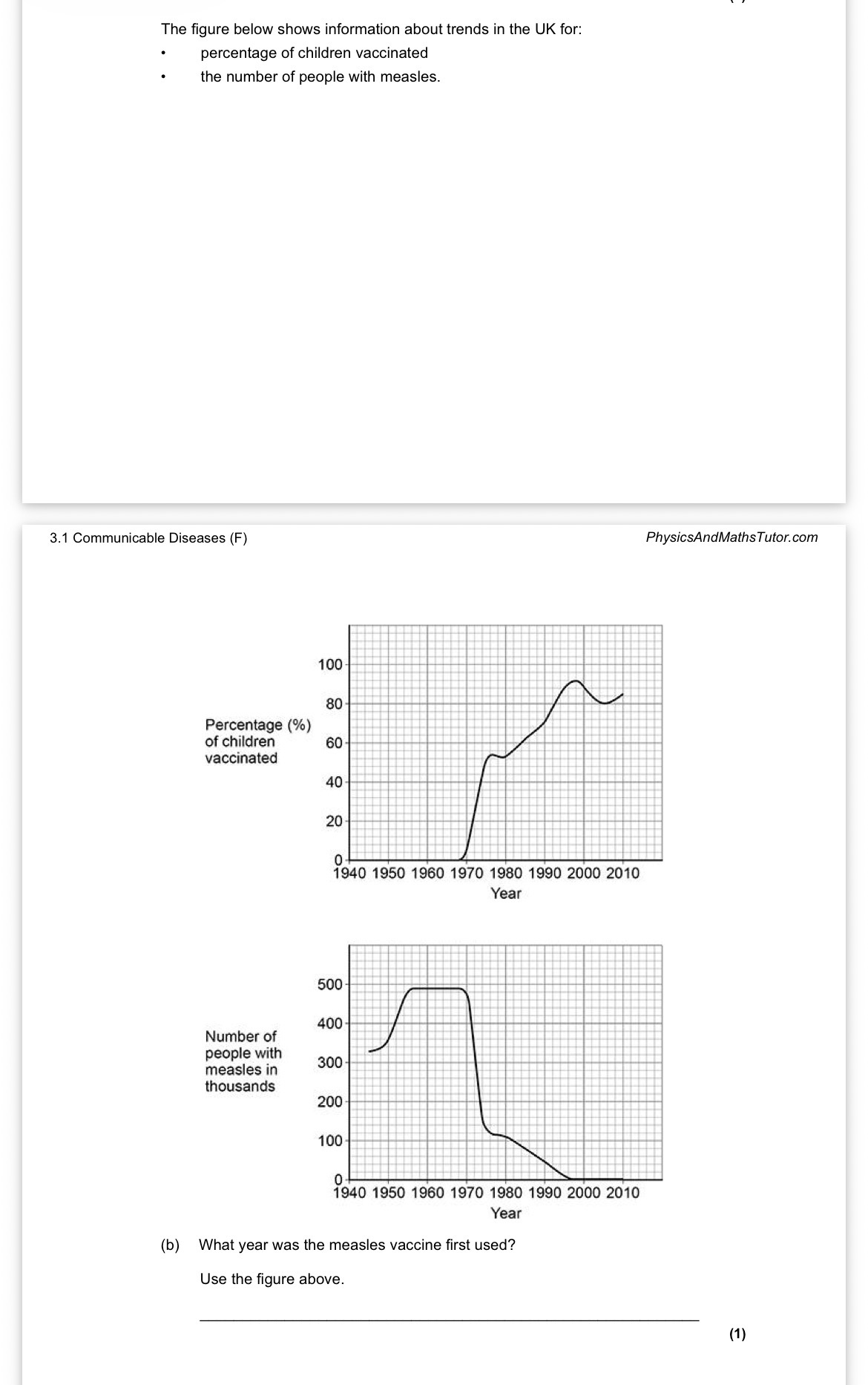
Describe the trend in the number of people with measles from 1945 to
1975.
Use the figure above.
increases
1
(then) levels off / plateaus
allow (then) stays the same
allow reaches a maximum
between 1956 and 1968
1
(then) decreases
ignore use of numbers of people
if no other mark awarded allow 1 mark for (overall)
decrease

In 1998, a scientific paper was published suggesting a link between condition X
and one type of measles vaccine.
(d) What happened to the percentage of children vaccinated against
measles after the scientific paper was published in 1998?
Use the figure above.
the percentage) decreased
e) Why might the claims made in the scientific paper have affected the
percentage of children vaccinated?
parents were worried their children would get condition X
In 2010, the scientific paper linking condition X and the measles vaccine
was shown to be based on false claims.
What should scientists do with scientific research to help detect false
claims?
) The person who wrote the scientific paper was paid to research the link
between condition X and the measles vaccine.
Why are the claims in the scientific paper likely to be considered not valid?
any one from:
• (the author was) biased
• (the author was) influenced by money
• because the research was not peer reviewed
• there was not enough evidence
• small sample size

+Suggest the reason for the change you described in part (e).
(percentage) decreases
more females were vaccinated (over time)
Malaria is caused by a protist.
The protist is passed from one person to another person by mosquitos.
(a) Which term describes the mosquito?
Vector
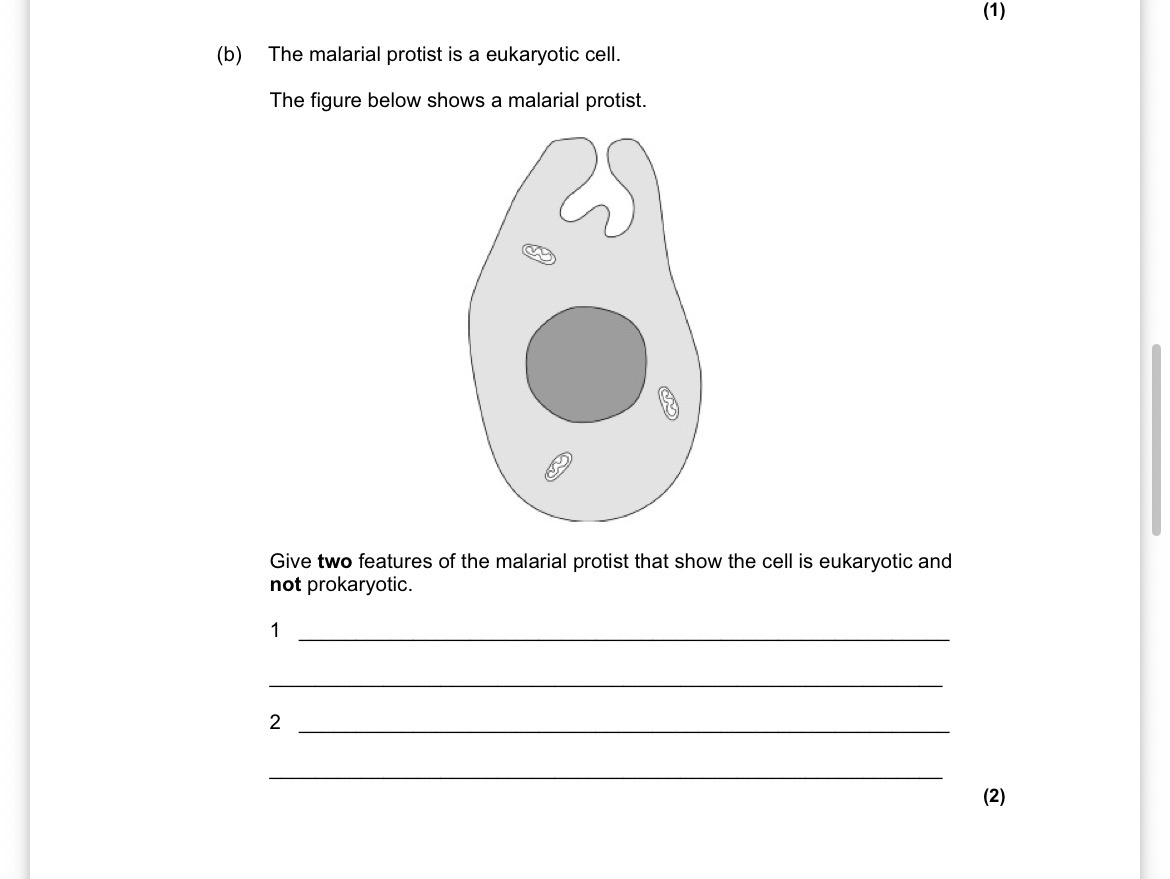
Give two features of the malarial protist that show the cell is eukaryotic and
not prokaryotic.
any two from:
• (it has) mitochondria
• (it has a) nucleus
if neither mark awarded, allow 1 mark
for protist has membrane-bound
structures
allow it does not have a loop of DNA
• (it has) no plasmids
Which organism is prokaryotic?
Salmonella
) The malarial protist reproduces asexually.
What is a feature of asexual reproduction?
only one parent is involved
Mitosis occurs in the malarial protist during asexual reproduction.
The protist has 14 chromosomes.
How many chromosomes will each new protist cell have after mitosis?
14
When a person has malaria, the protists destroy red blood cells.
What change would happen in the blood of a person with malaria?
decreased haemoglobin
It is estimated that 210 million people are infected with malaria every year.
Half of these infected people survive the disease.
Calculate how many people would survive the disease in 3 years if the
estimate is correct.
Give your answer in standard form.

The spread of malaria can be controlled by using mosquito nets to avoid
being bitten.
Describe two other ways that people can reduce the chance of being bitten
by mosquitos.
Do not refer to mosquito nets in your answer.
any two from:
• wear long(er) sleeves / clothes
allow reduce bare skin exposure
• use insect repellent or insecticides
allow insect repellent methods such as
citronella candles
• don’t go out in the evening
allow close doors / windows in the
evening
• avoid going to countries / places with malaria / mosquitos
• destroy breeding grounds
allow methods of destroying breeding
grounds such as drain water holes
• release sterile male mosquitos
ignore vaccination / anti-malarial drugs
allow other correct suggestions

percentage / chance (of getting malaria) decreases (with age)
do not accept percentage / chance of
having disorder S
decreases with age
1
2
1
correct use of data such as two pairs of data from the table
HIV (Human Immunodeficiency Virus) is a pathogen.
(a) How is HIV spread from one person to another person?
sexual intercourse
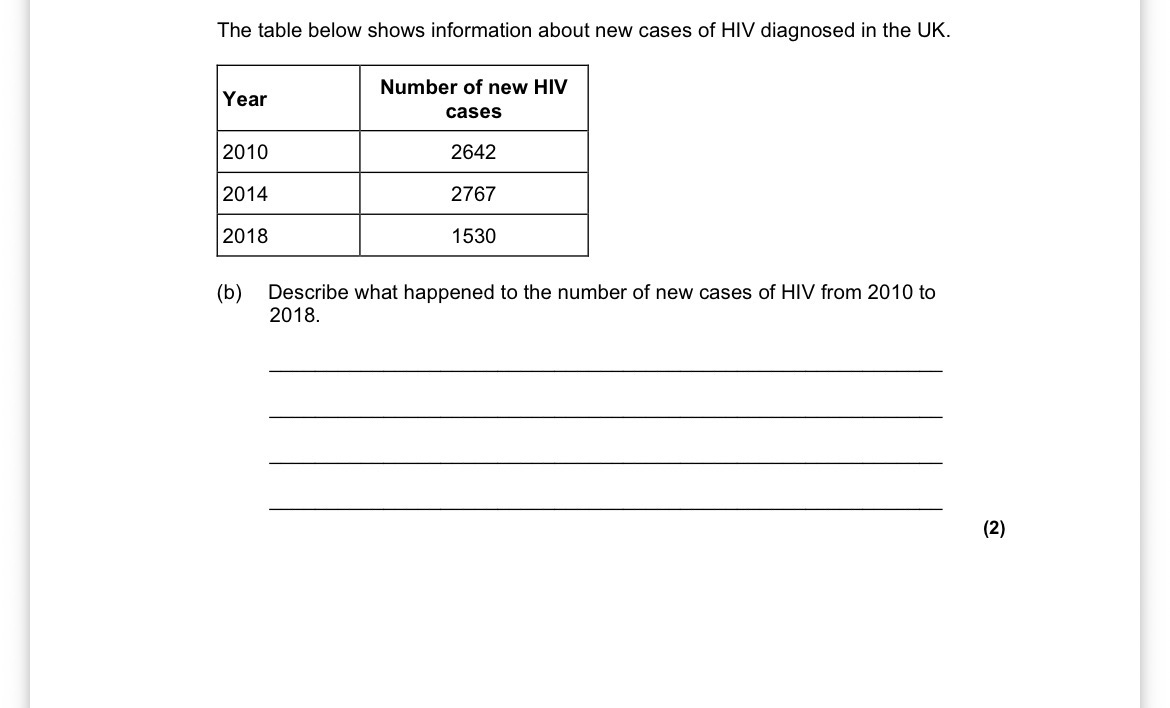
increased (at first)
1
(then) decreased
(c) What could cause a decrease in the number of new HIV cases in the
future?
Tick (✓) one box.
better education on how to prevent the spread of HIV

C) → E → A → B → D
e) When scientists produce a vaccine for a disease the vaccine is tested on
live animals.
What is the next stage in testing the vaccine?
testing on healthy volunteers
A vaccine for HIV is important because it is difficult to develop safe drugs to
destroy viruses.
Why is it difficult to develop safe drugs to destroy viruses?
drugs that destroy viruses also damage body tissues


Name one antibiotic
Penicillin

the bacterium is killed (by antibiotic C)
allow there is a zone of inhibition (around antibiotic
C)
1
if the bacterium was resistant, bacteria would be right up to the
(edge of the) antibiotic disc
Suggest why doctors are concerned about antibiotic resistance.
any two from:
• current / available antibiotics do not kill (certain) bacteria
allow current / available antibiotics have no effect
on (certain) bacteria
• diseases become more common
or
there will be some diseases that cannot be cured / treated
ignore more people become ill
• new antibiotics need to be developed which takes time / money
allow some diseases become more difficult to treat
Diseases caused by viruses cannot be treated using antibiotics.
(d) Suggest why viruses cannot be grown on agar.
viruses only exist / reproduce inside (living) cells
Why is it difficult for scientists to develop drugs to destroy viruses?
these) drugs (can) damage (body) cells / tissues
or
it is hard to get (these) drugs into (living) cells
Which disease is caused by a virus that damages white blood cells?
AIDS
Salmonella bacteria cause outbreaks of food poisoning in humans.
To prevent food poisoning in humans, farmers vaccinate their animals against
Salmonella bacteria.
(a) How do Salmonella bacteria in food cause the symptoms of vomiting and
diarrhoea?
bacteria) release / produce toxins
During a food poisoning outbreak, scientists identified the farm where the food
came from.
The farmer had not vaccinated the farm animals against Salmonella bacteria.
(b) The food poisoning outbreak could have been prevented if the farm
animals had been vaccinated.
Explain how:
• the immune systems of animals respond to a vaccination
• the immune response in farm animals prevents an outbreak of food
poisoning in humans.
Vaccination of animal
• (animal’s) white blood cells / lymphocytes produce antibodies
(against Salmonella / vaccine / antigens)
• antibodies are specific / complementary / correct to Salmonella
/ antigens
• (specific) antibodies bind to Salmonella / antigens
Secondary response in animal
• if infected (specific) antibodies are produced quickly or in large
numbers
• (so) white blood cells or antibodies would kill (live) Salmonella
• (so) fewer / no bacteria / pathogens / Salmonella in animals or
in animal products (meat / milk / eggs)
Prevention of food poisoning in humans
• (so) fewer / no bacteria / pathogens / Salmonella eaten or in
(named) food
• (so) number of bacteria never reaches a high enough level for
infection to develop
• (so) fewer toxins produced (in humans).
The scientists incubated the bacteria at 37 °C.
Students in school laboratories incubate bacteria at 25 °C.
Explain why scientists use 37 °C but students must use 25 °C to incubate
bacteria.
(37 °C)
37 °C is human / body temperature
1
Salmonella / bacteria grows best / better at 37 °C
allow (so) bacteria grow best / better at
human body temperature
1
(25 °C)
25 °C reduces / prevents the growth of bacteria that are harmful to
humans / students
What is the purpose of the paper disc with no antibiotic in the figure above?
Acts as a control
The scientists concluded that either antibiotic A or antibiotic B should be
prescribed to patients with food poisoning.
Why should antibiotic A or antibiotic B be prescribed?
) killed the most bacteria
prescribed.
Describe how the results in the figure above could be used to obtain a
quantitative comparison of antibiotics A and B.
measure the diameter / radius of each clear area
h) One year later, there was another outbreak at the farm involving
Salmonella bacteria.
Antibiotic B did not have an effect.
Suggest why antibiotic B no longer had an effect.
bacteria must be resistant (to antibiotic B)
Antibiotics treat food poisoning because they kill Salmonella bacteria
inside the human body.
Some antibiotics work because they damage the bacterial cell wall.
The bacteria die because the cells burst.
Explain why the cells burst.
water enters the (bacterial) cell
1
(water enters) by osmosis
allow (water enters) by diffusion through
a partially / selectively / semi permeable
membrane
do not accept if description of
concentrations is incorrect
(so) damaged / incomplete / no cell wall cannot withstand pressure
(of water)
3.
The protist that causes malaria is passed from one person to another person by
mosquitos.
(a) What term describes an organism that passes a pathogen from one person
to another person?
Vector
The malarial protist is a eukaryotic cell.
Describe three ways the structure of the malarial protist is different from
the structure of a prokaryotic cell.
Do not refer to size in your answer.
any three from:
allow converse for prokaryotic cells
allow eukaryotic for protist
• protist / it has mitochondria
• protist / it has (a) nucleus or protist DNA / genetic material is
not free in the cytoplasm
if neither mark awarded, allow 1 mark
for protist has membrane-bound
structures
ignore genetic information
• protist / it does not have a single loop of DNA / genetic material
ignore genetic information
• protist / it does not have plasmids
• protist / it does not have a cell wall
During one stage of malaria infection, the malarial protists enter red blood
cells and cause them to burst.
Explain why the bursting of red blood cells causes tiredness.
less oxygen carried (in blood)
allow less oxygen carried (to cells)
ignore reference to number of red blood
cells unqualified
do not accept no oxygen carried
1
less energy released from respiration
The malarial protist reproduces sexually and asexually during a life cycle.
Complete Table 1 to give three differences between sexual reproduction
and asexual reproduction.
One difference has been completed for you.

One drug for treating malaria prevents mitosis occurring in the malarial
protist.
The drug stops the synthesis of new DNA bases in the cell.
Suggest how the drug prevents mitosis occurring.
no bases so) DNA replication cannot occur

having disorder S reduces incidence / percentage of malaria
allow having disorder S reduces chance
of getting malaria
allow having disorder S protects against
malaria
1
as age increases a lower percentage of children with disorder S get
malaria until age 10, then the percentage increases
Human immunodeficiency virus (HIV) is a pathogen.
(a) Give one way HIV can spread from one person to another person.
any one from:
• sexual contact / intercourse
allow intercourse unqualified
ignore kissing
• exchange of body fluids
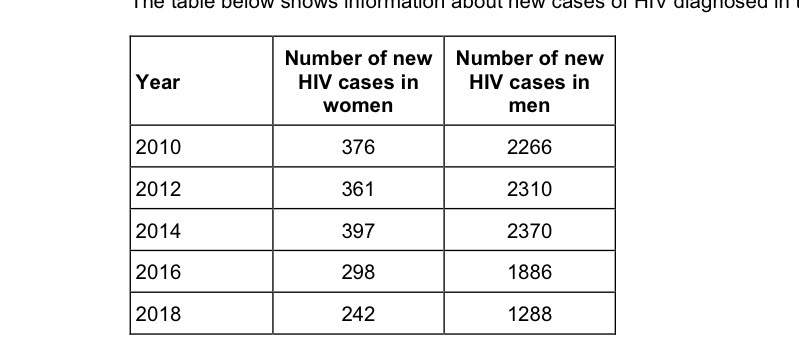
Describe the trends shown in the table above between 2010 and 2018.
(number of cases) in women decreases then increases, then
decreases
1
(number of cases) in men increases then decreases
Suggest one reason for the change in the number of new HIV cases
between 2014 and 2018.
any one from:
• better education (into prevention of spread of HIV)
allow increased awareness about HIV
• condoms more widely available or condoms easier to
source or condoms cheaper
ignore contraception / protection unqualified
• new / better drugs (to prevent HIV infection / spread)
allow PrEP / anti-retrovirals stop the virus being
passed on
ignore new treatments
do not accept antibiotics
• better / more testing / identification (of people with HIV)

Calculate the ratio of new cases of HIV in women to new cases of HIV in
men in 2018.
Give your answer to 3 significant figures.

In the UK population the total number of women is greater than the total
number of men.
The data in the table in part (a) is used to compare the proportions of new
cases of HIV in the population for men and women.
Suggest how the data could be presented differently so that a more valid
comparison can be made.
any one from:
• calculate as a percentage
• give the numbers per 100 000 people
Scientists have been working to produce a vaccine for HIV for many years.
(f) Explain how a vaccine for HIV could work to prevent a person developing
HIV infection.
inactive HIV / virus is injected (into bloodstream / muscle / body)
allow dead HIV / virus is injected (into bloodstream /
muscle / body)
allow (named) part of HIV / virus is injected (into
bloodstream / muscle / body)
1
white bloods cells produce antibodies (against inactive virus)
allow lymphocytes produce antibodies (against
inactive virus)
do not accept phagocytes produce antibodies
(against inactive virus)
1
(if infected with HIV) correct / specific antibodies are produced
quickly
1
antibodies destroy the (active) virus / HIV
A person with late stage HIV infection has AIDS.
Scientists have produced monoclonal antibodies for HIV.
The monoclonal antibodies can prevent a person infected with HIV developing
AIDS.
(g) Describe how the monoclonal antibody for HIV can be produced.
HIV / antigen / protein injected into mouse
1
extract / collect (mouse) lymphocytes that make a specific antibody
to HIV / antigen / protein
allow other correct small mammals eg rat
allow extract specific lymphocytes from someone
with HIV for 2 marks
lymphocytes are combined with tumour cell to create a hybridoma
allow lymphocytes are combined with a myeloma /
cancer cell to create a hybridoma
1
1
(hybridoma) cloned to create many cells that produce the antibody
alternative route
HIV / antigen / protein injected into mouse (1)
lymphocytes from mouse are combined with a
tumour cell to create a hybridoma (1)
the hybridoma that makes the specific / correct
antibody is isolated (1)
(hybridoma) cloned to create many cells that
produce the antibody (1)

Scientists use monoclonal antibodies to test for the presence of anabolic steroids
in an athlete’s urine.
To produce monoclonal antibodies, a mouse lymphocyte is combined with a
tumour cell.
(d) What type of cell is created when a mouse lymphocyte and a tumour cell
combine?
monoclonal antibody is complementary / specific to HIV antigen
allow correct description of complementarity
1
1
monoclonal antibodies attaches to (all the) HIV antigens
1
(so) HIV cannot bind to (human) cell
or
(so) HIV genetic material cannot enter (human) cell
allow white blood cells or phagocytes identify
(monoclonal) antibodies and engulf / destroy
(antibody bound) HIV
alternative route
monoclonal antibody is complementary / specific to
HIV antigen (1)
monoclonal antibody with (anti-retroviral) drug
attached attaches to the HIV antigens (1)
drug destroys the virus or drug destroys genetic
material (1)
allow ‘the virus’ for HIV throughout
Scientists use monoclonal antibodies to test for the presence of anabolic steroids
in an athlete’s urine.
To produce monoclonal antibodies, a mouse lymphocyte is combined with a
tumour cell.
(d) What type of cell is created when a mouse lymphocyte and a tumour cell
combine?
hybridoma
Describe how scientists make monoclonal antibodies using the cell created
when a mouse lymphocyte and a tumour cell combine.
any three from:
• (cell) is cloned
ignore name of cell
• many (identical) cells are produced
allow many clones are produced
• all the cells make the same antibody
• the antibody is (collected and) purified
f) What property makes a monoclonal antibody useful in detecting the
presence of an anabolic steroid in urine?
a monoclonal antibody only binds to the anabolic steroid

The end of the test strip is dipped in urine.
The urine moves up through the test strip.
The test area and the control area contain a dye.
The dye turns blue when monoclonal antibodies bind to it.
(g) Suggest the purpose of the control area in the test strip.
to show that the test is working

+Which athlete has tested positive for anabolic steroids in their urine?
evidence
no blue / visible dye (in control area)
allow no line(s) (in control area) allow
no colour change (in control area)
1
reason
(because) no (free) monoclonal antibodies bound to control area
or
(because) there were no (free) monoclonal antibodies on the end of
the (test) strip
(i) D
In the past many drugs were extracted from plants.
(c) Aspirin is a painkiller.
Which plant does aspirin originate from?
willow
The scientists usually extract chemical A from the berries of the deadly
nightshade plant.
Suggest one reason why berries are used instead of leaves or roots.
any one from:
• (berries are) easy to access / pick
ignore berries are not underground
• easier to extract chemical
• taking berries will not harm the plant

A deadly nightshade plant has chlorosis (yellow leaves).
The mass of chemical A found in the leaves of the plant is 60% of the mass
shown in the table above.
(e) Calculate the mass of chemical A in 200 g of the leaves with chlorosis.
Give your answer in mg
(0.6 × 1.2 =) 0.72
1
(0.72 × 2 =) 1.44
1
1.44 × 1000
allow conversion of a correct mass
calculated for berries / roots
1
1440 (mg)
Suggest one reason why the leaves of the deadly nightshade plant have
chlorosis.
lack of chlorophyll
allow lack of chloroplasts
• lack of magnesium (ions)
Chemical A has not been tested in large-scale clinical trials in the UK.
(g) It is important for drugs to be tested in clinical trials before the drugs are
approved for use by the public.
Give two reasons why.
There are many online reports making claims about the effects of chemical A.
Some of these reports are biased.
(h) Suggest one reason why a report making claims about the effects of
chemical A may be biased.
________________________
writers / companies may get) financial gain
or
(competitor may suffer) financial loss
some leaves, the green parts become yellow because of an ion deficiency.
(d) Which ion is deficient in a plant with yellow leaves?
Magnesium
Give the scientific term that describes the yellow colour of the leaves
Chlorosis

Hornets are insects that sting other animals and cause pain.
Hornet moths do not sting other animals.
Suggest how mimicry helps the hornet moth survive.
(it looks like the hornet so) predators / animals are tricked / deceived
(by the colouring) and so avoid eating it

less absorption of water
◦ less water so lower rate of photosynthesis
◦ so less glucose produced
◦ for respiration / energy release
◦ so less cellulose produced so fewer cells
walls / cells made
◦ so fewer amino acids produced to make new
proteins
◦ cells lose turgidity
less absorption of (named) ions / minerals
◦ fewer nitrates so fewer proteins made for growth
◦ fewer magnesium ions so less chlorophyll produced
◦ so lower rate of photosynthesis
• damage to phloem
◦ less transport of sugars to root cells
◦ for respiration / energy release
• damage to xylem
◦ less water transported (to cells)
◦ fewer nitrates reach cells
◦ so fewer proteins made for growth
◦ fewer magnesium ions reach cells
◦ so less chlorophyll produced
◦ less magnesium / chlorophyll so lower rate of
photosynthesis
• less anchorage
Mitosis
genetic material / DNA / chromosomes is doubled / replicated /
copied / duplicated
1
the (replicated) chromosomes are pulled / moved apart
the (replicated) chromosomes are separated
1
cytoplasm divides into two (cells)
or
cell membrane divides to form two cells
allow two new nuclei form
allow the nucleus divides (into two)
1
the set of chromosomes in each new cell are identical (to one
another)
Suggest one reason why viruses are not classed as cells.
any one from:
• they do not have a cell membrane
do not accept they do not have a cell
wall
• they do not have cytoplasm
• they do not have a nucleus
• they do not have mitochondria (like most eukaryotic cells)
• they do not have ribosomes


Tobacco mosaic virus (TMV) causes disease in plants.
TMV affects the rate of photosynthesis in plants.
(f) Which part of a plant shows discolouration caused by TMV?
Leaf
Explain why a high level of TMV infection reduces growth in a plant.
less chlorophyll
so) less glucose / starch / protein made
Q2.
The human body can defend itself against microorganisms that cause disease.
Viruses are one type of microorganism that cause disease.
(a) Name one type of microorganism that causes disease in humans.
Do not refer to viruses in your answer.
any one from:
• bacteria
• fungi
• protists
Which two defence systems prevent microorganisms infecting the human
body?
Tick (✓) two boxes.
hydrochloric acid is produced by the stomach
1
1
the skin is a barrier covering the whole body
How is the measles virus spread from one person to another?
by coughs / sneezes
allow ‘by droplets in the air’

f) (from day) 10 (to day) 18
(g) 14 (days)
(h) any one from:
• they had been vaccinated
• they already had antibodies
• they were immune
ignore they were resistant
• they had had it before
• they did not get any / enough virus from infected child
ignore they wore a mask unqualified
• they did not play (much) with the infected child
(i) antibiotics do not kill viruses
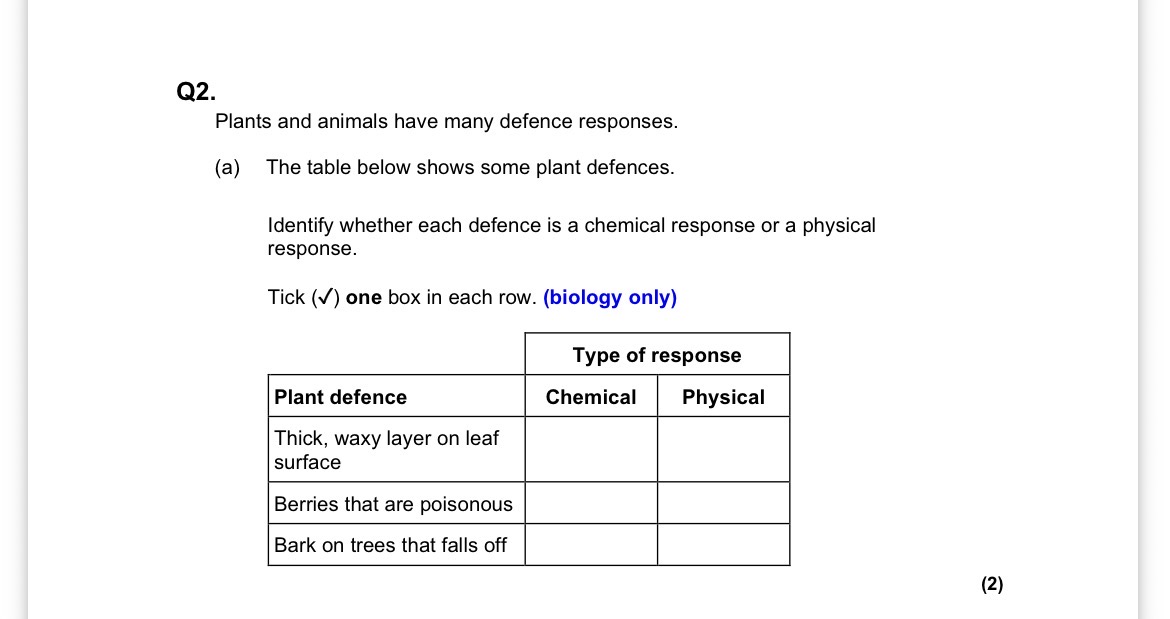
How will the poisonous berries help the deadly nightshade plant to survive?
will stop animals / herbivores eating it
Which type of defence mechanism are the berries?
chemical
Suggest how the gorse plant is adapted to defend itself.
thorns / spikes / spines / prickles (to stop animals / herbivores eating it)
The green leaves of the gorse plant make glucose for the plant to use.
What are two uses of glucose in the gorse plant?
for respiration
to store as starch
A student wanted to show that the leaves of a gorse plant contain glucose.
The student crushed the leaves to extract the liquid from the cells.
Describe the method the student could use to test the liquid from the cells
for glucose.
Include the result if glucose is present.
add Benedict’s (solution / reagent to the liquid)
boil / heat
(if glucose is present the blue) colour changes to yellow / green /
orange / brown / (brick) red
The roots of the gorse plant have bacteria that turn nitrogen gas into nitrate
ions.
Explain why nitrate ions are needed by the gorse plant.
(nitrate ions are needed) to make proteins / amino acids
allow to make chlorophyll / DNA / ATP /
nucleic acid
1
which are needed for growth / enzymes / new cells
The roots of gorse plants can be infected by honey fungus.
The honey fungus produces tiny spores underground.
Suggest how the honey fungus spores travel from the roots of an infected
gorse plant to the roots of a healthy gorse plant.
in / on the (soil) water
A drug can be extracted from gorse seeds.
Doctors want to trial the drug from gorse seeds to see if it can treat diarrhoea.
(h) Which two factors must the doctors test the drug for in the trial?
dosage
toxicity
Mosquitoes carry a pathogen that causes malaria.
(a) What type of pathogen causes malaria?
a protist

b) Lower percentage of people with malaria when using (mosquito) nets
C)any one from:
• some people who use (mosquito) nets have malaria
data from only one area / part of Africa
• size of group too small or sample size too small or only 476
people
allow correlation does not imply
causation
• only 50 people did not use (mosquito) nets
or
uneven group sizes (nets vs. no nets)
• no other information about people considered
allow examples of information not
considered e.g. age, other medical
issues such as sickle cell, whether
taking anti-malarial medication,
vaccination
ignore ref to other factors unqualified
• people may have lied about using (mosquito) nets

88-91
e) Use of mosquito nets has helped to reduce the number of deaths from
malaria each year.
Suggest one other reason for the reduced number of deaths from malaria
each year.
any one from:
• improved health care
allow examples of improved health care
such as more / cheaper / new
treatments / vaccinations / antibiotics
• use of mosquito control methods
allow descriptions such as spraying of
insecticides / repellent or draining water
holes or preventing mosquitoes from
breeding
• changing behaviour to avoid being bitten (by mosquitoes)
allow descriptions such as wear long
clothing or avoid going out at dusk
Describe how the human body:
• prevents pathogens from entering
• defends itself against pathogens inside the body. (6)
prevents pathogens from entering
skin
• tough / dry / dead outer layer
• skin acts as a barrier
• sebum / oil on (surface of) skin
• sebum / oil repels pathogens
scabs form over cuts or scabs form a barrier
• platelets are involved in forming clots / scab
stomach
• contains (hydrochloric) acid
• (HCl) kills bacteria
• in food or in swallowed mucus
eyes
• produce tears
• contains enzymes to kill bacteria
• tears are antiseptic
breathing system
• trachea / bronchi / nose produce mucus
• mucus is sticky
• (mucus) traps bacteria
• (mucus) carried away by cilia
defends itself against pathogens inside the body
• immune system / white blood cells (WBCs)
• WBCs engulf pathogens
• antitoxins are produced
• (antitoxins) neutralise toxins / poisons (produced by pathogen)
• antibodies are produced
• (antibodies) help destroy pathogens
• memory cells (are formed)
• (memory cells give a) more rapid response if pathogen
re-enters
man has the following symptoms:
• yellow discharge from his penis
• pain when urinating.
(a) The man has a bacterial infection.
What is the most likely cause of the man’s symptoms?
gonorrhoea
The man took a full course of antibiotics.
The man’s symptoms did not improve.
Why did the antibiotics not cure the symptoms?
the bacteria are resistant to the antibiotics
Using a condom can stop the bacteria being passed to another person
during sexual intercourse.
Suggest a different way the man could avoid passing the bacteria on to
someone else
abstain from sex(ual intercourse)
allow abstinence
or
wash hands after touching penis / urinating / using the toilet
ignore wash hands unqualified
Compare the effectiveness of the three antibiotics at killing the different
types of bacteria.
Indicative content:
qualitative statements
• 3 works best on A
• 1 works best on B
• 2 works best on C
• 1 is least effective on A
• 3 is least effective on B
• 3 is least effective
or has no effect on C
quantitative statements
• 1 kills more of B and C compared to A
• 2 kills more of C than A / B
• 3 kills more of A than B and C
• 2 kills the same amount of A and B
• 2 and 3 killed similar amounts of B
• C are resistant to 3
• only 2 worked well on all of the bacteria
• for A, 3 works best, 2 is next and 1 is least effective
• for B, 1 works best, 2 is next and 3 is least effective
• for C, 2 works best, 1 is next and 3 is least effective


e)sample E
f) 15+12+13+16/4
Or
56/4
14
g)an answer of 140 000 scores 3 marks
an incorrect answer for one step does
not prevent allocation of marks for
subsequent steps
(area = 0.1 × 0.1 =) 0.01
allow 1 × 10⁻²
(volume = 0.01 × 0.01 =) 0.0001
allow 1 × 10⁻⁴
1
1
(number = 14 =) 140 000
0.0001
allow ecf from part (f)
allow 1.4 × 10⁵
do not accept 14 × 104
area=0.01
Volume=0.0001
Number=140,000

h)Q
(i)
allow reverse argument
(bacteria) could make humans ill
allow (bacteria) cause infection /
disease
or
(bacteria) could kill humans
allow (bacteria) cause appropriately
named disease
or
(bacteria) could release toxins
ignore harmful
Eating food containing Salmonella bacteria can cause illness.
(a) Two symptoms of infection by Salmonella are vomiting and diarrhoea.
What causes these symptoms?
(a) toxins / poisons (secreted by / from / in bacteria)