Genetics Unit 1
 Call Kai
 Learn
Learn Practice Test
 Spaced Repetition
 Match
Match Flashcards
 Knowt Play
1/116

There's no tags or description
Looks like no tags are added yet.
Name | Mastery | Learn | Test | Matching | Spaced | Call with Kai | Chat |
|---|
No analytics yet
Send a link to your students to track their progress
117 Terms
What is Genetics?
study of heredity
Explain the study of heredity
how inherited characteristics are
1.) Encoded, replicated, expressed
2.) How it evolves over time
What does the study of Genetics influence the research of?
Development, Maladies, Agriculture, Biotechnology
How does Genetics study Development
How does Genetics study Maladies?
What are maladies?
How does Genetics change agriculture?
What is the Green Revolution?
Why is wheat a key example of how Genetics can modify the world?
How does Genetics change biotechnology?
List some examples of how Genetics influences biotechnology
Unifying Principle
all organisms use genetic systems
Where are genetic systems found in organisms?
Cell Nucleus: Houses the primary nuclear genome organized into chromosomes in plants, animals, and fungi.
Mitochondria: Contain their own distinct, small genetic systems used for cellular respiration.
Chloroplasts: House separate genetic systems in plants and algae for photosynthesis.
Cytoplasm (Prokaryotes): Floats directly in the cell fluid for bacteria and archaea without a true membrane-bound nucleus
Break down deoxyribonucleic acid
“without” “oxygen” “ribose sugar” “pH less than 7”
“-ose” signifies something is a
sugar
What is a ribose sugar made of?
pH of Acid
less than 7
pH of Base
more than 7
DNA is _____ parallel
anti
Why is it important that DNA is antiparallel?
Break down ribonucleic acid
“with” “ribose” “pH less than 7”
Monomer
Polymer
What are monomers (ex) like nucleotides
Nucleotides
Nucleosides
Why do bases turn into acids
How do bases make a double or single helix

Does the image show DNA or RNA? Why?
DNA, lacks a hydroxyl group
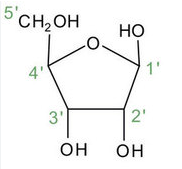
Does this image show DNA or RNA? Why?
RNA, has two hydroxyl groups
How do the two hydroxyl groups on RNA make it differ from DNA
increase its reactivity and make it more unstable, contributing to its single-stranded structure.
3 Lenses of Inheritance
What characteristics are common to all organisms under the unifying principle
encoding, copying, decoding, RNA or DNA, replication, amino acids
Genome
a complete set of genetic instructions for any organism
List the nitrogenous bases
What are the correct pairings of nitrogenous bases? (put number of bonds between them as well)
How do nitrogenous bases differ from RNA to DNA
How does the difference in nitrogenous bases impact the shape and function of RNA compared to DNA
Transmission Genetics
Molecular Genetics
Population Genetics
Give examples of population genetics
Evolution as it pertains to Genetics
What division of genetics is considered “classical” genetics?
Give an example of transmission genetics
Traits
Chromosomes
Gene
Alleles
What 4 biological levels of organization do observations and theories in genetics span over
Common characteristics of model organisms
Genetic Variation
Give examples of model organisms
Why is it important to understand the Kingdom Animalia for model organisms in genetics?
A biologist examines a series of cells and counts 160 cells in interphase, 20 cells in prophase, 6 cells in prometaphase, 2 cells in metaphase, 7 cells in anaphase, and 5 cells in telophase. If the complete cell cycle requires 24 hours, what is the average duration of the M phase in these cells? Of metaphase?
Is the following trait present or active in prokaryotes?
Nucleus
absent
Describe the following trait in prokaryotes (when needed say if it is absent or present)
cell diameter
relatively small (1-10 micrometers)
What type of squares show the possibilities of the zygote?
pumett
Describe anaphase
Describe prophase
Describe interphase
Describe telophase
What is the difference between meiosis I and meiosis II
Diploid
Haploid
In Meisosis, what type of parents make gametes with half the amount of genetic material?
diploid
In Meisosis, diploid parents make gamete with half the amount of genetic material called
haploid gametes.
In what process do haploid gametes fuse with each other to create a new diploid individual?
fertilization
What makes Meisosis similar to Mitosis
occurs in reproductive or sex cells/ germ cells
What phase does Meiosis proceed through first?
Interphase
After Meisosis proceeds through Interphase first, it then goes through two successive divisions to reduce the content by 1/2 , this is called
reduction division
What is the importance of reduction division?
It is crucial for maintaining the correct number of chromosomes in gametes, ensuring genetic diversity and stability during sexual reproduction.
Cytokinesis
What occurs during G1
cell grows
What occurs in G0
some cells may enter this phase, it is a non-dividing phase where cells perform their specific functions and can remain metabolically active.
What occurs in the G1/S checkpoint
assesses the cell's readiness for DNA replication by evaluating DNA integrity and ensuring all necessary growth signals and resources are present.
What is the cell committed to after the G1/S checkpoint?
dividing
What occurs in S
DNA duplicates
What occurs in G2
the cell prepares for mitosis by checking DNA replication and repairing any damage before proceeding.
After which checkpoint in the cell cycle can the cell divide
G2/M
What occurs in the G2/M checkpoint
The cell checks for DNA damage and confirms that DNA replication has completed successfully before entering mitosis.
In which phase do mitosis and cytokinesis take place in
M phase
What is the spindle assembly checkpoint of the cell cycle
a control mechanism during mitosis that ensures all chromosomes are properly attached to the spindle apparatus before proceeding with cell division.
The first Meiotic division goes through Prophase I, which is made up of what subdivisions?
Leptotene, zygotene, pachytene, diplotene, diakinesis
Lepotene
replicated chromosome condense
Zygotene
synapsis begins: chromosomes pair
Pachytene
A bivalent has formed and crossing over has occured
bivalent
four chromatids in close association (tetrad)
Diplotene
synaptonemal complex dissociates and homologous chromosomes begin to separate (chiasmata)
Chiasmata
Diakinesis
end of prophase I
What subphases of prophase I does crossing over occur?
zygotene, pachytene, diplotene
Interkinesis
in some types of cells, the spindle breaks down, chromosomes relax, and nuclear envelop re-forms, but no DNA synthesis takes place
What phase in Meiosis II, only occurs in cells that went through interkinesis?
Prophase II
Prophase II will happen only in cells that went through interkinesis. Other types of cells proceed directly to what phase after cytokinesis?
metaphase II
What are the results of meiosis?
Four genetically diverse haploid gametes produced from the original cell resulting in genetic variation
The result of meiosis is that chromosome number in each new cell is reduced by half, so the new cells are
haploid
The result of meiosis is newly formed cells that are __________ from one another and from the parental cell
genetically different
The ultimate result of meiosis is
genetic variation