Neoplasia Oncogene vs Tumor Suppressor
 Call Kai
 Learn
Learn Practice Test
 Spaced Repetition
 Match
Match Flashcards
 Knowt Play
1/17

There's no tags or description
Looks like no tags are added yet.
Name | Mastery | Learn | Test | Matching | Spaced | Call with Kai | Chat |
|---|
No analytics yet
Send a link to your students to track their progress
18 Terms
Describe Oncogenes
Definition?
Which type of genes affected?
Common Genes affected?
Oncogenes:
Definition:
Mutated genes -> excessive growth/over expression
Gain of Function Mutation in only one allele
Occurs in genes:
Signal transduction proteins
Growth factor receptors
Growth factors
Nuclear regulatory proteins
Cell cycle regulators – cyclins
Common genes affected
KRAS,
BRAF,
EGFR,
MYC
Draw out the Growth factor Receptor Pathway
What is the type of mutation in signal transduction proteins that causes uncontrolled growth?
Point Mutations
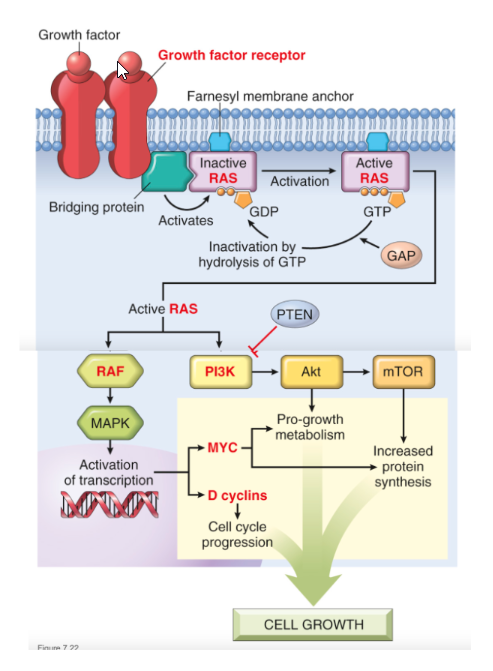
Describe the RAS gene (KRAS)
What are they?
Types?
STATS
How does KRAS mutation → oncogene
What are they?
Signal Transducers genes
KRAS, NRAS, HRAS
KRAS = most common
STATs
15-20% of all human tumors have RAS mutations
Found in:
90% of pancreatic adenocarcinoma
50% of colon, endometrial and thyroid cancers
30% of lung adenocarcinomas
How does KRAS mutation -> Oncogene:
KRAS (inactive) -> KRAS (active) via GDP -> GTP
Active -> inactive via GTPase activity (backwards)
Mutation -> reduce GTPase activity
Continuous active RAS = continuous growth signal
NOTE: When RAS gene mutations are present in a tumor, growth receptor mutations are usually absent
Describe the BRAF gene
What is it?
Clinical Importance
BRAF gene
What is it?
member of serine/threonine protein kinase family
Clinical Importance:
Mutation (V600E) -> 100% of hairy cell leukemia and 60% of melanoma
Describe Growth Factor Receptors
Encoded by?
Mech
Mutations?
Notable Receptor Names?
List some growth receptor mutations and associated cancers
Growth factor receptors
Encoded by?
Oncogenes
Mech:
Tyrosine kinase receptors tranduces growth signal across cell membrane
Mutations
point mutations, amplifications and translocations
Notable Receptor Names
EGFR, HER2 and ALK
Growth Receptor mutation and associated cancers
EGFR point mutation -> lung adenocarcinomas
HER2 amplification -> Breast Carcinoma
ALK translocation to EML4 -> fusion protein EML4-ALK -> lung adenocarcinoma
What do Glioblastomas express that correlates to its own growth?
Expresses PDGF (platelet derived growth factor) + own receptor -> own growth
Describe MYC
Function/Mech
Related Cancers/Mutations
MYC
Function/Mech:
Promotes Cell Division
Induces trxn of:
Cyclin D2, Cyclin E, + various CDKs
Removes Cell Cycle Brakes
Related Cancers/Mutations
Burkitt lymphoma (Translocation)
Neuroblastoma (amplification)
Describe Cyclins and CDK (Cyclin dependent kinases)
Function? Chekcpoints?
Related Cancers/Mutations
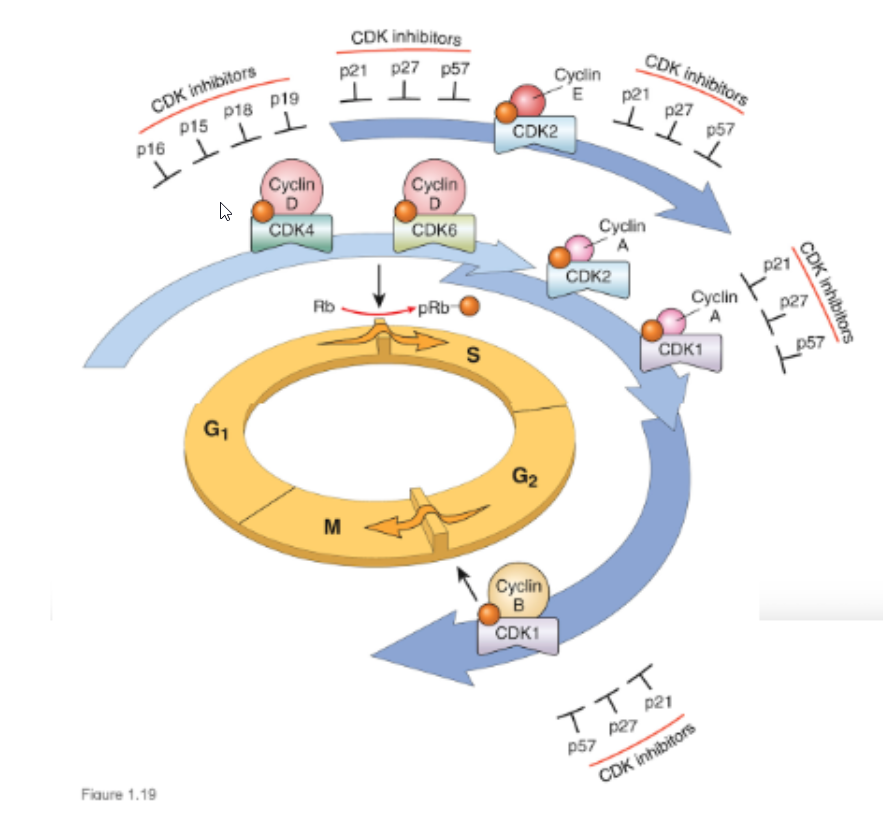
Cyclins and CDK (Cyclin dependent kinases)
Function:
Regulates progression through cell cycle
Two main checkpoints: G1/S and G2/M
Related Cancers/Mutations
D- Cyclin: Gain of function mutation -> unregulated growth/function as oncogenes
Lymphoma: translocations of Cyclin D1
Draw out how cyclin/CDKs progress the cell cycle
Describe Tumor Suppressor Gene
Function
Notable Genes
Mutation
What do these genes control?
Common genes affected → cancer?
Tumor Suppressor Gene
Function:
recognize DNA abnormality -> cell growth inhibition
Cell cycle arrest or apoptosis
Notable Genes:
Retinoblastoma (RB)
Tumor Protein 53 (p53)
Mutation:
Loss of Function
Occur In genes that control:
Cell cycle progression
Mitosis signaling pathway
DNA repair
EX: BRCA: breast cancer
EX: DNA mismatch repair: Colon Cancer
Common genes affected:
APC, VHL
Describe Retinoblastoma
What is it
Genetics?
Knudson two-hit hypothesis?
Function? Mech?
How can Retinoblastoma lose function?
Retinoblastoma
What is it?
Primary intraocular malignancy in children
Genetics:
40% inherited (germline), 60% sporadic
Autosomal dominant
Mutation in retinoblastoma gene
Increases risk of dev. Retinoblastoma 10,000x
Knudson two-hit hypothesis
Two mutations are req. for dev. of retinoblastoma (one on each allele)
Retinoblastoma function
Inhibits G1/S transition
Stops cell cycle in non-phosphorylated state
Mech:
In non-phosphorylated state -> stops cell cycle
By blocking trxn of S phase genes
How can Retinoblastoma lose function
Mutations in both RB genes
CDK4 + cyclin D genes amplification
cyclin dependent kinases inhibitors ((p16/INK4a)) Loss of Function
Virus that inhibits RB (HPV)
Describe p53
Nickname?
Clinical Importance
Function
Mech.
P53 loss of function consequences:
What is Li-Fraumeni syndrome
Tumor protein 53 (p53)
Nickname?
Nicknamed “Guardian of Genome” b/c trxn. regulator
Clinical Importance:
Loss of function mutation -> detected in 50% of cancers
Function:
Controls cell cycle arrest and DNA repair
Mechanism:
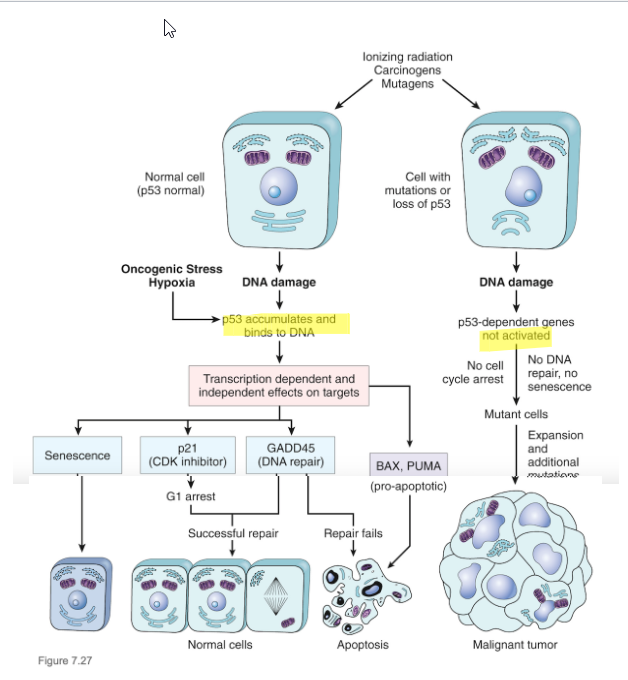
DNA damage, hypoxia, cell stress -> detected by ATM/ATR proteins -> release p53 from MDM2 -> accumulation
If DNA can’t repair -> p53 induces apoptosis/cease mitosis
P53 loss of function consequences:
accumulation of mutations
continued cell proliferation
increased risk of malignant transformation
Cancers w/ p53 mutations -> resistant to chemo + radiation therapy
Lung/colon
Li-Fraumeni syndrome
P53 inherited mutations -> 25x risk of developing Cancers (wide range)
Draw out the p53 pathway
Differentiate between Syndromic and Sporadic mutations
Syndromic: Germline mutations inherited
Sporadic: Somatic Mutations Acquired
Describe the PTEN gene (Phosphatase and tensin homolog)
Function
Describe Cowden Syndrome
Gene?
Consequence?
Function:
Negative regulator of PI3K/AKT signaling
Cowden Syndrome
Gene: Autosomal dominant
Consequence:
Benign growths of skin
(lipoma, fibromas)
Increased risk of breast/endometrial carcinoma
Describe the APC gene (Adenomatous polyposis coli)
Function?
Describe Adenomatous polyposis coli
Gene?
Consequence?
Stats?
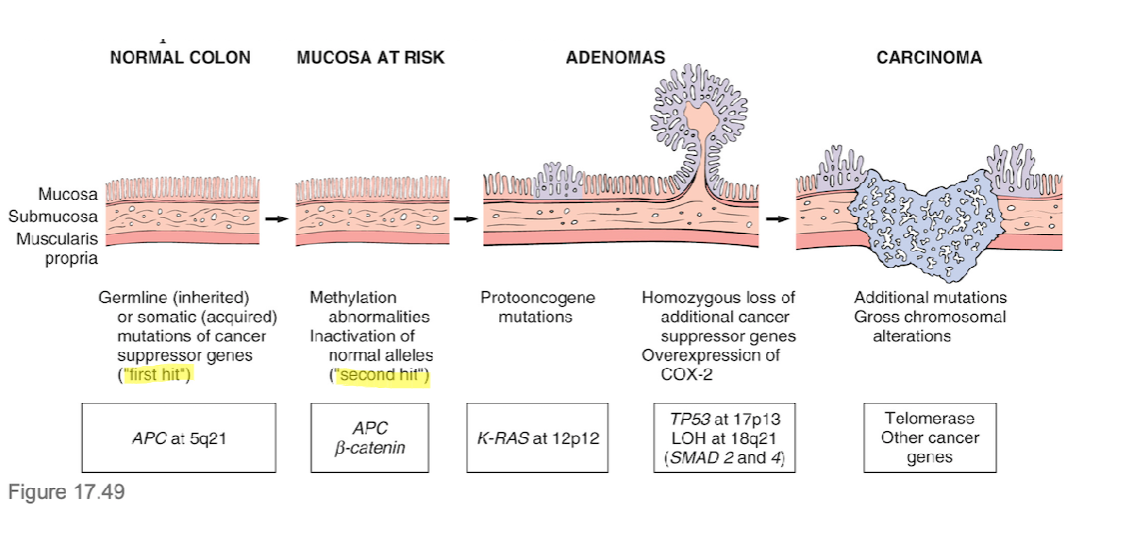
APC gene (Adenomatous polyposis coli)
Function:
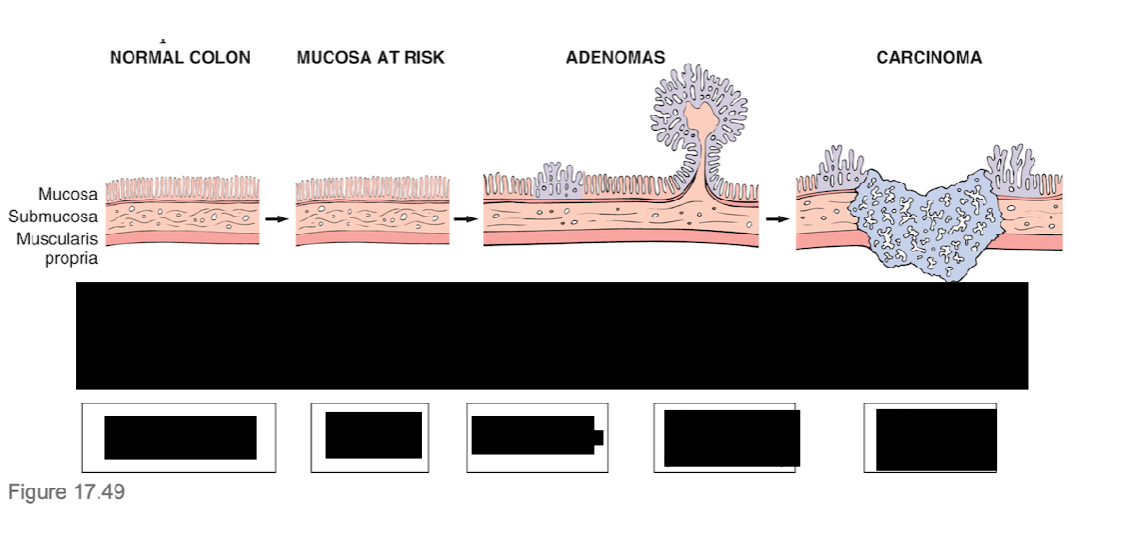
Tumor Suppressor gene -> inhibits mitosis signaling pathway
Adenomatous polyposis coli
GENE: Autosomal dominant
Consequence:
1 mutant allele -> 1000s of adenomas
2 mutant allele -> colon cancer
Stats
70-80% of sporadic colon cancer have mutations in APC (somatic mutations)
Describe the VHL gene
Function
Describe Von Hippel-Lindau syndrome
Gene
Consequences
Function:
Regulates cellular response to O2 levels
Von Hippel-Lindau syndrome
GENE: Autosomal dominant
Consequence:
renal cell carcinoma Risk
Clear cell type Risk
Pheochromocytoma Risk
Sporadic Renal Cell cancer
Has VHL mutations