Presentation 10: Sources of platform owner power
 Call Kai
 Learn
Learn Practice Test
 Spaced Repetition
 Match
Match Flashcards
 Knowt Play
1/16

Earn XP
Description and Tags
Power relations in digital platform ecosystem & government regulation of platforms
Name | Mastery | Learn | Test | Matching | Spaced | Call with Kai | Chat |
|---|
No analytics yet
Send a link to your students to track their progress
17 Terms
What creates market power in platform ecosystem/ What are the sources of platform owner power?
Market position & effects:
Market dominance: large installed base and long-lasting leadership
→ creates:
Network effects: more users attract more complementors
→ creates:
Data network effects: more data sharpens AI matching & ranking
Platform owner´s Control over architecture:
Architectural hub: controls architecture, compatibility and participation
Access, rules & data: sets the conditions for value creation and capture
→ Relational power: The owner’s power over complementors: it grows as their alternatives shrink
→ Market position and architectural control give the owner relational power over the ecosystem
What is the link between market power and power in the platform ecosystem?
Market dominance: Gatekeeping:
Platform = market: There are no alternatives for users & complementors to interact (platforms/ regular businesses)
Power in the platform ecosystem: resources, rules, pricing, visibility, etc.
→ Market power is the source of platform power
Define Gatekeeping.
= the platform owner's ability to control access to the platform ecosystem and to end users because complementors have few or no alternative distribution channels
A platform can only become a gatekeeper if it has enough market power
What does it mean going from market power to gatekeeping position?
market power =/= gatekeeping
the platform changes from being large to being unavoidable (unumgänglich)
e.g. small AppStore: Developers have many alternatives vs. Apple AppStore: Apple as a gatekeeper because complementors dont have alternatives
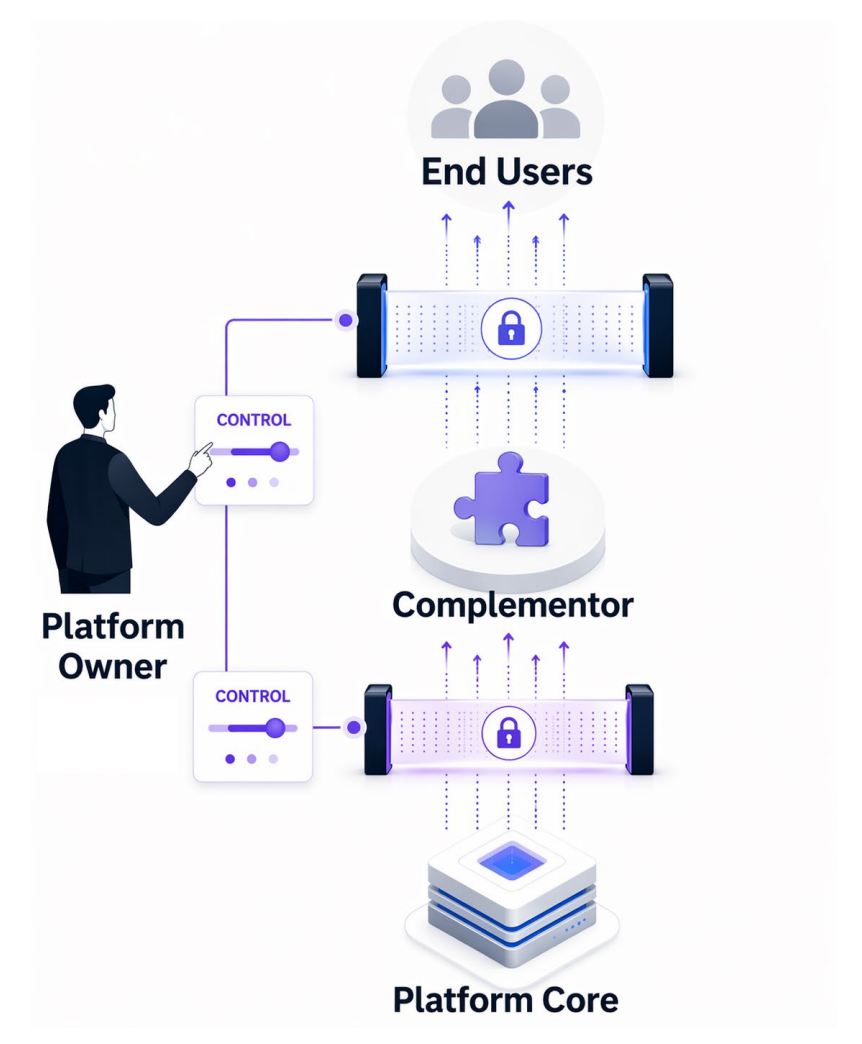
Explain why Gatekeeping creates a Bottleneck/control (Engpass) over access (platform core) and distribution.
Bottleneck = checkpoint, control point (e.g. market access, distribution, visibility)
exist because of market dominance (without market dominance there would be many alternatives e.g. AppleStores)
Gatekeeping:
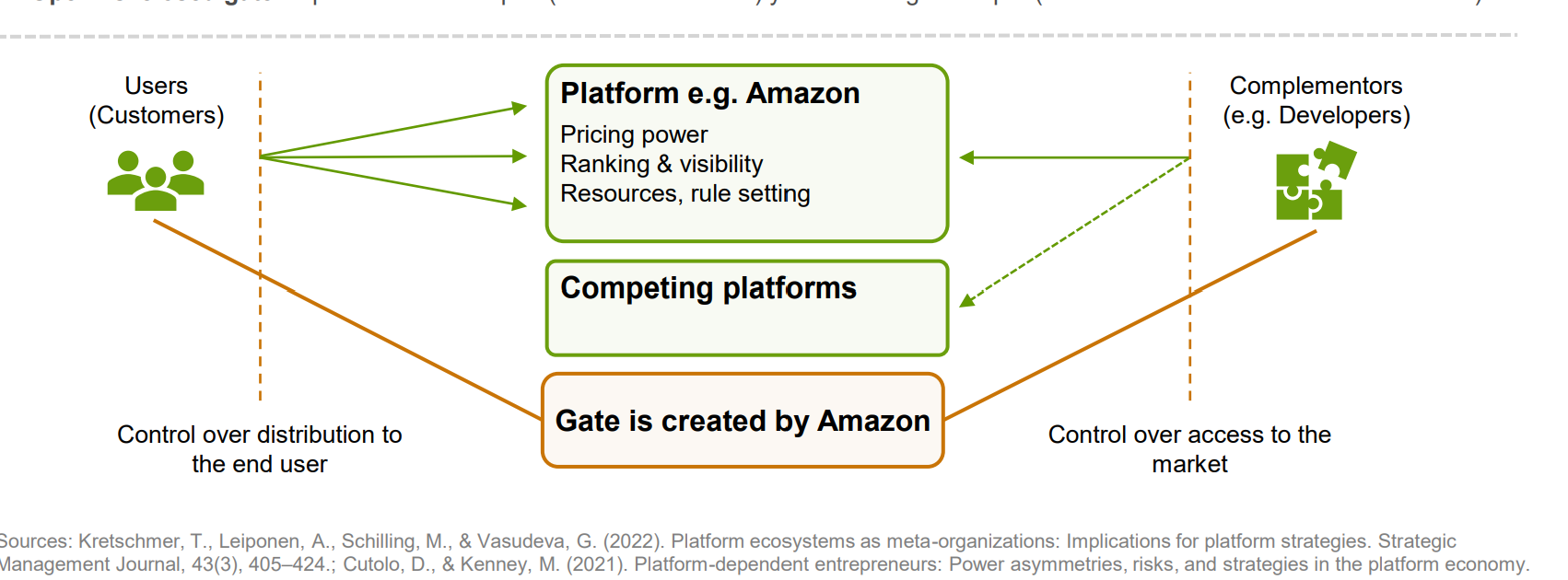
Market-bottleneck: The gate to the market which controls access to the market and distribution to end users
Arises from market position: Platform as quasi-monopoly (attracts all or most users) – few alternatives for complementors so platform becomes the gate to the market
Open vs. closed gate: A platform can be open (access to the core) yet still be a gatekeeper (controls access to the other market side)
Platform owner has:
Control over distribution for the end-user: enter the gate which is createt from e.g. Amazon to get to the platform (pricing power, Ranking & visibillity; resources, rule setting) (= end-user interface of complements)
Control over acess to the market for complementors: enter the gate which is created from e.g. Amazon to get to the platform (pricing power, Ranking & visibillity; resources, rule setting) and competing platforms (= interface to the platform core)
through boundary resources
Enables effective platform governance: Rulesetting authority (terms of service, policy changes), etc
Explain the difference between control over the end user interface (UI) of the platform and of the complement by the platform owner.
control over UI of the platform:
Platform owners’ control over the end user interface of the platform shapes the core interaction
Platform owners decide on the “filter” (e.g., recommendation system) on their platform
This regulates end users’ access to complements/value units
control over UI of the complement:
Some complementors relinquish (überlassen) control over the end user interface of their complement to the platform owner
This determines (bestimmt) complementors’ visibility and direct influence over end user interactions
e.g. TikTok:
Platform owner controls the UI of complements/value units
Complementors have no direct visibility over who watches their videos. Only generic statistics are provided
e.g. SAP:
Complementors control the UI of their complements/value units → They have direct visibility over end user interactions
SAP has only limited control over the UI of the complements
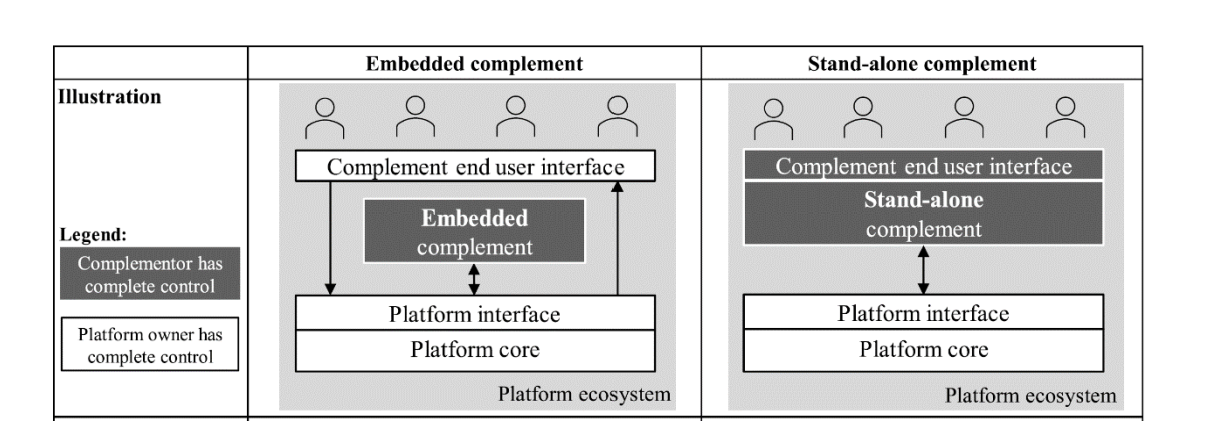
Explain the statement “who controls the UI decides who owns the user relationship”.
Embedded complement (e.g. GPTs in ChatGPT, videos on TikTok):
Owner fully controls the UI
Creator seen only if the algorithm shows it
No visibility into who interacts – generic stats only
Within embedded complements, the owner still sets the UI rules:
Standardization: App adopts the platform’s fonts, colours & layout
Users perceive it as part of the platform
Platform usage flows into the app (grouping)
Variety: App keeps its own fonts, colours & layout
Users perceive it as a separate app
More differentiation, weaker grouping e.g. Google Scholar Button blends into Chrome e.g. Playerline keeps its own dark UI
Stand-alone complement (e.g. apps in the SAP Store, own web apps):
Complementor controls the interface
Full visibility & direct influence on users
Owner’s reach into the complement is limited
Explain the Bootleneck over acess and distribution created by Gatekeeping with the example of App Store and Google Play Store.
Gatekeeping:
Apple + Google = 97% of the mobile operating system market (outside China)
No alternative for developers
Who wants to reach iOS users, has to go through the App Store
Apple is the only Gate
What Gatekeeping means:
Terms of participation are non-negotiable even for large corporations
e.g. Epic Games wanted other conditions for Fortnite in the App Store and removed it in the end
Explain how market power and gatekeeping create a selfreinforcing loop (selbst verstärkende Dynamik) to lick in complementors (binden).
1. Market power:
Market dominance
Network & data network effects
Architectural control
Gatekeeping:
positionControl over access & distribution
Bottleneck to the market
Exercise of gatekeeping:
Ranking & visibility
Fees & access (Pricing Power)
Selective data access
Complementor dependence
Lock-in & sunk costs
Rising switching costs
Limited multihoming
→ More user → more complementors > more data → better AI → better Ranking/matching → better user experience more user => (data) network effect loop
at the same time:
more user → market dominance → Platform becomes Gatekeeper → platform controls fees, ranking & visibility, API access, data access, rules → complementors become dependent → rising switching costs, Lock-in & sunk costs, limited multihoming → Fewer alternatives for complementors → strong relational power → stronger market power (selfreinforcig loop)
→ Self-reinforcing loop: Dependence and ecosystem-wide data feed back into network effects and power
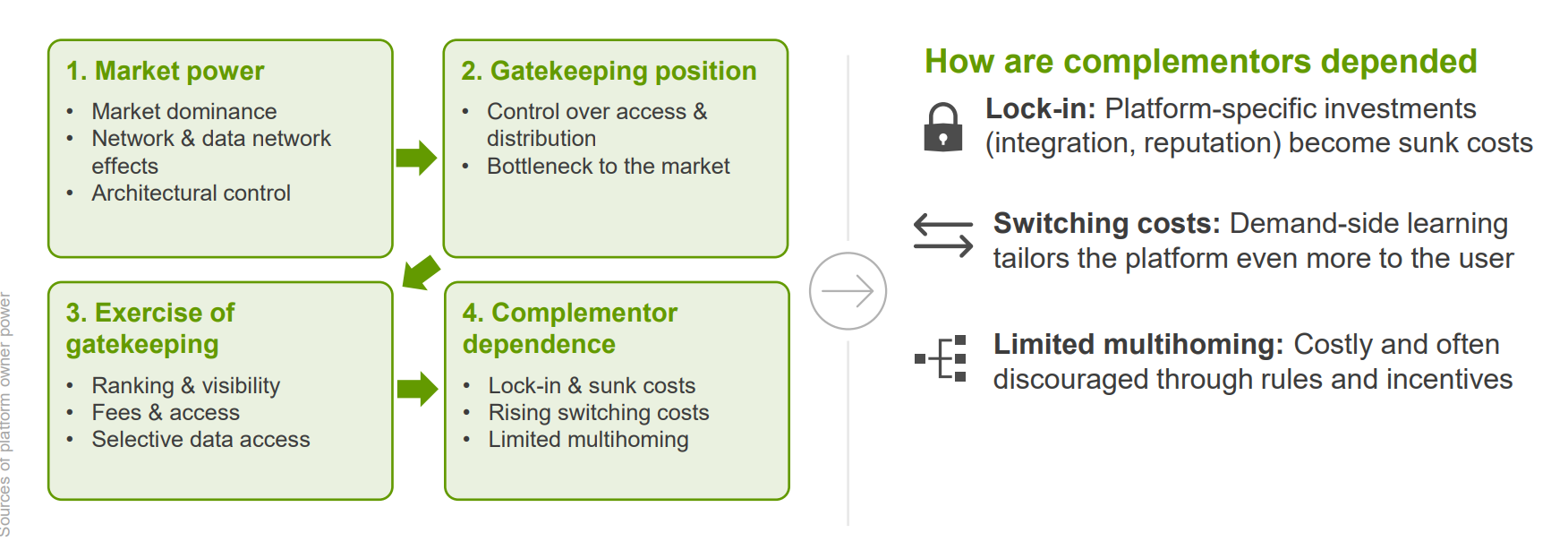
How are complementors depended on the self-reinforcing loop of market power and gatekeeping?
Lock-in: Platform-specific investments (integration, reputation) become sunk costs
Switching costs: Demand-side learning tailors the platform even more to the user
Limited multihoming: Costly and often discouraged through rules and incentives
What feeds the reinforcing loop?
Data asymmetry between owner and complementors:
Every action on a platform is digital and completely recorded
Platform owners obtain a panoptic view of all users' activities
Complementors only receive the data the platform chooses to share
This selection is strategic not incidental
The gap is self-reinforcing
Owner sees prices, sales, searches across all complementors; complementors get own, aggregated data only • Data network effects widen the gap over time
→ all user actions: searches, clicks, purchases → platform: panoptic (alles überblickend): view of everything → complementors: only a filtered fraction

Explain the pricing power in the context of gatekeeping.
Owners set the price of access and can change it unilaterally:
Pricing is how the gate to the market is monetized
No alternate platform, so complementors must pay
Fees are the entrance fee to the user base
Contracts behave like spot contracts (= Jetzt kaufen- Jetzt bezahlen Geschäft)
Terms changed unilaterally, anytime
Complementor carries (tragen) the risk
How does ranking and recommendation works for discover?
Ranking & review systems act as a screening mechanism: they create trust and steer customer choice
Recommendation systems direct traffic, so they decide which complementors get discovered
Yelp evidence: a one-star higher rating raises a business’s revenue and visibility by 5–9%
Why are ranking and recommendation systems risky for complementors?
The algorithms are opaque (undurchsichtig) and change unilaterally – complementors can only guess what satisfies them
Results look objective but express the platform’s agenda
“Profound uncertainty and vulnerability” („Tiefe Ungewissheit und Verwundbarkeit“) for platformdependent entrepreneurs (complementors)
→ Controlling visibility is controlling who succeeds – without ever owning the complement
Explain why the algorithms of Ranking and Visibility is risky for complementors.
Opaque (undurchsichtig): Ranking weights are never disclosed: complementors can only guess what counts
Volatile (schwankend): Thousands of algorithm changes per year – any change can disrupt a complementor overnight
Self-serving: Results express the platform’s agenda, not neutral quality
→ e.g. searching for “Podcast” in AppStore showes that 14 own apps ranked first
Why is gatekeeping considered the overarching source of platform owner power (zentrale Machtquelle), and how do pricing power and control over ranking & visibility relate to it?
Without gatekeeping the platform owner could not charge e.g. 30%, reject (ablehnen) apps, rank its own apps higher, restrict API access,…
Gatekeeping is the general power - Pricing and ranking are specific ways the owner exercises that power (e.g. comission, subscription fees, developer fees)
Give an example on how pricing power can be exercised by a platform.
Apple requires every iOS developer selling digital goods through the App Store to pay up to 30% commission (Provision)
Developers cannot negotiate individually because there is no alternative way to reach iPhone users
This is pricing power created by gatekeeping.