principles of psychopharmacology pt 2
 Call Kai
 Learn
Learn Practice Test
 Spaced Repetition
 Match
Match Flashcards
 Knowt Play
1/34

There's no tags or description
Looks like no tags are added yet.
Name | Mastery | Learn | Test | Matching | Spaced | Call with Kai | Chat |
|---|
No analytics yet
Send a link to your students to track their progress
35 Terms
unionized
lipid (fat, membranes, brain)
unionized particles can accumulate in fat stores
ionized
water (plasma, urine, extracellular fluid)
ionized particles get “trapped” in blood and eliminated
what is ibuprofen?
a weak acid
unionized in the stomach and can cross membranes
oral bioavailability = 95%
what is morphine?
a weak base
ionized in the stomach and does not easily cross membranes
oral availability = ~20%
what is elimination?
excretion of the drug via kidneys, tears, saliva, respiration
what is the half-life of a drug?
time required to eliminate 50% of the absorbed drug
what is clearance?
time it takes for drug to completely clear the body
steady-state plasma level?
absorption/distribution = metabolism/excretion
what does longer half-lives increase?
the likelihood of toxicity due to drug accumulation
what is metabolism?
done primarily by enzymes in the liver
breakdown/transform molecules
can make molecules even more active
enzyme induction
the increase in a particular enzyme due to repeated drug use
what induces CYP2E1? describe what happens with CYP2E1
induced by heavy alcohol use
more CYP2E1 activity breaks down alcohol faster, but also breaks down volatile (inhaled) anesthesia drugs
i.e. halothane, sevoflurane, isoflurane, enflurane, desflurane
CYP2E1 converts 10% of acetaminophen into NAPQI
can bind to liver cell proteins and membranes and kill them
what happens to NAPQI in non-alcoholics usually?
usually, the small amount of NAPQI is quickly neutralized via glutathione (GSH) in the liver as it binds to NAPQI and excretes the conjugate
how does chronic alcohol use affect this system?
it induces CYP2E1, and more acetaminophen is converted to NAPQI even at lower doses
hepatocellular necrosis
when NAPQI binds to liver cell proteins and membranes and kills them
what is the cytochrome P450 superfamily? characteristics, involved in
enzymes found in most tissues of the body
~57 different types
involved in 75% of drug metabolism
some are inhibited, some are activated
major source of adverse side effects and toxicity
effect of grapefruit
it inhibits CYP3A4, which can INCREASE effect of Adderall, Xanax, Valium, Zoloft, Viagra…
high levels of what is related to colon cancer?
CYP1A2
tobacco increases production of CYP1A2
it also is involved in breaking down caffeine some antidepressants
CYP2D6
metbolizes MANY psychotropic drugs
antidepressants, antipsychotics, antihistamines, analgesics, muscle relaxers, etc.
25% of all drug metabolism
sex differences

alcohol dehydrogenase
found in higher concentrations in the stomach of XY individuals
MAO-Inhibitors — description and example
MAO breaks down dopamine, serotonin, norepinephrine in the brain
in the liver, it breaks down amines such as tyramine (which is found in wine, beer, cheese, cured meats)
tyramine regulates blood pressure
high levels can cause high BP, migraines and cardiac arrythmias
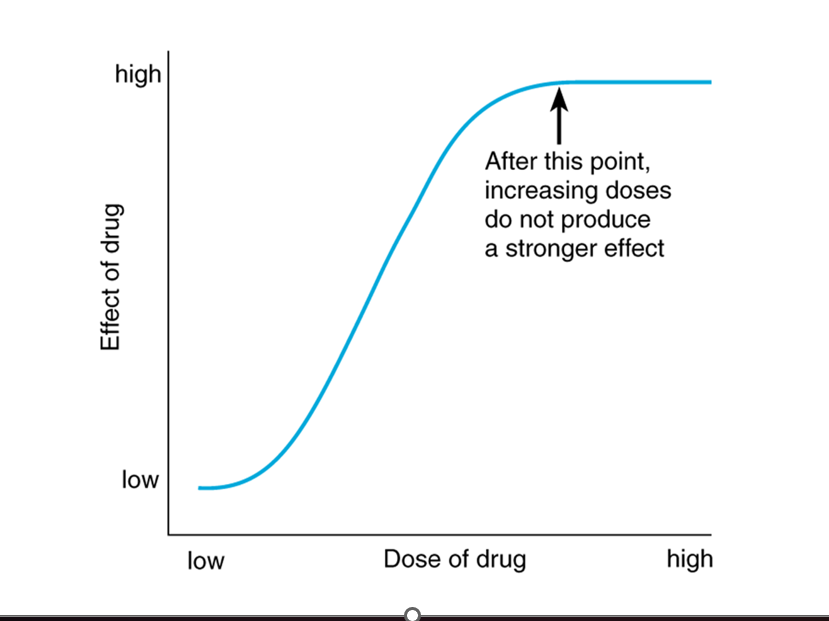
dose response curve
magnitude of effect as a function of amount administered
potency
strength of the drug
efficacy
point of maximum effect


which is more potent?
drug A is more potent because it has greater effects at lower doses

therapeutic index
measure of margin of safety
ED50
desired effect in 50% of sample
LD50
lethal in 50%
TD50
toxic effects in 50%
LD50/ED50
= therapeutic index
TD50/ED50
= therapeutic index
the lower the TI…
the more dangerous

goal of drug?
that is effective at a low dose with no toxicity except at very high doses, the TI will be large for a safer drug

which is more efficacious? which is more potent?
efficacious = A and B
potent = A, C, then B